Introduction
AI ETA Prediction APIs help businesses estimate when vehicles, shipments, deliveries, or orders are likely to arrive. Instead of relying only on static route calculations, these APIs can combine mapping data, traffic conditions, historical travel patterns, vehicle location, route information, and operational events to produce more useful arrival-time predictions.
For modern logistics teams, ETA prediction is increasingly important because customers expect accurate delivery windows while operations teams need early warning when transportation plans are likely to change. An API-based approach also allows companies to embed ETA intelligence directly into their own applications, transportation-management systems, customer portals, dispatch platforms, and supply-chain workflows.
Best for: Developers, logistics companies, retailers, manufacturers, transportation providers, fleet operators, delivery platforms, marketplaces, and enterprises building custom transportation applications.
Not ideal for: Small businesses that only need basic directions or occasional travel-time estimates. A standard mapping API may be simpler when advanced prediction, fleet data, and operational integration are unnecessary.
What’s Changed in AI ETA Prediction APIs
- ETA is becoming predictive rather than purely route-based: Modern systems can use more than distance and current traffic.
- Real-time signals matter more: Vehicle location, traffic conditions, road incidents, and changing route conditions can influence predictions.
- Historical behavior is increasingly useful: Repeated routes and transportation patterns can improve forecasting.
- Delivery-specific intelligence is becoming important: A commercial delivery ETA may need to account for stops, loading, unloading, and operational constraints.
- AI agents can consume ETA APIs: Logistics agents can use ETA predictions as inputs when prioritizing exceptions or recommending actions.
- Multimodal logistics data is expanding: APIs may be connected to GPS, telematics, order data, warehouse systems, and transportation platforms.
- Confidence matters: A useful prediction should ideally communicate uncertainty rather than presenting every ETA as equally reliable.
- Event-driven architectures are becoming more common: ETA updates can trigger notifications, workflow automation, and exception handling.
- Latency matters: An ETA API that responds slowly can become problematic for high-frequency fleet applications.
- Cost optimization is increasingly important: Large fleets can generate substantial API traffic, making caching, batching, and intelligent request frequency valuable.
- Privacy is becoming a bigger consideration: Location information can be commercially sensitive.
- API abstraction is increasingly valuable: Companies may want the flexibility to switch mapping or prediction providers without rebuilding their entire application.
Quick Buyer Checklist
Before choosing an AI ETA Prediction API, evaluate:
- Real-time ETA.
- Historical traffic.
- Live traffic.
- Route-aware prediction.
- Delivery-specific ETA.
- Fleet support.
- GPS integration.
- Telematics integration.
- Multiple transportation modes.
- Geographical coverage.
- API latency.
- Rate limits.
- Batch requests.
- Streaming or event support.
- Webhooks.
- SDK availability.
- REST or other API interfaces.
- Documentation quality.
- Sandbox/testing environment.
- Model transparency.
- Prediction confidence.
- Evaluation capabilities.
- Historical accuracy measurement.
- Data privacy.
- Data retention.
- Data residency.
- Encryption.
- Authentication.
- API-key management.
- Usage monitoring.
- Cost controls.
- Vendor lock-in.
- Ability to switch providers.
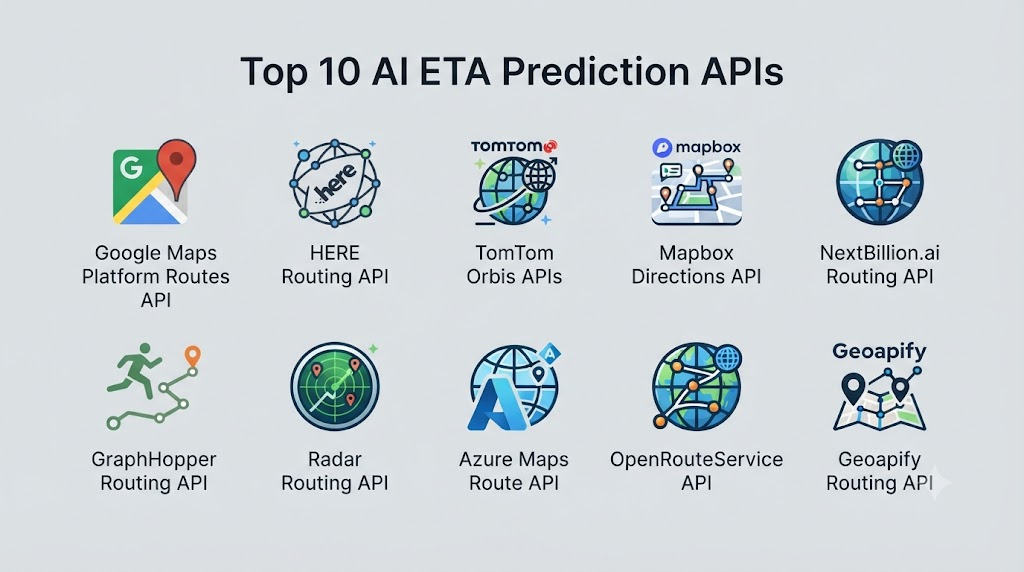
Top 10 AI ETA Prediction APIs
1. Google Maps Platform Routes API
One-line verdict: Best for developers needing scalable route, traffic-aware travel-time, and ETA functionality across consumer and enterprise applications.
Short description:
Google Maps Platform provides routing APIs that can calculate travel times and routes using mapping and traffic-related information. Developers can integrate these capabilities into logistics applications, delivery systems, fleet software, and customer-facing applications.
Standout Capabilities
- Route calculation.
- Travel-time estimation.
- Traffic-aware routing.
- Multiple route options.
- Waypoint support.
- Distance calculations.
- Developer APIs.
- Global mapping coverage.
AI-Specific Depth
- Model support: Google-operated routing and predictive systems; exact underlying models are not publicly stated.
- RAG / knowledge integration: N/A.
- Evaluation: Developers can compare predicted travel times against actual arrival data.
- Guardrails: API controls, authentication, quotas, and application-level policies.
- Observability: Usage metrics and API monitoring capabilities vary by service.
Pros
- Broad mapping ecosystem.
- Strong developer adoption.
- Useful foundation for custom ETA applications.
Cons
- Not a complete logistics control tower.
- Advanced delivery prediction may require custom application logic.
- Usage costs depend on API consumption.
Security & Compliance
Security controls depend on the Google Cloud environment and selected services. Organizations should verify applicable controls and contractual requirements for their specific implementation.
Deployment & Platforms
- Cloud API.
- Web applications.
- Windows applications through API integration.
- macOS applications through API integration.
- Linux applications through API integration.
- Mobile applications.
Integrations & Ecosystem
The API can become part of broader logistics and mobility applications.
- Fleet-management software.
- Delivery platforms.
- E-commerce applications.
- Mobile applications.
- Dispatch systems.
- Cloud applications.
- Custom logistics platforms.
Pricing Model
Usage-based pricing; exact pricing varies by API and consumption.
Best-Fit Scenarios
- Custom logistics applications.
- Delivery ETA.
- Fleet routing.
2. HERE Routing API
One-line verdict: Best for transportation applications requiring enterprise routing, traffic-aware travel times, and location intelligence.
Short description:
HERE provides mapping and location services for applications that require routing, navigation, traffic information, and transportation intelligence. Its APIs can be integrated into logistics and fleet applications.
Standout Capabilities
- Route calculation.
- Traffic-aware routing.
- Travel-time estimation.
- Location services.
- Fleet-oriented capabilities.
- Route optimization.
- Geospatial intelligence.
- Developer APIs.
AI-Specific Depth
- Model support: Proprietary location and routing technologies; exact model architecture is not publicly stated.
- RAG / knowledge integration: N/A.
- Evaluation: Developers can evaluate estimated versus actual arrival times.
- Guardrails: API authentication, usage controls, and application-level rules.
- Observability: API usage and operational monitoring depend on implementation.
Pros
- Strong location technology.
- Useful for fleet applications.
- Enterprise transportation orientation.
Cons
- Developers need to build application-specific ETA workflows.
- Advanced logistics use cases may require multiple services.
- Pricing varies by usage and service.
Security & Compliance
Security capabilities vary by service and deployment. Specific requirements should be verified before procurement.
Deployment & Platforms
- Cloud APIs.
- Web.
- Mobile.
- Enterprise applications.
- Custom backend systems.
Integrations & Ecosystem
- Fleet-management platforms.
- Telematics.
- Transportation applications.
- Mobile apps.
- Logistics platforms.
- APIs.
- Enterprise systems.
Pricing Model
Usage-based and/or contract-based depending on the service.
Best-Fit Scenarios
- Fleet applications.
- Transportation software.
- Global routing.
3. TomTom Routing API
One-line verdict: Best for applications requiring routing, traffic information, and location-based travel-time calculations.
Short description:
TomTom provides mapping, routing, traffic, and location APIs. Developers can use these services to build navigation, mobility, fleet, and logistics applications that require route and travel-time information.
Standout Capabilities
- Routing.
- Traffic-aware travel times.
- Route alternatives.
- Geocoding.
- Map services.
- Location intelligence.
- Traffic information.
- Developer APIs.
AI-Specific Depth
- Model support: Proprietary routing and traffic technologies.
- RAG / knowledge integration: N/A.
- Evaluation: Custom evaluation against actual arrival records.
- Guardrails: API authentication and usage controls.
- Observability: Application-level monitoring and API usage tracking.
Pros
- Strong mapping heritage.
- Useful routing APIs.
- Suitable for transportation applications.
Cons
- ETA quality depends on route and data conditions.
- Advanced delivery workflows require custom development.
- Pricing varies by usage.
Security & Compliance
Specific security and compliance capabilities should be evaluated against the selected service and deployment requirements.
Deployment & Platforms
- Cloud APIs.
- Web.
- Mobile.
- Backend applications.
Integrations & Ecosystem
- Fleet software.
- Navigation applications.
- Delivery platforms.
- Telematics.
- Custom applications.
- APIs.
Pricing Model
Usage-based and enterprise arrangements may apply.
Best-Fit Scenarios
- Navigation applications.
- Fleet routing.
- Delivery applications.
4. Mapbox Directions API
One-line verdict: Best for developers building highly customized mapping, routing, and location experiences into their own applications.
Short description:
Mapbox provides mapping and navigation technologies that developers can integrate into web, mobile, and backend applications. Its routing capabilities can provide travel-time information that can serve as the foundation for custom ETA systems.
Standout Capabilities
- Directions.
- Route calculation.
- Travel-time estimation.
- Map visualization.
- Geocoding.
- Navigation technologies.
- Developer customization.
- Location APIs.
AI-Specific Depth
- Model support: Mapbox routing and location technologies; exact predictive models are not publicly stated.
- RAG / knowledge integration: N/A.
- Evaluation: Application developers can evaluate estimated travel times against actual arrival data.
- Guardrails: API authentication, application restrictions, and usage controls.
- Observability: API usage monitoring and application-level metrics.
Pros
- Developer-friendly ecosystem.
- Flexible mapping capabilities.
- Useful for custom applications.
Cons
- Requires development expertise.
- Advanced logistics prediction requires additional logic.
- ETA accuracy depends on available transportation signals.
Security & Compliance
Security capabilities vary by service and account configuration. Specific requirements should be verified before implementation.
Deployment & Platforms
- Cloud APIs.
- Web.
- iOS.
- Android.
- Backend systems.
Integrations & Ecosystem
- Mobile applications.
- Fleet platforms.
- Delivery systems.
- E-commerce.
- Logistics applications.
- APIs.
Pricing Model
Usage-based pricing.
Best-Fit Scenarios
- Custom delivery applications.
- Mobile logistics applications.
- Developer-built ETA systems.
5. AWS Location Service
One-line verdict: Best for AWS-centric teams integrating location capabilities into cloud-native fleet and logistics applications.
Short description:
AWS Location Service provides location-based capabilities that developers can integrate into AWS applications. It can support mapping, tracking, routing, and geospatial workflows.
Standout Capabilities
- Maps.
- Tracking.
- Routing.
- Geocoding.
- Geofencing.
- Cloud integration.
- Location data processing.
- Application APIs.
AI-Specific Depth
- Model support: Location and routing capabilities; specific underlying predictive models are not publicly stated.
- RAG / knowledge integration: N/A.
- Evaluation: Custom ETA evaluation can be implemented using historical arrival data.
- Guardrails: AWS identity, access-management, and application controls.
- Observability: AWS monitoring capabilities can support application-level monitoring.
Pros
- Strong cloud integration.
- Useful for AWS-native architectures.
- Flexible foundation for custom logistics systems.
Cons
- Not a complete ETA intelligence platform by itself.
- Requires engineering resources.
- Advanced predictive ETA may require custom models.
Security & Compliance
AWS provides extensive security and identity capabilities, but applicable controls depend on the architecture and services used.
Deployment & Platforms
- Cloud.
- Web.
- Mobile.
- Backend applications.
Integrations & Ecosystem
- AWS services.
- IoT.
- Serverless applications.
- Fleet systems.
- Databases.
- APIs.
- Custom ML systems.
Pricing Model
Usage-based.
Best-Fit Scenarios
- AWS-native logistics platforms.
- IoT-enabled fleet systems.
- Custom ETA services.
6. Azure Maps
One-line verdict: Best for Microsoft-oriented organizations building location-aware logistics and transportation applications.
Short description:
Azure Maps provides mapping, routing, search, traffic, and geospatial capabilities for applications. It can be integrated into logistics systems that calculate travel times and build custom ETA workflows.
Standout Capabilities
- Routing.
- Traffic information.
- Maps.
- Search.
- Geocoding.
- Geospatial services.
- Enterprise cloud integration.
- Developer APIs.
AI-Specific Depth
- Model support: Microsoft-operated mapping and routing capabilities; exact underlying models are not publicly stated.
- RAG / knowledge integration: N/A.
- Evaluation: Custom ETA accuracy evaluation can be built around actual arrival data.
- Guardrails: Azure identity and application-level controls.
- Observability: Azure monitoring capabilities can support application metrics.
Pros
- Strong Microsoft ecosystem integration.
- Suitable for enterprise applications.
- Useful location services.
Cons
- Advanced ETA prediction requires application development.
- Cloud architecture may require Microsoft expertise.
- Pricing depends on consumption.
Security & Compliance
Security capabilities depend on Azure services and architecture. Organizations should verify the controls applicable to their implementation.
Deployment & Platforms
- Cloud.
- Web.
- Mobile.
- Enterprise applications.
Integrations & Ecosystem
- Microsoft Azure.
- IoT.
- Power Platform.
- Enterprise applications.
- Fleet platforms.
- APIs.
Pricing Model
Usage-based.
Best-Fit Scenarios
- Microsoft-based enterprises.
- Fleet applications.
- Custom transportation platforms.
7. OpenRouteService
One-line verdict: Best for developers seeking an open mapping and routing foundation for customized transportation applications.
Short description:
OpenRouteService provides routing and geospatial functionality based on open mapping data. It can be useful for developers who want more control over their routing architecture and wish to build additional ETA logic around routing services.
Standout Capabilities
- Routing.
- Geocoding.
- Isochrones.
- Distance calculations.
- Open mapping data.
- Developer APIs.
- Geospatial analysis.
- Custom routing workflows.
AI-Specific Depth
- Model support: Routing engine rather than a dedicated generative AI system.
- RAG / knowledge integration: N/A.
- Evaluation: Developers can implement their own ETA evaluation.
- Guardrails: Application-level controls.
- Observability: Depends on deployment and implementation.
Pros
- Open-data orientation.
- Flexible for developers.
- Useful geospatial foundation.
Cons
- Not a complete commercial AI ETA platform.
- Advanced prediction requires custom development.
- Operational support varies by deployment.
Security & Compliance
Depends on deployment and architecture.
Deployment & Platforms
- Web/API.
- Cloud.
- Self-hosted options may be available depending on the service and architecture.
Integrations & Ecosystem
- OpenStreetMap ecosystem.
- Custom applications.
- Backend services.
- GIS systems.
- Logistics platforms.
- APIs.
Pricing Model
Service and hosting arrangements vary.
Best-Fit Scenarios
- Open-source-oriented projects.
- Custom routing.
- Developer experimentation.
8. GraphHopper
One-line verdict: Best for developers building customized routing and vehicle-routing applications with control over transportation logic.
Short description:
GraphHopper provides routing technologies and vehicle-routing capabilities that can be integrated into transportation applications. Developers can use routing outputs as inputs to custom ETA prediction systems.
Standout Capabilities
- Route calculation.
- Vehicle routing.
- Route optimization.
- Geospatial processing.
- Developer APIs.
- Custom routing profiles.
- Fleet-oriented workflows.
- Open-source technologies.
AI-Specific Depth
- Model support: Routing and optimization technologies; dedicated AI model support varies.
- RAG / knowledge integration: N/A.
- Evaluation: Custom ETA evaluation is possible.
- Guardrails: Application-level controls.
- Observability: Depends on deployment and implementation.
Pros
- Developer flexibility.
- Strong vehicle-routing capabilities.
- Useful for custom logistics systems.
Cons
- Requires technical expertise.
- Not a turnkey predictive ETA platform.
- Production architecture requires engineering work.
Security & Compliance
Depends on deployment and hosting architecture.
Deployment & Platforms
- Cloud.
- APIs.
- Self-hosted options.
- Backend systems.
Integrations & Ecosystem
- Logistics applications.
- Fleet-management software.
- Custom APIs.
- Open-source projects.
- Databases.
- Transportation systems.
Pricing Model
Commercial and open-source options vary by product and deployment.
Best-Fit Scenarios
- Custom fleet applications.
- Vehicle routing.
- Developer-built logistics platforms.
9. HERE Matrix Routing
One-line verdict: Best for high-volume logistics applications requiring travel-time calculations across many origins and destinations.
Short description:
Matrix routing is particularly useful when logistics applications need to calculate travel times across many locations. It can support fleet planning, dispatch, route optimization, and ETA-related workflows.
Standout Capabilities
- Matrix travel-time calculations.
- Routing.
- Traffic-aware calculations.
- Fleet planning.
- Route optimization.
- Geospatial data.
- High-volume routing workflows.
- API integration.
AI-Specific Depth
- Model support: HERE routing and traffic technologies.
- RAG / knowledge integration: N/A.
- Evaluation: Custom historical ETA evaluation.
- Guardrails: API access and application controls.
- Observability: Usage and application monitoring.
Pros
- Useful for large routing problems.
- Supports fleet applications.
- Good foundation for custom optimization.
Cons
- Requires engineering.
- Matrix calculations are not the same as full predictive logistics visibility.
- Consumption can grow rapidly with large routing workloads.
Security & Compliance
Specific security controls depend on service and deployment.
Deployment & Platforms
- Cloud API.
- Backend systems.
- Web.
- Mobile.
Integrations & Ecosystem
- Fleet management.
- Dispatch systems.
- Transportation platforms.
- Route optimization engines.
- APIs.
- Data warehouses.
Pricing Model
Usage-based or enterprise pricing depending on service.
Best-Fit Scenarios
- Fleet dispatch.
- Route optimization.
- Large-scale travel-time calculations.
10. Radar
One-line verdict: Best for developers needing location infrastructure, geofencing, routing, and location-based application capabilities.
Short description:
Radar provides location infrastructure for applications that need location tracking, geofencing, maps, and related location services. Developers can combine these signals with custom ETA models and transportation logic.
Standout Capabilities
- Location tracking.
- Geofencing.
- Maps.
- Routing.
- Location intelligence.
- Mobile SDKs.
- APIs.
- Developer tools.
AI-Specific Depth
- Model support: Location intelligence and routing capabilities; exact AI model architecture is not publicly stated.
- RAG / knowledge integration: N/A.
- Evaluation: Custom evaluation against actual location and arrival data.
- Guardrails: Application-level access and location controls.
- Observability: Location events and application monitoring.
Pros
- Developer-oriented.
- Strong location infrastructure.
- Useful for mobile and logistics applications.
Cons
- Not a complete predictive ETA platform.
- Advanced prediction requires custom development.
- Exact capabilities depend on the architecture.
Security & Compliance
Specific security and compliance capabilities should be verified for the selected product and deployment.
Deployment & Platforms
- Cloud.
- Web.
- iOS.
- Android.
- Backend APIs.
Integrations & Ecosystem
- Mobile applications.
- Logistics systems.
- Delivery platforms.
- Geofencing workflows.
- APIs.
- Custom ML models.
Pricing Model
Usage-based and plan-based pricing may vary.
Best-Fit Scenarios
- Mobile logistics applications.
- Delivery tracking.
- Location-aware applications.
Comparison Table
| Tool Name | Best For | Deployment | Model Flexibility | Strength | Watch-Out | Public Rating |
|---|---|---|---|---|---|---|
| Google Maps Platform Routes API | General-purpose ETA | Cloud | Hosted | Broad mapping ecosystem | Usage costs | N/A |
| HERE Routing API | Enterprise transportation | Cloud | Hosted | Traffic-aware routing | Integration effort | N/A |
| TomTom Routing API | Routing applications | Cloud | Hosted | Traffic and mapping | Advanced logic required | N/A |
| Mapbox Directions API | Custom applications | Cloud | Hosted | Developer flexibility | Requires engineering | N/A |
| AWS Location Service | AWS applications | Cloud | Hosted | AWS integration | Custom prediction needed | N/A |
| Azure Maps | Microsoft applications | Cloud | Hosted | Enterprise ecosystem | Custom development | N/A |
| OpenRouteService | Open mapping projects | Cloud/Self-hosted | Open-source-oriented | Open-data flexibility | Limited turnkey AI | N/A |
| GraphHopper | Fleet routing | Cloud/Self-hosted | Open-source/commercial | Vehicle routing | Technical complexity | N/A |
| HERE Matrix Routing | High-volume routing | Cloud | Hosted | Matrix calculations | Workload scaling | N/A |
| Radar | Location applications | Cloud | Hosted | Location infrastructure | Custom ETA logic | N/A |
Scoring & Evaluation
The following scores are comparative editorial assessments rather than official vendor ratings. An ETA API should be evaluated against your own routes, geographic coverage, transportation modes, and historical arrival data.
The scoring model gives additional weight to core routing functionality, reliability, integrations, performance, and developer usability.
- Core features – 20%
- AI reliability & evaluation – 15%
- Guardrails & safety – 10%
- Integrations & ecosystem – 15%
- Ease of use – 10%
- Performance & cost controls – 15%
- Security & admin – 10%
- Support & community – 5%
| Tool | Core | Reliability/Eval | Guardrails | Integrations | Ease | Perf/Cost | Security/Admin | Support | Weighted Total |
|---|---|---|---|---|---|---|---|---|---|
| Google Maps Platform Routes API | 10 | 9 | 9 | 10 | 9 | 8 | 9 | 10 | 9.25 |
| HERE Routing API | 10 | 9 | 9 | 10 | 8 | 9 | 9 | 9 | 9.10 |
| TomTom Routing API | 9 | 9 | 9 | 9 | 8 | 9 | 9 | 9 | 8.95 |
| Mapbox Directions API | 9 | 8 | 9 | 10 | 9 | 8 | 9 | 9 | 8.90 |
| AWS Location Service | 9 | 8 | 10 | 10 | 8 | 9 | 10 | 10 | 9.15 |
| Azure Maps | 9 | 8 | 10 | 10 | 8 | 9 | 10 | 10 | 9.15 |
| OpenRouteService | 8 | 7 | 8 | 8 | 7 | 9 | 7 | 8 | 7.75 |
| GraphHopper | 9 | 8 | 8 | 9 | 7 | 9 | 8 | 9 | 8.30 |
| HERE Matrix Routing | 9 | 9 | 9 | 10 | 8 | 9 | 9 | 9 | 9.00 |
| Radar | 8 | 8 | 9 | 9 | 9 | 8 | 9 | 8 | 8.55 |
Top 3 for Enterprise
- Google Maps Platform Routes API — Strong general-purpose location and routing foundation.
- HERE Routing API — Strong fit for enterprise transportation applications.
- AWS Location Service — Particularly attractive for AWS-centric architectures.
Top 3 for SMB
- Google Maps Platform Routes API — Straightforward foundation for many application types.
- Mapbox Directions API — Useful when application customization is important.
- TomTom Routing API — Strong option for routing-focused applications.
Top 3 for Developers
- Mapbox Directions API — Flexible developer-oriented mapping ecosystem.
- GraphHopper — Strong option for customized routing.
- OpenRouteService — Useful for open-data and customized geospatial projects.
Which AI ETA Prediction API Is Right for You?
Solo / Freelancer
For a small project, avoid unnecessary complexity.
Prioritize:
- Simple API documentation.
- Easy authentication.
- Clear usage limits.
- Developer SDKs.
- Good mapping coverage.
- Predictable request behavior.
- Easy testing.
Google Maps Platform, Mapbox, or TomTom can be practical starting points depending on the application’s needs.
SMB
SMBs should focus on implementation speed and operational value.
Look for:
- Good geographic coverage.
- Traffic-aware routing.
- Simple API integration.
- Reasonable usage economics.
- Monitoring.
- Documentation.
- Mobile support if needed.
- Basic analytics.
Avoid building a complex prediction infrastructure when your application only needs route-based arrival estimates.
Mid-Market
Mid-market organizations should consider whether the API needs to support:
- Fleet tracking.
- Delivery windows.
- Dispatch.
- Multiple vehicles.
- Multiple regions.
- Historical ETA evaluation.
- Telematics.
- TMS integration.
- Event-driven workflows.
At this stage, separating the routing provider from your internal ETA abstraction layer can reduce future vendor lock-in.
Enterprise
Enterprises should evaluate APIs as infrastructure rather than simply mapping tools.
Important criteria include:
- Global coverage.
- SLA requirements.
- API scalability.
- High-volume routing.
- Traffic data.
- Historical evaluation.
- Security.
- Data governance.
- Data residency.
- Usage monitoring.
- Cost controls.
- Multi-provider architecture.
- Disaster recovery.
- Provider redundancy.
For large systems, an internal ETA service can sit between applications and external mapping providers.
Regulated Industries
Healthcare, pharmaceuticals, government, financial services, and other regulated organizations should carefully review:
- Location-data handling.
- Data retention.
- Access control.
- Encryption.
- Data residency.
- Auditability.
- Third-party data processing.
- Customer identifiers.
- Vehicle identifiers.
- API logs.
Avoid sending unnecessary personally identifiable or commercially sensitive information to external services.
Budget vs Premium
Budget-focused implementations should consider:
- Open-source routing.
- Self-hosted systems.
- Lower-frequency ETA updates.
- Caching.
- Batch calculations.
- Limited geographic coverage.
Premium approaches become more attractive when:
- Real-time ETA directly impacts revenue.
- Thousands of vehicles are active.
- Customer expectations are high.
- Route changes occur frequently.
- Traffic conditions significantly influence operations.
- API downtime has substantial business consequences.
Build vs Buy
Build when you have:
- Large historical datasets.
- Strong ML expertise.
- Specialized transportation requirements.
- Existing telematics infrastructure.
- A need for proprietary ETA models.
Buy when you need:
- Global routing.
- Traffic data.
- Geocoding.
- Reliable mapping.
- Rapid deployment.
- Broad geographic coverage.
A strong architecture often combines a commercial routing API with an internal ETA model.
Implementation Playbook: 30 / 60 / 90 Days
First 30 Days: Pilot + Success Metrics
Start with a limited geography and a representative set of routes.
Collect:
- GPS locations.
- Destination coordinates.
- Departure times.
- Planned routes.
- Actual arrival times.
- Vehicle information.
- Traffic conditions where available.
- Historical delivery records.
- Stop information.
Measure:
- Mean ETA error.
- Median ETA error.
- Percentage within the delivery window.
- Prediction lead time.
- API response time.
- API failure rate.
- Cost per ETA request.
Create a historical evaluation dataset before deploying the system to production.
Days 31–60: Security + Evaluation + Rollout
Create an ETA evaluation harness.
Test:
- Short trips.
- Long trips.
- Urban routes.
- Rural routes.
- Heavy traffic.
- Light traffic.
- Multi-stop deliveries.
- Route changes.
- GPS gaps.
- Unexpected stops.
- Different transportation modes.
Compare:
Predicted arrival time vs actual arrival time.
Also measure prediction degradation as the prediction horizon increases.
If generative AI is used around the ETA API, test:
- Prompt injection.
- Incorrect explanations.
- Unauthorized tool calls.
- Data leakage.
- Hallucinated ETA causes.
- Unsafe automated actions.
Days 61–90: Cost, Latency + Governance
Optimize:
- ETA update frequency.
- API request batching.
- Caching.
- Route reuse.
- Provider selection.
- Traffic refresh intervals.
- High-priority shipment handling.
Implement:
- API monitoring.
- Cost dashboards.
- Usage alerts.
- Rate-limit protection.
- Provider failover.
- Prediction-quality monitoring.
- Data retention policies.
Consider creating an internal abstraction layer so applications do not directly depend on one provider.
Common Mistakes & How to Avoid Them
- Confusing route duration with true ETA: Travel time is not always equivalent to delivery time.
- Ignoring stops: Loading, unloading, parking, and customer stops can materially affect arrival time.
- Using stale GPS data: Old location information can make predictions misleading.
- Calling the API too frequently: Excessive requests can increase cost without improving predictions proportionally.
- Ignoring API latency: Slow predictions can affect real-time dispatch systems.
- No historical evaluation: Always compare predicted arrival times against actual results.
- Ignoring geography: Model performance can differ dramatically between cities, countries, and road environments.
- Assuming traffic is enough: Traffic is only one factor in many logistics workflows.
- Ignoring route changes: ETA systems should react to major changes in the planned route.
- No confidence measurement: Users need to know when an ETA is uncertain.
- Over-automating decisions: ETA predictions should not automatically trigger expensive operational decisions without safeguards.
- Ignoring data privacy: Vehicle and location data can be commercially sensitive.
- No fallback provider: Critical logistics applications may benefit from redundancy.
- Vendor lock-in: Build an internal abstraction layer where practical.
- Ignoring model drift: Transportation patterns change over time.
- No cost governance: High-frequency fleet tracking can create substantial API consumption.
FAQs
1. What is an AI ETA Prediction API?
An AI ETA Prediction API provides estimated arrival times through an application interface. It can use routing, traffic, location, historical patterns, and other transportation signals.
2. Are ETA APIs actually AI-powered?
Some use machine-learning or proprietary predictive technologies, while others primarily provide routing and traffic calculations. The exact underlying models are often not publicly stated.
3. What is the difference between routing and ETA prediction?
Routing determines how to travel between locations and may estimate travel time. ETA prediction can incorporate additional operational and historical signals to estimate when an actual shipment or vehicle will arrive.
4. Can ETA APIs predict delivery times?
Yes, but the quality depends on the data and the API. Delivery ETA may require additional information about stops, loading time, driver behavior, and operational constraints.
5. Can I use an ETA API for fleet management?
Yes. Routing and ETA APIs can provide important inputs for fleet-management applications, especially when combined with GPS or telematics data.
6. Can ETA APIs work with GPS?
Yes. GPS coordinates can be continuously supplied to an application, which can then use routing or prediction services to calculate updated ETAs.
7. Can I build my own AI ETA model?
Yes. You can train a model using historical GPS, route, traffic, and actual arrival data. However, collecting reliable training data can be a major challenge.
8. Should I build or buy an ETA system?
Buy routing infrastructure when you need reliable maps, traffic, geocoding, and global road coverage. Build additional prediction logic when your business has specialized logistics requirements and sufficient data.
9. Can ETA APIs be self-hosted?
Some routing technologies support self-hosting, while many commercial mapping APIs are cloud services. Availability varies by provider and product.
10. How should I evaluate ETA accuracy?
Compare predicted ETAs with actual arrival times across representative routes. Measure median error, average error, percentage within the delivery window, and performance at different prediction horizons.
11. Can ETA prediction APIs work internationally?
Many major mapping providers support international locations, but coverage and data quality vary by country and region.
12. How frequently should an ETA be updated?
There is no universal interval. High-frequency fleet applications may need frequent updates, while less time-sensitive shipments can use lower update frequencies to reduce API usage.
13. Are ETA APIs expensive?
Pricing varies by provider, API, request volume, geography, and service type. Usage-based pricing is common.
14. Can ETA APIs handle thousands of vehicles?
Many enterprise-oriented APIs are designed for large workloads, but capacity, rate limits, and pricing must be evaluated against your actual request volume.
15. Can ETA APIs integrate with a TMS?
Yes. A TMS can provide planned routes and shipment information, while the ETA service can provide current travel-time or arrival predictions.
16. Can ETA predictions trigger automated alerts?
Yes. An internal application can trigger alerts when predicted arrival falls outside a delivery window or crosses a defined risk threshold.
17. Is it possible to use multiple ETA providers?
Yes. A provider abstraction layer can allow applications to switch between routing services or use fallback providers.
18. What security issues should developers consider?
Protect API credentials, minimize location data exposure, control access, monitor usage, encrypt sensitive information, and establish appropriate retention policies.
19. Can generative AI improve ETA systems?
Generative AI can add value around ETA systems by summarizing exceptions, explaining operational situations, interacting with users, and orchestrating workflows. It should not automatically be assumed to provide more accurate routing predictions.
20. What is the biggest challenge with AI ETA prediction?
The biggest challenge is often not the prediction algorithm itself but the quality and timeliness of operational data. Accurate GPS, route, traffic, and arrival information are essential.
Conclusion
AI ETA Prediction APIs provide an important building block for modern transportation and logistics software. They allow developers to embed routing, traffic intelligence, location information, and predictive arrival capabilities directly into applications instead of building every mapping component from scratch.The best choice depends on what you are actually building. Google Maps Platform, HERE, TomTom, Mapbox, AWS Location Service, Azure Maps, GraphHopper, OpenRouteService, and Radar serve different architectural and operational needs.For a simple application, a standard routing API may be enough. For a sophisticated delivery platform, the stronger architecture is often a combination of mapping + real-time GPS + historical data + internal ETA modeling + evaluation + operational rules.The goal should not simply be to generate an ETA. It should be to create an ETA system that is accurate, measurable, explainable, cost-efficient, resilient, and useful to the people making transportation decisi