Introduction
AI Tool Wear Prediction Systems use artificial intelligence, machine learning, sensor analytics, and manufacturing data to estimate how quickly cutting tools, inserts, drills, end mills, milling cutters, turning tools, and other machining components are wearing down. Instead of relying only on fixed replacement intervals or manual inspection, these systems analyze signals from machines and processes to identify wear patterns and estimate when a tool may need inspection, adjustment, or replacement.Tool wear can affect dimensional accuracy, surface finish, cycle time, scrap rates, energy consumption, and overall equipment effectiveness. AI-based prediction can help manufacturers move from reactive tool replacement toward condition-based and predictive maintenance.
What’s Changed in AI Tool Wear Prediction Systems
- Real-time monitoring is becoming more important: Manufacturers increasingly want wear information during machining rather than after a batch has already been completed.
- Sensor fusion is improving prediction: AI can combine spindle load, vibration, acoustic emission, cutting force, temperature, power consumption, feed rate, and machine-state data.
- Computer vision can complement sensor analytics: Cameras and inspection systems can provide visual information about tool edges, surfaces, chips, and machined parts.
- Remaining useful life prediction is becoming more practical: Instead of simply identifying whether a tool is worn, models can estimate how much useful machining life remains.
- Edge AI is increasingly valuable: Low-latency inference can happen close to the CNC machine, reducing dependence on cloud connectivity.
- Multimodal AI can connect process signals with quality data: Tool-condition data can be compared with dimensional inspection and surface-finish measurements.
- AI copilots can assist maintenance and process engineers: Natural-language interfaces can summarize tool history, explain anomalies, and help investigate recurring wear patterns.
- Agentic workflows can automate repetitive analysis: AI agents may collect machine history, tool usage, inspection results, and maintenance records before presenting an investigation.
- Model drift needs greater attention: Tool materials, workpiece materials, cutting parameters, machine conditions, and tooling suppliers can change model behavior.
- Explainability matters: Engineers need to know which process signals contributed to a wear prediction before relying on it operationally.
- Cost and latency are becoming practical evaluation criteria: A highly accurate model may not be useful if it creates excessive infrastructure costs or responds too slowly.
- Security-by-design is increasingly important: CNC and industrial data can contain sensitive production information and should be protected through appropriate access controls and network architecture.
Quick Buyer Checklist
Before selecting an AI tool wear prediction system, evaluate:
- CNC machine compatibility.
- Sensor compatibility.
- Vibration data support.
- Acoustic-emission data support.
- Spindle-load monitoring.
- Cutting-force monitoring.
- Temperature monitoring.
- Power-consumption monitoring.
- Tool-life tracking.
- Tool breakage detection.
- Remaining useful life prediction.
- Anomaly detection.
- Machine-learning support.
- Deep-learning support.
- Computer vision.
- Edge inference.
- Cloud analytics.
- Historical data support.
- Real-time processing.
- Model evaluation.
- Model drift monitoring.
- Explainability.
- Human review.
- Data privacy.
- Data retention.
- Role-based access.
- Auditability.
- API availability.
- MES integration.
- CNC/PLC integration.
- CMMS integration.
- Cost controls.
- Latency.
- Vendor lock-in.
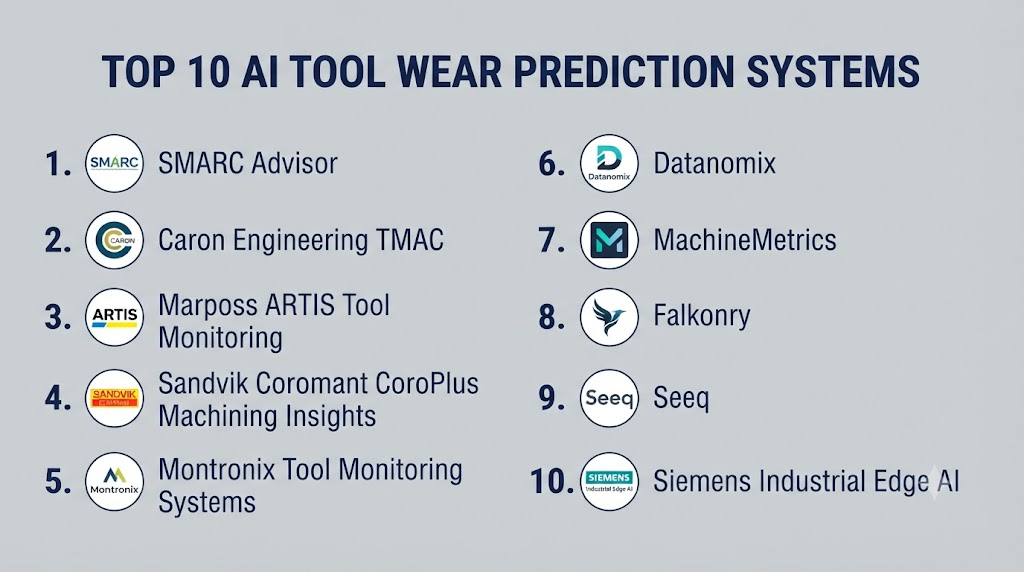
Top 10 AI Tool Wear Prediction Systems
1. Siemens Industrial AI and Machine Tool Solutions
One-line verdict: Best for manufacturers combining machine-tool monitoring, industrial AI, automation, and predictive manufacturing workflows.
Short description:
Siemens offers industrial software, automation, machine-tool, digital-twin, and AI technologies that can support predictive machining applications. Its broader industrial ecosystem can connect machine data, manufacturing workflows, engineering information, and analytics.
Standout Capabilities
- Industrial AI.
- CNC and machine-tool ecosystem.
- Machine monitoring.
- Predictive analytics.
- Digital twins.
- Process optimization.
- Manufacturing analytics.
- Industrial automation.
AI-Specific Depth
- Model support: AI and machine-learning capabilities vary by product and implementation.
- RAG / knowledge integration: Varies / N/A.
- Evaluation: Depends on the selected AI workflow.
- Guardrails: Enterprise and application-level controls vary.
- Observability: Machine and application monitoring capabilities vary.
Pros
- Broad industrial manufacturing ecosystem.
- Strong machine-tool and automation capabilities.
- Suitable for complex manufacturing environments.
Cons
- Product portfolio can be complex.
- Tool-wear use cases may require customization.
- Exact AI capabilities vary between products.
Security & Compliance
Security capabilities depend on the selected products and deployment architecture. Specific certifications should be verified during procurement.
Deployment & Platforms
- On-premises.
- Cloud.
- Hybrid.
- Industrial edge.
Integrations & Ecosystem
Siemens can integrate manufacturing equipment and software with broader industrial systems.
- CNC systems.
- PLCs.
- MES.
- Industrial IoT.
- Manufacturing databases.
- Analytics systems.
- APIs.
Pricing Model
Enterprise/custom pricing; exact pricing is Not publicly stated.
Best-Fit Scenarios
- Large manufacturing operations.
- CNC-heavy production environments.
- Industrial predictive-maintenance programs.
2. FANUC
One-line verdict: Best for manufacturers using FANUC CNC and automation environments that need machine-level production intelligence.
Short description:
FANUC provides CNC systems, industrial robots, factory automation, and manufacturing technologies. Its machine-tool ecosystem can provide valuable production and machine data for monitoring and predictive applications.
Standout Capabilities
- CNC systems.
- Machine monitoring.
- Factory automation.
- Production analytics.
- CNC data collection.
- Industrial robotics.
- Manufacturing connectivity.
- Machine-condition monitoring.
AI-Specific Depth
- Model support: AI functionality varies by FANUC product and application.
- RAG / knowledge integration: Varies / N/A.
- Evaluation: Product-specific.
- Guardrails: Industrial controls vary by implementation.
- Observability: Machine and production monitoring capabilities.
Pros
- Strong CNC ecosystem.
- Deep industrial automation expertise.
- Useful for machine-level monitoring.
Cons
- Strongest value may be within FANUC environments.
- Tool-wear prediction may require application-specific development.
- Cross-platform deployments can require additional integration.
Security & Compliance
Security capabilities vary according to product and implementation.
Deployment & Platforms
- On-premises.
- Industrial edge.
- Factory environment.
- Cloud capabilities vary.
Integrations & Ecosystem
- CNC.
- Industrial robots.
- PLCs.
- Factory automation.
- MES.
- Machine monitoring.
- APIs.
Pricing Model
Enterprise/custom pricing; exact pricing is Not publicly stated.
Best-Fit Scenarios
- FANUC-equipped machining facilities.
- Automated production lines.
- CNC condition-monitoring projects.
3. Sandvik Coromant CoroPlus
One-line verdict: Best for machining organizations seeking tooling intelligence, cutting optimization, and connected tooling workflows.
Short description:
Sandvik Coromant provides cutting tools, machining solutions, tooling software, and digital manufacturing technologies. Its CoroPlus ecosystem supports connected machining workflows and can help manufacturers improve tool selection, cutting parameters, and tooling performance.
Standout Capabilities
- Tooling data.
- Cutting-condition optimization.
- Tool-management workflows.
- Digital machining support.
- Tool-selection assistance.
- Connected manufacturing.
- Machining analytics.
- Process optimization.
AI-Specific Depth
- Model support: Varies / N/A.
- RAG / knowledge integration: Tooling and machining knowledge integration varies.
- Evaluation: Varies by application.
- Guardrails: Varies / N/A.
- Observability: Tool and machining monitoring capabilities vary.
Pros
- Deep tooling expertise.
- Strong machining knowledge base.
- Useful for tooling optimization.
Cons
- Not solely an AI tool-wear prediction platform.
- Capabilities vary across CoroPlus solutions.
- Best fit may depend on the tooling ecosystem.
Security & Compliance
Specific security and certification information varies by product and deployment.
Deployment & Platforms
- Cloud.
- Web.
- Industrial environments.
Integrations & Ecosystem
- CNC machines.
- Tool-management systems.
- CAM workflows.
- Machining data.
- Manufacturing software.
- APIs.
- Digital manufacturing applications.
Pricing Model
Commercial pricing varies by product and deployment; exact pricing is Not publicly stated.
Best-Fit Scenarios
- Tool-intensive machining operations.
- Cutting-parameter optimization.
- Tool-management programs.
4. Hexagon Manufacturing Intelligence
One-line verdict: Best for manufacturers connecting machining, metrology, production data, and quality analytics around tool-condition workflows.
Short description:
Hexagon provides manufacturing intelligence technologies spanning metrology, production software, machine tools, quality management, and manufacturing analytics. Its ecosystem can connect machining information with measurement and quality data.
Standout Capabilities
- Manufacturing analytics.
- Metrology.
- Quality management.
- Production monitoring.
- Machine data.
- Process optimization.
- Digital manufacturing.
- Manufacturing intelligence.
AI-Specific Depth
- Model support: AI capabilities vary by solution.
- RAG / knowledge integration: Varies / N/A.
- Evaluation: Product-specific.
- Guardrails: Enterprise controls vary.
- Observability: Manufacturing and quality monitoring capabilities vary.
Pros
- Strong manufacturing-data ecosystem.
- Excellent connection between production and quality.
- Useful for closed-loop manufacturing workflows.
Cons
- Tool-wear prediction is not its only focus.
- Portfolio complexity can increase implementation effort.
- Some capabilities may require multiple products.
Security & Compliance
Security and compliance capabilities vary by deployment and product.
Deployment & Platforms
- Cloud.
- On-premises.
- Hybrid.
- Industrial environments.
Integrations & Ecosystem
- CNC.
- CMM.
- Metrology systems.
- MES.
- Quality systems.
- Manufacturing databases.
- APIs.
Pricing Model
Enterprise/custom pricing; exact pricing is Not publicly stated.
Best-Fit Scenarios
- Precision manufacturing.
- Quality-driven machining.
- Closed-loop manufacturing initiatives.
5. MachineMetrics
One-line verdict: Best for manufacturers wanting accessible machine-data collection, monitoring, and analytics for CNC operations.
Short description:
MachineMetrics focuses on collecting and analyzing manufacturing-machine data. It can help machining organizations understand machine utilization, production performance, and operational conditions that can support predictive manufacturing initiatives.
Standout Capabilities
- CNC data collection.
- Machine monitoring.
- Production analytics.
- Machine utilization.
- Downtime tracking.
- Manufacturing dashboards.
- Production insights.
- Machine connectivity.
AI-Specific Depth
- Model support: AI/ML capabilities vary by implementation.
- RAG / knowledge integration: Varies / N/A.
- Evaluation: Varies / N/A.
- Guardrails: Varies / N/A.
- Observability: Strong focus on machine and production data.
Pros
- Focused on manufacturing data.
- Useful for CNC environments.
- Can provide a foundation for analytics.
Cons
- Tool-wear prediction may require additional modeling.
- AI depth varies by use case.
- Not a dedicated tooling-science platform.
Security & Compliance
Security capabilities should be evaluated based on the specific deployment and data architecture.
Deployment & Platforms
- Cloud.
- Industrial edge/data collection.
- Web.
Integrations & Ecosystem
- CNC machines.
- Machine controllers.
- Production systems.
- MES.
- APIs.
- Analytics tools.
- Manufacturing databases.
Pricing Model
Commercial subscription/custom pricing; exact pricing is Not publicly stated.
Best-Fit Scenarios
- CNC machine monitoring.
- Manufacturing data collection.
- Production analytics.
6. Tulip
One-line verdict: Best for manufacturers building flexible frontline applications around machine data, quality, maintenance, and production workflows.
Short description:
Tulip provides a frontline operations platform that can be used to build manufacturing applications. Organizations can connect equipment, production workflows, operators, quality information, and analytics.
Standout Capabilities
- Manufacturing applications.
- Machine connectivity.
- Frontline workflows.
- Production monitoring.
- Quality workflows.
- Digital work instructions.
- Data collection.
- AI-assisted applications.
AI-Specific Depth
- Model support: AI capabilities vary by platform configuration.
- RAG / knowledge integration: Available depending on application architecture.
- Evaluation: Varies by AI workflow.
- Guardrails: Platform and application controls vary.
- Observability: Application and manufacturing analytics capabilities.
Pros
- Flexible application platform.
- Strong frontline manufacturing orientation.
- Useful for integrating operators and machine data.
Cons
- Requires application configuration.
- Not specifically focused on cutting-tool physics.
- Advanced predictive models may require additional development.
Security & Compliance
Enterprise security and access controls vary by deployment and subscription.
Deployment & Platforms
- Cloud.
- Industrial edge.
- Web-based applications.
Integrations & Ecosystem
- CNC.
- PLC.
- MES.
- ERP.
- Databases.
- APIs.
- Manufacturing applications.
Pricing Model
Commercial subscription and enterprise pricing varies.
Best-Fit Scenarios
- Digital manufacturing workflows.
- Connected-worker applications.
- Custom tool-monitoring applications.
7. IBM watsonx
One-line verdict: Best for manufacturers developing custom AI models for tool-life prediction, anomaly detection, and predictive maintenance.
Short description:
IBM watsonx provides enterprise AI and data capabilities that can be used to build custom predictive manufacturing applications. It is particularly suitable when an organization wants to develop its own tool-wear models around proprietary machine and sensor data.
Standout Capabilities
- Machine learning.
- Generative AI.
- Predictive analytics.
- AI governance.
- Data integration.
- Model management.
- AI assistants.
- Custom AI applications.
AI-Specific Depth
- Model support: Multiple model options depending on product and configuration.
- RAG / knowledge integration: Supported through relevant data and AI services.
- Evaluation: AI evaluation capabilities vary by service.
- Guardrails: Enterprise AI governance and safety capabilities.
- Observability: AI and application monitoring capabilities vary.
Pros
- Flexible for custom AI.
- Strong enterprise governance orientation.
- Suitable for proprietary manufacturing data.
Cons
- Not a turnkey tool-wear platform.
- Requires data science expertise.
- CNC and sensor integration must be designed.
Security & Compliance
Enterprise security, identity, governance, and access-control capabilities are available. Specific certifications should be verified for the selected deployment.
Deployment & Platforms
- Cloud.
- On-premises.
- Hybrid.
Integrations & Ecosystem
- CNC data.
- IoT platforms.
- Manufacturing databases.
- MES.
- Data warehouses.
- AI models.
- APIs.
Pricing Model
Commercial enterprise and usage-based pricing varies by product.
Best-Fit Scenarios
- Custom tool-life prediction.
- Enterprise predictive maintenance.
- AI governance programs.
8. NVIDIA AI Enterprise
One-line verdict: Best for engineering teams developing high-performance custom AI models using machining sensor and vision data.
Short description:
NVIDIA provides accelerated computing and enterprise AI technologies that can support custom tool-wear prediction, computer vision, anomaly detection, and remaining-useful-life models.
Standout Capabilities
- GPU-accelerated machine learning.
- Deep learning.
- Computer vision.
- Edge AI.
- Model development.
- High-performance inference.
- Predictive analytics.
- Generative AI.
AI-Specific Depth
- Model support: Broad support for open and enterprise AI ecosystems.
- RAG / knowledge integration: Available through broader AI architectures.
- Evaluation: Depends on selected frameworks and application.
- Guardrails: Available through applicable AI software components.
- Observability: Infrastructure and application monitoring varies.
Pros
- Strong custom-AI capabilities.
- Excellent computer-vision ecosystem.
- Suitable for demanding inference workloads.
Cons
- Requires engineering expertise.
- Not a turnkey CNC tool-wear system.
- Infrastructure costs can be significant.
Security & Compliance
Enterprise security depends on software, infrastructure, and deployment configuration.
Deployment & Platforms
- Cloud.
- On-premises.
- Edge.
- Hybrid.
Integrations & Ecosystem
- CNC systems.
- Industrial IoT.
- Computer vision.
- AI frameworks.
- Data platforms.
- APIs.
- Edge devices.
Pricing Model
Commercial licensing and infrastructure costs vary.
Best-Fit Scenarios
- Custom AI development.
- Vision-based tool inspection.
- High-frequency edge inference.
9. AWS Industrial AI and Machine Learning Stack
One-line verdict: Best for manufacturers building scalable cloud-based predictive maintenance and tool-life analytics applications.
Short description:
AWS provides cloud, IoT, machine-learning, data-storage, and analytics services that can be combined to build tool-wear prediction systems. It is more of a technology foundation than a dedicated tooling application.
Standout Capabilities
- Cloud machine learning.
- IoT data ingestion.
- Predictive maintenance.
- Data lakes.
- Real-time analytics.
- Edge computing.
- Model deployment.
- Scalable infrastructure.
AI-Specific Depth
- Model support: Broad model and machine-learning flexibility.
- RAG / knowledge integration: Available through AWS AI services and architectures.
- Evaluation: Available through relevant ML and AI services.
- Guardrails: AI safety and governance capabilities vary by service.
- Observability: Cloud and ML monitoring capabilities.
Pros
- Highly scalable.
- Broad cloud ecosystem.
- Flexible architecture.
Cons
- Requires engineering effort.
- Cloud costs can become complex.
- Not specifically designed around machining tool physics.
Security & Compliance
AWS provides extensive security and identity capabilities, but the applicable controls and certifications depend on the services and architecture selected.
Deployment & Platforms
- Cloud.
- Edge.
- Hybrid.
Integrations & Ecosystem
- IoT.
- CNC gateways.
- Data lakes.
- MES.
- Databases.
- Machine-learning services.
- APIs.
Pricing Model
Usage-based cloud pricing across selected services.
Best-Fit Scenarios
- Enterprise predictive-maintenance projects.
- Cloud-based manufacturing analytics.
- Custom tool-life models.
10. PTC ThingWorx
One-line verdict: Best for industrial organizations connecting machines, IoT data, predictive analytics, and operational applications.
Short description:
PTC ThingWorx provides an industrial IoT and application-development platform that can connect equipment data with operational applications. It can support predictive maintenance and condition-monitoring workflows that include tool-wear analysis.
Standout Capabilities
- Industrial IoT.
- Machine connectivity.
- Predictive maintenance.
- Operational dashboards.
- Digital-twin capabilities.
- Workflow applications.
- Data visualization.
- Industrial analytics.
AI-Specific Depth
- Model support: AI/ML capabilities vary by implementation.
- RAG / knowledge integration: Varies / N/A.
- Evaluation: Depends on integrated AI models.
- Guardrails: Application and enterprise controls vary.
- Observability: Industrial IoT monitoring and application analytics.
Pros
- Strong industrial IoT foundation.
- Good machine connectivity.
- Useful for predictive-maintenance workflows.
Cons
- Tool wear may require custom models.
- Implementation can require industrial IoT expertise.
- Not dedicated exclusively to machining.
Security & Compliance
Security capabilities vary according to architecture, deployment, and selected products.
Deployment & Platforms
- Cloud.
- On-premises.
- Edge.
- Hybrid.
Integrations & Ecosystem
- CNC.
- PLC.
- Industrial IoT.
- MES.
- ERP.
- Databases.
- APIs.
Pricing Model
Enterprise/custom pricing; exact pricing is Not publicly stated.
Best-Fit Scenarios
- Industrial IoT programs.
- Predictive maintenance.
- Connected-machine applications.
Comparison Table
| Tool | Best For | Deployment | Model Flexibility | Strength | Watch-Out | Public Rating |
|---|---|---|---|---|---|---|
| Siemens Industrial AI | Industrial CNC intelligence | Cloud / Hybrid / Edge | Multi-model / Varies | Industrial ecosystem | Implementation complexity | N/A |
| FANUC | FANUC CNC environments | On-premises / Edge | Varies | CNC expertise | Ecosystem dependence | N/A |
| Sandvik Coromant CoroPlus | Tooling optimization | Cloud / Web | Varies | Tooling expertise | Not purely AI | N/A |
| Hexagon Manufacturing Intelligence | Quality + machining | Cloud / Hybrid | Varies | Manufacturing intelligence | Portfolio complexity | N/A |
| MachineMetrics | CNC data collection | Cloud / Edge | Varies | Machine monitoring | Limited dedicated tooling focus | N/A |
| Tulip | Custom manufacturing apps | Cloud / Edge | Multi-model / Varies | Flexible workflows | Requires configuration | N/A |
| IBM watsonx | Custom AI | Cloud / Hybrid | Multi-model | Enterprise AI | Requires integration | N/A |
| NVIDIA AI Enterprise | Custom AI development | Cloud / Edge / On-premises | Open / Multi-model | AI performance | Engineering required | N/A |
| AWS AI/ML Stack | Scalable predictive systems | Cloud / Edge | Multi-model / BYO | Cloud scalability | Architecture complexity | N/A |
| PTC ThingWorx | Industrial IoT | Cloud / Edge / Hybrid | Varies | Industrial connectivity | Custom modeling required | N/A |
Scoring & Evaluation
The scores below are comparative editorial assessments for tool-wear prediction use cases rather than official vendor scores.
The weighting is:
- Core features – 20%
- AI reliability & evaluation – 15%
- Guardrails & safety – 10%
- Integrations & ecosystem – 15%
- Ease of use – 10%
- Performance & cost controls – 15%
- Security & admin – 10%
- Support & community – 5%
| Tool | Core | Reliability/Eval | Guardrails | Integrations | Ease | Perf/Cost | Security/Admin | Support | Weighted Total |
|---|---|---|---|---|---|---|---|---|---|
| Siemens Industrial AI | 9 | 9 | 9 | 10 | 7 | 8 | 10 | 9 | 8.90 |
| FANUC | 9 | 8 | 9 | 10 | 8 | 9 | 9 | 10 | 8.95 |
| Sandvik Coromant CoroPlus | 9 | 8 | 8 | 9 | 9 | 9 | 8 | 9 | 8.70 |
| Hexagon Manufacturing Intelligence | 9 | 9 | 9 | 10 | 8 | 8 | 10 | 9 | 9.00 |
| MachineMetrics | 8 | 8 | 8 | 9 | 9 | 9 | 8 | 9 | 8.50 |
| Tulip | 8 | 8 | 9 | 9 | 9 | 8 | 9 | 9 | 8.65 |
| IBM watsonx | 8 | 9 | 10 | 9 | 8 | 8 | 10 | 9 | 8.90 |
| NVIDIA AI Enterprise | 9 | 10 | 9 | 9 | 6 | 9 | 9 | 10 | 8.90 |
| AWS AI/ML Stack | 8 | 9 | 9 | 10 | 6 | 9 | 10 | 10 | 8.70 |
| PTC ThingWorx | 8 | 8 | 9 | 10 | 8 | 8 | 9 | 9 | 8.60 |
Top 3 for Enterprise
- Siemens Industrial AI — Strong industrial and machine-tool ecosystem.
- Hexagon Manufacturing Intelligence — Strong connection between machining, measurement, and quality.
- FANUC — Particularly compelling for facilities heavily invested in FANUC CNC and automation.
Top 3 for SMB
- MachineMetrics — Accessible machine-data and monitoring foundation.
- Tulip — Flexible manufacturing application development.
- Sandvik Coromant CoroPlus — Strong option for tooling-centric optimization.
Top 3 for Developers
- NVIDIA AI Enterprise — Strong custom AI development environment.
- AWS AI/ML Stack — Flexible cloud architecture.
- IBM watsonx — Enterprise-oriented AI development and governance.
Which AI Tool Wear Prediction System Is Right for You?
Solo / Freelancer
A freelancer or independent manufacturing consultant usually does not need an extensive enterprise platform.
Focus on:
- CSV or database access.
- CNC data.
- Sensor streams.
- Python compatibility.
- Machine-learning libraries.
- Visualization.
- API access.
A lightweight machine-data platform combined with custom modeling can be more practical.
SMB
SMBs should begin with one machine family and one tooling problem.
Good pilot cases include:
- Tool-life prediction.
- Tool-breakage detection.
- Spindle-load anomaly detection.
- Vibration-based wear prediction.
- Automatic tool-change recommendations.
Avoid implementing AI across every machine until the first use case demonstrates measurable ROI.
Mid-Market
Mid-market manufacturers should focus on creating a standardized machine-data architecture.
A typical architecture could connect:
CNC → Sensors → Edge Gateway → Data Platform → AI Model → Dashboard/MES
This creates a foundation for additional predictive-maintenance applications.
Enterprise
Large manufacturers should prioritize:
- Multi-machine support.
- Multi-site deployment.
- Edge inference.
- Centralized model management.
- Tool traceability.
- Data governance.
- Model monitoring.
- MES integration.
- CMMS integration.
- Quality-system integration.
Enterprise systems should also support model retraining when tooling materials, workpiece materials, machines, or cutting strategies change.
Regulated Industries
Aerospace, defense, medical-device, automotive, and other highly controlled manufacturing environments should pay particular attention to:
- Production-data security.
- Access control.
- Auditability.
- Data retention.
- IP protection.
- Supplier access.
- Model governance.
- Human approval.
- Network segmentation.
Budget vs Premium
A budget-conscious manufacturer should first determine whether a basic machine-monitoring solution can collect the signals needed for prediction.
Premium systems become more attractive when:
- Tool costs are high.
- Scrap is expensive.
- Tool failure can damage machines.
- Production volumes are high.
- Dimensional tolerances are strict.
- Downtime has substantial financial impact.
Build vs Buy
Build when:
- You have experienced data scientists.
- You possess extensive historical sensor data.
- Your machining processes are highly specialized.
- Tooling behavior is a competitive differentiator.
Buy when:
- You need faster deployment.
- Your organization lacks ML expertise.
- Machine connectivity is difficult.
- You require vendor support.
- You need an integrated industrial platform.
A hybrid approach can be particularly effective: purchase machine connectivity and monitoring while developing proprietary tool-wear models.
Implementation Playbook: 30 / 60 / 90 Days
First 30 Days: Pilot + Success Metrics
Choose one machining process.
For example:
- CNC milling.
- CNC turning.
- Drilling.
- High-speed machining.
Collect:
- Tool ID.
- Tool age.
- Cutting time.
- Spindle speed.
- Feed rate.
- Depth of cut.
- Spindle load.
- Vibration.
- Acoustic emission.
- Temperature.
- Workpiece material.
- Tool material.
- Inspection results.
Establish a baseline for:
- Tool life.
- Tool replacement frequency.
- Scrap.
- Surface quality.
- Dimensional accuracy.
- Unplanned tool failures.
Days 31–60: Harden Security + Evaluation + Rollout
Create a representative evaluation dataset containing different:
- Machines.
- Operators.
- Materials.
- Tool types.
- Cutting conditions.
- Production batches.
Test:
- Wear classification.
- Remaining useful life.
- Breakage detection.
- False positives.
- False negatives.
- Inference latency.
For AI assistants, evaluate:
- Hallucination.
- Unauthorized access.
- Prompt injection.
- Incorrect recommendations.
- Retrieval accuracy.
Implement:
- Model version control.
- Dataset versioning.
- Access controls.
- Audit logging.
- Human review.
- Incident handling.
Days 61–90: Optimize Cost, Latency + Governance + Scale
Move the validated system toward production.
Optimize:
- Sensor sampling.
- Feature engineering.
- Edge inference.
- Cloud processing.
- Model size.
- Alert thresholds.
- Data-storage costs.
Establish governance around:
- Model updates.
- Tool changes.
- Machine changes.
- Material changes.
- New cutting parameters.
- Model drift.
- AI incidents.
- Human overrides.
Then expand to additional machines and tooling families.
Common Mistakes & How to Avoid Them
- Training only on one machine: Models may fail when deployed on different CNC equipment.
- Ignoring tooling differences: Different insert grades, coatings, geometries, and suppliers can produce different wear patterns.
- Ignoring workpiece materials: Tool wear can change significantly with material and hardness.
- Using only machine-load data: Combining multiple signals can provide better information.
- No ground-truth wear measurements: Models need reliable labels or measurements.
- Ignoring tool replacement history: Replacement events provide valuable context.
- No model-drift monitoring: Manufacturing conditions change.
- Ignoring rare tool-breakage events: Class imbalance can distort model performance.
- Using an unsuitable sampling rate: Important vibration or acoustic patterns may be lost.
- No evaluation harness: Models should be tested on unseen production data.
- Over-automating tool changes: AI recommendations should be validated before automatic intervention.
- Ignoring latency: A prediction that arrives after the machining cycle may have limited operational value.
- Creating too many alerts: Excessive warnings can lead to operator fatigue.
- Ignoring explainability: Engineers need to understand why the system believes a tool is approaching failure.
- Ignoring cybersecurity: Connected CNC machines and industrial gateways can increase the attack surface.
- Failing to integrate quality data: Tool wear should ultimately be connected to dimensional and surface-quality outcomes.
FAQs
1. What is an AI tool wear prediction system?
An AI tool wear prediction system uses machine-learning or related AI techniques to analyze machining data and estimate tool condition, wear progression, or remaining useful life.
2. How does AI predict cutting-tool wear?
AI models can analyze signals such as vibration, spindle load, cutting force, acoustic emission, temperature, power consumption, cutting parameters, and historical tool-life information.
3. What sensors are useful for tool wear prediction?
Common signals include vibration, acoustic emission, spindle current, spindle power, cutting force, temperature, and machine-controller data. The best combination depends on the machining process.
4. Can AI predict remaining tool life?
Yes. Remaining useful life models can estimate how much productive machining time may remain before a tool reaches a defined wear threshold.
5. Can AI detect tool breakage?
Yes. Tool-breakage detection models can identify abnormal sensor patterns that indicate sudden tool failure. The effectiveness depends on sensor quality, machining conditions, and model training.
6. Can tool wear prediction work with CNC machines?
Yes. CNC machines can provide valuable process and machine-state information. Connectivity depends on the controller, machine architecture, available interfaces, and selected platform.
7. Does tool wear prediction require expensive sensors?
Not always. Some applications can start with machine-controller information such as spindle load and power. More demanding applications may benefit from dedicated vibration, force, or acoustic sensors.
8. Can computer vision predict tool wear?
Yes. Cameras and microscopes can inspect cutting edges and tool surfaces. Computer vision models can classify wear patterns when suitable images and ground-truth measurements are available.
9. What is the difference between tool-life monitoring and AI tool-wear prediction?
Traditional tool-life monitoring may replace tools after a predetermined number of cycles or minutes. AI prediction attempts to estimate actual tool condition based on observed process behavior.
10. Can AI reduce tooling costs?
Potentially. Better prediction can help avoid premature tool replacement while reducing unexpected tool failures. Actual savings depend on the manufacturing process and baseline tool-management strategy.
11. Can AI prevent defective parts caused by worn tools?
It can help. If a model identifies increasing wear early enough, manufacturers can inspect or replace the tool before it causes unacceptable dimensional or surface-quality problems.
12. Can AI tool-wear systems work offline?
Yes. Edge or on-premises architectures can perform inference without sending all production data to the cloud. This can also help reduce latency and data-transfer requirements.
13. Should tool-wear AI run at the edge or in the cloud?
Edge inference is attractive for low-latency decisions and machine connectivity. Cloud architectures are useful for centralized analytics, model training, and multi-site data aggregation. Hybrid architectures can combine both.
14. How much historical data is required?
There is no universal number. Requirements depend on the machining process, signal quality, tool types, wear variability, and model complexity. Reliable ground-truth wear measurements are often more important than simply having a large dataset.
15. Can one model predict wear for every tool?
Usually not reliably. Tool geometry, material, coating, machine, workpiece, and cutting conditions can significantly influence wear. Models often perform better when the relevant process context is included.
16. How should manufacturers validate a tool-wear AI model?
Test it against previously unseen production data and measure wear-prediction accuracy, false alarms, missed failures, lead time, latency, and impact on scrap and tool consumption.
17. Can generative AI help with tool maintenance?
Yes. A generative-AI assistant can summarize tool history, explain machine alerts, retrieve maintenance information, and help engineers investigate recurring wear patterns when connected to trusted manufacturing data.
18. Are AI agents suitable for automatic tool replacement?
AI agents can assist with tool-change workflows, but automatic replacement decisions should have appropriate permissions, validation, safeguards, and human oversight where production risk is significant.
19. What security issues should manufacturers consider?
Important concerns include unauthorized access to machine data, insecure APIs, excessive AI permissions, exposed production information, compromised edge devices, and inappropriate access to manufacturing systems.
20. What is the best way to start?
Start with a single high-value machining process, collect reliable sensor and tool-history data, establish a baseline, build an evaluation dataset, run a controlled pilot, and measure actual improvements in tool life, quality, downtime, and scrap.
Conclusion
AI Tool Wear Prediction Systems can help manufacturers move beyond fixed tool-change schedules and reactive failure detection toward condition-based machining. By analyzing machine signals, tooling information, process parameters, and quality results, AI can help predict wear, detect anomalies, estimate remaining tool life, and support better maintenance decisions.The strongest platform depends heavily on the manufacturing environment. Siemens and FANUC are particularly relevant for organizations deeply invested in industrial automation and CNC ecosystems. Sandvik Coromant is attractive when tooling expertise and cutting optimization are central. Hexagon can be valuable where machining and metrology need to work together. MachineMetrics and Tulip provide flexible manufacturing-data and application approaches, while IBM, NVIDIA, AWS, and PTC can provide foundations for organizations developing customized AI-driven predictive systems.There is no universal best tool-wear prediction platform. The right choice depends on machine connectivity, sensor availability, tooling diversity, production volume, quality requirements, AI expertise, deployment architecture, and security requirement