Introduction
AI MES Augmentation Modules are AI-powered capabilities that extend a Manufacturing Execution System (MES) rather than replacing it. They add intelligence to production scheduling, quality management, maintenance, operator support, process monitoring, anomaly detection, production analytics, and decision-making.
Traditional MES platforms are excellent at recording and coordinating manufacturing activities, but modern factories generate far more data than production teams can manually analyze. AI augmentation can turn that data into recommendations, predictions, alerts, summaries, and automated workflows.
When evaluating an AI MES augmentation solution, buyers should consider MES compatibility, data connectivity, AI model flexibility, real-time performance, explainability, cybersecurity, integration APIs, human oversight, deployment architecture, data governance, evaluation capabilities, and total cost of ownership.
What’s Changed in AI MES Augmentation
- AI is increasingly being layered over existing MES systems: Manufacturers can add intelligence without completely replacing established production infrastructure.
- Natural-language manufacturing analytics are becoming more practical: Users can ask questions about production performance using conversational interfaces.
- AI copilots can assist operators and engineers: Instead of searching across multiple systems, users can receive contextual information through an AI interface.
- Predictive quality is becoming more integrated with production execution: AI can identify conditions associated with defects before final inspection.
- Agentic workflows are emerging: AI agents can potentially coordinate information across MES, QMS, CMMS, ERP, and industrial-data systems.
- Multimodal manufacturing AI is expanding: Text, machine telemetry, images, maintenance records, and quality information can be analyzed together.
- Real-time anomaly detection is increasingly important: AI can monitor production signals and highlight unusual behavior.
- AI-based scheduling can augment conventional planning: Models can evaluate constraints and recommend schedule changes.
- Data contextualization is critical: AI requires relationships between machines, products, operations, batches, work orders, and quality results.
- Human-in-the-loop workflows remain important: Production decisions involving safety, quality, or compliance should have appropriate human oversight.
- AI governance is becoming part of MES modernization: Model versions, data lineage, access controls, and auditability need to be managed.
- Edge and cloud architectures are increasingly combined: Latency-sensitive manufacturing workloads can remain near the production environment while larger analytics workloads use cloud infrastructure.
Quick Buyer Checklist
Before selecting an AI MES augmentation module, check:
- Existing MES compatibility.
- MES vendor and version support.
- API availability.
- Database connectivity.
- OPC UA support where relevant.
- Industrial IoT connectivity.
- ERP integration.
- QMS integration.
- CMMS/EAM integration.
- Historian connectivity.
- Real-time processing.
- Batch processing.
- Predictive analytics.
- Anomaly detection.
- Natural-language interfaces.
- AI copilots.
- Agentic workflow capabilities.
- Model evaluation.
- Human approval workflows.
- Guardrails.
- Prompt-injection protection for AI assistants.
- Data privacy.
- Data retention.
- Data residency.
- Role-based access.
- Audit logs.
- Encryption.
- Model monitoring.
- Cost controls.
- Latency controls.
- Edge deployment.
- Cloud deployment.
- Vendor lock-in risk.
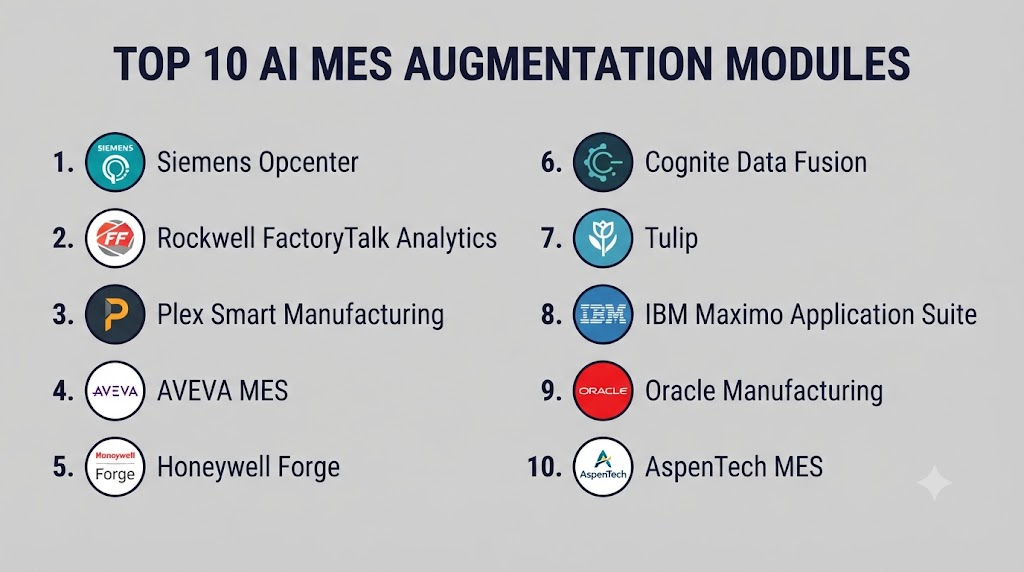
Top 10 AI MES Augmentation Modules
1. Siemens Industrial Copilot
One-line verdict: Best for manufacturers wanting AI assistance integrated with industrial engineering, automation, and production environments.
Short description:
Siemens Industrial Copilot is designed to bring generative AI assistance into industrial workflows. Depending on the implementation, it can help engineers, operators, and manufacturing teams interact with technical information and automate selected engineering and operational tasks.
Standout Capabilities
- Generative AI assistance for industrial workflows.
- Natural-language interaction.
- Engineering assistance.
- Industrial knowledge access.
- Automation-related support.
- Manufacturing workflow augmentation.
- Integration with Siemens industrial technologies.
- AI-assisted productivity.
AI-Specific Depth
- Model support: Platform-provided AI capabilities; exact model flexibility varies.
- RAG / knowledge integration: Designed for contextual industrial information.
- Evaluation: AI performance depends on the specific implementation and use case.
- Guardrails: Enterprise controls and workflow restrictions vary.
- Observability: AI and industrial monitoring capabilities vary by deployment.
Pros
- Strong fit for Siemens-centered manufacturing environments.
- Brings generative AI closer to industrial workflows.
- Can support engineering and operational productivity.
Cons
- Best suited to organizations already using compatible industrial technologies.
- AI functionality varies by application.
- Enterprise deployment can require substantial integration work.
Security & Compliance
Enterprise security capabilities depend on the specific Siemens product configuration and deployment. Specific certifications should be verified before procurement.
Deployment & Platforms
- Cloud.
- Industrial environments.
- Enterprise systems.
- Hybrid architectures may vary.
Integrations & Ecosystem
Siemens Industrial Copilot is most relevant within the broader Siemens industrial ecosystem.
- Automation systems.
- Engineering tools.
- Manufacturing systems.
- Industrial IoT.
- Data platforms.
- APIs.
- Enterprise applications.
Pricing Model
Enterprise/custom pricing; exact pricing is Not publicly stated.
Best-Fit Scenarios
- Siemens-based factories.
- Industrial engineering teams.
- Manufacturing organizations adopting generative AI.
2. Microsoft Copilot for Manufacturing
One-line verdict: Best for manufacturers already invested in Microsoft cloud, data, collaboration, and enterprise application ecosystems.
Short description:
Microsoft’s industrial AI capabilities can augment manufacturing operations by connecting AI assistants, analytics, enterprise data, and operational workflows. The exact MES functionality depends on the selected Microsoft products and implementation.
Standout Capabilities
- Generative AI assistance.
- Natural-language analytics.
- Enterprise data integration.
- Workflow automation.
- Manufacturing knowledge assistance.
- Cloud analytics.
- Business intelligence.
- AI application development.
AI-Specific Depth
- Model support: Microsoft-hosted AI models and broader model options vary by service.
- RAG / knowledge integration: Strong support through Microsoft’s data and AI ecosystem.
- Evaluation: AI evaluation capabilities vary by application.
- Guardrails: Enterprise AI governance and safety capabilities are available across relevant services.
- Observability: Monitoring capabilities vary by service architecture.
Pros
- Strong enterprise ecosystem.
- Flexible AI development options.
- Useful for manufacturers already using Microsoft infrastructure.
Cons
- May require multiple Microsoft services.
- Manufacturing-specific MES capabilities depend on implementation.
- Architecture can become complex.
Security & Compliance
Microsoft provides extensive enterprise security and identity capabilities, but the exact controls and certifications applicable to a deployment should be verified.
Deployment & Platforms
- Cloud.
- Hybrid.
- Enterprise.
- Windows and web environments.
Integrations & Ecosystem
- Microsoft Fabric.
- Azure.
- Power Platform.
- Microsoft 365.
- ERP systems.
- MES platforms.
- APIs.
Pricing Model
Service-based and usage-based pricing varies by Microsoft product and implementation.
Best-Fit Scenarios
- Microsoft-centric enterprises.
- Manufacturers building custom AI copilots.
- Organizations connecting MES data to broader enterprise analytics.
3. AWS Industrial AI / Manufacturing AI Solutions
One-line verdict: Best for manufacturers wanting flexible cloud infrastructure to build custom AI augmentation around existing MES platforms.
Short description:
AWS provides cloud infrastructure, machine-learning services, IoT capabilities, databases, analytics, and generative-AI tools that can be combined to create MES augmentation architectures.
Standout Capabilities
- Machine learning.
- Generative AI.
- Industrial IoT.
- Data lakes.
- Streaming analytics.
- Predictive maintenance.
- Computer vision.
- Custom AI applications.
AI-Specific Depth
- Model support: Strong multi-model flexibility through AWS AI services and model ecosystem.
- RAG / knowledge integration: Broad support through databases, search, and AI services.
- Evaluation: AI evaluation capabilities vary by service and architecture.
- Guardrails: AI safety and governance capabilities vary by selected services.
- Observability: Cloud monitoring, logging, and application observability capabilities.
Pros
- Highly flexible architecture.
- Suitable for large-scale manufacturing data.
- Strong developer ecosystem.
Cons
- Requires cloud and AI engineering expertise.
- Cost management can become complicated.
- Not a turnkey MES replacement.
Security & Compliance
AWS provides extensive enterprise security capabilities. Applicable certifications and controls depend on the specific services and deployment architecture.
Deployment & Platforms
- Cloud.
- Hybrid.
- Edge options.
- Industrial environments.
Integrations & Ecosystem
- MES.
- ERP.
- IoT.
- Data lakes.
- APIs.
- Machine-learning services.
- Databases.
Pricing Model
Primarily usage-based cloud pricing; exact costs vary significantly according to architecture and consumption.
Best-Fit Scenarios
- Large manufacturers.
- Custom AI MES augmentation.
- Organizations with AWS expertise.
4. Google Cloud Manufacturing AI
One-line verdict: Best for manufacturers building AI-heavy production analytics, data platforms, and custom MES augmentation workflows.
Short description:
Google Cloud provides data, AI, machine-learning, analytics, and application services that can augment MES environments. Manufacturers can use these services to develop predictive quality, production analytics, computer vision, and AI assistants.
Standout Capabilities
- Generative AI.
- Machine learning.
- Data analytics.
- Manufacturing data processing.
- Computer vision.
- Predictive analytics.
- AI application development.
- Cloud-scale data infrastructure.
AI-Specific Depth
- Model support: Multiple model and AI-service options.
- RAG / knowledge integration: Strong support through Google Cloud data and search technologies.
- Evaluation: AI evaluation capabilities vary by implementation.
- Guardrails: Enterprise AI safety and governance capabilities vary by service.
- Observability: Cloud monitoring and AI application monitoring capabilities.
Pros
- Strong AI and data ecosystem.
- Good for large-scale analytics.
- Flexible architecture.
Cons
- Requires technical expertise.
- MES functionality is usually integration-driven.
- Cloud architecture needs careful cost management.
Security & Compliance
Enterprise security and governance capabilities are available, but applicable certifications and controls should be verified for each deployment.
Deployment & Platforms
- Cloud.
- Hybrid.
- Edge integrations.
Integrations & Ecosystem
- MES.
- ERP.
- IoT.
- Databases.
- Data warehouses.
- APIs.
- AI/ML services.
Pricing Model
Usage-based cloud pricing; exact cost depends on services and workload.
Best-Fit Scenarios
- AI-first manufacturers.
- Data-intensive factories.
- Organizations developing custom manufacturing copilots.
5. PTC ThingWorx
One-line verdict: Best for manufacturers connecting industrial IoT, production data, applications, and AI-enabled operational workflows.
Short description:
ThingWorx is an industrial IoT and application-development platform that can extend manufacturing systems with connected data, applications, analytics, and intelligent workflows.
Standout Capabilities
- Industrial IoT.
- Connected equipment.
- Manufacturing applications.
- Real-time operational data.
- Workflow development.
- Digital-twin capabilities.
- Analytics.
- Industrial data integration.
AI-Specific Depth
- Model support: AI/ML capabilities vary by product and connected services.
- RAG / knowledge integration: Varies / N/A.
- Evaluation: Depends on connected AI models.
- Guardrails: Application and enterprise controls vary.
- Observability: Operational monitoring and application analytics.
Pros
- Strong industrial IoT capabilities.
- Flexible manufacturing applications.
- Useful for connecting legacy systems.
Cons
- Requires implementation expertise.
- AI capabilities depend on architecture.
- Can involve significant application development.
Security & Compliance
Security capabilities depend on deployment and configuration. Specific certifications should be verified.
Deployment & Platforms
- Cloud.
- On-premises.
- Hybrid.
- Industrial environments.
Integrations & Ecosystem
- MES.
- ERP.
- PLCs.
- Sensors.
- IoT gateways.
- APIs.
- Industrial databases.
Pricing Model
Commercial enterprise licensing; exact pricing varies.
Best-Fit Scenarios
- Connected factories.
- Industrial IoT programs.
- MES extension projects.
6. Tulip
One-line verdict: Best for frontline manufacturing teams that need configurable AI-assisted workflows around existing production systems.
Short description:
Tulip provides a frontline operations platform that can complement MES environments with digital work instructions, applications, machine connectivity, data collection, quality workflows, and AI-enabled assistance.
Standout Capabilities
- Frontline applications.
- Digital work instructions.
- Machine connectivity.
- Quality workflows.
- Production data collection.
- No-code/low-code development.
- Operational dashboards.
- AI-assisted applications.
AI-Specific Depth
- Model support: AI capabilities vary by product and configuration.
- RAG / knowledge integration: Can support contextual knowledge workflows depending on implementation.
- Evaluation: Varies by AI application.
- Guardrails: Workflow and permissions can provide operational controls.
- Observability: Application and production metrics.
Pros
- Strong operator experience.
- Flexible application development.
- Useful for modernizing frontline workflows.
Cons
- Not a complete MES replacement.
- Complex enterprises may require additional integration.
- Advanced SPC and analytics may require complementary tools.
Security & Compliance
Enterprise security controls vary by configuration and should be verified.
Deployment & Platforms
- Cloud.
- Web.
- Connected manufacturing devices.
Integrations & Ecosystem
- MES.
- ERP.
- Machines.
- Databases.
- APIs.
- IoT.
- Quality systems.
Pricing Model
Commercial subscription model; exact pricing varies.
Best-Fit Scenarios
- Frontline manufacturing.
- Digital work instructions.
- MES augmentation projects.
7. AVEVA
One-line verdict: Best for industrial enterprises integrating MES, operations data, analytics, and AI across complex manufacturing environments.
Short description:
AVEVA provides industrial software spanning MES, operations, data infrastructure, visualization, and analytics. Its broader ecosystem can be used to augment manufacturing execution with advanced analytics and AI.
Standout Capabilities
- MES functionality.
- Industrial data management.
- Manufacturing analytics.
- Process visualization.
- Production monitoring.
- Industrial IoT.
- Data contextualization.
- AI-enabled analytics.
AI-Specific Depth
- Model support: AI capabilities vary across AVEVA products and integrations.
- RAG / knowledge integration: Varies.
- Evaluation: Depends on AI implementation.
- Guardrails: Enterprise governance varies by product.
- Observability: Industrial operational monitoring.
Pros
- Broad industrial software portfolio.
- Strong manufacturing heritage.
- Suitable for enterprise environments.
Cons
- Product portfolio can be complex.
- Implementation requires specialist expertise.
- Exact AI functionality varies across products.
Security & Compliance
Security capabilities depend on the specific product and architecture.
Deployment & Platforms
- Cloud.
- On-premises.
- Hybrid.
Integrations & Ecosystem
- MES.
- Historians.
- ERP.
- SCADA.
- PLCs.
- Industrial databases.
- APIs.
Pricing Model
Enterprise/custom pricing; exact pricing is Not publicly stated.
Best-Fit Scenarios
- Enterprise manufacturing.
- Process industries.
- AVEVA-centered industrial environments.
8. Rockwell Automation FactoryTalk
One-line verdict: Best for manufacturers seeking AI and analytics augmentation within Rockwell Automation production environments.
Short description:
FactoryTalk is a broad family of manufacturing software and automation technologies. Depending on configuration, manufacturers can use FactoryTalk capabilities alongside analytics and AI tools to extend production visibility and execution.
Standout Capabilities
- Manufacturing operations.
- Production monitoring.
- Data collection.
- Quality workflows.
- Industrial analytics.
- Automation integration.
- Manufacturing visualization.
- Connected-factory capabilities.
AI-Specific Depth
- Model support: AI/analytics options vary.
- RAG / knowledge integration: Varies / N/A.
- Evaluation: Depends on connected AI applications.
- Guardrails: Enterprise and operational controls vary.
- Observability: Manufacturing and equipment monitoring.
Pros
- Strong Rockwell ecosystem.
- Broad industrial automation integration.
- Useful for existing FactoryTalk users.
Cons
- Product portfolio can be complex.
- AI capabilities depend on the selected components.
- Best fit may require Rockwell infrastructure.
Security & Compliance
Security capabilities vary by product and deployment.
Deployment & Platforms
- On-premises.
- Cloud.
- Hybrid.
- Industrial environments.
Integrations & Ecosystem
- Allen-Bradley PLCs.
- MES.
- ERP.
- SCADA.
- Historians.
- IoT.
- APIs.
Pricing Model
Enterprise/custom pricing; exact pricing varies.
Best-Fit Scenarios
- Rockwell-based factories.
- Industrial automation environments.
- Connected production programs.
9. Honeywell Forge
One-line verdict: Best for industrial enterprises connecting production operations, assets, data, analytics, and AI-enabled decision support.
Short description:
Honeywell Forge provides industrial analytics and operational software that can complement manufacturing execution environments. It is particularly relevant for organizations seeking broader operational intelligence across plants and assets.
Standout Capabilities
- Industrial analytics.
- Operational intelligence.
- Asset monitoring.
- Predictive analytics.
- Production insights.
- Data integration.
- Performance dashboards.
- Industrial workflows.
AI-Specific Depth
- Model support: Platform AI capabilities; exact model flexibility varies.
- RAG / knowledge integration: Varies.
- Evaluation: Depends on the application.
- Guardrails: Enterprise controls vary.
- Observability: Operational and asset monitoring.
Pros
- Strong industrial ecosystem.
- Broad operational analytics.
- Enterprise-oriented architecture.
Cons
- Can be complex to implement.
- MES augmentation depends on integration.
- Enterprise pricing can be difficult to estimate before solution design.
Security & Compliance
Security and compliance capabilities depend on deployment and product configuration.
Deployment & Platforms
- Cloud.
- Enterprise.
- Industrial environments.
Integrations & Ecosystem
- MES.
- ERP.
- Industrial control systems.
- Sensors.
- Historians.
- APIs.
- Enterprise data systems.
Pricing Model
Enterprise/custom pricing; exact pricing is Not publicly stated.
Best-Fit Scenarios
- Large industrial enterprises.
- Asset-intensive manufacturing.
- Operational analytics programs.
10. Cognite Data Fusion
One-line verdict: Best for industrial enterprises creating an AI data layer around existing MES and operational systems.
Short description:
Cognite Data Fusion focuses on industrial data contextualization, integration, and AI readiness. Rather than replacing MES, it can provide the data foundation needed for AI applications built around manufacturing execution systems.
Standout Capabilities
- Industrial data contextualization.
- Time-series analytics.
- Data integration.
- Knowledge graphs.
- AI-ready industrial data.
- Asset context.
- Operational analytics.
- AI application enablement.
AI-Specific Depth
- Model support: Designed to support multiple AI and analytics workflows.
- RAG / knowledge integration: Strong industrial-context capabilities.
- Evaluation: Depends on connected AI applications.
- Guardrails: Enterprise data-access and governance capabilities vary.
- Observability: Industrial data and application monitoring.
Pros
- Strong AI-ready industrial data foundation.
- Useful for complex MES ecosystems.
- Good fit for enterprise AI initiatives.
Cons
- Not a dedicated MES augmentation module by itself.
- Requires strong data architecture.
- Implementation can require specialist resources.
Security & Compliance
Security and compliance capabilities depend on deployment and contract. Specific certifications should be verified before procurement.
Deployment & Platforms
- Cloud.
- Enterprise.
- Industrial environments.
Integrations & Ecosystem
- MES.
- ERP.
- Historians.
- IoT.
- Databases.
- APIs.
- Industrial applications.
Pricing Model
Enterprise/custom pricing; exact pricing is Not publicly stated.
Best-Fit Scenarios
- Enterprise industrial AI.
- Complex MES environments.
- Data-contextualization initiatives.
Comparison Table
| Tool | Best For | Deployment | Model Flexibility | Strength | Watch-Out | Public Rating |
|---|---|---|---|---|---|---|
| Siemens Industrial Copilot | Siemens manufacturing environments | Cloud / Hybrid | Hosted / Varies | Industrial AI assistance | Ecosystem dependency | N/A |
| Microsoft Manufacturing AI | Microsoft-centric enterprises | Cloud / Hybrid | Hosted / BYO / Multi-model varies | Enterprise AI ecosystem | Architecture complexity | N/A |
| AWS Industrial AI | Custom AI augmentation | Cloud / Hybrid | Multi-model / BYO | Flexibility | Requires engineering expertise | N/A |
| Google Cloud Manufacturing AI | AI-heavy manufacturing analytics | Cloud / Hybrid | Multi-model / BYO | AI and data platform | Integration effort | N/A |
| PTC ThingWorx | Industrial IoT augmentation | Cloud / Hybrid | Varies | Industrial connectivity | Requires configuration | N/A |
| Tulip | Frontline manufacturing | Cloud | Hosted / Varies | Operator workflows | Not full MES | N/A |
| AVEVA | Enterprise industrial operations | Cloud / Hybrid | Varies | Broad industrial ecosystem | Portfolio complexity | N/A |
| Rockwell FactoryTalk | Rockwell-based factories | Cloud / Hybrid | Varies | Automation integration | Ecosystem dependency | N/A |
| Honeywell Forge | Industrial analytics | Cloud | Hosted / Varies | Operational intelligence | Enterprise complexity | N/A |
| Cognite Data Fusion | Industrial AI data layer | Cloud | Multi-model / BYO varies | Data contextualization | Requires architecture | N/A |
Scoring & Evaluation
The following scoring is a comparative editorial rubric, not an official vendor score. A platform with strong cloud AI capabilities may score differently from a specialized manufacturing application.
The weighted formula uses:
- Core features – 20%
- AI reliability & evaluation – 15%
- Guardrails & safety – 10%
- Integrations & ecosystem – 15%
- Ease of use – 10%
- Performance & cost controls – 15%
- Security & admin – 10%
- Support & community – 5%
| Tool | Core | Reliability/Eval | Guardrails | Integrations | Ease | Perf/Cost | Security/Admin | Support | Weighted Total |
|---|---|---|---|---|---|---|---|---|---|
| Siemens Industrial Copilot | 9 | 9 | 9 | 10 | 8 | 8 | 10 | 9 | 9.05 |
| Microsoft Manufacturing AI | 9 | 9 | 10 | 10 | 8 | 8 | 10 | 10 | 9.30 |
| AWS Industrial AI | 9 | 10 | 10 | 10 | 6 | 9 | 10 | 10 | 9.25 |
| Google Cloud Manufacturing AI | 9 | 10 | 10 | 9 | 7 | 9 | 10 | 9 | 9.15 |
| PTC ThingWorx | 9 | 8 | 8 | 10 | 8 | 8 | 9 | 9 | 8.75 |
| Tulip | 8 | 8 | 8 | 9 | 10 | 8 | 8 | 8 | 8.45 |
| AVEVA | 10 | 8 | 9 | 10 | 7 | 8 | 10 | 9 | 9.00 |
| Rockwell FactoryTalk | 10 | 8 | 9 | 10 | 7 | 8 | 10 | 9 | 9.00 |
| Honeywell Forge | 9 | 8 | 9 | 10 | 7 | 8 | 10 | 9 | 8.90 |
| Cognite Data Fusion | 9 | 9 | 9 | 10 | 7 | 9 | 10 | 9 | 9.15 |
Top 3 for Enterprise
- Microsoft Manufacturing AI — Strong enterprise AI, data, identity, and application ecosystem.
- AWS Industrial AI — Highly flexible for custom AI/MES architectures.
- Siemens Industrial Copilot — Strong industrial integration for Siemens-oriented environments.
Top 3 for SMB
- Tulip — Strong frontline application and workflow capabilities.
- PTC ThingWorx — Useful for connected manufacturing and IoT initiatives.
- Microsoft Manufacturing AI — Attractive when Microsoft infrastructure is already available.
Top 3 for Developers
- AWS Industrial AI — Broad infrastructure and AI development flexibility.
- Google Cloud Manufacturing AI — Strong AI and data capabilities.
- Cognite Data Fusion — Strong industrial data-contextualization foundation.
Which AI MES Augmentation Tool Is Right for You?
Solo / Freelancer
Independent manufacturing consultants generally do not need a complete industrial AI architecture.
Focus on:
- Data accessibility.
- API availability.
- Analytics.
- Rapid prototyping.
- Easy deployment.
- Visualization.
- Export capabilities.
A lightweight analytics or application platform may be more practical than a large enterprise industrial stack.
SMB
SMBs should focus on specific operational problems instead of attempting to transform the entire MES architecture at once.
Good starting points include:
- Operator assistance.
- Production reporting.
- Quality analytics.
- Predictive maintenance.
- Digital work instructions.
- Simple anomaly detection.
Tulip or a cloud AI ecosystem can be appropriate depending on existing infrastructure.
Mid-Market
Mid-market organizations should prioritize integration.
The AI layer should connect:
MES → ERP → QMS → CMMS → Historian → AI Analytics
Useful capabilities include:
- Predictive quality.
- Production anomaly detection.
- AI scheduling.
- Maintenance prioritization.
- Operator copilots.
- Automated reporting.
Enterprise
Large manufacturers should treat MES augmentation as an architectural program rather than simply purchasing an AI feature.
Prioritize:
- Multi-site architecture.
- Data governance.
- Identity management.
- Model governance.
- API-first integration.
- Edge processing.
- AI observability.
- Centralized analytics.
- Human approval.
- Auditability.
Regulated Industries
Manufacturers in regulated environments should evaluate:
- Traceability.
- Electronic records.
- Change management.
- Data integrity.
- Audit logs.
- Model validation.
- Access control.
- Human approval.
- Data residency.
- Retention policies.
AI should enhance existing controlled processes rather than introduce an uncontrolled decision layer.
Budget vs Premium
A smaller organization may only need one augmentation module.
For example:
- AI quality prediction.
- AI maintenance prioritization.
- AI production reporting.
Large enterprises may benefit from a broader architecture combining MES, industrial data, AI, analytics, and enterprise systems.
Build vs Buy
Build when:
- Your MES already exposes strong APIs.
- You have a mature data platform.
- Your use case is highly specialized.
- You have AI engineering resources.
- You need complete model control.
Buy when:
- You need production-ready functionality quickly.
- You lack specialized AI engineers.
- Governance is important.
- You need vendor support.
- Integration is already available.
A hybrid strategy is often practical: purchase the MES and core manufacturing applications, then build specialized AI services around them.
Implementation Playbook: 30 / 60 / 90 Days
First 30 Days: Pilot + Success Metrics
Select one measurable manufacturing problem.
Good candidates include:
- Production downtime.
- Quality deviations.
- Scheduling delays.
- Maintenance backlog.
- Operator information retrieval.
- Production reporting.
Document:
- Current workflow.
- Existing MES data.
- Required integrations.
- Users.
- Decision points.
- Current performance.
- Desired outcome.
Create baseline metrics such as:
- Downtime.
- Throughput.
- First-pass yield.
- Scrap.
- OEE.
- Mean time to resolution.
- Scheduling adherence.
Days 31–60: Harden Security + Evaluation + Rollout
Build an AI evaluation framework.
Test:
- Accuracy.
- Hallucination rate.
- Retrieval quality.
- False alerts.
- Missing events.
- Latency.
- Model consistency.
- User acceptance.
For AI copilots, test prompt injection and unauthorized information retrieval.
Introduce:
- Role-based access.
- Audit logging.
- Prompt/version control.
- Model versioning.
- Human approval.
- Data-retention rules.
- Incident response.
Days 61–90: Optimize Cost, Latency + Governance + Scale
Expand the successful pilot.
Optimize:
- Model selection.
- Inference frequency.
- Data pipelines.
- Edge/cloud processing.
- Caching.
- Retrieval.
- Token consumption.
- Alert thresholds.
Create governance around:
- Model changes.
- Data changes.
- AI incidents.
- Access.
- Performance.
- Human overrides.
Then expand to additional production lines or plants.
Common Mistakes & How to Avoid Them
- Replacing the MES unnecessarily: AI augmentation should solve specific problems before broader replacement is considered.
- Ignoring existing MES APIs: Start by understanding what data and workflows are already available.
- Building AI without clean data: Poor manufacturing data leads to poor AI decisions.
- No data contextualization: Machine tags without asset, product, batch, or operation context are difficult for AI to interpret.
- No evaluation harness: AI assistants need repeatable tests before production deployment.
- Ignoring hallucinations: Generative AI should not invent production information.
- Over-automation: Critical manufacturing decisions should have appropriate human oversight.
- No prompt-injection protection: AI assistants connected to enterprise data require security controls.
- Ignoring data retention: Manufacturing records can contain sensitive operational information.
- No observability: Track latency, failures, model behavior, usage, and costs.
- Ignoring model drift: Production conditions and product mixes change.
- Creating too many alerts: Excessive notifications reduce operator attention.
- Locking everything to one AI provider: Maintain abstraction where practical.
- Ignoring edge requirements: Cloud-only architectures may not suit latency-sensitive production processes.
FAQs
1. What are AI MES Augmentation Modules?
They are AI capabilities added around an existing Manufacturing Execution System to improve production analysis, decision support, automation, quality, maintenance, scheduling, or operator workflows.
2. Do AI MES modules replace MES?
Usually, no. Their primary purpose is to extend existing MES capabilities with AI, analytics, automation, or natural-language interfaces.
3. What is the biggest benefit of AI MES augmentation?
The major benefit is turning existing production data into actionable insights and recommendations without requiring manufacturers to completely replace their MES.
4. Can AI MES modules connect to existing MES platforms?
Yes, depending on the MES and augmentation solution. APIs, databases, middleware, event streams, and industrial protocols may be used.
5. Can AI MES augmentation support predictive quality?
Yes. AI models can analyze process parameters, production history, inspection data, and product information to identify conditions associated with quality problems.
6. Can AI MES systems use generative AI?
Yes. Generative AI can be used for production copilots, knowledge retrieval, report generation, troubleshooting assistance, and natural-language analytics.
7. What is an AI manufacturing copilot?
An AI manufacturing copilot is an assistant designed to help operators, engineers, supervisors, or managers access information and perform selected manufacturing tasks through natural-language interaction.
8. Can AI agents operate MES workflows?
Potentially. Agentic systems can be designed to interact with MES and other enterprise applications, but sensitive production actions should use permissions, validation, and human approval where appropriate.
9. Is RAG useful for MES augmentation?
Yes. Retrieval-augmented generation can help AI systems retrieve relevant manufacturing documentation, procedures, work instructions, equipment information, and historical records before generating responses.
10. What data does an AI MES module need?
Depending on the use case, it may use production orders, machine data, quality records, operator notes, maintenance records, inventory information, process parameters, and historical production data.
11. Can AI MES augmentation work with legacy systems?
Yes, although integration can be more difficult. Middleware, APIs, database connections, industrial gateways, or historians may help connect older systems.
12. Is cloud deployment necessary?
No. Cloud, on-premises, edge, and hybrid architectures can all be appropriate depending on latency, connectivity, cybersecurity, data governance, and operational requirements.
13. How should manufacturers evaluate an AI MES module?
Start with a specific business problem and measurable baseline. Evaluate accuracy, reliability, integration quality, latency, security, cost, usability, and production impact.
14. Can AI MES augmentation reduce downtime?
It can help identify emerging problems, prioritize maintenance, detect anomalies, and improve decision-making. Actual downtime reduction depends on implementation and operational response.
15. What security risks should manufacturers consider?
Important risks include unauthorized access, prompt injection, data leakage, excessive AI permissions, insecure APIs, model manipulation, and inappropriate automated actions.
16. Should AI be allowed to make production decisions automatically?
Not always. Decisions involving safety, regulatory requirements, product quality, or significant production changes should generally have appropriate controls and human oversight.
17. Can manufacturers use their own AI models?
Some architectures support BYO models or connections to external/open-source models, while others are more tightly tied to platform-provided AI services. Capabilities vary.
18. What is the difference between AI MES augmentation and an AI-native MES?
AI MES augmentation adds intelligence around or inside an existing MES environment. An AI-native MES would have AI capabilities designed into the core system architecture from the beginning.
19. Should an SMB buy an enterprise AI platform?
Not necessarily. SMBs should begin with a narrowly defined use case and choose a platform proportional to their data volume, integration requirements, skills, and budget.
20. What is the best way to start an AI MES project?
Choose one high-value use case, establish measurable baseline metrics, connect only the required data, run a controlled pilot, evaluate AI performance, and expand after demonstrating measurable results.
Conclusion
AI MES Augmentation Modules provide manufacturers with a practical way to introduce AI into production without immediately replacing their existing manufacturing execution infrastructure.The strongest implementations connect MES data with industrial historians, ERP systems, QMS platforms, maintenance systems, IoT devices, and AI services. This creates an intelligence layer capable of supporting predictive quality, production optimization, maintenance prioritization, operator assistance, anomaly detection, scheduling, and natural-language analytics.Siemens, Microsoft, AWS, Google Cloud, PTC, Tulip, AVEVA, Rockwell Automation, Honeywell, and Cognite represent different approaches to this market. Some are strongest within specific industrial ecosystems, while others provide flexible foundations for building custom AI applications.