Introduction
AI Change Risk Prediction tools help engineering and IT teams estimate the likelihood that a software, infrastructure, configuration, database, or cloud change could cause an incident. Instead of treating every deployment equally, these systems analyze historical changes, service dependencies, code modifications, deployment patterns, incident records, telemetry, and operational context to identify changes that deserve additional attention.This matters because modern production environments can contain thousands of deployments, configuration updates, infrastructure modifications, and dependency changes. Manual review cannot always determine which changes are genuinely risky. AI can help prioritize engineering attention by identifying patterns associated with previous failures.When evaluating these tools, buyers should examine change-data coverage, historical incident analysis, dependency awareness, predictive accuracy, explainability, evaluation methodology, observability integrations, CI/CD support, governance, security, privacy, model flexibility, latency, cost, and integration depth.
What’s Changed in AI Change Risk Prediction Tools
AI-assisted change-risk analysis is evolving from static approval checklists toward continuous, evidence-based risk assessment.
- Predictive change scoring: Tools increasingly attempt to estimate the probability that a change will cause operational problems before it reaches production.
- AI-assisted code analysis: Change assessment can consider the actual code or configuration being modified rather than relying only on deployment metadata.
- Dependency awareness: A small change to a shared service may carry more risk than a large change to an isolated component.
- Historical incident learning: Previous failed deployments, rollbacks, incidents, and service degradation can provide valuable signals for future risk predictions.
- Change intelligence: Recent deployment frequency, ownership, file history, service health, and infrastructure changes can become part of risk assessment.
- Observability-aware decisions: Current error rates, latency, saturation, and service health can influence whether a change should proceed.
- Kubernetes-aware risk analysis: Changes to manifests, workloads, services, cluster configuration, and resource policies can be assessed in context.
- AI-assisted release gates: Risk predictions can increasingly become part of CI/CD approval workflows.
- Explainable risk scores: Engineering teams need to understand why a change was considered high risk instead of receiving an unexplained numerical score.
- Agentic workflows: AI agents can potentially inspect pull requests, deployment history, telemetry, ownership data, and incident records before producing a recommendation.
- Human-in-the-loop approvals: High-risk changes can be routed to experienced engineers while low-risk changes proceed automatically.
- Security-aware change analysis: A deployment can be operationally safe but security-sensitive, requiring risk evaluation across multiple dimensions.
- Continuous learning: Risk models can improve as organizations collect more deployment outcomes and incident feedback.
- Cost and latency considerations: Risk checks need to fit into developer workflows without creating unacceptable CI/CD delays.
- Governance: Organizations increasingly need audit trails showing why a change was approved, blocked, escalated, or automatically released.
Quick Buyer Checklist
Before selecting an AI change-risk prediction platform, evaluate:
- Deployment risk scoring
- Pull-request analysis
- Code-change analysis
- Infrastructure-change analysis
- Configuration-change analysis
- Kubernetes support
- CI/CD integrations
- Incident-history analysis
- Rollback history
- Service dependency mapping
- Ownership information
- Observability integrations
- Change-impact analysis
- Risk explanations
- Confidence indicators
- Historical validation
- Offline evaluation
- Regression testing
- Human review
- Approval workflows
- Automated release gates
- Policy controls
- RBAC
- SSO
- Audit logging
- Data retention
- Data residency
- Encryption
- Sensitive-code handling
- Model flexibility
- API access
- Webhooks
- Cost controls
- Latency controls
- Vendor lock-in risk
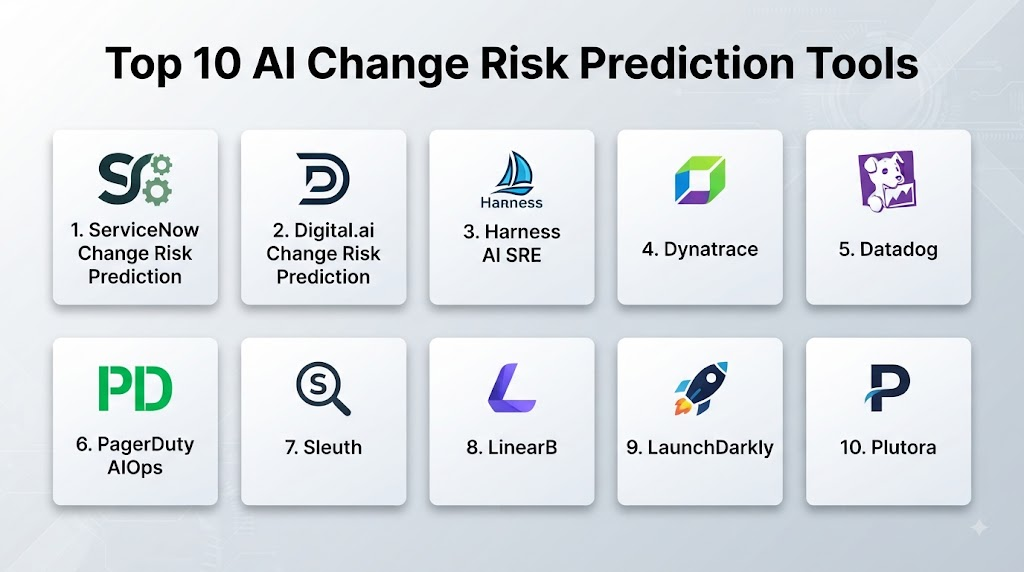
Top 10 AI Change Risk Prediction Tools
1 — Harness
One-line verdict: Best for engineering organizations connecting AI-assisted change assessment with CI/CD, deployment automation, and release governance.
Short description:
Harness provides software delivery, continuous integration, continuous delivery, cloud cost, security, and engineering automation capabilities. Its change-management capabilities can help organizations evaluate deployment risk using software delivery context, verification, policies, and operational information.
Standout Capabilities
- CI/CD automation
- Deployment governance
- Release management
- Deployment verification
- Kubernetes support
- Infrastructure automation
- Change management
- Automated release controls
AI-Specific Depth
- Model support: AI capabilities vary by product and configuration.
- RAG / knowledge integration: Engineering, deployment, and operational context can support AI-assisted workflows.
- Evaluation: Deployment outcomes and verification data can be used to evaluate risk decisions.
- Guardrails: Approval gates, policies, permissions, and deployment controls can constrain automated decisions.
- Observability: Deployment verification and connected observability provide operational context.
Pros
- Strong connection between risk assessment and deployment workflows.
- Useful for teams already investing in delivery automation.
- Supports controlled release processes.
Cons
- Broad platform scope can increase implementation complexity.
- Advanced capabilities may require multiple modules.
- Risk prediction depends on the quality of historical deployment data.
Security & Compliance
Enterprise security and administrative controls vary by product and plan. Specific certifications, retention, residency, encryption, and access requirements should be verified before procurement.
Deployment & Platforms
- Web: Yes
- Windows/macOS/Linux: Browser-based
- Mobile: Varies / N/A
- Deployment: Cloud/SaaS with product-specific deployment options
Integrations & Ecosystem
Harness connects software delivery with engineering and operational systems.
- Git repositories
- CI/CD systems
- Kubernetes
- Cloud platforms
- Infrastructure-as-Code
- Observability tools
- Security platforms
Pricing Model
Tiered SaaS and enterprise pricing. Exact pricing varies by product and usage.
Best-Fit Scenarios
- Enterprise DevOps teams
- High-frequency deployment organizations
- Teams wanting risk controls inside CI/CD
2 — Dynatrace
One-line verdict: Best for enterprises combining change intelligence, application observability, dependency analysis, and operational risk assessment.
Short description:
Dynatrace provides full-stack observability, application monitoring, infrastructure visibility, service topology, and AI-assisted operations. Its deep understanding of application dependencies makes it relevant for assessing whether changes could affect production services.
Standout Capabilities
- Application observability
- Dependency mapping
- Change tracking
- Service health analysis
- AI-assisted operations
- Deployment monitoring
- Kubernetes observability
- Application performance analysis
AI-Specific Depth
- Model support: Proprietary AI and analytics capabilities.
- RAG / knowledge integration: Operational context and organizational information can support analysis.
- Evaluation: Historical incidents and observed service outcomes can validate predictions.
- Guardrails: Enterprise permissions and workflow policies can restrict automated actions.
- Observability: Strong metrics, logs, traces, service topology, and application telemetry.
Pros
- Strong application and dependency context.
- Useful for complex distributed environments.
- Can connect change activity with real production behavior.
Cons
- Can require significant implementation effort.
- Broad observability capabilities may exceed simple change-management requirements.
- Risk prediction quality depends on instrumentation and historical data.
Security & Compliance
Enterprise security and administrative capabilities are available. Exact certifications and contractual requirements should be verified for the applicable deployment.
Deployment & Platforms
- Web: Yes
- Windows/macOS/Linux: Browser-based
- Mobile: Varies / N/A
- Deployment: Cloud and environment-specific options
Integrations & Ecosystem
- Cloud platforms
- Kubernetes
- CI/CD
- Applications
- Databases
- Infrastructure
- Incident-management systems
Pricing Model
Enterprise subscription and usage-based pricing vary by environment.
Best-Fit Scenarios
- Large distributed applications
- Enterprise SRE organizations
- Teams wanting observability-driven change intelligence
3 — Datadog
One-line verdict: Best for cloud-native teams that want change analysis connected directly to application, infrastructure, and deployment telemetry.
Short description:
Datadog provides application performance monitoring, infrastructure monitoring, logs, metrics, traces, cloud monitoring, and deployment visibility. Its broad telemetry foundation can help engineering teams evaluate changes against current and historical system behavior.
Standout Capabilities
- Application monitoring
- Infrastructure monitoring
- Deployment tracking
- Change detection
- Metrics
- Logs
- Distributed tracing
- Kubernetes monitoring
AI-Specific Depth
- Model support: Hosted AI capabilities; exact model configuration varies.
- RAG / knowledge integration: Operational telemetry and connected context can support investigation.
- Evaluation: Change outcomes can be compared with historical service behavior.
- Guardrails: Platform permissions and workflow controls apply; detailed AI-specific prompt-injection defenses vary.
- Observability: Strong operational telemetry across applications and infrastructure.
Pros
- Excellent telemetry coverage.
- Strong cloud-native integration.
- Useful for teams already using Datadog monitoring.
Cons
- Large telemetry environments can become expensive.
- Risk analysis depends on adequate historical data.
- Broad platform functionality may require configuration.
Security & Compliance
Enterprise security capabilities are available. Exact certifications, retention, residency, and administrative controls should be confirmed for the applicable plan.
Deployment & Platforms
- Web: Yes
- Windows/macOS/Linux: Browser-based
- Mobile: Available
- Deployment: Cloud/SaaS
Integrations & Ecosystem
Datadog connects application and infrastructure data with engineering workflows.
- Cloud providers
- Kubernetes
- Git and CI/CD systems
- Databases
- Infrastructure
- Incident-management platforms
- Collaboration tools
Pricing Model
Usage-based and subscription pricing varies by service and telemetry volume.
Best-Fit Scenarios
- Cloud-native engineering teams
- Kubernetes environments
- Organizations already using Datadog observability
4 — PagerDuty
One-line verdict: Best for organizations combining change intelligence with incident response, operational workflows, and release-risk management.
Short description:
PagerDuty is primarily an incident-management and operations platform, but its broader operational intelligence capabilities can help teams connect changes with incidents and service health. It is especially useful when change risk needs to feed directly into response and escalation workflows.
Standout Capabilities
- Incident management
- Change intelligence
- Event correlation
- Service ownership
- Operational workflows
- AI-assisted operations
- On-call management
- Automation
AI-Specific Depth
- Model support: Hosted AI capabilities; exact underlying models vary.
- RAG / knowledge integration: Incident context and operational information can support analysis.
- Evaluation: Historical incident outcomes can help validate change-risk decisions.
- Guardrails: Workflow permissions and approval controls can constrain operational actions.
- Observability: Strong incident context; deeper telemetry depends on integrations.
Pros
- Strong operational workflow integration.
- Useful for connecting changes with incident response.
- Mature on-call and escalation capabilities.
Cons
- Not primarily a code-analysis platform.
- Requires observability and CI/CD integrations for richer risk context.
- Broader incident-management functionality may be unnecessary for some teams.
Security & Compliance
Enterprise controls are available. Specific certifications and data-handling requirements should be verified for the selected plan.
Deployment & Platforms
- Web: Yes
- Windows/macOS/Linux: Browser-based
- Mobile: Available
- Deployment: Cloud/SaaS
Integrations & Ecosystem
- CI/CD platforms
- Monitoring systems
- Observability tools
- Cloud services
- Collaboration platforms
- Ticketing systems
- Automation platforms
Pricing Model
Tiered SaaS and enterprise pricing. Exact pricing varies.
Best-Fit Scenarios
- Mature SRE teams
- Organizations with formal incident management
- Teams connecting release events with operational response
5 — ServiceNow
One-line verdict: Best for enterprises connecting AI-assisted change risk with ITSM, governance, approvals, and enterprise change management.
Short description:
ServiceNow provides enterprise IT service management, change management, workflows, governance, and automation. Its strength in this category is the ability to connect technical change decisions with formal organizational approval and operational processes.
Standout Capabilities
- Enterprise change management
- ITSM
- Workflow automation
- Approval processes
- Configuration management
- Service relationships
- Operational governance
- AI-assisted workflows
AI-Specific Depth
- Model support: Enterprise AI capabilities vary by product and configuration.
- RAG / knowledge integration: Knowledge bases, service data, configuration information, and organizational context can support AI workflows.
- Evaluation: Change outcomes and incident records can be used to evaluate predictions.
- Guardrails: Strong workflow, role, policy, and approval mechanisms.
- Observability: Depends on integrations with monitoring and observability systems.
Pros
- Excellent enterprise governance.
- Strong change-management processes.
- Connects technical changes with business workflows.
Cons
- Can be complex to implement.
- May be excessive for smaller engineering teams.
- Requires integration for deep engineering telemetry.
Security & Compliance
ServiceNow provides extensive enterprise security and administrative capabilities. Exact certifications, retention, residency, encryption, and compliance requirements should be verified for the specific product and contract.
Deployment & Platforms
- Web: Yes
- Windows/macOS/Linux: Browser-based
- Mobile: Available
- Deployment: Cloud/SaaS
Integrations & Ecosystem
- ITSM
- CMDB
- CI/CD
- Monitoring
- Cloud platforms
- Security systems
- Enterprise workflows
Pricing Model
Enterprise/custom pricing. Exact pricing varies by products and contract.
Best-Fit Scenarios
- Large enterprises
- Regulated organizations
- Organizations with mature formal change-management processes
6 — Splunk
One-line verdict: Best for enterprises using extensive operational data to understand change impact, detect anomalies, and investigate change-related incidents.
Short description:
Splunk provides machine-data analytics, observability, security, and operational investigation. Its ability to analyze large volumes of historical operational data makes it useful for organizations trying to connect changes with subsequent service behavior.
Standout Capabilities
- Log analytics
- Observability
- Machine-data search
- Change investigation
- Event correlation
- Anomaly detection
- Security analytics
- Operational dashboards
AI-Specific Depth
- Model support: Enterprise AI capabilities vary.
- RAG / knowledge integration: Large operational datasets can provide contextual grounding.
- Evaluation: Historical changes and incidents can be analyzed for prediction validation.
- Guardrails: Enterprise access controls and security workflows can restrict data and actions.
- Observability: Strong operational and machine-data analytics.
Pros
- Excellent historical data analysis.
- Strong security and operations overlap.
- Useful for complex change investigations.
Cons
- Can require significant technical expertise.
- Data volume can affect cost.
- Not primarily a CI/CD-native risk scoring product.
Security & Compliance
Enterprise security and administrative capabilities are available. Exact certifications and controls should be confirmed for the applicable deployment.
Deployment & Platforms
- Web: Yes
- Windows/macOS/Linux: Supported components vary
- Mobile: Varies
- Deployment: Cloud and other deployment options vary
Integrations & Ecosystem
- Cloud platforms
- Applications
- Infrastructure
- Security systems
- CI/CD
- ITSM
- Monitoring tools
Pricing Model
Enterprise and usage-oriented pricing. Exact costs vary by data volume and product configuration.
Best-Fit Scenarios
- Large enterprises
- Security and operations teams
- Organizations with extensive historical machine data
7 — GitLab
One-line verdict: Best for software teams wanting change-risk controls integrated directly into source control, CI/CD, and DevSecOps workflows.
Short description:
GitLab combines source-code management, CI/CD, security, deployment workflows, and DevOps processes. This makes it relevant for change-risk assessment because risk evaluation can happen close to the code and deployment pipeline.
Standout Capabilities
- Source-code management
- Merge requests
- CI/CD
- Deployment workflows
- Security testing
- Release management
- DevSecOps
- Automation
AI-Specific Depth
- Model support: AI capabilities vary by GitLab product and configuration.
- RAG / knowledge integration: Repository and engineering context can support AI-assisted workflows.
- Evaluation: CI/CD tests, deployment results, and historical changes provide evaluation signals.
- Guardrails: Approval rules, protected branches, permissions, and pipeline policies provide controls.
- Observability: Requires integrations with observability systems for deeper production context.
Pros
- Change assessment occurs close to the source code.
- Strong CI/CD integration.
- Useful for DevSecOps teams.
Cons
- Production-risk prediction depends on operational integrations.
- Not primarily an observability platform.
- Advanced AI capabilities vary by plan and configuration.
Security & Compliance
Enterprise security, access management, and governance capabilities are available depending on product and plan. Specific certifications should be verified for the intended deployment.
Deployment & Platforms
- Web: Yes
- Windows/macOS/Linux: Supported clients and browser workflows
- Mobile: Available
- Deployment: Cloud and self-managed options vary
Integrations & Ecosystem
- Git repositories
- CI/CD
- Kubernetes
- Cloud platforms
- Security scanners
- Observability tools
- Infrastructure-as-Code
Pricing Model
Tiered subscription and self-managed enterprise offerings vary by product.
Best-Fit Scenarios
- DevSecOps organizations
- Teams already using GitLab
- Engineering groups wanting risk controls inside CI/CD
8 — Harness Service Reliability Management
One-line verdict: Best for teams that want deployment risk evaluation tied to service health, verification, and release automation.
Short description:
Harness provides capabilities for assessing deployment behavior and verifying service health during software delivery. Its service-reliability workflows can help organizations make release decisions using operational signals rather than deployment status alone.
Standout Capabilities
- Deployment verification
- Release risk assessment
- Service reliability
- CI/CD integration
- Kubernetes workflows
- Automated rollback
- Release governance
- Operational metrics
AI-Specific Depth
- Model support: AI functionality varies by product.
- RAG / knowledge integration: Deployment and service context can support analysis.
- Evaluation: Historical release outcomes provide a practical evaluation dataset.
- Guardrails: Approval gates and automated rollback controls can reduce release risk.
- Observability: Service health verification can use integrated operational telemetry.
Pros
- Strong release-focused workflow.
- Connects changes with deployment outcomes.
- Useful for progressive delivery strategies.
Cons
- Best suited to teams already using modern CI/CD.
- Requires reliable service-level metrics.
- Exact AI capabilities vary by product.
Security & Compliance
Enterprise controls vary by product and plan. Certifications and security requirements should be verified before procurement.
Deployment & Platforms
- Web: Yes
- Windows/macOS/Linux: Browser-based
- Mobile: Varies
- Deployment: Cloud/SaaS with product-specific options
Integrations & Ecosystem
- CI/CD
- Kubernetes
- Cloud platforms
- Monitoring
- APM tools
- Infrastructure-as-Code
- Deployment systems
Pricing Model
Subscription and enterprise pricing vary by service.
Best-Fit Scenarios
- High-frequency release teams
- Platform engineering organizations
- Teams using progressive delivery
9 — IBM Concert
One-line verdict: Best for enterprises assessing application change risk using application intelligence, dependency context, and operational information.
Short description:
IBM Concert focuses on application management and operational intelligence. It can help organizations understand application dependencies, risks, operational health, and change-related information across enterprise environments.
Standout Capabilities
- Application inventory
- Application dependency awareness
- Operational intelligence
- Application risk insights
- AI-assisted analysis
- Enterprise application management
- Risk visualization
- Workflow integration
AI-Specific Depth
- Model support: IBM enterprise AI capabilities; exact model configuration varies.
- RAG / knowledge integration: Enterprise application and operational information can provide context.
- Evaluation: Change outcomes and operational incidents can support ongoing evaluation.
- Guardrails: Enterprise permissions and workflow controls can govern recommendations.
- Observability: Application visibility depends on connected systems.
Pros
- Strong enterprise application context.
- Useful for complex application estates.
- Can connect application intelligence with operational workflows.
Cons
- Enterprise-oriented implementation.
- May be more than smaller teams need.
- Deeper change prediction depends on connected data sources.
Security & Compliance
Enterprise security and administrative controls are available. Specific certifications and data-handling requirements should be verified for the relevant deployment.
Deployment & Platforms
- Web: Yes
- Windows/macOS/Linux: Browser-based
- Mobile: Varies
- Deployment: Cloud and enterprise deployment options vary
Integrations & Ecosystem
- Enterprise applications
- Cloud environments
- Observability platforms
- IT operations
- Automation tools
- Application management systems
- Enterprise workflows
Pricing Model
Enterprise/custom pricing. Exact pricing varies.
Best-Fit Scenarios
- Large application estates
- Enterprise IT organizations
- Teams seeking application-centric risk intelligence
10 — Elastic Observability
One-line verdict: Best for technically sophisticated teams building flexible change-risk analysis around logs, metrics, traces, and search.
Short description:
Elastic provides observability, search, security, and machine-data capabilities. Its flexible architecture can support organizations building customized change-risk workflows that combine historical telemetry, deployment events, service data, and AI-assisted analysis.
Standout Capabilities
- Logs
- Metrics
- Distributed tracing
- Search
- Observability
- Security analytics
- Custom analytics
- Flexible deployment
AI-Specific Depth
- Model support: Supported AI model options vary by configuration.
- RAG / knowledge integration: Strong search and knowledge-integration capabilities.
- Evaluation: Historical deployment and incident data can be used to evaluate change-risk predictions.
- Guardrails: Security and access controls can help constrain workflows.
- Observability: Strong operational telemetry and search capabilities.
Pros
- Flexible architecture.
- Strong search capabilities.
- Suitable for custom engineering workflows.
Cons
- Requires technical expertise.
- Change-risk prediction may require additional configuration.
- Organizations building custom AI workflows assume more governance responsibility.
Security & Compliance
Enterprise security capabilities vary by product and deployment. Specific certifications and controls should be verified for the intended environment.
Deployment & Platforms
- Web: Yes
- Windows/macOS/Linux: Supported
- Mobile: Varies
- Deployment: Cloud, self-managed, and hybrid options vary
Integrations & Ecosystem
- Kubernetes
- Cloud platforms
- Git systems
- CI/CD
- Applications
- Infrastructure
- AI model providers
Pricing Model
Open and commercial offerings vary by product, deployment, and usage.
Best-Fit Scenarios
- Platform engineering teams
- Custom AIOps environments
- Organizations wanting flexible telemetry architecture
Comparison Table
| Tool | Best For | Deployment | Model Flexibility | Strength | Watch-Out | Public Rating |
|---|---|---|---|---|---|---|
| Harness | CI/CD risk management | Cloud | Hosted / product-dependent | Release automation | Broad platform scope | N/A |
| Dynatrace | Enterprise change intelligence | Cloud / hybrid options | Hosted / proprietary | Dependency context | Implementation complexity | N/A |
| Datadog | Cloud-native teams | Cloud | Hosted | Telemetry-driven analysis | Data-volume costs | N/A |
| PagerDuty | Change + incident management | Cloud | Hosted | Operational workflows | Not code-centric | N/A |
| ServiceNow | Enterprise governance | Cloud | Enterprise AI | Formal change control | Complexity | N/A |
| Splunk | Historical operational analysis | Cloud / varies | Enterprise-configurable | Machine-data analytics | Data costs | N/A |
| GitLab | DevSecOps teams | Cloud / self-managed | Hosted / varies | CI/CD integration | Needs production telemetry | N/A |
| Harness SRM | Release verification | Cloud | Hosted / product-dependent | Deployment validation | Requires good service metrics | N/A |
| IBM Concert | Enterprise application intelligence | Cloud / enterprise options | Enterprise AI | Application context | Enterprise complexity | N/A |
| Elastic Observability | Custom engineering workflows | Cloud / self-managed | Multi-model options vary | Search and flexibility | Requires technical expertise | N/A |
Scoring & Evaluation
The following scores are comparative editorial assessments, not official vendor ratings. The rubric evaluates suitability for AI-assisted change-risk prediction rather than overall product quality.
The weighting emphasizes core change-risk capabilities while also considering AI reliability, safety, integrations, usability, performance, security, and support.
| Tool | Core | Reliability/Eval | Guardrails | Integrations | Ease | Perf/Cost | Security/Admin | Support | Weighted Total |
|---|---|---|---|---|---|---|---|---|---|
| Harness | 9.3 | 8.8 | 9.0 | 9.5 | 8.0 | 8.2 | 9.0 | 8.6 | 8.8 |
| Dynatrace | 9.4 | 9.2 | 9.0 | 9.5 | 7.7 | 7.8 | 9.3 | 8.9 | 8.8 |
| Datadog | 9.0 | 8.8 | 8.6 | 9.7 | 8.4 | 7.7 | 9.1 | 8.9 | 8.7 |
| PagerDuty | 8.7 | 8.5 | 9.1 | 9.5 | 8.6 | 8.0 | 9.2 | 8.9 | 8.7 |
| ServiceNow | 9.2 | 8.7 | 9.5 | 9.5 | 7.2 | 7.5 | 9.5 | 9.0 | 8.7 |
| Splunk | 8.8 | 9.0 | 9.0 | 9.5 | 7.3 | 7.2 | 9.4 | 9.0 | 8.5 |
| GitLab | 8.8 | 8.5 | 9.0 | 9.4 | 8.8 | 8.3 | 9.0 | 8.6 | 8.7 |
| Harness SRM | 8.9 | 8.8 | 9.1 | 9.4 | 8.0 | 8.1 | 9.0 | 8.6 | 8.7 |
| IBM Concert | 8.6 | 8.5 | 9.1 | 9.0 | 7.4 | 7.7 | 9.3 | 8.8 | 8.5 |
| Elastic Observability | 8.5 | 8.4 | 8.7 | 9.5 | 7.6 | 8.5 | 9.1 | 8.7 | 8.6 |
Top 3 for Enterprise
- ServiceNow — particularly strong for formal governance, approval, ITSM, and enterprise change management.
- Dynatrace — excellent for application-aware change intelligence and production context.
- Harness — strong for organizations that want risk assessment embedded into software delivery.
Top 3 for SMB
- Datadog — useful when observability and change visibility are already centralized.
- GitLab — practical for teams wanting change controls close to source code and CI/CD.
- PagerDuty — useful for teams connecting deployment events with incident management.
Top 3 for Developers
- GitLab — strong integration with source control and CI/CD.
- Harness — useful for deployment-centric risk management.
- Datadog — strong production telemetry and deployment context.
Which AI Change Risk Prediction Tool Is Right for You?
Solo / Freelancer
Solo developers and very small teams usually do not need a dedicated AI change-risk platform.
Start with:
- Automated tests
- CI/CD checks
- Code review
- Deployment monitoring
- Rollback
- Basic observability
- Security scanning
AI risk prediction becomes more useful when deployments become frequent or when one engineer is responsible for many production services.
SMB
SMBs should focus on changes that have historically caused operational problems.
Prioritize:
- Deployment risk scoring
- Automated testing
- Observability
- Rollback
- Change history
- CI/CD integration
- Simple approval workflows
GitLab, Datadog, PagerDuty, or Harness may fit depending on the organization’s existing engineering stack.
Mid-Market
Mid-market organizations should connect development activity with production outcomes.
Evaluate:
- Pull-request information
- Deployment history
- Service dependencies
- Incident history
- Observability
- Release frequency
- Rollback frequency
- Ownership
- Change approval
- Risk scoring
Harness, Dynatrace, Datadog, and GitLab are strong candidates for this environment.
Enterprise
Enterprise organizations should focus on governance as much as prediction.
Prioritize:
- Enterprise change workflows
- RBAC
- SSO
- Audit trails
- Approval policies
- Service ownership
- Dependency mapping
- Historical incident data
- Production telemetry
- Risk explanations
- Data retention
- Data residency
- AI governance
- Automated release gates
ServiceNow, Dynatrace, Harness, and Splunk are particularly relevant depending on the existing architecture.
Regulated Industries
Finance, healthcare, public-sector, and other regulated environments should carefully evaluate how source code, infrastructure data, incident information, and customer-related telemetry are processed.
Review:
- Data residency
- Data retention
- Encryption
- Access control
- Audit logs
- Model-provider relationships
- Code confidentiality
- Customer-data exposure
- AI governance
- Approval requirements
- Automated deployment boundaries
A risk prediction system should normally recommend and prioritize changes rather than independently overriding formal governance processes.
Budget vs Premium
Budget-conscious teams should first establish strong engineering fundamentals.
Before purchasing a sophisticated AI risk platform, ensure that you have:
- Reliable CI/CD
- Automated testing
- Deployment history
- Production monitoring
- Incident tracking
- Rollback capability
- Service ownership
Premium platforms become more attractive when organizations have hundreds or thousands of services, frequent deployments, multiple engineering teams, and significant costs associated with production incidents.
Build vs Buy
Building a custom change-risk system can make sense for organizations with strong engineering and data teams.
A custom platform could combine:
- Git history
- Pull requests
- Deployment records
- Incident history
- Service topology
- Observability
- Infrastructure changes
- Ownership information
- AI models
- Risk scoring
- Release gates
However, a production-ready system also needs:
- Evaluation datasets
- Model monitoring
- Security controls
- Auditability
- Data governance
- Version management
- False-positive handling
- False-negative analysis
- Developer feedback
- Integration maintenance
For many organizations, buying the foundation and building organization-specific risk policies on top is more practical than creating an entire prediction system from scratch.
Implementation Playbook
First 30 Days: Pilot + Success Metrics
Start with a limited application group.
Collect historical information about:
- Deployments
- Pull requests
- Rollbacks
- Incidents
- Service degradation
- Configuration changes
- Infrastructure changes
- Test failures
- Ownership
- Deployment frequency
Create a baseline.
Measure:
- Change failure rate
- Rollback rate
- Change-related incidents
- Mean time to recovery
- Number of high-risk changes
- False-positive risk scores
- Missed high-risk changes
- Developer review time
Run the AI system in advisory mode.
Do not block deployments initially.
Compare predictions with actual outcomes.
Days 31–60: Security + Evaluation + Rollout
Build an evaluation dataset from historical changes.
Include:
- Successful low-risk changes
- Successful high-complexity changes
- Failed deployments
- Rollbacks
- Incident-causing changes
- Database changes
- Infrastructure changes
- Kubernetes changes
- Dependency updates
- Configuration changes
Measure:
- Precision
- Recall
- False-positive rate
- False-negative rate
- Risk-score calibration
- Detection latency
- Developer acceptance
- Release delays
Create separate tests for unusual situations.
For example:
- Major architecture changes
- Emergency releases
- Large dependency upgrades
- Infrastructure migrations
- Database schema changes
- High-traffic releases
- Security-sensitive modifications
Days 61–90: Cost, Latency, Governance + Scale
Once the prediction system demonstrates useful performance:
- Add automated release gates.
- Route high-risk changes for review.
- Allow low-risk changes to proceed automatically where appropriate.
- Track prediction accuracy continuously.
- Monitor developer feedback.
- Version risk models and prompts.
- Maintain a historical evaluation set.
- Connect risk scores to incident outcomes.
- Establish escalation rules.
- Review false positives and false negatives.
- Monitor model and infrastructure costs.
Avoid treating a risk score as an absolute truth.
A change rated “low risk” can still fail.
A change rated “high risk” can still be completely successful.
The purpose of prediction is to allocate engineering attention more intelligently, not eliminate engineering judgment.
Common Mistakes & How to Avoid Them
- Treating risk scores as guarantees: A low-risk prediction does not mean a deployment is safe.
- Using insufficient historical data: Prediction quality depends heavily on relevant historical examples.
- Ignoring service dependencies: Changes to shared infrastructure can have much larger blast radii than they initially appear to.
- Ignoring observability: Without production telemetry, it is difficult to determine whether previous changes caused actual problems.
- Blocking too many deployments: Excessive false positives can cause developers to ignore the system.
- Allowing false negatives: Missing genuinely dangerous changes can undermine trust quickly.
- Ignoring emergency changes: Emergency deployments behave differently from normal release workflows.
- No explainability: Engineers need to know why a change was classified as risky.
- Ignoring business context: A major release before a critical business event may deserve additional scrutiny.
- No rollback strategy: Risk prediction should complement, not replace, safe rollback.
- Ignoring security risk: Operational risk and security risk are not always the same.
- No human review: High-impact changes should have clear escalation policies.
- Ignoring prompt injection: AI systems analyzing code, tickets, or logs can encounter malicious instructions.
- No model evaluation: Predictions must be tested against real historical outcomes.
- No model drift monitoring: Application architecture and deployment patterns change over time.
- Over-reliance on code size: A small code change can create a large production impact.
- Ignoring organizational ownership: Risk assessment is more useful when the responsible team and service are known.
- Vendor lock-in: Maintain portable change history and evaluation data where practical.
FAQs
What is AI Change Risk Prediction?
AI Change Risk Prediction uses machine learning, AI, historical deployment information, code changes, operational telemetry, and other signals to estimate whether a planned change could cause problems.
Why is change-risk prediction important?
Modern engineering organizations may deploy hundreds or thousands of changes. Risk prediction helps teams identify which changes deserve additional testing, review, monitoring, or approval.
Can AI predict whether a deployment will fail?
It can estimate the likelihood of failure based on available signals, but no AI system can guarantee the outcome of a future deployment.
What data does an AI change-risk system need?
Useful data can include pull requests, commits, deployments, rollbacks, incidents, service dependencies, observability data, configuration changes, ownership information, and historical release outcomes.
Can AI analyze code changes?
Some platforms and development workflows can incorporate code-change information. The exact depth of code analysis varies between products.
Can AI predict Kubernetes deployment risk?
Yes, when the platform has access to relevant Kubernetes configuration, deployment history, workload behavior, service health, and cluster telemetry.
Can change-risk prediction work without observability?
It can provide limited predictions using source-code and deployment history, but production telemetry significantly improves the ability to connect changes with actual system behavior.
Does AI change-risk prediction replace code review?
No. It complements code review by adding historical and operational context. Human reviewers still provide architectural, business, and domain-specific judgment.
Can risk prediction automatically block deployments?
Some CI/CD workflows can use risk assessments as release gates. Organizations should carefully tune thresholds because excessive blocking can slow delivery and reduce developer trust.
What is a false positive in change-risk prediction?
A false positive occurs when a system classifies a change as risky but the deployment completes successfully without the predicted problems.
What is a false negative?
A false negative occurs when a system classifies a change as low risk even though it subsequently causes an incident or other significant operational problem.
How should prediction accuracy be measured?
Use historical changes and compare predictions with actual outcomes. Precision, recall, calibration, change failure rate, rollback frequency, and incident impact are useful measures.
What is change intelligence?
Change intelligence connects deployment activity with service health, incidents, dependencies, and operational events to help determine whether a change contributed to a problem.
Can AI evaluate infrastructure changes?
Yes. Infrastructure-as-Code, configuration changes, cloud modifications, Kubernetes manifests, and other operational changes can be evaluated when the necessary data is available.
Is AI change-risk prediction useful for small companies?
It can be, but smaller teams may get more value from strong automated testing, CI/CD, monitoring, and rollback mechanisms before adopting specialized prediction tools.
Can regulated companies use AI for change-risk prediction?
Potentially, but they should carefully evaluate data processing, code confidentiality, retention, residency, access controls, auditability, and AI governance.
Can organizations build their own change-risk prediction model?
Yes. Historical deployments, incidents, rollbacks, service topology, code changes, and telemetry can be combined into a custom predictive system.
What is the difference between change-risk prediction and deployment verification?
Change-risk prediction attempts to estimate risk before or during a release. Deployment verification evaluates whether the service remains healthy after the change has been introduced.
Can AI detect risky database migrations?
Potentially. Database migrations can be evaluated using migration complexity, schema changes, historical failures, affected services, data volume, execution patterns, and deployment context.
Should every high-risk change require approval?
Not necessarily. Organizations should establish policies based on business impact, blast radius, service criticality, and confidence in the risk assessment.
What is the best way to introduce AI change-risk prediction?
Start in advisory mode, evaluate historical changes, measure prediction quality, tune thresholds, collect developer feedback, and gradually introduce release gates for clearly defined scenarios.
Conclusion
AI Change Risk Prediction tools are becoming an important layer between software development and production operations.Instead of treating every deployment as equally risky, these systems can combine code changes, deployment history, service dependencies, incident records, observability, ownership, and operational context to help teams focus attention where it matters most.Harness is particularly relevant for organizations that want change-risk intelligence embedded into CI/CD. Dynatrace provides strong application and dependency context. Datadog is useful for teams already operating on a broad observability platform. PagerDuty connects change intelligence with incident response. ServiceNow is especially valuable when formal enterprise change governance is a priority. Splunk provides powerful historical machine-data analysis. GitLab brings change controls close to source code and CI/CD. IBM Concert targets enterprise application intelligence, while Elastic Observability offers flexibility for organizations building customized operational workflows.