Introduction
AI Network Anomaly Detection uses machine learning, behavioral analytics, and security telemetry to identify unusual activity across network traffic, devices, applications, users, and infrastructure. Instead of relying only on predefined signatures or static rules, these systems can learn what normal network behavior looks like and highlight deviations that may indicate security threats, operational problems, or compromised systems.This technology is particularly useful as networks become more distributed across data centers, cloud platforms, remote offices, SaaS environments, IoT infrastructure, and hybrid architectures. Modern organizations generate enormous volumes of network telemetry, making manual analysis increasingly difficult.Common use cases include detecting command-and-control activity, unusual outbound connections, lateral movement, data exfiltration, compromised devices, anomalous DNS behavior, suspicious east-west traffic, insider activity, and previously unknown network threats.
What’s Changed in AI Network Anomaly Detection
- Machine learning is increasingly used to establish network-behavior baselines instead of relying exclusively on signatures.
- Detection increasingly combines network, identity, endpoint, cloud, and application context.
- AI-assisted investigation can help analysts understand complex network anomalies more quickly.
- Behavioral detection is becoming more important as attackers use legitimate credentials and normal administrative tools.
- Modern systems increasingly analyze east-west traffic to identify lateral movement.
- Cloud and hybrid environments require visibility across multiple network planes.
- Network anomaly detection increasingly incorporates identity context to determine whether activity is legitimate.
- DNS analytics remains an important signal for detecting suspicious communication.
- Encrypted traffic creates greater demand for metadata-based behavioral analysis.
- AI models are increasingly expected to prioritize alerts instead of simply generating more detections.
- Automated response requires strong safeguards because network isolation can interrupt legitimate business operations.
- Security teams increasingly evaluate detection systems using false-positive rates, investigation time, and measurable outcomes.
- Privacy and data-governance requirements are becoming more important when network telemetry contains user-related information.
- Organizations are increasingly combining AI anomaly detection with SIEM, SOAR, NDR, XDR, and threat-intelligence platforms.
- Explainability matters because analysts need to understand why a network behavior was considered suspicious.
Quick Buyer Checklist
- Network traffic visibility.
- East-west traffic monitoring.
- North-south traffic monitoring.
- Behavioral baselining.
- Machine-learning detection.
- DNS analytics.
- Network flow analysis.
- Encrypted-traffic metadata analysis.
- Cloud-network visibility.
- IoT visibility.
- User and entity context.
- Endpoint integration.
- Threat-intelligence integration.
- SIEM integration.
- SOAR integration.
- Risk scoring.
- Alert prioritization.
- False-positive reduction.
- AI explainability.
- Evaluation capabilities.
- Model transparency.
- Guardrails for automated response.
- Data retention controls.
- Data privacy.
- Data residency.
- RBAC.
- SSO.
- Audit logs.
- API access.
- Cost controls.
- Deployment flexibility.
- Vendor lock-in considerations.
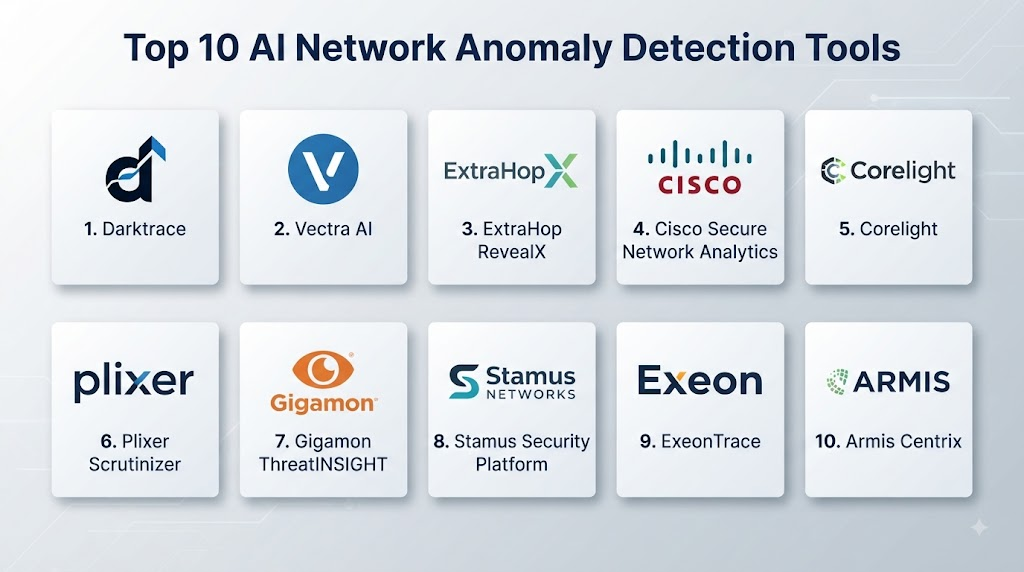
Top 10 AI Network Anomaly Detection Tools
1. Darktrace
One-line verdict: Best for organizations seeking AI-driven behavioral network detection across complex enterprise environments.
Short description
Darktrace applies machine learning and behavioral analysis to identify unusual activity across networks, users, devices, applications, and other digital assets. It is designed to detect deviations from established behavioral patterns and help security teams investigate potential threats.
Standout Capabilities
- AI-driven network behavioral analysis.
- Network anomaly detection.
- Device behavior monitoring.
- User behavior analysis.
- Threat investigation.
- Automated response capabilities.
- Cloud and enterprise visibility.
- Security operations integration.
AI-Specific Depth
- Model support: Vendor-managed machine-learning and AI models.
- RAG / knowledge integration: Security telemetry and behavioral context support investigation.
- Evaluation: Detailed model-evaluation methodology is not publicly stated.
- Guardrails: Automated response controls and administrative policies can govern actions.
- Observability: Network and security dashboards provide anomaly and investigation visibility.
Pros
- Strong behavioral-analysis approach.
- Useful for complex environments.
- Can identify previously unknown patterns.
Cons
- Requires significant network telemetry.
- AI-generated detections require analyst validation.
- Enterprise deployment can require careful tuning.
Security & Compliance
Enterprise security controls are available. Specific certifications and compliance capabilities should be verified for the applicable service and deployment.
Deployment & Platforms
- Cloud.
- Hybrid.
- Enterprise network environments.
Integrations & Ecosystem
Darktrace can integrate network intelligence with broader security operations.
- Network infrastructure.
- Cloud environments.
- Endpoint telemetry.
- SIEM.
- SOAR.
- Security operations workflows.
Pricing Model
Enterprise and custom subscription pricing; exact pricing varies.
Best-Fit Scenarios
- Large enterprise networks.
- Behavioral network monitoring.
- Unknown-threat detection.
2. Vectra AI
One-line verdict: Best for security teams combining network behavior analytics with identity, cloud, and threat detection.
Short description
Vectra AI uses behavioral analytics and machine learning to identify suspicious network activity and prioritize potential threats across enterprise environments.
Standout Capabilities
- Network detection.
- Behavioral analytics.
- Threat prioritization.
- Lateral-movement detection.
- Command-and-control detection.
- Identity correlation.
- Cloud threat detection.
- Security operations integration.
AI-Specific Depth
- Model support: Vendor-managed AI and machine-learning models.
- RAG / knowledge integration: Network, identity, cloud, and threat context support investigations.
- Evaluation: Detailed AI evaluation methodology is not publicly stated.
- Guardrails: Administrative and response controls govern automated actions.
- Observability: Detection dashboards and investigation workflows provide visibility.
Pros
- Strong network behavioral detection.
- Useful identity correlation.
- Good fit for SOC environments.
Cons
- Requires appropriate network telemetry.
- Enterprise-oriented platform.
- Pricing can vary significantly by deployment.
Security & Compliance
Enterprise security and administrative controls are available. Specific certifications should be verified for the selected offering.
Deployment & Platforms
- Cloud.
- Hybrid.
- Enterprise environments.
Integrations & Ecosystem
Vectra AI is designed to integrate network analytics with broader security operations.
- SIEM.
- SOAR.
- Identity providers.
- Cloud platforms.
- Network infrastructure.
- APIs.
Pricing Model
Enterprise subscription and custom pricing.
Best-Fit Scenarios
- Network detection and response.
- Identity-network correlation.
- Enterprise SOC operations.
3. ExtraHop Reveal(x)
One-line verdict: Best for organizations requiring deep network visibility, behavioral analytics, and threat investigation.
Short description
ExtraHop Reveal(x) provides network detection and response capabilities that analyze network traffic and behavioral patterns to identify suspicious activity.
Standout Capabilities
- Network traffic analysis.
- Behavioral anomaly detection.
- Threat detection.
- Lateral-movement visibility.
- Asset discovery.
- Network investigation.
- Cloud visibility.
- Automated security workflows.
AI-Specific Depth
- Model support: Vendor-managed machine learning and behavioral analytics.
- RAG / knowledge integration: Network and asset telemetry provide investigation context.
- Evaluation: Detailed model-evaluation methodology is not publicly stated.
- Guardrails: Response controls allow security teams to govern actions.
- Observability: Network analytics provide detailed investigation visibility.
Pros
- Deep network visibility.
- Strong asset discovery.
- Useful for detailed investigations.
Cons
- Network telemetry requirements can be significant.
- Requires skilled security analysts.
- Enterprise pricing may be substantial.
Security & Compliance
Security and administrative capabilities are available. Certifications should be verified for the relevant deployment.
Deployment & Platforms
- Cloud.
- Hybrid.
- Enterprise infrastructure.
Integrations & Ecosystem
ExtraHop supports integration with broader security infrastructure.
- SIEM.
- SOAR.
- Network infrastructure.
- Cloud environments.
- Identity systems.
- APIs.
Pricing Model
Enterprise/custom pricing.
Best-Fit Scenarios
- Network detection and response.
- Data-center visibility.
- Detailed traffic investigations.
4. Cisco Secure Network Analytics
One-line verdict: Best for enterprises seeking network behavioral analytics integrated with Cisco security and networking infrastructure.
Short description
Cisco Secure Network Analytics analyzes network telemetry to identify unusual activity and potential threats across enterprise environments.
Standout Capabilities
- Network behavior analysis.
- Flow analytics.
- Threat detection.
- Anomaly detection.
- Encrypted-traffic analysis.
- Network visibility.
- Security investigation.
- Cisco ecosystem integration.
AI-Specific Depth
- Model support: Cisco-managed analytics and machine-learning capabilities.
- RAG / knowledge integration: Network telemetry and security context support investigations.
- Evaluation: Detailed AI evaluation methodology is not publicly stated.
- Guardrails: Cisco security controls and administrative policies support governed responses.
- Observability: Network dashboards and telemetry provide operational visibility.
Pros
- Strong enterprise network integration.
- Useful flow-based visibility.
- Good fit for Cisco-centric environments.
Cons
- Strongest value may require Cisco infrastructure.
- Enterprise deployment can be complex.
- Licensing varies by environment.
Security & Compliance
Enterprise security controls are available. Specific certifications should be verified for the applicable product.
Deployment & Platforms
- Cloud.
- On-premises.
- Hybrid.
Integrations & Ecosystem
Cisco Secure Network Analytics integrates with network and security infrastructure.
- Cisco networking.
- SIEM.
- SOAR.
- Firewall platforms.
- Identity systems.
- Security APIs.
Pricing Model
Enterprise subscription and custom licensing.
Best-Fit Scenarios
- Cisco-heavy networks.
- Large enterprises.
- Network behavior monitoring.
5. Corelight
One-line verdict: Best for security teams wanting high-quality network telemetry and flexible integration with existing security analytics platforms.
Short description
Corelight provides network visibility and security telemetry designed to help organizations analyze network behavior and detect suspicious activity.
Standout Capabilities
- Network visibility.
- Network telemetry.
- Behavioral detection.
- Protocol analysis.
- Threat investigation.
- Open security data approach.
- Security ecosystem integration.
- Cloud and enterprise monitoring.
AI-Specific Depth
- Model support: AI and machine-learning capabilities vary by associated deployment and ecosystem.
- RAG / knowledge integration: Network telemetry can feed external analytics and detection systems.
- Evaluation: Platform-specific AI evaluation details are not publicly stated.
- Guardrails: Response controls depend on connected security platforms.
- Observability: Network telemetry provides detailed visibility.
Pros
- High-quality network telemetry.
- Flexible security ecosystem.
- Useful for advanced SOC teams.
Cons
- May require additional analytics platforms.
- Requires networking expertise.
- AI functionality depends on deployment and integrations.
Security & Compliance
Specific certifications and controls should be verified for the applicable offering.
Deployment & Platforms
- Cloud.
- On-premises.
- Hybrid.
Integrations & Ecosystem
Corelight is designed to work with a broad security ecosystem.
- SIEM.
- SOAR.
- Network tools.
- Threat intelligence.
- Security analytics.
- APIs.
Pricing Model
Enterprise/custom pricing.
Best-Fit Scenarios
- Advanced network visibility.
- SOC data pipelines.
- Security analytics environments.
6. Splunk Enterprise Security
One-line verdict: Best for organizations using Splunk to combine network anomalies with endpoint, identity, cloud, and security telemetry.
Short description
Splunk Enterprise Security provides broad security analytics that can correlate network telemetry with identity, endpoint, cloud, and application data.
Standout Capabilities
- Security analytics.
- Network event correlation.
- Risk-based alerting.
- Behavioral analytics.
- Threat investigation.
- Machine-learning capabilities.
- Security dashboards.
- SOAR integration.
AI-Specific Depth
- Model support: Splunk analytics and machine-learning capabilities.
- RAG / knowledge integration: Broad telemetry ingestion enables contextual analysis.
- Evaluation: Detection and analytics testing can be implemented, but exact AI evaluation capabilities vary.
- Guardrails: RBAC and security administration support controlled operations.
- Observability: Extensive event, analytics, and investigation visibility.
Pros
- Broad data integration.
- Strong security operations ecosystem.
- Flexible analytics.
Cons
- Can require significant expertise.
- Data volume can influence costs.
- Configuration can be complex.
Security & Compliance
Enterprise security controls are available. Specific certifications should be confirmed for the applicable service.
Deployment & Platforms
- Cloud.
- Hybrid.
- Enterprise environments.
Integrations & Ecosystem
Splunk supports extensive security and network integrations.
- Network devices.
- Firewalls.
- Endpoint tools.
- Identity systems.
- Cloud platforms.
- SOAR.
- APIs.
Pricing Model
Subscription and usage-based models vary by service.
Best-Fit Scenarios
- Mature SOCs.
- Large security-data environments.
- Multi-source network analytics.
7. Microsoft Defender for Endpoint
One-line verdict: Best for organizations seeking endpoint-centric network anomaly context within the Microsoft security ecosystem.
Short description
Microsoft Defender for Endpoint provides endpoint security telemetry and behavioral detection that can help identify suspicious network activity originating from or targeting managed devices.
Standout Capabilities
- Endpoint telemetry.
- Network activity monitoring.
- Threat detection.
- Behavioral analytics.
- Attack investigation.
- Device risk assessment.
- Automated response.
- Microsoft security integration.
AI-Specific Depth
- Model support: Microsoft-managed machine learning and AI analytics.
- RAG / knowledge integration: Endpoint, identity, and security telemetry provide contextual analysis.
- Evaluation: Detailed model-evaluation methodology is not publicly stated.
- Guardrails: Security policies and administrative controls govern response.
- Observability: Defender dashboards provide device and threat visibility.
Pros
- Strong Microsoft integration.
- Useful endpoint-network context.
- Broad security ecosystem.
Cons
- Endpoint-centric rather than purely network-centric.
- Best value comes from Microsoft environments.
- Advanced capabilities can involve complex licensing.
Security & Compliance
Microsoft provides enterprise security controls. Specific certifications should be verified for the applicable service.
Deployment & Platforms
- Cloud.
- Windows.
- macOS.
- Linux.
- Mobile coverage varies by capability.
Integrations & Ecosystem
Defender for Endpoint integrates endpoint telemetry with broader security operations.
- Microsoft Defender.
- Microsoft Sentinel.
- Microsoft Entra.
- SIEM.
- SOAR.
- Security APIs.
Pricing Model
Microsoft subscription and licensing models vary.
Best-Fit Scenarios
- Microsoft environments.
- Endpoint-network investigations.
- Enterprise security operations.
8. IBM Security QRadar Suite
One-line verdict: Best for organizations needing centralized security analytics and network anomaly investigation within an enterprise SOC.
Short description
IBM security analytics capabilities can correlate network events with identity, endpoint, cloud, and other security telemetry to support anomaly detection and investigation.
Standout Capabilities
- Security analytics.
- Network event analysis.
- Threat correlation.
- Behavioral analytics.
- Risk prioritization.
- Incident investigation.
- AI-assisted security workflows.
- Enterprise integrations.
AI-Specific Depth
- Model support: IBM-managed AI and analytics capabilities.
- RAG / knowledge integration: Security telemetry provides investigation context.
- Evaluation: Detailed AI evaluation methodology is not publicly stated.
- Guardrails: Enterprise administrative controls support governed security workflows.
- Observability: Security dashboards and investigations provide operational visibility.
Pros
- Enterprise security analytics.
- Broad integration ecosystem.
- Strong SOC orientation.
Cons
- Can require specialized expertise.
- Enterprise deployment may be complex.
- Pricing varies.
Security & Compliance
Enterprise security controls are available. Specific certifications should be verified for the selected service.
Deployment & Platforms
- Cloud.
- Hybrid.
- Enterprise environments.
Integrations & Ecosystem
IBM security analytics can integrate with diverse security and network systems.
- Network devices.
- SIEM.
- SOAR.
- Endpoint security.
- Identity systems.
- Cloud infrastructure.
Pricing Model
Enterprise/custom pricing.
Best-Fit Scenarios
- Enterprise SOCs.
- Complex security-data environments.
- Network-security analytics.
9. ExtraHop Reveal(x) 360
One-line verdict: Best for cloud-first organizations needing network detection and behavioral visibility across distributed infrastructure.
Short description
ExtraHop Reveal(x) 360 extends network detection and response capabilities into distributed and cloud environments, helping teams analyze network behavior and investigate threats.
Standout Capabilities
- Cloud network visibility.
- Behavioral analytics.
- Network anomaly detection.
- Asset discovery.
- Threat investigation.
- Lateral-movement analysis.
- Cloud monitoring.
- Security integrations.
AI-Specific Depth
- Model support: Vendor-managed machine learning and analytics.
- RAG / knowledge integration: Network and cloud telemetry provide contextual investigation.
- Evaluation: Detailed AI evaluation methodology is not publicly stated.
- Guardrails: Administrative controls govern response workflows.
- Observability: Network and cloud analytics provide operational visibility.
Pros
- Strong cloud visibility.
- Useful network investigation capabilities.
- Good fit for distributed environments.
Cons
- Requires network telemetry.
- Enterprise-oriented.
- Advanced deployment can require specialized expertise.
Security & Compliance
Security controls are available. Specific certifications should be verified for the applicable offering.
Deployment & Platforms
- Cloud.
- Hybrid.
- Distributed infrastructure.
Integrations & Ecosystem
Reveal(x) 360 can integrate network analytics with broader security infrastructure.
- Cloud platforms.
- SIEM.
- SOAR.
- Identity systems.
- Network infrastructure.
- APIs.
Pricing Model
Enterprise/custom pricing.
Best-Fit Scenarios
- Cloud-first organizations.
- Hybrid networks.
- Distributed infrastructure monitoring.
10. Zeek
One-line verdict: Best for technically advanced teams wanting flexible open network telemetry for custom anomaly detection and security analytics.
Short description
Zeek is an open-source network security monitoring framework that generates detailed network telemetry. It can serve as a foundation for custom anomaly-detection pipelines and AI-assisted security analytics.
Standout Capabilities
- Network traffic analysis.
- Protocol monitoring.
- Rich network logs.
- Custom scripting.
- Network security monitoring.
- Flexible data pipelines.
- Open-source ecosystem.
- Integration with security analytics.
AI-Specific Depth
- Model support: AI capabilities depend on external analytics and machine-learning systems.
- RAG / knowledge integration: Network logs can feed external knowledge and analytics systems.
- Evaluation: Depends on the ML or AI system connected to Zeek.
- Guardrails: Depends on the surrounding detection and response architecture.
- Observability: Detailed network logs provide strong telemetry visibility.
Pros
- Open-source.
- Highly customizable.
- Excellent network telemetry foundation.
Cons
- Requires technical expertise.
- AI detection is not turnkey.
- Maintenance and analytics engineering can be significant.
Security & Compliance
Security controls depend heavily on the deployment architecture and surrounding systems.
Deployment & Platforms
- Linux.
- On-premises.
- Cloud.
- Hybrid.
Integrations & Ecosystem
Zeek can feed many security analytics platforms.
- SIEM.
- Data lakes.
- Threat intelligence.
- Machine-learning pipelines.
- Network monitoring.
- Custom APIs.
Pricing Model
Open-source software; infrastructure and enterprise-support costs vary.
Best-Fit Scenarios
- Security engineering teams.
- Custom detection pipelines.
- Research and advanced network monitoring.
Comparison Table
| Tool Name | Best For | Deployment | Model Flexibility | Strength | Watch-Out | Public Rating |
|---|---|---|---|---|---|---|
| Darktrace | AI behavioral detection | Cloud/Hybrid | Hosted | Behavioral AI | Requires tuning | N/A |
| Vectra AI | Network threat detection | Cloud/Hybrid | Hosted | Threat prioritization | Telemetry requirements | N/A |
| ExtraHop Reveal(x) | Network detection and response | Cloud/Hybrid | Hosted | Deep network visibility | Enterprise complexity | N/A |
| Cisco Secure Network Analytics | Cisco environments | Cloud/Hybrid | Hosted | Flow analytics | Cisco ecosystem fit | N/A |
| Corelight | Network telemetry | Cloud/Hybrid | Flexible | High-quality telemetry | Requires additional analytics | N/A |
| Splunk Enterprise Security | Security analytics | Cloud/Hybrid | Flexible | Broad correlation | Cost and complexity | N/A |
| Microsoft Defender for Endpoint | Endpoint-network security | Cloud | Hosted | Microsoft integration | Endpoint-centric | N/A |
| IBM Security QRadar Suite | Enterprise SOC | Cloud/Hybrid | Hosted | Security correlation | Complexity | N/A |
| ExtraHop Reveal(x) 360 | Cloud networks | Cloud/Hybrid | Hosted | Distributed visibility | Enterprise focus | N/A |
| Zeek | Custom network analytics | Self-hosted/Hybrid | Open ecosystem | Flexibility | Requires engineering | N/A |
Scoring & Evaluation
The following scores are comparative editorial assessments rather than official vendor scores.
They evaluate network-detection depth, AI reliability, guardrails, integrations, usability, performance, security administration, and support.
Organizations should validate these scores through proof-of-concept testing because network architecture, telemetry quality, and existing security infrastructure can significantly affect outcomes.
| Tool | Core | Reliability/Eval | Guardrails | Integrations | Ease | Perf/Cost | Security/Admin | Support | Weighted Total |
|---|---|---|---|---|---|---|---|---|---|
| Darktrace | 10 | 9 | 9 | 9 | 8 | 8 | 9 | 10 | 8.90 |
| Vectra AI | 10 | 9 | 9 | 10 | 8 | 8 | 9 | 10 | 9.00 |
| ExtraHop Reveal(x) | 10 | 9 | 9 | 9 | 8 | 8 | 10 | 10 | 8.95 |
| Cisco Secure Network Analytics | 10 | 9 | 9 | 10 | 8 | 8 | 10 | 10 | 9.10 |
| Corelight | 9 | 9 | 8 | 10 | 7 | 9 | 9 | 9 | 8.80 |
| Splunk Enterprise Security | 10 | 9 | 9 | 10 | 7 | 7 | 10 | 10 | 9.00 |
| Microsoft Defender for Endpoint | 9 | 9 | 9 | 10 | 9 | 9 | 10 | 10 | 9.30 |
| IBM Security QRadar Suite | 9 | 9 | 9 | 9 | 7 | 7 | 10 | 10 | 8.70 |
| ExtraHop Reveal(x) 360 | 10 | 9 | 9 | 9 | 8 | 8 | 10 | 10 | 8.95 |
| Zeek | 9 | 8 | 7 | 10 | 6 | 10 | 8 | 9 | 8.15 |
Top 3 for Enterprise
- Microsoft Defender for Endpoint — Strong choice for Microsoft-centered organizations requiring endpoint and network context.
- Cisco Secure Network Analytics — Strong option for large Cisco-centric network environments.
- Vectra AI — Strong choice for organizations prioritizing AI-based network and identity threat detection.
Top 3 for SMB
- Microsoft Defender for Endpoint — Practical for organizations already using Microsoft security.
- Vectra AI — Useful when behavioral network detection is a priority.
- Corelight — Suitable for teams that already have strong security engineering capabilities.
Top 3 for Developers
- Zeek — Excellent flexibility for custom telemetry and detection pipelines.
- Corelight — Strong network data foundation for advanced security engineering.
- Splunk Enterprise Security — Useful for teams building centralized security analytics.
Which AI Network Anomaly Detection Tool Is Right for You?
Solo / Freelancer
Smaller environments should avoid overly complicated network analytics platforms.
Prioritize:
- Simple deployment.
- Basic anomaly detection.
- Clear dashboards.
- Affordable telemetry ingestion.
- Easy integration.
- Low administrative overhead.
Open-source tools can be useful when technical expertise is available.
SMB
SMBs should focus on identifying high-impact network threats without creating excessive alert volume.
Prioritize:
- Suspicious outbound traffic.
- DNS anomalies.
- Compromised devices.
- Lateral movement.
- Cloud visibility.
- SIEM integration.
- Simple investigation workflows.
Mid-Market
Mid-market organizations should combine network analytics with endpoint and identity context.
Prioritize:
- East-west traffic.
- Cloud networks.
- Identity correlation.
- Endpoint integration.
- Threat intelligence.
- Behavioral baselining.
- Automated response.
Enterprise
Enterprise buyers should evaluate platforms against the full network architecture.
Important requirements include:
- Data-center visibility.
- Cloud visibility.
- Hybrid networking.
- Network segmentation.
- East-west traffic.
- Remote users.
- IoT.
- Identity context.
- Endpoint telemetry.
- Threat intelligence.
- SIEM.
- SOAR.
- RBAC.
- Auditability.
- Data governance.
Regulated Industries
Financial, healthcare, government, and other regulated organizations should pay particular attention to:
- Data retention.
- Data residency.
- Encryption.
- Access controls.
- Audit logs.
- Privacy.
- Third-party access.
- AI data usage.
- Security monitoring.
- Incident response.
- Automated-response governance.
Network telemetry may expose sensitive information about users, applications, devices, and communications, so privacy controls should be assessed carefully.
Budget vs Premium
Budget-conscious organizations should prioritize reliable visibility into their most important network segments rather than collecting every possible telemetry source.
Premium platforms become more attractive when organizations need extensive network coverage, AI-assisted investigations, cloud visibility, automated response, and integration with large SOC environments.
Build vs Buy
Building a custom AI anomaly-detection pipeline can make sense for organizations with strong network-security engineering teams.
A DIY approach can provide:
- Custom machine-learning models.
- Full data control.
- Flexible detection logic.
- Customized integrations.
- Potentially lower software licensing costs.
However, organizations must also manage data pipelines, model development, model evaluation, false positives, infrastructure, monitoring, response automation, and ongoing maintenance.
For most organizations, a commercial NDR or security analytics platform is easier to operate.
Implementation Playbook: 30 / 60 / 90 Days
30 Days: Pilot + Success Metrics
- Identify critical network segments.
- Inventory network data sources.
- Enable flow and traffic telemetry.
- Establish normal traffic baselines.
- Identify critical servers and devices.
- Define anomaly categories.
- Establish detection-quality metrics.
- Measure current alert volume.
- Create representative test scenarios.
- Define escalation procedures.
60 Days: Harden Security + Evaluation + Rollout
- Connect SIEM.
- Connect endpoint telemetry.
- Connect identity systems.
- Connect threat intelligence.
- Tune behavioral models.
- Test lateral-movement scenarios.
- Test command-and-control scenarios.
- Test data-exfiltration scenarios.
- Test DNS anomalies.
- Evaluate false positives.
- Conduct red-team exercises.
- Establish AI evaluation procedures.
- Define automated-response guardrails.
90 Days: Optimize Cost/Latency + Governance + Scale
- Expand network visibility.
- Optimize telemetry ingestion.
- Reduce unnecessary data collection.
- Tune detection thresholds.
- Monitor detection latency.
- Measure investigation time.
- Review storage costs.
- Establish data-retention policies.
- Create incident-response playbooks.
- Monitor automated response.
- Review AI-generated explanations.
- Establish periodic detection evaluations.
- Expand coverage to cloud and remote environments.
Common Mistakes & How to Avoid Them
- Collecting everything without a strategy: Start with critical network segments.
- Ignoring east-west traffic: Lateral movement often requires internal network visibility.
- Relying only on signatures: Behavioral analytics can identify unknown or modified threats.
- No baseline: AI detection needs an understanding of normal network behavior.
- Ignoring encrypted traffic: Evaluate metadata-based detection capabilities.
- Generating too many alerts: Prioritize risk and investigateability.
- Ignoring identity context: Network activity becomes more meaningful when tied to users and entities.
- No endpoint integration: Combine network and endpoint evidence where possible.
- No cloud visibility: Hybrid networks require cloud-aware monitoring.
- Over-automating response: Network isolation should include safeguards.
- No AI evaluation: Test anomaly detection using controlled scenarios.
- Ignoring model drift: Network behavior changes as applications and infrastructure evolve.
- Poor data retention: Network telemetry can contain sensitive information.
- No observability: Track ingestion health, latency, false positives, and detection performance.
- Ignoring cost growth: High-volume traffic telemetry can create substantial storage and processing requirements.
FAQs
What is AI Network Anomaly Detection?
AI Network Anomaly Detection uses machine learning and behavioral analytics to identify network activity that differs from expected patterns. It can help detect threats, compromised systems, unusual communication, and operational anomalies.
How does AI detect network anomalies?
AI systems can learn normal patterns involving traffic volume, destinations, protocols, devices, applications, and communication relationships. Activity that significantly deviates from these patterns can be flagged for investigation.
Can AI Network Anomaly Detection identify unknown threats?
Potentially. Behavioral approaches do not always require a known malware signature, allowing them to identify unusual activity that may indicate previously unknown or modified threats.
Can these tools detect lateral movement?
Many network detection platforms can identify patterns associated with lateral movement by analyzing internal communication, authentication behavior, unusual connections, and other network signals.
Can AI analyze encrypted network traffic?
Some platforms can analyze metadata and behavioral characteristics without decrypting all traffic. Capabilities vary, so organizations should evaluate this requirement during a proof of concept.
Does AI Network Anomaly Detection replace a firewall?
No. Firewalls and anomaly-detection platforms serve different purposes. Anomaly detection provides behavioral visibility, while firewalls primarily enforce network-access policies.
Can these platforms integrate with SIEM systems?
Yes. Many enterprise network detection platforms integrate with SIEM systems so network anomalies can be correlated with identity, endpoint, cloud, and other security events.
Can AI network tools integrate with SOAR platforms?
Many platforms can integrate with SOAR systems or security automation workflows. Automated actions should be carefully governed to prevent legitimate network activity from being disrupted.
Is network telemetry sensitive?
It can be. Network telemetry may reveal information about users, devices, applications, destinations, and communication patterns. Data retention, access control, and privacy should therefore be evaluated.
Can these tools monitor cloud networks?
Many modern platforms support cloud and hybrid environments. Buyers should verify support for their specific cloud providers, network architecture, and telemetry sources.
Do AI network detection platforms support BYO AI models?
BYO-model functionality varies. Most commercial platforms rely primarily on vendor-managed machine-learning and analytics systems, while open platforms can provide greater flexibility.
How should AI network anomaly detection be evaluated?
Test the platform against normal traffic, suspicious outbound connections, lateral movement, unusual DNS behavior, data-exfiltration scenarios, compromised devices, and legitimate administrative activity.
How can organizations reduce false positives?
Establish accurate behavioral baselines, provide identity and asset context, tune thresholds, classify known business applications, and continuously review detection performance.
What is the difference between NDR and AI Network Anomaly Detection?
NDR is a broader security approach focused on network detection and response. AI anomaly detection is one of the techniques that NDR platforms may use to identify suspicious network behavior.
Can AI detect data exfiltration?
AI can identify behavioral indicators associated with potential data exfiltration, such as unusual traffic volume, destinations, protocols, or communication patterns. Detection quality depends on available telemetry and context.
What should organizations evaluate before purchasing a platform?
Evaluate network visibility, detection quality, cloud support, identity correlation, endpoint integration, SIEM/SOAR connectivity, AI explainability, privacy, scalability, cost, and response capabilities.
How much do AI Network Anomaly Detection tools cost?
Pricing varies based on traffic volume, monitored assets, deployment model, features, data retention, and licensing structure. Exact pricing should be confirmed with each vendor.
Are open-source options available?
Yes. Open-source network monitoring technologies can provide powerful telemetry and can be combined with machine-learning pipelines. However, they generally require more engineering and operational expertise than turnkey commercial platforms.
Conclusion
AI Network Anomaly Detection has become an important part of modern security operations because traditional signature-based approaches cannot always identify unusual behavior, compromised devices, lateral movement, or emerging threats. Machine learning and behavioral analytics allow security teams to examine network activity in a more contextual way.Platforms such as Darktrace, Vectra AI, ExtraHop Reveal(x), Cisco Secure Network Analytics, Corelight, Splunk Enterprise Security, Microsoft Defender for Endpoint, IBM Security QRadar Suite, ExtraHop Reveal(x) 360, and Zeek provide different approaches to network visibility and anomaly detection.The best choice depends on network architecture, cloud adoption, telemetry availability, security-team expertise, existing tools, and budget. Enterprises may prioritize broad visibility and advanced analytics, while smaller teams may benefit from simpler deployments or flexible open-source approaches.