Introduction
AI Identity Threat Detection Tools help security teams identify suspicious identity activity, compromised accounts, privilege abuse, credential misuse, and unusual authentication behavior. These platforms combine identity telemetry, machine learning, behavioral analytics, threat intelligence, and security automation to detect activity that traditional rule-based monitoring may miss.Modern identity environments are increasingly complex because organizations use cloud applications, SaaS platforms, remote access, privileged accounts, service identities, APIs, and machine identities. Attackers can exploit stolen credentials without deploying traditional malware, making identity-focused detection an important part of modern security operations.Common use cases include account-takeover detection, impossible-travel analysis, anomalous authentication detection, privileged-account monitoring, suspicious session detection, identity-based lateral movement detection, insider-risk investigation, credential-abuse detection, and identity threat response.
What’s Changed in AI Identity Threat Detection Tools
- Machine learning is increasingly used to establish behavioral baselines for users and entities.
- Identity detection is moving beyond simple login rules toward behavioral context.
- Modern platforms analyze authentication, endpoint, cloud, SaaS, network, and identity-provider telemetry together.
- Risk-based authentication can use contextual signals to identify suspicious access.
- AI-assisted investigations can correlate multiple identity events into a broader incident.
- Identity attacks increasingly involve legitimate credentials rather than obvious malware.
- Privileged identities require greater monitoring because compromised administrative accounts can have broad access.
- Machine identities, service accounts, API credentials, and workload identities are becoming important detection targets.
- SaaS applications create additional identity telemetry that security teams need to monitor.
- Organizations increasingly expect identity detection platforms to integrate with SIEM and SOAR systems.
- AI assistants can help analysts summarize identity incidents and investigate unusual behavior.
- AI-generated conclusions require validation because false positives can disrupt legitimate users.
- Privacy and data-minimization controls are important when monitoring employee behavior.
- Identity analytics increasingly incorporate threat intelligence and attack-pattern context.
- Automated response needs safeguards to prevent legitimate accounts from being unnecessarily disabled.
- Organizations are increasingly evaluating platforms on detection quality, investigation speed, and response effectiveness rather than alert volume alone.
Quick Buyer Checklist
- User and entity behavior analytics.
- Authentication monitoring.
- Identity-provider integration.
- Privileged-account monitoring.
- Impossible-travel detection.
- Suspicious login detection.
- Credential-abuse detection.
- Account-takeover detection.
- Service-account monitoring.
- Machine-identity monitoring.
- Cloud identity monitoring.
- SaaS identity visibility.
- Risk scoring.
- Behavioral baselines.
- Threat intelligence.
- SIEM integration.
- SOAR integration.
- Identity-provider integrations.
- Endpoint telemetry.
- Network telemetry.
- AI-assisted investigation.
- AI model transparency.
- Evaluation capabilities.
- False-positive management.
- Guardrails.
- Human approval workflows.
- Automated response controls.
- Data retention controls.
- Data residency.
- Encryption.
- RBAC.
- SSO.
- Audit logs.
- API access.
- Cost controls.
- Vendor lock-in considerations.
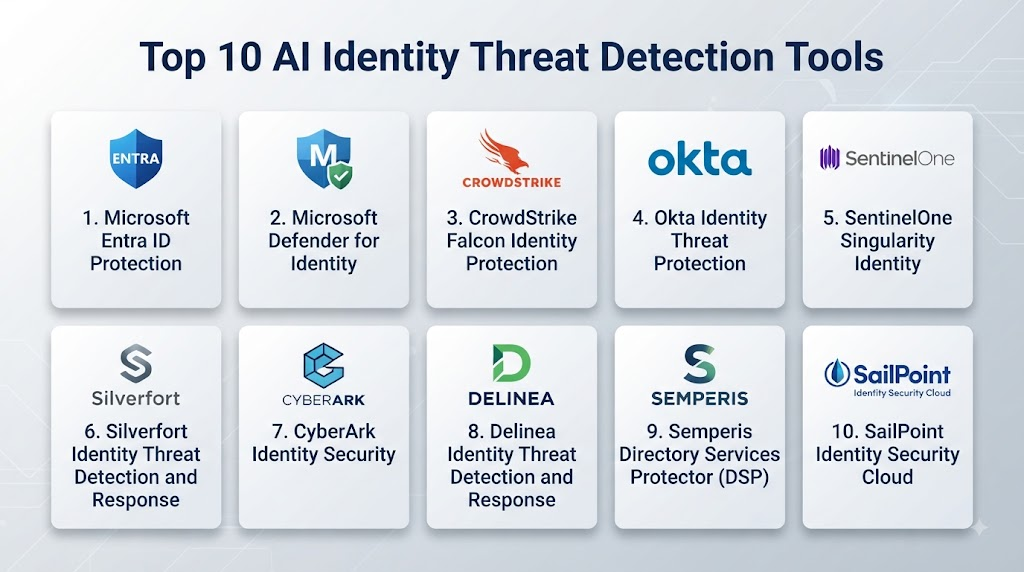
Top 10 AI Identity Threat Detection Tools
1. Microsoft Entra ID Protection
One-line verdict: Best for Microsoft-centric organizations seeking identity-risk detection integrated with cloud authentication and access controls.
Short description
Microsoft Entra ID Protection helps organizations detect identity-related risks associated with compromised accounts, suspicious authentication behavior, and other identity threats.
Standout Capabilities
- Identity risk detection.
- Risky-user identification.
- Risky-sign-in detection.
- Authentication intelligence.
- Identity threat investigation.
- Conditional Access integration.
- Microsoft security ecosystem integration.
- Automated risk-based policies.
AI-Specific Depth
- Model support: Microsoft-managed machine learning and risk analytics.
- RAG / knowledge integration: Identity telemetry and Microsoft security intelligence provide contextual information.
- Evaluation: Detailed model-evaluation methodology is not publicly stated.
- Guardrails: Conditional Access and identity policies can enforce controlled responses.
- Observability: Identity-risk dashboards and investigation information provide operational visibility.
Pros
- Strong Microsoft identity integration.
- Useful risk-based authentication capabilities.
- Good fit for organizations already using Microsoft security products.
Cons
- Strongest value comes within the Microsoft ecosystem.
- Licensing can become complex.
- Advanced functionality may require additional Microsoft services.
Security & Compliance
Microsoft provides enterprise security controls, identity governance, encryption, administrative controls, and auditing capabilities. Specific certifications should be verified for the applicable service.
Deployment & Platforms
- Cloud.
- Web.
- Microsoft identity environments.
Integrations & Ecosystem
Microsoft Entra ID Protection works closely with Microsoft’s identity and security ecosystem.
- Microsoft Entra ID.
- Conditional Access.
- Microsoft Defender.
- Microsoft Sentinel.
- Microsoft Graph.
- Security operations workflows.
Pricing Model
Licensing varies by Microsoft plan, tenant configuration, and required capabilities.
Best-Fit Scenarios
- Microsoft 365 environments.
- Hybrid identity.
- Enterprise account-risk detection.
2. CrowdStrike Falcon Identity Protection
One-line verdict: Best for organizations wanting identity threat detection connected with endpoint, threat intelligence, and security operations telemetry.
Short description
CrowdStrike Falcon Identity Protection focuses on detecting identity threats and suspicious authentication activity while connecting identity security with broader endpoint and threat intelligence.
Standout Capabilities
- Identity threat detection.
- Credential-abuse detection.
- Active Directory monitoring.
- Account compromise detection.
- Privileged identity visibility.
- Threat intelligence.
- Endpoint context.
- Automated security workflows.
AI-Specific Depth
- Model support: CrowdStrike-managed AI and machine-learning capabilities.
- RAG / knowledge integration: Identity, endpoint, and threat intelligence can provide broader investigation context.
- Evaluation: Detailed AI evaluation methodology is not publicly stated.
- Guardrails: Security policies and administrative controls support governed response.
- Observability: Identity and endpoint telemetry provide investigation visibility.
Pros
- Strong endpoint and identity correlation.
- Useful threat intelligence context.
- Good fit for CrowdStrike environments.
Cons
- Enterprise-focused.
- Full value may require broader CrowdStrike adoption.
- Pricing varies according to deployment scope.
Security & Compliance
Enterprise security controls are available. Specific certifications should be confirmed for the applicable product and service.
Deployment & Platforms
- Cloud.
- Enterprise environments.
- Windows and identity infrastructure integration.
Integrations & Ecosystem
The platform connects identity intelligence with broader security operations.
- Falcon platform.
- Endpoint security.
- Threat intelligence.
- SIEM.
- SOAR.
- APIs.
Pricing Model
Subscription and enterprise/custom pricing.
Best-Fit Scenarios
- Active Directory environments.
- Enterprise identity protection.
- Threat-informed identity detection.
3. Microsoft Defender for Identity
One-line verdict: Best for organizations protecting Active Directory and hybrid identities with Microsoft security analytics.
Short description
Microsoft Defender for Identity is designed to detect suspicious activity and threats targeting Active Directory and identity infrastructure.
Standout Capabilities
- Active Directory monitoring.
- Identity threat detection.
- Lateral movement detection.
- Credential-abuse detection.
- Domain-controller monitoring.
- Identity investigation.
- Microsoft security integration.
- Security incident correlation.
AI-Specific Depth
- Model support: Microsoft-managed machine learning and analytics.
- RAG / knowledge integration: Identity and security telemetry provide contextual analysis.
- Evaluation: Detailed model-evaluation methodology is not publicly stated.
- Guardrails: Microsoft security and identity controls govern access and response.
- Observability: Defender dashboards and incident views provide operational visibility.
Pros
- Strong Active Directory focus.
- Useful hybrid identity protection.
- Integrates with Microsoft’s broader security platform.
Cons
- Most useful within Microsoft environments.
- Deployment requires appropriate identity infrastructure.
- Licensing can be complex.
Security & Compliance
Microsoft provides enterprise security controls and identity governance. Specific certifications should be verified for the relevant service.
Deployment & Platforms
- Cloud-managed.
- Windows identity environments.
- Hybrid environments.
Integrations & Ecosystem
Microsoft Defender for Identity integrates with broader Microsoft security operations.
- Microsoft Defender.
- Microsoft Entra.
- Microsoft Sentinel.
- Active Directory.
- Security APIs.
- Incident response workflows.
Pricing Model
Microsoft licensing and subscription requirements vary.
Best-Fit Scenarios
- Active Directory security.
- Hybrid identity environments.
- Microsoft security operations.
4. Okta Identity Threat Protection
One-line verdict: Best for organizations using Okta to detect identity threats across authentication, applications, and access workflows.
Short description
Okta Identity Threat Protection provides identity-focused threat detection and response capabilities around authentication and access activity.
Standout Capabilities
- Identity threat detection.
- Authentication monitoring.
- Risk-based access.
- Suspicious-session detection.
- Identity telemetry.
- Threat response.
- Application access context.
- Okta ecosystem integration.
AI-Specific Depth
- Model support: Vendor-managed analytics and machine-learning capabilities vary.
- RAG / knowledge integration: Identity telemetry and contextual risk signals support investigation.
- Evaluation: Detailed AI evaluation methodology is not publicly stated.
- Guardrails: Identity policies and access controls provide response governance.
- Observability: Identity dashboards and event data support monitoring.
Pros
- Strong Okta ecosystem integration.
- Identity-focused security workflows.
- Useful for cloud identity environments.
Cons
- Best suited to Okta-centric organizations.
- Advanced capabilities may require additional Okta products.
- Pricing varies.
Security & Compliance
Enterprise identity security controls are available. Specific certifications should be verified for the applicable service.
Deployment & Platforms
- Cloud.
- Web.
- SaaS identity environments.
Integrations & Ecosystem
Okta connects identity security with applications and authentication infrastructure.
- Okta Identity Cloud.
- SaaS applications.
- APIs.
- SIEM.
- SOAR.
- Identity providers.
Pricing Model
Subscription-based enterprise licensing; exact pricing varies.
Best-Fit Scenarios
- Okta environments.
- SaaS-heavy organizations.
- Identity-centric SOC operations.
5. SentinelOne Singularity Identity
One-line verdict: Best for teams combining identity threat detection with autonomous endpoint security and broader behavioral analytics.
Short description
SentinelOne provides identity-security capabilities within its broader security platform, connecting identity signals with endpoint and threat detection.
Standout Capabilities
- Identity threat detection.
- Behavioral analytics.
- Credential monitoring.
- Active Directory protection.
- Endpoint correlation.
- Threat detection.
- Automated security workflows.
- Incident investigation.
AI-Specific Depth
- Model support: Vendor-managed AI and machine-learning capabilities.
- RAG / knowledge integration: Identity and endpoint telemetry provide contextual investigation data.
- Evaluation: Detailed AI evaluation methodology is not publicly stated.
- Guardrails: Security controls govern automated actions.
- Observability: Security dashboards and incident telemetry provide operational visibility.
Pros
- Identity and endpoint correlation.
- Strong behavioral security focus.
- Useful for consolidated security operations.
Cons
- Broader platform adoption can increase value.
- Enterprise-focused.
- Product capabilities evolve over time.
Security & Compliance
Enterprise security and administrative controls are available. Specific certifications should be verified for the applicable service.
Deployment & Platforms
- Cloud.
- Enterprise environments.
- Endpoint and identity infrastructure.
Integrations & Ecosystem
SentinelOne connects identity security with broader security operations.
- Endpoint security.
- SIEM.
- SOAR.
- Threat intelligence.
- Identity infrastructure.
- APIs.
Pricing Model
Subscription and enterprise/custom pricing.
Best-Fit Scenarios
- Enterprise identity security.
- Endpoint-identity correlation.
- Active Directory protection.
6. Vectra AI
One-line verdict: Best for organizations using behavioral AI to detect identity attacks across network and security telemetry.
Short description
Vectra AI uses behavioral analytics and AI-driven detection to identify suspicious activity across identity, network, cloud, and other security environments.
Standout Capabilities
- Identity threat detection.
- Behavioral analytics.
- Attack detection.
- Threat prioritization.
- Network context.
- Identity context.
- Threat investigation.
- Automated detection.
AI-Specific Depth
- Model support: Vendor-managed AI and machine-learning models.
- RAG / knowledge integration: Security telemetry provides context for behavioral detections.
- Evaluation: Detailed model-evaluation methodology is not publicly stated.
- Guardrails: Administrative controls govern platform access and response workflows.
- Observability: Detection and investigation dashboards provide operational visibility.
Pros
- Strong behavioral analytics.
- Identity and network context.
- Useful for SOC teams.
Cons
- Requires security telemetry.
- Can be more complex than standalone identity tools.
- Pricing varies.
Security & Compliance
Enterprise controls are available. Specific certifications should be verified for the applicable product.
Deployment & Platforms
- Cloud.
- Enterprise environments.
- Network and identity infrastructure.
Integrations & Ecosystem
Vectra AI can integrate identity intelligence with broader security operations.
- SIEM.
- SOAR.
- Identity providers.
- Network infrastructure.
- Cloud platforms.
- APIs.
Pricing Model
Enterprise subscription/custom pricing.
Best-Fit Scenarios
- AI-based SOC detection.
- Identity and network correlation.
- Enterprise threat detection.
7. Darktrace / Identity
One-line verdict: Best for organizations seeking behavioral AI to identify anomalous identity activity across complex digital environments.
Short description
Darktrace applies machine learning and behavioral analysis to identify unusual activity across users, identities, applications, devices, and digital infrastructure.
Standout Capabilities
- Behavioral baselining.
- Anomaly detection.
- Identity monitoring.
- Account compromise detection.
- Threat investigation.
- Automated response.
- Security telemetry correlation.
- Enterprise monitoring.
AI-Specific Depth
- Model support: Vendor-managed machine-learning and AI models.
- RAG / knowledge integration: Security telemetry and behavioral context provide investigation information.
- Evaluation: Detailed model-evaluation methodology is not publicly stated.
- Guardrails: Automated response controls and administrative policies govern actions.
- Observability: Threat dashboards and behavioral analytics provide visibility.
Pros
- Strong behavioral detection.
- Useful for complex environments.
- AI-centric security architecture.
Cons
- AI-generated detections require analyst validation.
- Deployment can involve significant telemetry.
- Enterprise pricing varies.
Security & Compliance
Enterprise security controls are available. Specific certifications should be verified for the selected service.
Deployment & Platforms
- Cloud.
- Enterprise environments.
- Hybrid infrastructure.
Integrations & Ecosystem
Darktrace can correlate identity activity with broader security telemetry.
- Network.
- Endpoint.
- Cloud.
- SaaS.
- SIEM.
- Security operations.
Pricing Model
Enterprise/custom subscription pricing.
Best-Fit Scenarios
- Behavioral identity monitoring.
- Large enterprise environments.
- Complex hybrid infrastructures.
8. Gurucul Identity Analytics
One-line verdict: Best for organizations seeking user and entity behavior analytics with identity-focused risk scoring and investigation.
Short description
Gurucul provides identity analytics and user/entity behavior analytics designed to detect unusual behavior, insider threats, compromised accounts, and risky identities.
Standout Capabilities
- User behavior analytics.
- Entity behavior analytics.
- Identity risk scoring.
- Insider-risk detection.
- Account compromise detection.
- Behavioral baselining.
- Threat prioritization.
- Security analytics.
AI-Specific Depth
- Model support: Machine-learning and behavioral analytics capabilities.
- RAG / knowledge integration: Identity and security telemetry can provide contextual analysis.
- Evaluation: Detailed AI evaluation methodology is not publicly stated.
- Guardrails: Policy and administrative controls govern response.
- Observability: Risk dashboards and behavioral analytics provide monitoring.
Pros
- Strong UEBA orientation.
- Useful risk scoring.
- Supports identity-focused analytics.
Cons
- Requires quality telemetry.
- Configuration can require security expertise.
- Exact capabilities vary by deployment.
Security & Compliance
Specific security controls and certifications should be verified for the applicable product.
Deployment & Platforms
- Cloud.
- On-premises or hybrid options may vary.
- Enterprise environments.
Integrations & Ecosystem
Gurucul can ingest identity and security telemetry from multiple systems.
- SIEM.
- Identity providers.
- Active Directory.
- Cloud platforms.
- Endpoint systems.
- APIs.
Pricing Model
Enterprise/custom pricing.
Best-Fit Scenarios
- UEBA programs.
- Insider-risk detection.
- Identity analytics.
9. Exabeam
One-line verdict: Best for security teams using behavioral analytics to detect compromised identities and investigate identity-centric security incidents.
Short description
Exabeam provides security analytics and behavioral detection capabilities that can help identify suspicious identity activity and correlate events into security investigations.
Standout Capabilities
- User behavior analytics.
- Identity monitoring.
- Security analytics.
- Risk scoring.
- Session analysis.
- Incident investigation.
- Threat detection.
- Security operations integration.
AI-Specific Depth
- Model support: Vendor-managed machine learning and analytics.
- RAG / knowledge integration: Security and identity telemetry provide investigation context.
- Evaluation: Detailed AI evaluation methodology is not publicly stated.
- Guardrails: Security policies and administrative controls support governed operations.
- Observability: Investigation timelines and behavioral analytics provide visibility.
Pros
- Strong security analytics.
- Useful behavioral detection.
- Good SOC integration.
Cons
- Requires telemetry integration.
- Broader security analytics may require configuration.
- Enterprise pricing varies.
Security & Compliance
Enterprise security controls are available. Specific certifications should be verified for the applicable offering.
Deployment & Platforms
- Cloud.
- Hybrid.
- Enterprise environments.
Integrations & Ecosystem
Exabeam can combine identity data with broader security telemetry.
- SIEM.
- Identity providers.
- Active Directory.
- Endpoint tools.
- Cloud systems.
- APIs.
Pricing Model
Enterprise subscription/custom pricing.
Best-Fit Scenarios
- SOC identity monitoring.
- UEBA.
- Compromised-account investigations.
10. Splunk User Behavior Analytics
One-line verdict: Best for organizations already using Splunk to correlate identity behavior with broader security telemetry and investigations.
Short description
Splunk provides security analytics and user/entity behavior capabilities that can help identify unusual identity activity by correlating authentication and security events.
Standout Capabilities
- User behavior analytics.
- Risk-based detection.
- Identity monitoring.
- Security-event correlation.
- Threat investigation.
- Risk scoring.
- Security dashboards.
- SOC integration.
AI-Specific Depth
- Model support: Splunk-managed analytics and machine-learning capabilities vary.
- RAG / knowledge integration: Security telemetry and identity data provide contextual investigation.
- Evaluation: Detailed AI evaluation methodology is not publicly stated.
- Guardrails: Role-based access and security controls govern analytics workflows.
- Observability: Dashboards, event data, and investigation workflows provide visibility.
Pros
- Strong security analytics ecosystem.
- Broad data ingestion capabilities.
- Useful for mature SOC teams.
Cons
- Requires experienced Splunk administrators.
- Data ingestion can affect cost.
- Configuration can be complex.
Security & Compliance
Enterprise security controls are available. Specific certifications should be verified for the applicable service.
Deployment & Platforms
- Cloud.
- Hybrid.
- Enterprise environments.
Integrations & Ecosystem
Splunk can correlate identity data with a broad range of security telemetry.
- Identity providers.
- Active Directory.
- Endpoint security.
- Network security.
- Cloud platforms.
- SOAR.
- APIs.
Pricing Model
Subscription and usage-based models may vary by Splunk service and deployment.
Best-Fit Scenarios
- Splunk-based SOCs.
- Large identity environments.
- Cross-domain security analytics.
Comparison Table
| Tool Name | Best For | Deployment | Model Flexibility | Strength | Watch-Out | Public Rating |
|---|---|---|---|---|---|---|
| Microsoft Entra ID Protection | Microsoft identity security | Cloud | Hosted | Risk-based identity protection | Microsoft ecosystem dependency | N/A |
| CrowdStrike Falcon Identity Protection | Identity and endpoint correlation | Cloud | Hosted | Threat-informed detection | Enterprise focus | N/A |
| Microsoft Defender for Identity | Active Directory | Hybrid/Cloud | Hosted | AD threat detection | Microsoft-centric | N/A |
| Okta Identity Threat Protection | Okta environments | Cloud | Hosted | Identity-centric detection | Okta dependency | N/A |
| SentinelOne Singularity Identity | Identity and endpoint security | Cloud | Hosted | Behavioral security | Enterprise focus | N/A |
| Vectra AI | Behavioral identity detection | Cloud/Hybrid | Hosted | AI-driven detection | Telemetry requirements | N/A |
| Darktrace / Identity | Behavioral anomaly detection | Cloud/Hybrid | Hosted | Behavioral AI | Requires validation | N/A |
| Gurucul Identity Analytics | UEBA | Cloud/Hybrid | Hosted | Identity analytics | Configuration complexity | N/A |
| Exabeam | SOC identity analytics | Cloud/Hybrid | Hosted | Behavioral investigation | Requires data integration | N/A |
| Splunk User Behavior Analytics | Splunk-based SOCs | Cloud/Hybrid | Hosted | Broad analytics | Cost and complexity | N/A |
Scoring & Evaluation
The following scoring is a comparative editorial assessment rather than an official vendor ranking.
The scores consider detection depth, behavioral analytics, AI-assisted capabilities, integrations, usability, performance, security controls, and support.
A high score does not mean that a platform will perform equally well in every identity environment.
Organizations should test identity providers, Active Directory, privileged accounts, cloud identities, service accounts, and SaaS applications during a proof of concept.
| Tool | Core | Reliability/Eval | Guardrails | Integrations | Ease | Perf/Cost | Security/Admin | Support | Weighted Total |
|---|---|---|---|---|---|---|---|---|---|
| Microsoft Entra ID Protection | 10 | 9 | 10 | 10 | 9 | 9 | 10 | 10 | 9.60 |
| CrowdStrike Falcon Identity Protection | 10 | 9 | 10 | 10 | 9 | 8 | 10 | 10 | 9.45 |
| Microsoft Defender for Identity | 10 | 9 | 10 | 10 | 9 | 9 | 10 | 10 | 9.60 |
| Okta Identity Threat Protection | 9 | 9 | 10 | 10 | 9 | 8 | 10 | 10 | 9.35 |
| SentinelOne Singularity Identity | 9 | 9 | 10 | 9 | 9 | 8 | 10 | 10 | 9.20 |
| Vectra AI | 10 | 9 | 9 | 10 | 8 | 8 | 10 | 10 | 9.20 |
| Darktrace / Identity | 9 | 9 | 9 | 9 | 8 | 8 | 9 | 10 | 8.85 |
| Gurucul Identity Analytics | 9 | 9 | 9 | 9 | 8 | 8 | 9 | 9 | 8.80 |
| Exabeam | 9 | 9 | 9 | 10 | 8 | 8 | 9 | 10 | 9.00 |
| Splunk User Behavior Analytics | 10 | 9 | 9 | 10 | 7 | 7 | 10 | 10 | 9.05 |
Top 3 for Enterprise
- Microsoft Entra ID Protection — Strong choice for organizations with Microsoft identity infrastructure.
- Microsoft Defender for Identity — Particularly useful for Active Directory and hybrid identity.
- CrowdStrike Falcon Identity Protection — Strong for organizations wanting identity and endpoint correlation.
Top 3 for SMB
- Microsoft Entra ID Protection — Practical for Microsoft cloud environments.
- Okta Identity Threat Protection — Strong for SaaS-centric identity environments.
- SentinelOne Singularity Identity — Useful where endpoint and identity protection need to work together.
Top 3 for Developers
- Okta Identity Threat Protection — Useful for application-centric identity environments.
- Microsoft Entra ID Protection — Strong for applications built around Microsoft identity.
- Splunk User Behavior Analytics — Useful for development organizations already operating centralized security analytics.
Which AI Identity Threat Detection Tool Is Right for You?
Solo / Freelancer
Small environments should prioritize simplicity and actionable detections.
Look for:
- Basic behavioral analytics.
- Identity-provider integration.
- Suspicious login detection.
- Clear alerts.
- Easy dashboards.
- Affordable licensing.
A full enterprise UEBA platform may be unnecessary if there are only a few users and applications.
SMB
SMBs should focus on identity attacks that are most likely to create immediate business risk.
Prioritize:
- Account takeover detection.
- Risky sign-in detection.
- MFA-related anomalies.
- Privileged-account monitoring.
- SaaS identity visibility.
- Simple automated responses.
Mid-Market
Mid-market organizations should combine identity detection with endpoint and cloud telemetry.
Prioritize:
- Active Directory.
- Cloud identity.
- SaaS applications.
- Privileged identities.
- Service accounts.
- Behavioral analytics.
- SIEM integration.
- Automated investigation.
Enterprise
Enterprise environments require broad identity visibility and strong administrative controls.
Prioritize:
- Hybrid identity.
- Multi-cloud identities.
- Privileged users.
- Service identities.
- Machine identities.
- Behavioral baselines.
- Risk scoring.
- Threat intelligence.
- SIEM and SOAR integration.
- RBAC.
- SSO.
- Audit logs.
- Data governance.
- Automated response controls.
Regulated Industries
Organizations operating in regulated environments should carefully assess:
- Data retention.
- Data residency.
- Encryption.
- Access controls.
- Auditability.
- Employee privacy.
- AI data usage.
- Model-training policies.
- Third-party access.
- Incident response.
- Administrative separation.
Identity telemetry can contain sensitive information about employees and customers, so privacy governance should be included in the evaluation.
Budget vs Premium
Budget-conscious teams should focus on strong identity detection and simple deployment.
Premium platforms become more attractive when organizations have large identity environments, multiple identity providers, hybrid infrastructure, extensive privileged access, and mature SOC operations.
Build vs Buy
Building an identity-threat analytics platform internally may make sense for organizations with advanced security engineering capabilities and highly specialized detection requirements.
However, building reliable behavioral baselines, identity correlation, risk scoring, threat intelligence integration, response automation, and continuous model evaluation requires substantial engineering and operational investment.
For most organizations, a mature commercial platform is more practical.
Implementation Playbook: 30 / 60 / 90 Days
30 Days: Pilot + Success Metrics
- Connect the primary identity provider.
- Connect Active Directory where applicable.
- Establish baseline authentication behavior.
- Identify privileged accounts.
- Identify service accounts.
- Identify high-value applications.
- Measure existing identity-alert volume.
- Define detection-quality metrics.
- Create a test dataset.
- Establish initial identity-risk thresholds.
60 Days: Harden Security + Evaluation + Rollout
- Connect endpoint telemetry.
- Connect cloud identity sources.
- Connect SaaS applications.
- Integrate SIEM.
- Integrate SOAR.
- Configure RBAC.
- Enable SSO.
- Test suspicious-login scenarios.
- Test account-takeover scenarios.
- Test privilege escalation scenarios.
- Evaluate false positives.
- Conduct red-team exercises.
- Test AI-generated investigations.
- Establish human-review procedures.
90 Days: Optimize Cost/Latency + Governance + Scale
- Expand identity coverage.
- Tune behavioral thresholds.
- Reduce unnecessary alerts.
- Optimize telemetry ingestion.
- Monitor detection latency.
- Review data-retention settings.
- Establish AI governance.
- Document incident-response procedures.
- Review automated-response permissions.
- Monitor model-assisted recommendations.
- Create executive risk reporting.
- Conduct periodic detection-quality reviews.
Common Mistakes & How to Avoid Them
- Monitoring only employee logins: Include privileged, service, machine, and application identities.
- Ignoring service accounts: Non-human identities can become valuable attack targets.
- Relying on static rules: Behavioral analytics can identify activity that fixed rules miss.
- No behavioral baseline: Detection quality depends on understanding normal identity behavior.
- Excessive false positives: Tune thresholds based on real organizational behavior.
- Ignoring privileged identities: Administrative accounts deserve stronger monitoring.
- No identity-provider integration: Identity detection requires reliable authentication telemetry.
- Ignoring cloud identities: Cloud access creates new attack paths.
- Ignoring SaaS applications: SaaS accounts can be compromised without affecting traditional infrastructure.
- Over-automating account suspension: Automatic blocking should have appropriate safeguards.
- No AI evaluation: Test AI-generated explanations and recommendations.
- Ignoring prompt injection: AI assistants connected to security data need appropriate guardrails.
- Poor data retention controls: Identity telemetry can contain sensitive information.
- No observability: Monitor ingestion, detection latency, false positives, and response actions.
- Ignoring machine identities: Service principals, API keys, and workloads should be included where possible.
- Vendor lock-in: Maintain access to identity events and risk data through supported APIs or exports.
FAQs
What are AI Identity Threat Detection Tools?
They are security platforms that use machine learning, behavioral analytics, identity telemetry, and threat intelligence to detect suspicious identity activity and potential account compromise.
How does AI detect identity threats?
AI can establish behavioral patterns for users and entities and identify activity that deviates from expected behavior. Detection can include authentication, access, privilege, device, and application context.
Can AI detect compromised accounts?
Yes. Identity analytics can identify suspicious authentication patterns, unusual access, abnormal locations, privilege changes, and other signals associated with potentially compromised accounts.
Can these tools detect insider threats?
Many identity analytics platforms can help identify unusual user behavior associated with insider-risk scenarios. However, detection should be handled carefully because behavioral anomalies do not automatically indicate malicious intent.
Do identity threat detection tools monitor privileged accounts?
Many platforms can monitor privileged identities and identify unusual administrative behavior. Buyers should verify support for their specific privileged-access environment.
Can these tools detect service-account abuse?
Some platforms can monitor service and non-human identities. Coverage varies, so organizations should test the platform against their service-account architecture.
Do these platforms work with Active Directory?
Many enterprise identity-security platforms support Active Directory or hybrid identity environments. Exact functionality varies by product and deployment model.
Can these tools monitor cloud identities?
Yes, many modern identity-security platforms can monitor cloud identity activity. Buyers should verify support for the cloud providers and identity services they use.
Can AI identity tools work with Okta or Microsoft Entra ID?
Many platforms integrate with major identity providers such as Okta and Microsoft Entra ID. The available detection and response capabilities vary between products.
Do these platforms replace SIEM systems?
Usually not. Identity threat detection platforms can complement SIEM systems by providing specialized identity analytics and risk context.
Can these tools automatically block suspicious users?
Some platforms can trigger automated responses through identity and security integrations. Automated blocking should be carefully governed to avoid disrupting legitimate users.
What should organizations evaluate before buying an AI identity-security platform?
Evaluate detection accuracy, identity-provider support, behavioral analytics, integrations, response capabilities, privacy, data retention, administrative controls, scalability, and AI transparency.
Can organizations use their own AI models?
BYO-model support varies considerably. Most commercial identity-security platforms rely primarily on vendor-managed machine-learning and analytics capabilities.
Are identity-security AI models reliable?
They can be highly useful, but no detection system should be treated as infallible. Organizations should measure false positives, false negatives, detection latency, and investigation quality using their own data.
How should AI-generated identity alerts be evaluated?
Test the system with known normal behavior, simulated attacks, compromised-account scenarios, privilege changes, unusual authentication patterns, and false-positive cases.
Is identity telemetry sensitive?
Yes. Identity telemetry can contain information about users, authentication activity, devices, applications, and access patterns. Data governance should therefore be part of platform selection.
What privacy controls should buyers check?
Review data retention, data residency, encryption, access controls, employee-data handling, third-party access, AI training policies, and deletion procedures.
Are self-hosted identity threat detection tools available?
Some identity analytics and security platforms support hybrid or self-managed components, but deployment options vary considerably. Verify architecture requirements before purchasing.
How much do AI Identity Threat Detection Tools cost?
Pricing varies based on users, identities, telemetry volume, features, deployment, integrations, and contract terms. Exact pricing should be confirmed with the vendor.
Can identity threat detection reduce SOC workload?
It can reduce manual investigation when behavioral analytics correlate multiple identity signals and prioritize higher-risk events. Poorly tuned systems can have the opposite effect by generating excessive alerts.
Conclusion
AI Identity Threat Detection Tools are becoming increasingly important as attackers rely more heavily on stolen credentials, compromised sessions, privilege abuse, and legitimate access mechanisms. Modern platforms combine behavioral analytics, machine learning, identity telemetry, threat intelligence, and security automation to identify suspicious activity.Microsoft Entra ID Protection, Microsoft Defender for Identity, CrowdStrike Falcon Identity Protection, Okta Identity Threat Protection, SentinelOne Singularity Identity, Vectra AI, Darktrace, Gurucul, Exabeam, and Splunk provide different approaches to identity threat detection and behavioral analytics.