Introduction
AI Attack Surface Discovery with ML platforms help security teams continuously identify, classify, and analyze the digital assets that could be exposed to attackers. Instead of relying only on manually maintained asset inventories, these systems use machine learning, automated discovery, external intelligence, and security analytics to uncover known and unknown assets across internet-facing infrastructure.The technology can help discover domains, subdomains, IP addresses, cloud resources, applications, APIs, services, certificates, exposed technologies, and other digital assets. Machine learning can then help classify assets, identify relationships, detect changes, and prioritize potentially risky exposures.Common use cases include external attack-surface management, unknown asset discovery, shadow IT detection, cloud asset discovery, domain monitoring, API discovery, exposed-service identification, digital-risk monitoring, and vulnerability prioritization.
What’s Changed in AI Attack Surface Discovery with ML
- Continuous discovery is replacing periodic asset inventory exercises.
- Machine learning is increasingly used to classify discovered assets and reduce manual investigation.
- External attack-surface monitoring can identify infrastructure that security teams did not previously know about.
- Cloud adoption has made asset discovery more dynamic and difficult to maintain manually.
- API discovery is becoming increasingly important as organizations expose more services through APIs.
- Machine learning can help identify relationships between domains, certificates, IP addresses, applications, and infrastructure.
- Asset classification can help distinguish production systems from development and test environments.
- AI-assisted investigation can summarize asset relationships and potential security concerns.
- Natural-language interfaces can make attack-surface information easier for analysts to investigate.
- Organizations increasingly expect discovery systems to integrate with vulnerability-management and security-operations workflows.
- Continuous monitoring can identify newly exposed services and infrastructure changes faster.
- AI-generated findings require validation because incorrect asset classification can create unnecessary investigation work.
- Privacy and data governance matter when platforms collect detailed information about an organization’s internet-facing infrastructure.
- Security teams are increasingly evaluating discovery platforms based on unknown assets found and successfully remediated.
- API access is important for integrating discovered assets into existing security workflows.
- Automation needs appropriate controls to prevent incorrect remediation of legitimate infrastructure.
Quick Buyer Checklist
- Continuous external asset discovery.
- Domain and subdomain discovery.
- IP address discovery.
- Certificate monitoring.
- Cloud asset discovery.
- API discovery.
- Application discovery.
- Technology fingerprinting.
- Port and service identification.
- Shadow IT detection.
- Unknown asset identification.
- Machine-learning asset classification.
- Relationship mapping.
- Attack-path context.
- Vulnerability correlation.
- Threat intelligence.
- Risk scoring.
- Data privacy controls.
- Data retention controls.
- Data residency options.
- AI model transparency.
- AI evaluation capabilities.
- Guardrails.
- Prompt-injection protection for AI assistants.
- Human review workflows.
- API access.
- SIEM integration.
- SOAR integration.
- ITSM integration.
- Cloud integrations.
- Identity integrations.
- Alert customization.
- Audit logs.
- RBAC.
- SSO.
- Cost controls.
- Vendor lock-in considerations.
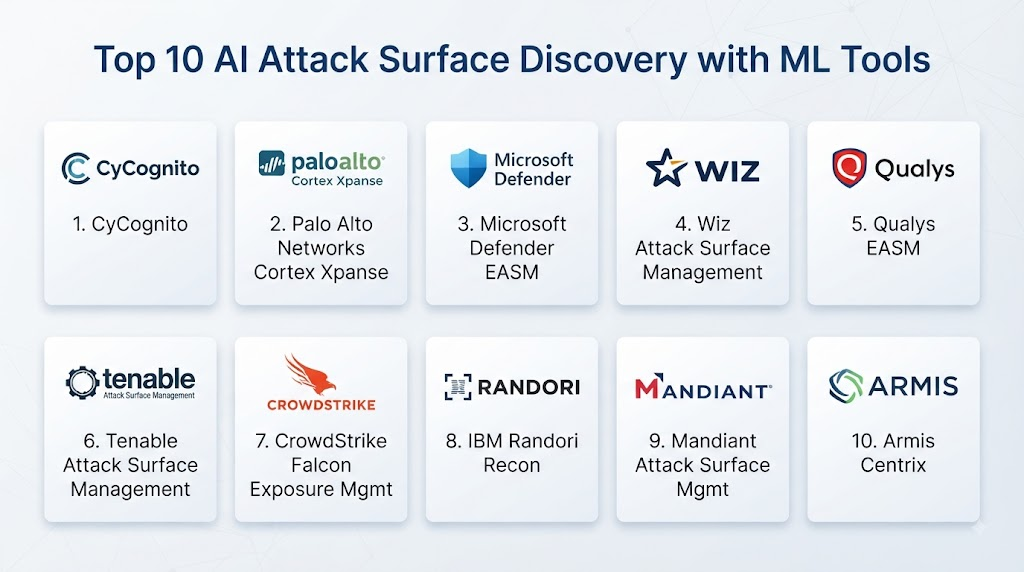
Top 10 AI Attack Surface Discovery with ML Tools
1. Censys Attack Surface Intelligence
One-line verdict: Best for organizations needing broad internet-wide asset discovery, infrastructure intelligence, and external exposure visibility.
Short description
Censys provides internet infrastructure intelligence that helps security teams discover and understand internet-facing hosts, services, certificates, domains, and related infrastructure.
Standout Capabilities
- Internet asset discovery.
- Host discovery.
- Domain intelligence.
- Certificate intelligence.
- Service identification.
- Infrastructure relationships.
- Exposure monitoring.
- Internet-wide search.
AI-Specific Depth
- Model support: Machine-learning and automated analytics capabilities vary by product.
- RAG / knowledge integration: Internet infrastructure data provides contextual information about discovered assets.
- Evaluation: Detailed AI evaluation methodology is not publicly stated.
- Guardrails: Access controls and usage policies govern platform operation.
- Observability: Asset and infrastructure intelligence provides discovery visibility.
Pros
- Extensive internet infrastructure visibility.
- Strong certificate and host intelligence.
- Useful for external attack-surface research.
Cons
- Internet intelligence can produce large datasets.
- Requires experienced security analysts for effective investigation.
- Pricing varies by service and usage.
Security & Compliance
Enterprise security controls vary by service. Specific certifications should be verified for the applicable offering.
Deployment & Platforms
- Cloud.
- Web.
- APIs.
- Enterprise security environments.
Integrations & Ecosystem
Censys can provide infrastructure intelligence to broader security workflows.
- APIs.
- Security platforms.
- SIEM.
- Threat intelligence workflows.
- Investigation tools.
- Automation systems.
Pricing Model
Subscription, usage-based, and enterprise/custom arrangements may vary.
Best-Fit Scenarios
- External attack-surface discovery.
- Security research.
- Internet-facing asset monitoring.
2. SecurityScorecard Attack Surface Intelligence
One-line verdict: Best for organizations combining external attack-surface discovery with security ratings and third-party risk visibility.
Short description
SecurityScorecard provides external security visibility that can help organizations identify internet-facing assets, monitor changes, and understand security posture across organizations and third parties.
Standout Capabilities
- External asset discovery.
- Digital footprint monitoring.
- Security ratings.
- Third-party risk visibility.
- Internet-facing infrastructure analysis.
- Security issue identification.
- Continuous monitoring.
- Risk reporting.
AI-Specific Depth
- Model support: Vendor-managed analytics and machine-learning capabilities vary.
- RAG / knowledge integration: External infrastructure and security intelligence provide contextual information.
- Evaluation: Detailed AI evaluation methodology is not publicly stated.
- Guardrails: Enterprise administrative controls govern access and workflows.
- Observability: Security ratings and external monitoring provide visibility into changes.
Pros
- Useful for third-party risk programs.
- Combines external visibility with risk scoring.
- Suitable for enterprise security teams.
Cons
- Security ratings may not replace detailed technical investigation.
- Broader platform capabilities may require additional configuration.
- Pricing varies.
Security & Compliance
Security and administrative capabilities vary by service. Certifications should be verified for the intended offering.
Deployment & Platforms
- Cloud.
- Web.
- Enterprise environments.
Integrations & Ecosystem
The platform can feed external security intelligence into risk-management workflows.
- APIs.
- Security operations.
- Third-party risk systems.
- SIEM.
- ITSM.
- Reporting systems.
Pricing Model
Subscription and enterprise/custom pricing.
Best-Fit Scenarios
- Third-party risk.
- External asset monitoring.
- Enterprise security ratings.
3. Palo Alto Networks Cortex Xpanse
One-line verdict: Best for enterprises seeking automated external asset discovery and exposure management integrated with broader security operations.
Short description
Cortex Xpanse is designed to discover internet-facing assets and identify exposures that may otherwise remain outside traditional security inventories.
Standout Capabilities
- Automated asset discovery.
- External attack-surface management.
- Unknown asset identification.
- Internet exposure monitoring.
- Service discovery.
- Risk prioritization.
- Exposure investigation.
- Security operations integration.
AI-Specific Depth
- Model support: Vendor-managed AI and machine-learning capabilities vary.
- RAG / knowledge integration: Asset and exposure intelligence contributes to contextual analysis.
- Evaluation: Detailed AI evaluation methodology is not publicly stated.
- Guardrails: Enterprise security policies and access controls support governed operations.
- Observability: Asset discovery and exposure dashboards provide operational visibility.
Pros
- Strong external discovery.
- Enterprise security ecosystem integration.
- Useful for finding unmanaged internet assets.
Cons
- Enterprise-oriented.
- Can generate significant discovery data in large environments.
- Pricing varies.
Security & Compliance
Enterprise security controls are available. Specific certifications should be verified for the applicable product and service.
Deployment & Platforms
- Cloud.
- Web.
- Enterprise environments.
Integrations & Ecosystem
Cortex Xpanse can connect external exposure information with security operations.
- Cortex security products.
- SIEM.
- SOAR.
- ITSM.
- Threat intelligence.
- APIs.
Pricing Model
Enterprise/custom subscription pricing.
Best-Fit Scenarios
- Large enterprises.
- External attack-surface management.
- Palo Alto Networks environments.
4. Microsoft Defender External Attack Surface Management
One-line verdict: Best for Microsoft-focused organizations seeking continuous discovery of internet-facing assets and external exposure.
Short description
Microsoft Defender External Attack Surface Management helps security teams discover and monitor an organization’s external digital footprint, including assets that may not be present in internal inventories.
Standout Capabilities
- External asset discovery.
- Domain discovery.
- Internet-facing asset identification.
- Shadow IT visibility.
- Asset classification.
- Vulnerability context.
- Exposure monitoring.
- Microsoft security integration.
AI-Specific Depth
- Model support: Microsoft-managed AI and analytics capabilities vary.
- RAG / knowledge integration: Microsoft security intelligence and discovered asset information provide contextual analysis.
- Evaluation: Detailed AI evaluation methodology is not publicly stated.
- Guardrails: Microsoft identity, RBAC, and administrative controls support governed access.
- Observability: Defender security dashboards provide operational visibility.
Pros
- Strong Microsoft ecosystem integration.
- Useful external asset discovery.
- Convenient for existing Defender users.
Cons
- Best suited to Microsoft security environments.
- Licensing can be complex.
- Some capabilities depend on broader Microsoft adoption.
Security & Compliance
Microsoft provides enterprise security, identity, governance, encryption, and auditing capabilities. Specific certifications should be verified for the applicable service.
Deployment & Platforms
- Cloud.
- Web.
- Enterprise environments.
Integrations & Ecosystem
Microsoft Defender External Attack Surface Management integrates with Microsoft’s broader security environment.
- Microsoft Defender.
- Microsoft Sentinel.
- Entra.
- Cloud security.
- Security APIs.
- Security operations workflows.
Pricing Model
Licensing and subscription requirements vary.
Best-Fit Scenarios
- Microsoft-centric enterprises.
- External attack-surface monitoring.
- Integrated SOC operations.
5. CrowdStrike Falcon Surface
One-line verdict: Best for organizations wanting external attack-surface visibility connected with endpoint, identity, cloud, and threat intelligence.
Short description
CrowdStrike provides external attack-surface capabilities designed to help organizations identify internet-facing assets and understand external exposure in the context of broader security telemetry.
Standout Capabilities
- External asset discovery.
- Internet exposure monitoring.
- Asset intelligence.
- Threat intelligence.
- Domain monitoring.
- Risk prioritization.
- Endpoint context.
- Security operations integration.
AI-Specific Depth
- Model support: Vendor-managed AI and machine-learning capabilities.
- RAG / knowledge integration: Threat intelligence and security telemetry provide additional asset context.
- Evaluation: Detailed AI evaluation methodology is not publicly stated.
- Guardrails: Security policies and administrative controls govern access.
- Observability: Exposure and security telemetry provide operational visibility.
Pros
- Strong security telemetry.
- Useful threat-intelligence context.
- Good fit for existing CrowdStrike customers.
Cons
- Broader platform adoption may be required for maximum value.
- Enterprise-oriented.
- Product capabilities can change as the platform evolves.
Security & Compliance
Enterprise security and administrative controls are available. Specific certifications should be confirmed for the selected service.
Deployment & Platforms
- Cloud.
- Web.
- Enterprise environments.
Integrations & Ecosystem
CrowdStrike can connect external exposure information with its broader security ecosystem.
- EDR.
- Threat intelligence.
- SIEM.
- SOAR.
- Identity.
- Cloud security.
- APIs.
Pricing Model
Subscription and enterprise/custom pricing.
Best-Fit Scenarios
- Enterprise external exposure monitoring.
- CrowdStrike environments.
- Threat-informed asset discovery.
6. Wiz
One-line verdict: Best for cloud-native organizations discovering external and cloud assets while connecting exposure with attack-path context.
Short description
Wiz provides cloud security and exposure-management capabilities that can help organizations discover cloud assets, identify external exposure, and understand relationships between resources, identities, vulnerabilities, and configurations.
Standout Capabilities
- Cloud asset discovery.
- External exposure identification.
- Security graph.
- Attack-path analysis.
- Vulnerability discovery.
- Identity context.
- Cloud configuration analysis.
- Exposure prioritization.
AI-Specific Depth
- Model support: Vendor-managed AI capabilities vary by feature.
- RAG / knowledge integration: Cloud resources, relationships, and security findings provide contextual information.
- Evaluation: Detailed AI evaluation methodology is not publicly stated.
- Guardrails: Access controls and security policies support governed workflows.
- Observability: Cloud exposure relationships provide detailed security visibility.
Pros
- Strong cloud visibility.
- Useful relationship analysis.
- Good fit for cloud-native environments.
Cons
- Cloud-centric.
- Requires cloud inventory and configuration access.
- Enterprise pricing can be significant.
Security & Compliance
Enterprise security controls are available. Specific certifications should be verified for the applicable service.
Deployment & Platforms
- Cloud.
- Web.
- Multi-cloud.
Integrations & Ecosystem
Wiz connects cloud asset information with security and operational workflows.
- AWS.
- Microsoft Azure.
- Google Cloud.
- SIEM.
- SOAR.
- Identity.
- APIs.
Pricing Model
Enterprise/custom subscription pricing.
Best-Fit Scenarios
- Cloud asset discovery.
- Multi-cloud security.
- Attack-path analysis.
7. Tenable One
One-line verdict: Best for organizations combining attack-surface discovery with vulnerability management and broader exposure analytics.
Short description
Tenable One provides exposure-management capabilities that connect asset discovery, vulnerability information, cloud security, application security, and risk analysis.
Standout Capabilities
- External attack-surface management.
- Asset discovery.
- Vulnerability prioritization.
- Exposure analysis.
- Cloud security.
- Application security.
- Attack-path context.
- Risk analytics.
AI-Specific Depth
- Model support: Vendor-managed analytics and AI capabilities vary.
- RAG / knowledge integration: Asset, vulnerability, cloud, and exposure data contribute to contextual analysis.
- Evaluation: Detailed AI evaluation methodology is not publicly stated.
- Guardrails: Administrative and access controls support governed security workflows.
- Observability: Exposure and vulnerability dashboards provide operational visibility.
Pros
- Broad exposure platform.
- Strong vulnerability foundation.
- Useful security-data correlation.
Cons
- Enterprise-oriented.
- Platform complexity can require training.
- Pricing depends on product scope.
Security & Compliance
Enterprise security controls are available. Specific certifications should be verified for the selected service.
Deployment & Platforms
- Cloud.
- Web.
- Enterprise environments.
Integrations & Ecosystem
Tenable can connect asset-discovery information with security operations.
- SIEM.
- SOAR.
- ITSM.
- Cloud.
- Vulnerability scanners.
- APIs.
Pricing Model
Subscription and enterprise/custom pricing.
Best-Fit Scenarios
- Enterprise exposure management.
- Vulnerability operations.
- External asset discovery.
8. Randori Recon
One-line verdict: Best for security teams seeking adversary-focused external reconnaissance and attack-surface intelligence.
Short description
Randori Recon focuses on external attack-surface intelligence and adversary-oriented discovery to help organizations understand how their internet-facing infrastructure may appear to attackers.
Standout Capabilities
- External reconnaissance.
- Attack-surface discovery.
- Asset identification.
- Adversary perspective.
- Internet-facing infrastructure analysis.
- Risk prioritization.
- Continuous monitoring.
- Security investigation.
AI-Specific Depth
- Model support: Machine-learning and automated analytics capabilities vary.
- RAG / knowledge integration: External infrastructure and reconnaissance data support contextual analysis.
- Evaluation: Detailed AI evaluation methodology is not publicly stated.
- Guardrails: Platform permissions and administrative controls support controlled usage.
- Observability: External asset and reconnaissance information provides visibility.
Pros
- Adversary-focused perspective.
- Useful external reconnaissance.
- Strong security-team use cases.
Cons
- More specialized than broad exposure platforms.
- Requires experienced security teams.
- Pricing is generally enterprise-oriented.
Security & Compliance
Specific security controls and certifications should be verified for the selected offering.
Deployment & Platforms
- Cloud.
- Web.
- Enterprise environments.
Integrations & Ecosystem
Reconnaissance information can support broader security operations.
- APIs.
- SIEM.
- SOAR.
- Threat intelligence.
- Security workflows.
- Investigation platforms.
Pricing Model
Enterprise/custom pricing.
Best-Fit Scenarios
- Red-team preparation.
- External attack-surface monitoring.
- Adversary-focused security programs.
9. Detectify
One-line verdict: Best for organizations combining automated external discovery with web application and exposed-asset security testing.
Short description
Detectify provides automated security testing and external asset discovery capabilities that can help organizations identify weaknesses in internet-facing applications and infrastructure.
Standout Capabilities
- External asset discovery.
- Web application security testing.
- Domain monitoring.
- Vulnerability detection.
- Automated scanning.
- Asset visibility.
- Security testing.
- Continuous monitoring.
AI-Specific Depth
- Model support: Specific AI model architecture is not publicly stated.
- RAG / knowledge integration: Security testing and discovered asset information provide contextual findings.
- Evaluation: Detailed AI evaluation methodology is not publicly stated.
- Guardrails: Scan configuration and access controls help govern testing.
- Observability: Security findings and scan results provide operational visibility.
Pros
- Strong web-security orientation.
- Automated security testing.
- Useful for internet-facing applications.
Cons
- More application-security focused.
- May not provide the breadth of a large enterprise exposure platform.
- Advanced requirements may require additional tools.
Security & Compliance
Specific certifications and controls should be verified for the applicable service.
Deployment & Platforms
- Cloud.
- Web.
- Enterprise environments.
Integrations & Ecosystem
Detectify can integrate security findings into development and security workflows.
- APIs.
- CI/CD.
- Issue tracking.
- Security workflows.
- Development tools.
- Notifications.
Pricing Model
Subscription and tiered pricing may vary.
Best-Fit Scenarios
- Web application teams.
- External application security.
- Continuous security testing.
10. Intruder
One-line verdict: Best for organizations seeking accessible external attack-surface monitoring combined with vulnerability scanning and security alerts.
Short description
Intruder provides vulnerability management and external security monitoring capabilities designed to help organizations identify internet-facing assets and security weaknesses.
Standout Capabilities
- External asset monitoring.
- Vulnerability scanning.
- Attack-surface visibility.
- Automated scanning.
- Security alerts.
- Risk prioritization.
- Network exposure assessment.
- Reporting.
AI-Specific Depth
- Model support: Specific AI model architecture is not publicly stated.
- RAG / knowledge integration: Security findings and asset data provide contextual analysis.
- Evaluation: Detailed AI evaluation methodology is not publicly stated.
- Guardrails: Scan controls and account permissions govern security testing.
- Observability: Scan results and vulnerability dashboards provide visibility.
Pros
- Relatively straightforward security workflow.
- Combines external monitoring and vulnerability assessment.
- Useful for smaller security teams.
Cons
- Less enterprise breadth than some larger platforms.
- Advanced AI capabilities may vary.
- Larger environments may require additional security tooling.
Security & Compliance
Specific security certifications and controls should be verified for the applicable service.
Deployment & Platforms
- Cloud.
- Web.
- Enterprise environments.
Integrations & Ecosystem
Intruder supports security workflows through integrations and automation capabilities.
- APIs.
- Issue tracking.
- Security notifications.
- Cloud environments.
- Development workflows.
- Security operations.
Pricing Model
Tiered subscription pricing; exact pricing varies by plan and scope.
Best-Fit Scenarios
- SMB security teams.
- External vulnerability monitoring.
- Internet-facing asset discovery.
Comparison Table
| Tool Name | Best For | Deployment | Model Flexibility | Strength | Watch-Out | Public Rating |
|---|---|---|---|---|---|---|
| Censys | Internet-wide asset intelligence | Cloud | Hosted | Broad infrastructure visibility | Large datasets | N/A |
| SecurityScorecard | External exposure and third-party risk | Cloud | Hosted | Risk context | Ratings are not full technical assessments | N/A |
| Cortex Xpanse | Enterprise external discovery | Cloud | Hosted | Automated asset discovery | Enterprise complexity | N/A |
| Microsoft Defender EASM | Microsoft environments | Cloud | Hosted | Microsoft integration | Ecosystem dependency | N/A |
| CrowdStrike Falcon Surface | Threat-informed discovery | Cloud | Hosted | Security telemetry | Enterprise focus | N/A |
| Wiz | Cloud exposure | Cloud | Hosted | Cloud security graph | Cloud-centric | N/A |
| Tenable One | Exposure management | Cloud | Hosted | Broad security context | Platform complexity | N/A |
| Randori Recon | Adversary-focused reconnaissance | Cloud | Hosted | Attacker perspective | Specialized use case | N/A |
| Detectify | Web-facing applications | Cloud | Hosted | Automated application testing | Application focus | N/A |
| Intruder | SMB external monitoring | Cloud | Hosted | Accessibility | Less enterprise breadth | N/A |
Scoring & Evaluation
The following scores are comparative editorial assessments rather than official vendor scores.
Each platform is evaluated on its ability to discover assets, apply intelligent analysis, integrate with security workflows, manage exposure data, and support operational security teams.
The AI reliability and evaluation score reflects the maturity and transparency of AI-assisted functionality rather than claiming a specific model accuracy percentage.
Organizations should validate these scores through a proof of concept using their own domains, cloud infrastructure, applications, and security workflows.
| Tool | Core | Reliability/Eval | Guardrails | Integrations | Ease | Perf/Cost | Security/Admin | Support | Weighted Total |
|---|---|---|---|---|---|---|---|---|---|
| Censys | 10 | 9 | 9 | 9 | 8 | 9 | 9 | 9 | 9.05 |
| SecurityScorecard | 9 | 9 | 9 | 9 | 9 | 8 | 9 | 9 | 8.95 |
| Cortex Xpanse | 10 | 9 | 10 | 10 | 9 | 8 | 10 | 10 | 9.55 |
| Microsoft Defender EASM | 10 | 9 | 10 | 10 | 9 | 9 | 10 | 10 | 9.65 |
| CrowdStrike Falcon Surface | 9 | 9 | 10 | 10 | 9 | 8 | 10 | 10 | 9.40 |
| Wiz | 10 | 9 | 10 | 10 | 9 | 8 | 10 | 9 | 9.45 |
| Tenable One | 10 | 9 | 9 | 10 | 8 | 8 | 10 | 10 | 9.25 |
| Randori Recon | 9 | 9 | 9 | 9 | 8 | 8 | 9 | 9 | 8.75 |
| Detectify | 8 | 8 | 8 | 9 | 9 | 9 | 8 | 9 | 8.50 |
| Intruder | 8 | 8 | 8 | 8 | 9 | 9 | 8 | 9 | 8.35 |
Top 3 for Enterprise
- Microsoft Defender EASM — Strong choice for Microsoft-centric enterprise environments.
- Cortex Xpanse — Strong automated external discovery capabilities.
- Wiz — Particularly strong for cloud-heavy organizations.
Top 3 for SMB
- Intruder — Practical for smaller security teams.
- Detectify — Useful for internet-facing applications.
- SecurityScorecard — Useful when third-party and external risk visibility are priorities.
Top 3 for Developers
- Detectify — Strong application-security orientation.
- Wiz — Useful for cloud-native development environments.
- Microsoft Defender EASM — Useful where development infrastructure is closely integrated with Microsoft security.
Which AI Attack Surface Discovery with ML Tool Is Right for You?
Solo / Freelancer
Solo professionals generally need simplicity rather than a large enterprise platform.
Prioritize:
- Domain discovery.
- Subdomain discovery.
- External vulnerability monitoring.
- Technology fingerprinting.
- Clear alerts.
- Affordable deployment.
- Easy reporting.
A lightweight external vulnerability scanner may be enough when the environment is small.
SMB
SMBs should focus on finding unknown internet-facing assets and quickly identifying high-risk exposures.
Prioritize:
- Continuous discovery.
- Asset classification.
- External monitoring.
- Vulnerability correlation.
- Simple dashboards.
- Alerting.
- API access.
- Practical remediation guidance.
Mid-Market
Mid-market organizations should look for platforms that connect discovery with broader security operations.
Prioritize:
- Cloud discovery.
- API discovery.
- Attack-surface monitoring.
- Asset ownership.
- Vulnerability integration.
- SIEM integration.
- ITSM integration.
- Automated alerting.
Enterprise
Enterprises need continuous discovery across large, distributed environments.
Prioritize:
- Unknown asset discovery.
- Global internet monitoring.
- Cloud asset visibility.
- Attack-path analysis.
- Asset relationships.
- Threat intelligence.
- Identity context.
- API access.
- RBAC.
- SSO.
- Audit logging.
- Data governance.
- Workflow automation.
Regulated Industries
Organizations handling regulated information should carefully evaluate:
- Data residency.
- Data retention.
- Encryption.
- Access controls.
- Audit logging.
- AI data usage.
- Model-training policies.
- Third-party access.
- Incident response.
- Administrative separation.
Attack-surface data can reveal sensitive infrastructure details, so governance should be treated as a core purchasing requirement.
Budget vs Premium
Budget-focused organizations should prioritize discovery accuracy, alert quality, and operational simplicity.
Premium platforms become more valuable when organizations operate multiple cloud environments, thousands of assets, numerous domains, large application portfolios, or complex security operations.
Build vs Buy
Building an internal discovery system can be attractive for organizations with advanced security engineering teams and specialized requirements.
However, maintaining internet-scale discovery, machine-learning classification, certificate intelligence, infrastructure relationships, vulnerability correlation, and continuous monitoring can require significant engineering investment.
For most organizations, buying a mature platform is more practical unless attack-surface intelligence is itself a strategic capability.
Implementation Playbook: 30 / 60 / 90 Days
30 Days: Pilot + Success Metrics
- Define organizational domains.
- Identify known internet-facing assets.
- Connect the first discovery sources.
- Establish asset ownership.
- Discover unknown assets.
- Classify production and non-production systems.
- Measure false-positive rates.
- Define discovery success metrics.
- Create an initial asset baseline.
- Establish an AI evaluation dataset.
60 Days: Harden Security + Evaluation + Rollout
- Connect cloud environments.
- Integrate vulnerability scanners.
- Connect SIEM.
- Connect ITSM.
- Configure RBAC.
- Enable SSO.
- Validate asset classification.
- Test ML-generated relationships.
- Evaluate AI-generated summaries.
- Test false-positive scenarios.
- Conduct red-team exercises.
- Establish incident-handling procedures.
90 Days: Optimize Cost/Latency + Governance + Scale
- Expand discovery coverage.
- Monitor newly registered domains.
- Track infrastructure changes.
- Tune discovery rules.
- Reduce duplicate assets.
- Optimize API usage.
- Review data-retention policies.
- Establish AI governance.
- Monitor model-assisted recommendations.
- Build executive dashboards.
- Automate approved workflows.
- Periodically reassess discovery accuracy.
Common Mistakes & How to Avoid Them
- Relying only on known asset inventories: Continuously search for unknown assets.
- Ignoring subdomains: Subdomains can expose applications and services outside standard inventories.
- Ignoring cloud infrastructure: Cloud resources can appear and disappear rapidly.
- Treating discovery as remediation: Finding an asset is only the first step.
- Accepting ML classification blindly: Validate important asset classifications.
- Ignoring false positives: Poor classification can overwhelm security teams.
- Failing to assign ownership: Every important discovered asset should have a responsible team.
- Ignoring third-party infrastructure: Vendors and service providers can expand external exposure.
- No continuous monitoring: Periodic scans can miss rapidly changing infrastructure.
- Ignoring APIs: APIs increasingly represent important external attack surfaces.
- No evaluation framework: Measure whether AI improves discovery and investigation.
- Over-automating remediation: Discovery platforms should not automatically modify critical infrastructure without appropriate controls.
- Ignoring data retention: External infrastructure information can be sensitive.
- No observability: Monitor discovery coverage, asset changes, false positives, and integration failures.
- Ignoring vendor lock-in: Preserve access to discovered asset data through APIs and exports.
- Failing to test AI assistants: Natural-language security interfaces should be tested for prompt injection and incorrect recommendations.
FAQs
What is AI Attack Surface Discovery with ML?
AI Attack Surface Discovery with ML uses machine learning, automated discovery, internet intelligence, and security analytics to identify and classify an organization’s externally exposed digital assets.
What types of assets can these platforms discover?
Depending on the platform, they may identify domains, subdomains, IP addresses, certificates, cloud resources, applications, APIs, services, technologies, and other internet-facing infrastructure.
How does machine learning improve attack-surface discovery?
Machine learning can help classify assets, identify relationships, detect patterns, reduce duplicate findings, and prioritize information that deserves analyst attention.
Can AI discover unknown assets?
Yes. External discovery platforms are specifically designed to identify assets that may not appear in an organization’s internal inventory. Accuracy varies by technology and environment.
Why is unknown asset discovery important?
Unknown assets can remain outside normal security controls and monitoring. Discovering them gives security teams an opportunity to determine ownership, assess exposure, and apply appropriate protection.
Can these platforms discover cloud assets?
Many platforms can identify cloud-related assets, although cloud discovery depth varies. Organizations should test the platform against their actual cloud providers and account structure.
Can AI attack-surface tools discover APIs?
Some platforms provide API discovery or application-security capabilities. Buyers should verify supported API discovery methods and the environments covered.
Do these platforms replace vulnerability scanners?
Usually not. Attack-surface discovery focuses on finding and understanding assets, while vulnerability scanners provide deeper security testing. Many organizations use both.
Can these tools detect shadow IT?
They can help identify externally exposed infrastructure that is not present in official inventories. Security teams still need to validate ownership and determine whether discovered systems are authorized.
Can these platforms automatically remediate discovered assets?
Some can integrate with security and IT workflows, but automatic remediation should be carefully controlled. Discovery results should normally be validated before high-impact changes are made.
Do AI attack-surface platforms support self-hosting?
Most commercial platforms in this category are primarily cloud-based. Self-hosted or hybrid options vary and should be confirmed with the vendor.
Can organizations use their own AI models?
BYO-model support varies considerably. Many commercial attack-surface platforms use vendor-managed analytics and machine-learning capabilities.
How should AI discovery accuracy be tested?
Create a known asset inventory and compare platform discoveries against it. Then measure unknown assets, false positives, classification accuracy, duplicate findings, and remediation outcomes.
Is attack-surface data sensitive?
Yes. Information about domains, infrastructure, services, technologies, and exposed systems can reveal details about an organization’s security posture. Data handling and access controls should therefore be evaluated carefully.
What should buyers check for AI privacy?
Review where data is processed, where it is stored, retention periods, whether customer data is used for model training, access controls, encryption, and available data-residency options.
How much do AI attack-surface discovery platforms cost?
Pricing varies according to assets, domains, users, features, monitoring scope, integrations, and contract terms. Exact pricing should be confirmed with each vendor.
What is the biggest benefit of ML-based attack-surface discovery?
The biggest benefit is continuous visibility. Instead of depending entirely on manually maintained inventories, security teams can continuously identify changes and previously unknown internet-facing assets.
Should organizations use multiple attack-surface discovery tools?
Not necessarily. Multiple platforms can create duplicate findings and additional operational work. Organizations should first determine whether one platform provides sufficient discovery coverage for their environment.
Conclusion
AI Attack Surface Discovery with ML helps security teams move beyond static asset inventories toward continuous visibility of internet-facing infrastructure. Machine learning can improve asset classification, relationship analysis, prioritization, and investigation, but human validation remains important.Censys, SecurityScorecard, Cortex Xpanse, Microsoft Defender EASM, CrowdStrike Falcon Surface, Wiz, Tenable One, Randori Recon, Detectify, and Intruder provide different approaches to discovering and analyzing external attack surfaces.The right platform depends on infrastructure complexity, cloud adoption, application exposure, security maturity, existing tools, budget, and governance requirements.