Introduction
AI Malware Classification Tools use artificial intelligence, machine learning, behavioral analysis, static analysis, and threat intelligence to identify, categorize, and prioritize potentially malicious files, applications, scripts, and other digital artifacts. Instead of depending exclusively on traditional signatures, these systems can analyze patterns that may indicate malware families, suspicious behavior, or previously unseen threats.Modern malware changes rapidly through obfuscation, packing, polymorphism, living-off-the-land techniques, and automated code generation. AI can help security teams process large numbers of files and alerts while giving analysts additional context for investigation and response.Common use cases include malware family classification, suspicious-file triage, ransomware detection, phishing attachment analysis, executable analysis, sandbox enrichment, endpoint detection, threat hunting, incident response, and automated security operations.
What’s Changed in AI Malware Classification Tools
- AI is increasingly being combined with traditional signatures rather than replacing them.
- Behavioral analysis is becoming more important for identifying previously unknown malware.
- Machine-learning models can analyze static characteristics before execution.
- Dynamic analysis can combine sandbox behavior with AI-based classification.
- Large language models can help analysts summarize malware-analysis results.
- AI-assisted malware triage can reduce the time required to investigate suspicious files.
- Malware classification increasingly combines file, network, process, and endpoint telemetry.
- Advanced systems can correlate malware characteristics with known families and campaigns.
- Automated analysis can help prioritize samples for human malware researchers.
- Adversarial machine-learning risks require continuous testing of classification models.
- Attackers can intentionally modify malware to evade machine-learning detection.
- AI systems must treat malware samples and embedded content as untrusted input.
- Prompt-injection risks become relevant when LLMs analyze attacker-controlled files or reports.
- Model explainability is increasingly important when analysts need to understand why a file was classified as malicious.
- Privacy and data-residency requirements matter when samples are uploaded to cloud analysis services.
- Organizations increasingly need retention controls for potentially sensitive files.
- API-driven malware classification supports automated SOC and SOAR workflows.
- Cost and latency become important when millions of files require automated inspection.
- Human analysts remain essential for high-confidence attribution and advanced reverse engineering.
Quick Buyer Checklist
- Static malware analysis.
- Dynamic malware analysis.
- Machine-learning classification.
- Behavioral analysis.
- Sandbox integration.
- Malware-family classification.
- File reputation.
- Executable analysis.
- Script analysis.
- Document analysis.
- Ransomware detection.
- Endpoint integration.
- EDR/XDR integration.
- SIEM integration.
- SOAR integration.
- Threat-intelligence integration.
- API access.
- Automated triage.
- Explainable classifications.
- Malware-analysis reports.
- Sample isolation.
- Secure detonation.
- Data retention controls.
- Data residency.
- Encryption.
- SSO.
- RBAC.
- Audit logs.
- AI evaluation.
- Adversarial testing.
- Model monitoring.
- Cost controls.
- Latency management.
- Human-review workflows.
- Export capabilities.
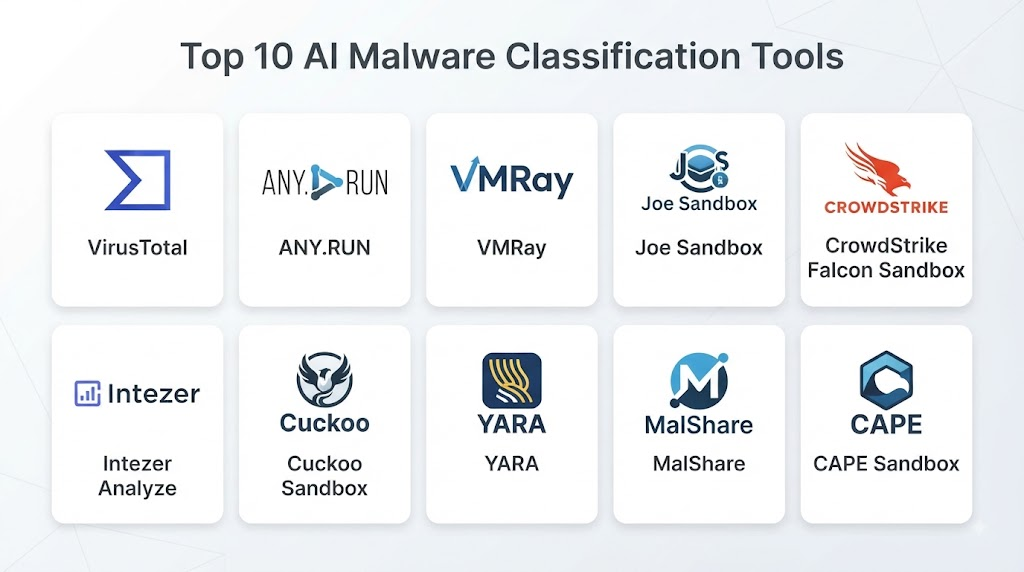
Top 10 AI Malware Classification Tools
1. Google Threat Intelligence
One-line verdict: Best for enterprises combining malware analysis, threat intelligence, indicator investigation, and large-scale security research.
Short description
Google Threat Intelligence provides security intelligence and analysis capabilities that can help teams investigate suspicious files, malware, domains, URLs, and related infrastructure. It combines threat research with large-scale security intelligence.
Standout Capabilities
- Malware intelligence.
- File analysis.
- Indicator investigation.
- Threat-actor research.
- Domain analysis.
- URL investigation.
- Threat intelligence.
- Security research.
AI-Specific Depth
- Model support: Vendor-managed AI and machine-learning capabilities vary by service.
- RAG / knowledge integration: Threat intelligence and security research provide substantial contextual information.
- Evaluation: Detection and intelligence quality are continuously evaluated; detailed AI evaluation methodology is not publicly stated.
- Guardrails: Security controls and access management govern platform usage.
- Observability: Investigation and security activity can be monitored depending on service configuration.
Pros
- Strong malware-analysis ecosystem.
- Broad threat intelligence context.
- Useful for advanced investigations.
Cons
- Enterprise-oriented.
- Advanced analysis requires security expertise.
- Pricing varies by service.
Security & Compliance
Enterprise security controls are available. Specific certifications and regulatory coverage should be verified for the applicable service.
Deployment & Platforms
- Cloud.
- Web.
- APIs.
- Enterprise security environments.
Integrations & Ecosystem
Google Threat Intelligence can support malware workflows across security environments.
- SIEM.
- SOAR.
- EDR/XDR.
- Malware analysis.
- Threat intelligence.
- APIs.
Pricing Model
Enterprise/custom pricing.
Best-Fit Scenarios
- Enterprise malware research.
- Threat intelligence teams.
- Advanced SOC investigations.
2. VirusTotal
One-line verdict: Best for rapid malware sample investigation, multi-source detection comparison, and automated file reputation workflows.
Short description
VirusTotal provides file, URL, domain, and IP analysis using information from multiple security engines and sources. It is widely useful for initial malware triage and indicator investigation.
Standout Capabilities
- File scanning.
- Malware detection.
- Multi-engine analysis.
- Behavioral information.
- File relationships.
- URL analysis.
- Hash investigation.
- API access.
AI-Specific Depth
- Model support: Specific AI model support varies and is not universally publicly stated.
- RAG / knowledge integration: Extensive security intelligence and relationships can provide contextual investigation.
- Evaluation: Multiple detection engines provide comparative evidence; AI-specific evaluation varies.
- Guardrails: Platform access and service controls apply.
- Observability: API and investigation activity can be monitored depending on subscription.
Pros
- Fast malware triage.
- Large security ecosystem.
- Useful API functionality.
Cons
- Results require analyst interpretation.
- Multi-engine detections can disagree.
- Advanced enterprise capabilities may require paid access.
Security & Compliance
Security and privacy controls depend on the service and account configuration. Specific certifications should be verified where required.
Deployment & Platforms
- Web.
- Cloud.
- APIs.
Integrations & Ecosystem
VirusTotal can be incorporated into automated malware-analysis workflows.
- SIEM.
- SOAR.
- EDR.
- Threat-intelligence systems.
- Malware-analysis pipelines.
- APIs.
Pricing Model
Free functionality is available alongside paid and enterprise options.
Best-Fit Scenarios
- Malware triage.
- SOC investigation.
- Automated file enrichment.
3. CrowdStrike Falcon
One-line verdict: Best for organizations requiring AI-assisted endpoint malware detection, behavioral analysis, and enterprise threat response.
Short description
CrowdStrike Falcon provides endpoint security capabilities that use behavioral detection, machine learning, threat intelligence, and endpoint telemetry to identify malicious activity.
Standout Capabilities
- Machine-learning detection.
- Behavioral analysis.
- Endpoint telemetry.
- Malware prevention.
- Threat intelligence.
- Automated investigation.
- Threat hunting.
- Incident response.
AI-Specific Depth
- Model support: Vendor-managed machine-learning and AI capabilities.
- RAG / knowledge integration: Threat intelligence and endpoint telemetry provide contextual security information.
- Evaluation: Detection models are continuously tested and updated; detailed model evaluation methodology is not fully public.
- Guardrails: Security policies and access controls govern automated responses.
- Observability: Endpoint telemetry, detections, investigations, and response activity provide strong visibility.
Pros
- Strong endpoint visibility.
- Behavioral malware detection.
- Broad security ecosystem.
Cons
- Enterprise-focused.
- Advanced features may require additional modules.
- Requires security expertise for complex environments.
Security & Compliance
Enterprise security and administrative controls are available. Specific certifications should be verified against the applicable product and service configuration.
Deployment & Platforms
- Cloud.
- Windows.
- macOS.
- Linux.
- Endpoint environments.
Integrations & Ecosystem
CrowdStrike provides a broad security ecosystem.
- SIEM.
- SOAR.
- Identity systems.
- Threat intelligence.
- Cloud security.
- APIs.
- Security operations platforms.
Pricing Model
Subscription and enterprise/custom pricing vary.
Best-Fit Scenarios
- Enterprise endpoint protection.
- Malware prevention.
- SOC threat hunting.
4. Microsoft Defender for Endpoint
One-line verdict: Best for Microsoft-centric organizations combining machine learning, endpoint telemetry, malware detection, and automated investigation.
Short description
Microsoft Defender for Endpoint provides endpoint detection and response capabilities with machine learning, behavioral analysis, threat intelligence, and automated investigation. It can help classify and respond to suspicious files and activities.
Standout Capabilities
- Machine-learning malware detection.
- Behavioral analysis.
- Endpoint telemetry.
- Automated investigation.
- Threat intelligence.
- Attack-surface visibility.
- Incident response.
- Microsoft security integration.
AI-Specific Depth
- Model support: Microsoft-managed AI and machine-learning models.
- RAG / knowledge integration: Security intelligence and Microsoft security telemetry provide contextual information.
- Evaluation: Detection capabilities are continuously updated; detailed model evaluation methodology is not fully public.
- Guardrails: Security policies and administrative controls govern response actions.
- Observability: Detailed endpoint telemetry and investigation data support security operations.
Pros
- Strong Microsoft integration.
- Broad endpoint telemetry.
- Automated investigation capabilities.
Cons
- Best fit for Microsoft environments.
- Configuration can be complex.
- Advanced functionality depends on licensing.
Security & Compliance
Microsoft provides enterprise identity, RBAC, audit, encryption, and governance capabilities. Specific certifications should be verified for the applicable service.
Deployment & Platforms
- Cloud.
- Windows.
- macOS.
- Linux.
- Endpoint environments.
Integrations & Ecosystem
Microsoft Defender for Endpoint integrates across Microsoft’s security ecosystem.
- Microsoft Sentinel.
- Microsoft Defender.
- Entra.
- Endpoint management.
- Security APIs.
- SIEM.
- SOAR.
Pricing Model
Subscription-based licensing with capabilities varying by Microsoft licensing arrangement.
Best-Fit Scenarios
- Microsoft-heavy enterprises.
- Endpoint malware protection.
- Integrated SOC operations.
5. SentinelOne Singularity
One-line verdict: Best for autonomous endpoint protection using behavioral AI, machine learning, and automated malware response.
Short description
SentinelOne Singularity provides endpoint protection and response capabilities designed to identify malicious behavior, suspicious files, and attack activity using machine learning and behavioral techniques.
Standout Capabilities
- Behavioral AI.
- Malware detection.
- Endpoint protection.
- Automated response.
- Threat hunting.
- Storyline-based investigation.
- Ransomware protection.
- Endpoint telemetry.
AI-Specific Depth
- Model support: Vendor-managed AI and machine-learning capabilities.
- RAG / knowledge integration: Threat intelligence and endpoint context support investigation.
- Evaluation: Detection models are continuously developed; detailed AI evaluation methodology is not publicly stated.
- Guardrails: Security policies and administrative controls govern autonomous actions.
- Observability: Endpoint telemetry and attack timelines provide investigation visibility.
Pros
- Strong behavioral detection.
- Automation capabilities.
- Useful attack-story context.
Cons
- Enterprise-oriented.
- Automated response requires careful policy configuration.
- Advanced capabilities can require specialist skills.
Security & Compliance
Enterprise security controls are available. Specific certifications and compliance claims should be verified for the selected service.
Deployment & Platforms
- Cloud.
- Windows.
- macOS.
- Linux.
- Endpoint platforms.
Integrations & Ecosystem
SentinelOne supports broad security integrations.
- SIEM.
- SOAR.
- Identity.
- Cloud security.
- Threat intelligence.
- APIs.
Pricing Model
Subscription and enterprise/custom pricing.
Best-Fit Scenarios
- Automated endpoint protection.
- Ransomware defense.
- Enterprise malware detection.
6. Palo Alto Networks Cortex XDR
One-line verdict: Best for organizations correlating endpoint, network, cloud, and threat intelligence data for advanced malware detection.
Short description
Cortex XDR combines endpoint security with broader security telemetry and analytics. Its machine-learning and behavioral capabilities can help identify malware and suspicious activity across multiple security data sources.
Standout Capabilities
- Machine-learning detection.
- Behavioral analysis.
- Endpoint protection.
- Network correlation.
- Threat intelligence.
- Incident investigation.
- Automated response.
- Cross-data analytics.
AI-Specific Depth
- Model support: Vendor-managed AI and machine-learning capabilities.
- RAG / knowledge integration: Security telemetry and threat intelligence provide investigation context.
- Evaluation: Detection capabilities are continuously updated; detailed model evaluation methodology is not publicly stated.
- Guardrails: Policies and access controls govern automated responses.
- Observability: Cross-source security telemetry provides investigation visibility.
Pros
- Broad security correlation.
- Strong enterprise SOC capabilities.
- Useful cross-data investigation.
Cons
- Broad platform requires configuration.
- Can be complex for smaller teams.
- Pricing varies significantly.
Security & Compliance
Enterprise security and administrative controls are available. Specific certifications should be verified for the applicable configuration.
Deployment & Platforms
- Cloud.
- Windows.
- macOS.
- Linux.
- Security operations environments.
Integrations & Ecosystem
Cortex XDR works across Palo Alto Networks security technologies.
- SIEM.
- SOAR.
- Network security.
- Cloud security.
- Threat intelligence.
- APIs.
Pricing Model
Subscription and enterprise/custom pricing.
Best-Fit Scenarios
- Enterprise SOCs.
- Cross-platform malware detection.
- Integrated security analytics.
7. Joe Sandbox
One-line verdict: Best for deep automated malware analysis, sandboxing, behavioral inspection, and advanced security research workflows.
Short description
Joe Sandbox provides automated malware-analysis capabilities designed to execute and inspect suspicious files and URLs in controlled environments. It is particularly relevant to malware researchers and security teams conducting detailed analysis.
Standout Capabilities
- Malware sandboxing.
- Dynamic analysis.
- Behavioral analysis.
- Static analysis.
- Network analysis.
- File analysis.
- Automated reports.
- Threat intelligence enrichment.
AI-Specific Depth
- Model support: Specific AI model support varies and is not universally publicly stated.
- RAG / knowledge integration: Analysis results and threat intelligence can provide contextual information.
- Evaluation: Sandbox behavior provides evidence for classification; AI-specific evaluation varies.
- Guardrails: Isolated execution environments provide important security boundaries.
- Observability: Detailed process, network, file, and system behavior can be observed.
Pros
- Deep malware analysis.
- Strong sandboxing.
- Useful researcher-focused capabilities.
Cons
- Requires specialized security expertise.
- Advanced analysis can be resource intensive.
- Primarily designed for security professionals.
Security & Compliance
Security controls depend on the deployment and service configuration. Specific certifications should be verified where required.
Deployment & Platforms
- Cloud.
- Self-hosted options may vary.
- Web.
- APIs.
Integrations & Ecosystem
Joe Sandbox can support malware-analysis pipelines.
- SIEM.
- SOAR.
- Threat intelligence.
- Malware repositories.
- APIs.
- Security research workflows.
Pricing Model
Commercial licensing and enterprise/custom options vary.
Best-Fit Scenarios
- Malware research.
- Advanced SOC investigations.
- Automated sandbox analysis.
8. ANY.RUN
One-line verdict: Best for interactive malware analysis, sandbox investigations, behavioral analysis, and rapid analyst-driven threat research.
Short description
ANY.RUN provides interactive sandboxing that allows security professionals to observe suspicious files and URLs while they execute in controlled environments. It is useful for malware investigation and behavioral analysis.
Standout Capabilities
- Interactive sandboxing.
- Dynamic malware analysis.
- Network analysis.
- Process monitoring.
- Behavioral inspection.
- Threat intelligence.
- Collaborative analysis.
- Automated reporting.
AI-Specific Depth
- Model support: Specific AI model architecture is not publicly stated.
- RAG / knowledge integration: Analysis and threat-intelligence information provide investigation context.
- Evaluation: Behavioral evidence can support classification; AI-specific evaluation varies.
- Guardrails: Isolated execution provides an important security boundary.
- Observability: Detailed process and network behavior can be observed during execution.
Pros
- Interactive investigation.
- Useful for analysts and researchers.
- Rich behavioral visibility.
Cons
- Requires malware-analysis expertise.
- Interactive workflows can be resource intensive.
- Cloud analysis requires careful data-handling review.
Security & Compliance
Security and privacy controls depend on the account and deployment model. Specific certifications should be verified for organizational requirements.
Deployment & Platforms
- Cloud.
- Web.
- APIs.
Integrations & Ecosystem
ANY.RUN can integrate into security investigation workflows.
- SIEM.
- SOAR.
- Threat intelligence.
- Malware research.
- APIs.
- Security operations.
Pricing Model
Subscription-based and enterprise options vary.
Best-Fit Scenarios
- Interactive malware analysis.
- SOC investigations.
- Security research.
9. Hybrid Analysis
One-line verdict: Best for automated malware analysis, file investigation, sandboxing, and threat-intelligence enrichment.
Short description
Hybrid Analysis provides malware-analysis services that can help security teams inspect suspicious files and understand their behavior. It is useful for malware triage and threat research.
Standout Capabilities
- Malware sandboxing.
- File analysis.
- Behavioral analysis.
- Hash investigation.
- Network behavior.
- Malware intelligence.
- Automated reports.
- API access.
AI-Specific Depth
- Model support: Specific AI model support is not publicly stated.
- RAG / knowledge integration: Analysis results and security intelligence provide contextual information.
- Evaluation: Behavioral analysis contributes evidence for classification.
- Guardrails: Sandboxed execution provides isolation.
- Observability: Process, network, and file activity can be observed.
Pros
- Useful malware triage.
- Accessible analysis workflows.
- Strong sandbox-based investigation.
Cons
- Requires analyst interpretation.
- Cloud submission requires privacy consideration.
- Advanced use may require security expertise.
Security & Compliance
Security and compliance capabilities vary by service and account configuration. Specific certifications should be verified where needed.
Deployment & Platforms
- Cloud.
- Web.
- APIs.
Integrations & Ecosystem
Hybrid Analysis can support automated security workflows.
- SIEM.
- SOAR.
- Threat intelligence.
- Malware repositories.
- APIs.
Pricing Model
Free and commercial capabilities vary.
Best-Fit Scenarios
- Malware triage.
- File investigation.
- Threat research.
10. MISP
One-line verdict: Best for organizations building customizable malware-intelligence workflows around open-source threat intelligence and structured data.
Short description
MISP is an open-source threat intelligence platform rather than a dedicated malware classifier. It can provide structured intelligence, relationships, indicators, and external enrichment that support malware-classification workflows.
Standout Capabilities
- Malware intelligence management.
- IOC storage.
- Threat relationships.
- Intelligence sharing.
- STIX support.
- API access.
- Feed management.
- Custom integrations.
AI-Specific Depth
- Model support: No universal built-in AI model; external AI services can be integrated.
- RAG / knowledge integration: MISP datasets can serve as structured knowledge for external AI systems.
- Evaluation: Depends on the connected AI or classification pipeline.
- Guardrails: Permissions and deployment controls govern access.
- Observability: Events, feeds, and connector activity can be monitored.
Pros
- Open-source.
- Highly customizable.
- Strong threat-intelligence foundation.
Cons
- Not a dedicated AI malware-classification engine.
- Requires technical administration.
- AI functionality requires additional integration.
Security & Compliance
Security depends on deployment architecture and administration. Specific certifications are not universally applicable to the open-source platform.
Deployment & Platforms
- Self-hosted.
- Linux.
- Web.
- APIs.
Integrations & Ecosystem
MISP is designed for extensibility.
- Threat feeds.
- STIX/TAXII.
- SIEM.
- SOAR.
- Malware-analysis platforms.
- APIs.
- Custom AI pipelines.
Pricing Model
Open-source with optional commercial support and hosting options.
Best-Fit Scenarios
- Custom malware-intelligence pipelines.
- Research environments.
- Organizations requiring data ownership.
Comparison Table
| Tool Name | Best For | Deployment | Model Flexibility | Strength | Watch-Out | Public Rating |
|---|---|---|---|---|---|---|
| Google Threat Intelligence | Enterprise malware intelligence | Cloud | Hosted | Intelligence depth | Enterprise complexity | N/A |
| VirusTotal | File and IOC triage | Cloud | Hosted/API | Multi-source analysis | Requires interpretation | N/A |
| CrowdStrike Falcon | Endpoint malware detection | Cloud | Hosted | Behavioral detection | Enterprise focus | N/A |
| Microsoft Defender for Endpoint | Microsoft environments | Cloud | Hosted | Endpoint integration | Licensing complexity | N/A |
| SentinelOne Singularity | Autonomous endpoint protection | Cloud | Hosted | Behavioral AI | Tuning required | N/A |
| Cortex XDR | Cross-source detection | Cloud | Hosted | Security correlation | Platform complexity | N/A |
| Joe Sandbox | Deep malware analysis | Cloud/Self-hosted varies | Hosted/API | Sandbox analysis | Specialist skills | N/A |
| ANY.RUN | Interactive malware analysis | Cloud | Hosted/API | Interactive sandbox | Data-handling considerations | N/A |
| Hybrid Analysis | Automated malware triage | Cloud | Hosted/API | Sandbox analysis | Analyst interpretation | N/A |
| MISP | Custom intelligence workflows | Self-hosted | Open/integrations | Flexibility | Requires engineering | N/A |
Scoring & Evaluation
The scoring below is a comparative assessment rather than an official vendor rating.
The rubric evaluates malware-analysis depth, AI reliability, safety controls, integrations, usability, performance and cost, security administration, and support.
Dedicated malware-analysis platforms and endpoint-security platforms serve different purposes, so scores should be interpreted according to the intended deployment.
A proof of concept using representative malware samples is strongly recommended before selecting a platform.
| Tool | Core | Reliability/Eval | Guardrails | Integrations | Ease | Perf/Cost | Security/Admin | Support | Weighted Total |
|---|---|---|---|---|---|---|---|---|---|
| Google Threat Intelligence | 10 | 10 | 9 | 10 | 8 | 8 | 9 | 10 | 9.35 |
| VirusTotal | 9 | 9 | 8 | 10 | 10 | 9 | 8 | 9 | 8.95 |
| CrowdStrike Falcon | 10 | 10 | 10 | 10 | 9 | 8 | 10 | 10 | 9.70 |
| Microsoft Defender for Endpoint | 10 | 9 | 10 | 10 | 9 | 9 | 10 | 10 | 9.55 |
| SentinelOne Singularity | 10 | 9 | 10 | 9 | 9 | 9 | 9 | 9 | 9.30 |
| Cortex XDR | 10 | 9 | 10 | 10 | 8 | 8 | 10 | 9 | 9.25 |
| Joe Sandbox | 10 | 10 | 10 | 9 | 7 | 7 | 9 | 9 | 9.05 |
| ANY.RUN | 9 | 9 | 9 | 9 | 9 | 8 | 8 | 9 | 8.85 |
| Hybrid Analysis | 9 | 8 | 9 | 9 | 9 | 9 | 8 | 8 | 8.65 |
| MISP | 8 | 8 | 8 | 10 | 7 | 10 | 8 | 8 | 8.35 |
Top 3 for Enterprise
- CrowdStrike Falcon — Strong endpoint detection and behavioral analysis.
- Microsoft Defender for Endpoint — Excellent for Microsoft-centric environments.
- Google Threat Intelligence — Strong threat intelligence and malware investigation capabilities.
Top 3 for SMB
- Microsoft Defender for Endpoint — Practical for organizations already using Microsoft security.
- VirusTotal — Useful for straightforward malware and file investigation.
- SentinelOne Singularity — Strong automated endpoint protection.
Top 3 for Developers
- MISP — Flexible foundation for custom intelligence pipelines.
- VirusTotal — Useful APIs for automated file and indicator investigation.
- ANY.RUN — Useful for security research and sandbox-driven workflows.
Which AI Malware Classification Tools Is Right for You?
Solo / Freelancer
Individual researchers generally need fast investigation rather than a complete enterprise platform.
Prioritize:
- File analysis.
- Hash lookup.
- Sandbox capabilities.
- Behavioral visibility.
- API access.
- Clear reports.
Cloud analysis can be convenient, but sensitive samples should not be uploaded without understanding the service’s data-handling model.
SMB
SMBs should prioritize automated endpoint protection and simple malware classification.
A good platform should detect suspicious files without requiring dedicated malware researchers.
Integration with existing endpoint and email-security tools can significantly improve value.
Mid-Market
Mid-market organizations should combine endpoint detection with centralized malware intelligence.
Important capabilities include:
- Automated file analysis.
- Endpoint telemetry.
- Threat intelligence.
- Sandbox integration.
- SIEM integration.
- SOAR automation.
- API access.
- Malware-family context.
Enterprise
Enterprises should look for:
- Large-scale classification.
- Behavioral detection.
- Dynamic analysis.
- Static analysis.
- Threat intelligence.
- Endpoint telemetry.
- Automated investigation.
- Sandbox integration.
- Advanced APIs.
- RBAC.
- Audit logging.
- Data governance.
- AI evaluation.
- Model monitoring.
Regulated Industries
Regulated organizations should carefully assess malware-sample handling.
Important questions include:
- Where are samples processed?
- How long are samples retained?
- Can submitted files become accessible to other users?
- Can sensitive samples be processed in isolated environments?
- What encryption controls are available?
- What access logs are available?
- Can organizations control data residency?
- Can AI providers use submitted content for model improvement?
Budget vs Premium
Budget-conscious teams can combine existing endpoint protection with targeted malware-analysis services.
Premium platforms become more attractive when the organization needs large-scale automation, advanced behavioral analysis, enterprise support, threat intelligence, and SOC integration.
Build vs Buy
Building a malware classifier can make sense for organizations with substantial machine-learning expertise and proprietary datasets.
However, maintaining datasets, sandbox infrastructure, model evaluation, adversarial testing, detection pipelines, and threat intelligence can become expensive.
Buying an established platform is generally easier for organizations that need operational protection quickly.
Implementation Playbook: 30 / 60 / 90 Days
30 Days: Pilot + Success Metrics
- Identify major malware entry points.
- Collect representative samples.
- Define benign and malicious datasets.
- Establish classification categories.
- Connect endpoint telemetry.
- Test static analysis.
- Test dynamic analysis.
- Measure false positives.
- Measure false negatives.
- Establish analyst review procedures.
- Create an AI evaluation dataset.
60 Days: Harden Security + Evaluation + Rollout
- Isolate malware-analysis environments.
- Configure RBAC.
- Enable SSO where available.
- Review sample-retention policies.
- Test adversarial samples.
- Test packed and obfuscated malware.
- Evaluate model explanations.
- Establish human-review thresholds.
- Version classification rules.
- Integrate SIEM and SOAR.
- Create incident escalation procedures.
90 Days: Optimize Cost/Latency + Governance + Scale
- Monitor classification latency.
- Optimize sandbox execution.
- Reduce duplicate analysis.
- Cache safe intelligence results where appropriate.
- Monitor AI inference costs.
- Review classification accuracy.
- Conduct adversarial testing.
- Establish model-performance monitoring.
- Review data-retention policies.
- Automate low-risk triage.
- Keep high-impact decisions under appropriate human control.
Common Mistakes & How to Avoid Them
- Treating AI classification as absolute truth: Classification should be combined with evidence and analyst review.
- Ignoring false positives: Incorrect malware classifications can disrupt legitimate business applications.
- Ignoring false negatives: Attackers continuously modify malware to evade detection.
- Using only static analysis: Sophisticated threats may require behavioral analysis.
- Using only sandboxing: Some malware detects sandbox environments and changes behavior.
- Ignoring adversarial machine learning: Attackers can intentionally manipulate characteristics used by classifiers.
- Uploading sensitive samples without reviewing privacy controls: Malware samples can contain proprietary information.
- No evaluation dataset: Test against realistic malware and benign files.
- Ignoring model drift: Malware families and attack techniques change continuously.
- No observability: Track classification latency, errors, confidence, and analyst overrides.
- Over-automating response: Malware classification should not automatically trigger destructive actions without appropriate controls.
- Ignoring prompt injection: LLM-based analysis systems must treat file contents as untrusted input.
- No evidence preservation: Keep supporting indicators and behavioral evidence for investigations.
- Ignoring cost: Large-scale sandboxing and AI analysis can become expensive.
- Creating vendor lock-in: Maintain portable intelligence and standardized APIs where possible.
FAQs
What are AI Malware Classification Tools?
AI Malware Classification Tools use machine learning, behavioral analysis, static analysis, dynamic analysis, and threat intelligence to identify and categorize potentially malicious files and activities.
How does AI classify malware?
AI can analyze characteristics such as file structure, code behavior, API calls, network activity, processes, metadata, and relationships with known malware to estimate whether an artifact is malicious.
Can AI detect new malware?
AI can identify suspicious characteristics in previously unseen samples, but no classifier can guarantee detection of every new malware variant.
What is the difference between static and dynamic malware analysis?
Static analysis examines a file without executing it, while dynamic analysis observes what happens when the file runs in a controlled environment.
Can AI identify malware families?
Yes. Machine-learning systems can help classify samples according to known malware families or behavioral categories, although accuracy varies by sample and model.
Can AI malware classification replace antivirus software?
No. AI classification is one component of a broader security architecture that can include endpoint protection, signatures, behavioral detection, threat intelligence, and incident response.
Can malware samples be analyzed in the cloud?
Yes, many services provide cloud-based analysis. Organizations should verify sample privacy, retention, sharing, processing location, and access controls before uploading sensitive files.
Can companies use their own AI model?
Some custom malware-analysis pipelines can use organization-managed or open-source models, while many commercial platforms rely primarily on vendor-managed models.
How should malware classification accuracy be tested?
Use representative malicious and benign datasets and measure precision, recall, false-positive rates, false-negative rates, classification consistency, latency, and analyst acceptance.
What is malware sandboxing?
Sandboxing executes suspicious files inside an isolated environment so analysts can observe processes, file changes, network connections, system calls, and other behaviors without exposing production systems.
Can attackers evade AI malware classifiers?
Yes. Attackers can use obfuscation, packing, polymorphism, environmental checks, and adversarial techniques to make malicious samples harder to classify.
How can AI malware-analysis systems be protected from prompt injection?
Treat malware samples and extracted content as untrusted data, isolate processing, restrict tool permissions, validate AI outputs, and prevent untrusted content from directly controlling security actions.
How can organizations reduce malware-analysis costs?
Use lightweight static analysis for initial triage, reserve expensive dynamic analysis for higher-risk samples, deduplicate files, cache appropriate results, and monitor API and compute usage.
Can malware classification integrate with SIEM and SOAR?
Yes. APIs and connectors can allow classification results, sandbox reports, indicators, and threat intelligence to become part of automated security workflows.
What should enterprises look for in an AI malware classifier?
Enterprises should prioritize classification accuracy, behavioral analysis, sandboxing, threat intelligence, integrations, APIs, security controls, privacy, auditability, scalability, and strong evaluation processes.
Conclusion
AI Malware Classification Tools can help security teams process suspicious files faster and identify malicious behavior across endpoints, email systems, cloud environments, and security operations platforms.The strongest solutions combine machine learning with behavioral analysis, static and dynamic analysis, threat intelligence, sandboxing, endpoint telemetry, and human investigation rather than depending on a single AI model.Enterprise endpoint platforms such as CrowdStrike Falcon, Microsoft Defender for Endpoint, SentinelOne Singularity, and Cortex XDR can provide broad operational protection. Specialized platforms such as Joe Sandbox, ANY.RUN, and Hybrid Analysis are more focused on malware investigation and sandbox analysis, while VirusTotal and MISP can support intelligence-driven workflows.
It would also be valuable to compare how tools handle encrypted or heavily packed samples. These cases can significantly reduce the usefulness of traditional static features. Understanding what happens when the classifier has limited visibility is important when evaluating real-world detection coverage.