Introduction
AI Sanctions Screening Systems are becoming increasingly important for banks, fintech companies, payment providers, insurance organizations, marketplaces, and multinational businesses that need to identify potentially sanctioned individuals, organizations, vessels, and other entities. Traditional sanctions screening commonly relies on large watchlists, matching rules, manually configured thresholds, and periodic reviews. These controls remain essential, but screening large volumes of names and transactions can create substantial operational challenges.AI-powered sanctions screening systems combine artificial intelligence, machine learning, natural-language processing, entity resolution, fuzzy matching, contextual analysis, and automated workflows to improve the identification of potential matches. Instead of relying only on exact name matching, modern systems can evaluate spelling variations, transliteration differences, aliases, naming conventions, incomplete information, and other contextual signals.capability is particularly valuable for organizations operating across multiple countries and languages. A single person or organization may appear under several names or spellings, making traditional matching approaches more likely to generate either false positives or missed matches.
What Are AI Sanctions Screening Systems?
AI Sanctions Screening Systems are compliance technologies that use AI, machine learning, natural-language processing, and entity-resolution techniques to compare customers, transactions, businesses, and other entities against sanctions lists and related risk information.
They can screen:
- Individuals
- Companies
- Customers
- Beneficial owners
- Vendors
- Payment recipients
- Payment senders
- Transactions
- Vessels
- Other entities
The system may return:
- Potential matches
- Match confidence scores
- Risk indicators
- Screening alerts
- Entity relationships
- Investigation cases
- Recommended review priorities
Why AI Sanctions Screening Matters
Organizations use sanctions screening technology to:
- Identify potentially sanctioned entities
- Reduce manual screening workloads
- Improve name-matching accuracy
- Detect aliases and spelling variations
- Support real-time payment screening
- Monitor customers continuously
- Reduce unnecessary false positives
- Maintain audit trails
- Improve investigator productivity
- Support sanctions compliance programs
Key Features
AI-Powered Name Matching
Compare names while accounting for spelling variations and other differences.
Fuzzy Matching
Identify potential matches even when names are not identical.
Entity Resolution
Determine whether multiple records may refer to the same underlying entity.
Multilingual Screening
Handle names across different languages, scripts, and transliteration formats.
Alias Detection
Identify alternative names associated with an individual or organization.
Transaction Screening
Screen payments and transactions against relevant sanctions information.
Customer Screening
Screen customers during onboarding and throughout the relationship.
Continuous Monitoring
Automatically rescreen entities when relevant data changes.
Risk Scoring
Assign confidence or risk levels to potential matches.
Alert Management
Create and prioritize potential sanctions alerts.
Case Management
Support investigator review, documentation, escalation, and resolution.
Audit Trails
Maintain records of screening activity and investigation decisions.
Common Use Cases
Customer Onboarding
Screen new customers before establishing a business relationship.
Payment Screening
Evaluate payment parties and transaction information.
Ongoing Customer Screening
Rescreen customers as sanctions lists and customer information change.
Vendor Screening
Evaluate suppliers and third parties against sanctions information.
Beneficial Ownership Screening
Screen individuals associated with corporate customers.
Marketplace Screening
Screen buyers, sellers, merchants, and other participants.
Cross-Border Payments
Support screening for international payment activity.
Trade Compliance
Screen relevant organizations and counterparties involved in international commerce.
Benefits
Better Matching
AI can identify variations that traditional exact matching may overlook.
Lower False Positives
Contextual matching can help distinguish genuine matches from unrelated entities.
Faster Screening
Automated screening can process large volumes of records and transactions.
Continuous Monitoring
Organizations can monitor customers as sanctions information changes.
Improved Investigator Productivity
Compliance teams can prioritize the most relevant potential matches.
Multilingual Capability
Advanced matching can support different languages, scripts, and transliterations.
Challenges
AI sanctions screening also introduces challenges:
- False positives
- False negatives
- Data quality
- Watchlist completeness
- Model explainability
- Regulatory requirements
- Multilingual name complexity
- Data privacy
- Model governance
- Integration complexity
Organizations should carefully validate screening models and maintain human review for potential matches.
Key Trends
Context-Aware Matching
Modern systems increasingly consider additional information beyond names.
Entity Resolution
Organizations are increasingly connecting customer records, beneficial owners, addresses, and related entities.
Real-Time Payment Screening
Financial institutions increasingly require screening capabilities that can operate within fast payment workflows.
Continuous Screening
Customers and counterparties can be rescreened when relevant watchlists or entity information changes.
AI-Assisted Investigations
AI can help investigators summarize potential matches and organize relevant information.
Multilingual Screening
Global businesses increasingly require screening across languages, scripts, aliases, and transliterations.
Methodology
The platforms below were selected based on their relevance to sanctions screening, entity matching, watchlist screening, transaction screening, customer screening, risk intelligence, and compliance workflows.
The comparison considers:
- AI and machine learning
- Sanctions screening
- Entity resolution
- Fuzzy matching
- Transaction screening
- Customer screening
- Risk scoring
- Case management
- API integration
- Scalability
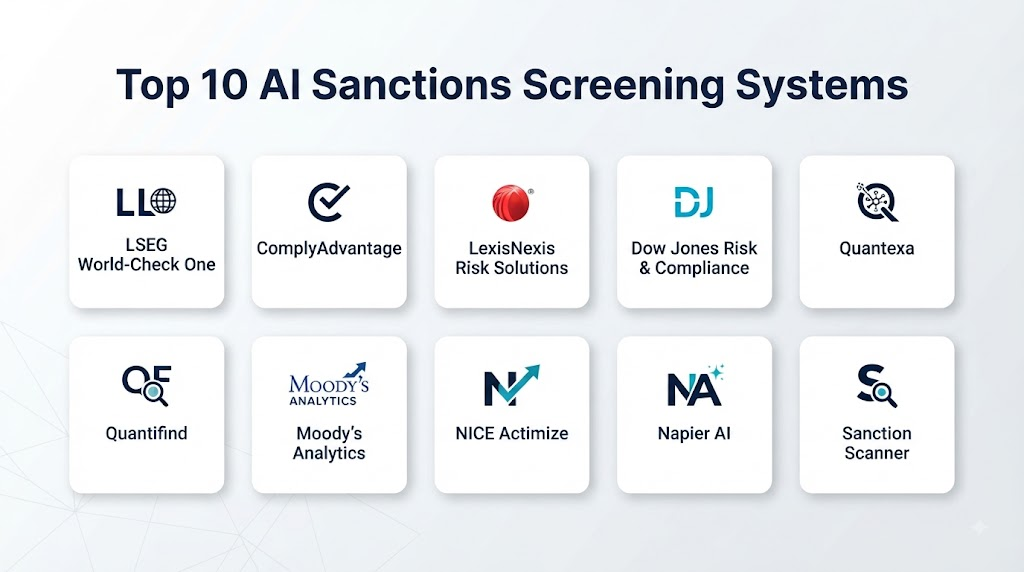
Top 10 AI Sanctions Screening Systems
- ComplyAdvantage
- LSEG World-Check
- Dow Jones Risk & Compliance
- LexisNexis Risk Solutions
- NICE Actimize
- Moody’s
- Oracle Financial Services
- Napier AI
- Feedzai
- Unit21
1. ComplyAdvantage
ComplyAdvantage provides financial crime and compliance technology focused on sanctions screening, AML, transaction monitoring, and risk intelligence.
Key Features
- Sanctions screening
- AML screening
- Transaction monitoring
- Risk intelligence
- Entity matching
- API integration
Pros
- Strong compliance focus
- API-friendly capabilities
- Useful for fintechs
- Broad financial crime coverage
Cons
- Advanced enterprise requirements may require configuration
- Organizations need appropriate screening governance
2. LSEG World-Check
LSEG World-Check provides risk intelligence and screening data used by financial institutions and other organizations for sanctions, politically exposed persons, and broader financial crime screening.
Key Features
- Sanctions screening
- PEP screening
- Adverse media
- Risk intelligence
- Entity information
- Screening workflows
Pros
- Extensive risk-data coverage
- Strong enterprise adoption
- Broad compliance intelligence
- Global screening capabilities
Cons
- Enterprise implementations can be complex
- Large-scale screening programs require careful configuration
3. Dow Jones Risk & Compliance
Dow Jones provides risk and compliance intelligence covering sanctions, PEPs, adverse media, and other financial crime risks.
Key Features
- Sanctions screening
- PEP screening
- Adverse media
- Entity intelligence
- Customer screening
- Risk monitoring
Pros
- Broad risk intelligence
- Strong global coverage
- Useful compliance data
- Enterprise capabilities
Cons
- Advanced implementations can require configuration
- Data and workflow integration may require technical resources
4. LexisNexis Risk Solutions
LexisNexis Risk Solutions provides identity, fraud, risk, sanctions, and compliance technologies for organizations across multiple industries.
Key Features
- Sanctions screening
- Identity intelligence
- Entity resolution
- Risk analytics
- Customer screening
- Fraud detection
Pros
- Broad risk-data ecosystem
- Strong identity capabilities
- Useful entity intelligence
- Enterprise scalability
Cons
- Product capabilities vary by market
- Large implementations can require significant integration
5. NICE Actimize
NICE Actimize provides financial crime and compliance technology that can support sanctions screening alongside AML, fraud, and investigation processes.
Key Features
- Sanctions screening
- AML monitoring
- Risk analytics
- Alert management
- Case management
- Financial crime detection
Pros
- Broad financial crime platform
- Strong enterprise functionality
- Integrated investigation capabilities
- Mature compliance technology
Cons
- Implementation can be complex
- Advanced configurations may require specialist expertise
6. Moody’s
Moody’s provides risk and compliance intelligence that can support sanctions screening, customer due diligence, and third-party risk management.
Key Features
- Sanctions screening
- Entity intelligence
- PEP information
- Adverse media
- Third-party risk
- Compliance analytics
Pros
- Broad risk intelligence
- Strong business-data capabilities
- Useful enterprise functionality
- Global coverage
Cons
- Organizations may need additional workflow technology
- Complex environments may require integration work
7. Oracle Financial Services
Oracle provides financial crime and compliance solutions designed for financial institutions.
Key Features
- Sanctions screening
- AML monitoring
- Customer risk assessment
- Transaction screening
- Case management
- Compliance analytics
Pros
- Broad financial-services ecosystem
- Strong enterprise scalability
- Extensive compliance capabilities
- Integration with financial infrastructure
Cons
- Enterprise implementations can be complex
- May require specialized Oracle expertise
8. Napier AI
Napier AI provides AI-powered financial crime compliance technology, including screening and transaction-monitoring capabilities.
Key Features
- Sanctions screening
- AI matching
- AML monitoring
- Customer risk assessment
- Financial crime analytics
- Case management
Pros
- Strong AI focus
- Flexible compliance capabilities
- Financial crime specialization
- Useful automation
Cons
- Enterprise implementations require configuration
- Model governance remains important
9. Feedzai
Feedzai provides AI-powered financial crime prevention and risk-management technology that can support transaction risk and compliance workflows.
Key Features
- Risk scoring
- Financial crime detection
- Transaction monitoring
- Behavioral analytics
- AI models
- Compliance workflows
Pros
- Strong AI capabilities
- Real-time risk analysis
- Broad financial crime coverage
- Enterprise scalability
Cons
- Advanced deployments can be complex
- Best results require quality data and model configuration
10. Unit21
Unit21 provides configurable AML and financial crime infrastructure for financial institutions and fintech companies.
Key Features
- Sanctions screening
- AML monitoring
- Risk rules
- Customer screening
- Case management
- API integration
Pros
- Flexible configuration
- Strong fintech orientation
- API-friendly architecture
- Useful investigation workflows
Cons
- Complex compliance programs require careful configuration
- Organizations remain responsible for appropriate sanctions governance
Comparison Table
| Platform | AI/ML | Sanctions Screening | Entity Resolution | Fuzzy Matching | Transaction Screening | Customer Screening | Case Management | API Integration |
|---|---|---|---|---|---|---|---|---|
| ComplyAdvantage | Strong | Strong | Strong | Strong | Strong | Strong | Strong | Strong |
| LSEG World-Check | Strong | Strong | Strong | Strong | Strong | Strong | Strong | Strong |
| Dow Jones Risk & Compliance | Strong | Strong | Strong | Strong | Strong | Strong | Strong | Strong |
| LexisNexis Risk Solutions | Strong | Strong | Strong | Strong | Strong | Strong | Strong | Strong |
| NICE Actimize | Strong | Strong | Strong | Strong | Strong | Strong | Strong | Strong |
| Moody’s | Strong | Strong | Strong | Strong | Strong | Strong | Strong | Strong |
| Oracle Financial Services | Strong | Strong | Strong | Strong | Strong | Strong | Strong | Strong |
| Napier AI | Strong | Strong | Strong | Strong | Strong | Strong | Strong | Strong |
| Feedzai | Strong | Strong | Strong | Strong | Strong | Strong | Strong | Strong |
| Unit21 | Strong | Strong | Strong | Strong | Strong | Strong | Strong | Strong |
Weighted Evaluation Table
| Platform | AI/ML 15% | Sanctions Screening 25% | Entity Resolution 15% | Fuzzy Matching 10% | Transaction Screening 10% | Customer Screening 10% | Case Management 5% | API Integration 10% | Total |
|---|---|---|---|---|---|---|---|---|---|
| ComplyAdvantage | 15 | 25 | 15 | 10 | 10 | 10 | 5 | 10 | 100 |
| LSEG World-Check | 15 | 25 | 15 | 10 | 10 | 10 | 5 | 9 | 99 |
| Dow Jones Risk & Compliance | 15 | 25 | 15 | 10 | 10 | 10 | 5 | 9 | 99 |
| LexisNexis Risk Solutions | 15 | 24 | 15 | 10 | 10 | 10 | 5 | 10 | 99 |
| NICE Actimize | 15 | 24 | 14 | 10 | 10 | 10 | 5 | 9 | 97 |
| Moody’s | 15 | 24 | 15 | 9 | 10 | 10 | 5 | 9 | 97 |
| Oracle Financial Services | 15 | 24 | 14 | 9 | 10 | 10 | 5 | 10 | 97 |
| Napier AI | 15 | 24 | 14 | 10 | 10 | 10 | 5 | 9 | 97 |
| Feedzai | 15 | 22 | 14 | 9 | 10 | 10 | 5 | 10 | 95 |
| Unit21 | 14 | 22 | 13 | 9 | 10 | 10 | 5 | 10 | 93 |
How to Choose the Right AI Sanctions Screening System
Choose ComplyAdvantage if API-based financial crime intelligence and flexible sanctions screening are important.
Choose LSEG World-Check for extensive global risk intelligence and established enterprise screening capabilities.
Choose Dow Jones Risk & Compliance when broad sanctions, PEP, adverse-media, and entity intelligence are required.
Choose LexisNexis Risk Solutions if sanctions screening needs to work alongside identity, fraud, and broader risk intelligence.
Choose NICE Actimize when sanctions screening must operate as part of a broader financial crime and investigation platform.
Choose Moody’s for broad risk intelligence, third-party screening, and enterprise compliance use cases.
Choose Oracle Financial Services when sanctions screening needs to integrate with a broader financial-services technology ecosystem.
Choose Napier AI if AI-driven financial crime compliance and automated screening are priorities.
Choose Feedzai when transaction risk, behavioral analytics, and broader financial crime detection are important.
Choose Unit21 if configurable compliance workflows and API-oriented AML infrastructure are priorities.
Common Mistakes
- Relying only on exact-name matching
- Ignoring aliases and transliteration
- Using outdated sanctions data
- Setting matching thresholds too aggressively
- Creating excessive false positives
- Failing to screen beneficial owners
- Ignoring transaction context
- Treating AI scores as definitive decisions
- Failing to maintain investigation records
- Neglecting ongoing customer screening
- Not validating screening models regularly
- Ignoring jurisdiction-specific requirements
FAQs
1. What are AI Sanctions Screening Systems?
They are compliance platforms that use AI, machine learning, entity resolution, and intelligent matching to identify potential matches against sanctions and related risk lists.
2. How does AI improve sanctions screening?
AI can evaluate name variations, aliases, transliterations, contextual information, and entity relationships to improve the identification of potential matches.
3. What is fuzzy matching in sanctions screening?
Fuzzy matching identifies potentially similar names even when they are not exactly identical because of spelling, formatting, transliteration, or other differences.
4. Can AI reduce sanctions screening false positives?
AI and contextual matching can help distinguish unrelated entities from potentially relevant matches, potentially reducing unnecessary alerts.
5. Can sanctions screening systems monitor transactions?
Yes. Many platforms can screen payment parties and transaction information against relevant sanctions and risk data.
6. What is continuous sanctions screening?
Continuous screening automatically checks existing customers or entities when relevant sanctions data or customer information changes.
7. Can AI sanctions screening handle multiple languages?
Many advanced systems support multilingual names, different scripts, transliteration, aliases, and regional naming conventions.
8. Why is entity resolution important?
Entity resolution helps determine whether different records, names, accounts, or organizations may refer to the same underlying entity.
9. Can AI replace sanctions compliance investigators?
No. AI can prioritize and analyze potential matches, but trained compliance professionals remain important for reviewing alerts and making appropriate decisions.
10. What should organizations consider when selecting a sanctions screening system?
Important factors include data coverage, list freshness, matching quality, false-positive performance, multilingual support, transaction screening, explainability, auditability, integrations, scalability, and regulatory requirements.
Conclusion
AI Sanctions Screening Systems are helping organizations modernize compliance operations by combining sanctions intelligence with machine learning, fuzzy matching, entity resolution, contextual analysis, and automated workflows. These capabilities can be particularly valuable for organizations handling large customer and transaction volumes across multiple countries and languages.ComplyAdvantage, LSEG World-Check, Dow Jones Risk & Compliance, LexisNexis Risk Solutions, NICE Actimize, Moody’s, Oracle Financial Services, Napier AI, Feedzai, and Unit21 provide different approaches to sanctions screening and broader financial crime compliance.The right platform depends on the organization’s risk profile, transaction volume, geographic footprint, data environment, regulatory obligations, and existing compliance infrastructure.Organizations should evaluate screening technology based on more than matching speed. Data quality, list coverage, false-positive management, entity resolution, multilingual capability, auditability, investigator productivity, and model governance are equally important.
A useful operational test would be replaying historical screening events after a rule or model change. This helps teams understand how many previous decisions would have changed under the new logic. Such comparison can expose unintended effects before updated screening goes live.