Introduction
AI Credit Scoring Platforms are transforming how lenders, financial institutions, fintech companies, and other organizations evaluate credit risk. Traditional credit scoring often depends heavily on established credit histories, predefined scoring models, financial statements, and manually reviewed information. While these approaches remain important, they may not fully represent the financial behavior of applicants with limited or non-traditional credit histories.AI-powered credit scoring platforms use machine learning, predictive analytics, alternative data, behavioral signals, and automated decisioning to evaluate borrower risk. These systems can analyze larger and more diverse datasets to identify patterns associated with repayment behavior, default probability, affordability, and overall creditworthiness.For lenders, AI can support faster credit decisions while potentially improving risk segmentation. Instead of assigning borrowers to broad risk categories using a limited number of variables, AI models can evaluate many signals simultaneously and identify relationships that traditional approaches may overlook.
What Are AI Credit Scoring Platforms?
AI Credit Scoring Platforms use artificial intelligence, machine learning, statistical modeling, and financial data to estimate the credit risk associated with an individual or business.
These platforms may evaluate:
- Credit history
- Payment behavior
- Debt levels
- Income information
- Cash-flow patterns
- Bank-account activity
- Business performance
- Transaction history
- Alternative financial data
- Identity information
- Application characteristics
The resulting score or risk assessment can help lenders determine eligibility, pricing, credit limits, or additional verification requirements.
Key Features
Machine Learning Credit Models
Use predictive algorithms to estimate borrower risk.
Alternative Data Analysis
Evaluate financial signals beyond traditional credit bureau information.
Automated Underwriting
Automate parts of the lending decision process.
Risk Scoring
Generate borrower-level risk scores.
Cash-Flow Analysis
Analyze income, expenses, and transaction patterns.
Explainable Decisions
Provide information about factors influencing a credit decision.
Fraud Detection
Identify potentially suspicious applications or borrower behavior.
Credit Policy Management
Apply lender-specific underwriting rules and policies.
API Integration
Connect credit scoring capabilities with lending applications and financial systems.
Portfolio Monitoring
Monitor borrower risk after credit has been issued.
Benefits
- Faster credit decisions
- Automated underwriting
- Broader data analysis
- Potentially improved risk segmentation
- Support for thin-file borrowers
- Reduced manual underwriting
- Scalable lending operations
- More consistent decisioning
- Improved portfolio monitoring
Challenges
AI credit scoring also creates several challenges:
- Data privacy requirements
- Model explainability
- Bias and fairness concerns
- Regulatory requirements
- Poor-quality data
- Model drift
- Integration complexity
- Limited credit histories
- Incorrect alternative-data interpretation
Organizations should validate models carefully and establish governance processes before using AI-generated scores for material lending decisions.
Methodology
The platforms below were selected based on their relevance to AI-powered credit scoring, automated underwriting, alternative data, credit risk assessment, financial decisioning, and lending analytics.
The comparison considers:
- AI and machine learning
- Credit risk scoring
- Alternative data
- Underwriting
- API capabilities
- Explainability
- Fraud and identity signals
- Integrations
- Scalability
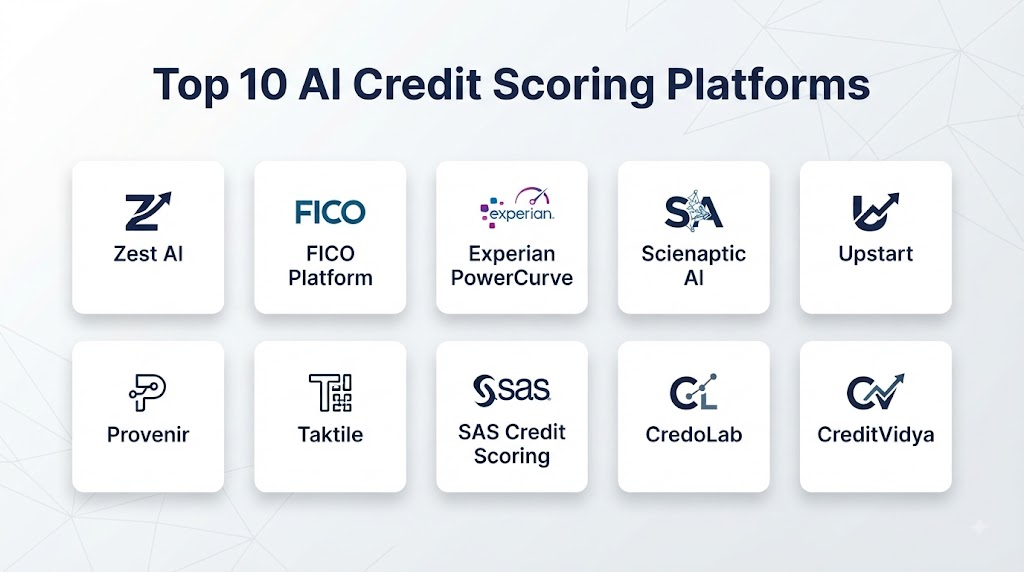
Top 10 AI Credit Scoring Platforms
1. FICO
FICO provides credit scoring, decision-management, analytics, and risk-management technologies used across lending and financial services.
Key Features
- Credit scoring
- Predictive analytics
- Risk modeling
- Decision management
- Portfolio analytics
- Fraud analytics
Pros
- Extensive credit-risk expertise
- Broad financial-services capabilities
- Mature analytics ecosystem
- Strong enterprise functionality
Cons
- Enterprise deployments can be complex
- Advanced capabilities may require specialized expertise
2. Experian
Experian provides credit data, analytics, decisioning, identity intelligence, and risk-management capabilities for lenders and financial institutions.
Key Features
- Credit scoring
- Credit data
- Risk assessment
- Automated decisioning
- Identity verification
- Fraud prevention
Pros
- Extensive credit data
- Strong analytics
- Broad lending capabilities
- Enterprise scalability
Cons
- Pricing and availability can vary by market
- Large deployments may require significant integration
3. Equifax
Equifax provides credit information, analytics, risk solutions, and decisioning technologies for financial institutions and businesses.
Key Features
- Credit scoring
- Credit reports
- Risk analytics
- Automated decisioning
- Identity intelligence
- Fraud detection
Pros
- Broad credit-data ecosystem
- Strong financial-services experience
- Useful risk analytics
- Enterprise capabilities
Cons
- Integration can be complex
- Product availability varies by region
4. TransUnion
TransUnion provides credit information, analytics, identity solutions, and risk-management technologies for lenders and financial institutions.
Key Features
- Credit scoring
- Credit risk analytics
- Identity intelligence
- Fraud detection
- Decisioning
- Portfolio monitoring
Pros
- Strong credit-data capabilities
- Broad risk-management functionality
- Useful identity signals
- Enterprise scalability
Cons
- Enterprise integrations may require specialized support
- Product availability differs across markets
5. Zest AI
Zest AI focuses on machine-learning technology for lending and credit decisioning.
Key Features
- Machine learning
- Credit risk modeling
- Automated underwriting
- Explainable AI
- Model management
- Risk analytics
Pros
- Strong lending focus
- Emphasis on explainable machine learning
- Useful for modern underwriting
- Flexible modeling
Cons
- Requires appropriate lending data
- Implementation can require model-management expertise
6. Upstart
Upstart uses AI-powered lending technology and alternative data to support automated credit decisioning and underwriting.
Key Features
- AI underwriting
- Credit risk assessment
- Alternative data
- Automated decisioning
- Lending analytics
- Risk segmentation
Pros
- Strong AI lending focus
- Automated underwriting
- Alternative-data capabilities
- Consumer lending experience
Cons
- Primarily oriented toward lending use cases
- Model performance depends on data quality and market conditions
7. Scienaptic AI
Scienaptic AI provides AI-powered credit decisioning and underwriting technology for financial institutions.
Key Features
- AI credit decisioning
- Automated underwriting
- Risk assessment
- Alternative data
- Credit policy management
- Explainable AI
Pros
- Strong credit decisioning focus
- AI-driven underwriting
- Supports alternative data
- Useful for financial institutions
Cons
- Implementation can require integration work
- Model governance remains important
8. Ocrolus
Ocrolus provides financial-document automation and data extraction capabilities that can support lending and credit decisioning.
Key Features
- Document analysis
- Financial data extraction
- Income verification
- Lending automation
- Data validation
- Underwriting support
Pros
- Strong document-processing capabilities
- Useful for lending workflows
- Automates manual data extraction
- Supports financial verification
Cons
- More focused on financial-data automation than standalone credit scoring
- Often works as part of a broader lending technology stack
9. Provenir
Provenir provides AI-powered risk decisioning and data orchestration technology for financial institutions and fintech businesses.
Key Features
- Credit risk decisioning
- AI analytics
- Data orchestration
- Automated underwriting
- Fraud detection
- API integration
Pros
- Flexible decisioning infrastructure
- Strong API capabilities
- Supports multiple data sources
- Useful for fintech applications
Cons
- Requires careful decision-model configuration
- Complex lending workflows may require implementation expertise
10. Amount
Amount provides digital lending and financial technology infrastructure that can support credit applications, underwriting, and automated decisioning.
Key Features
- Digital lending
- Credit decisioning
- Application automation
- Underwriting
- Risk assessment
- Lending workflows
Pros
- Strong digital lending focus
- Automation capabilities
- Useful application workflows
- Supports modern lending operations
Cons
- Primarily focused on lending infrastructure
- Advanced credit analytics may require complementary solutions
Comparison Table
| Platform | AI Credit Scoring | Automated Underwriting | Alternative Data | Risk Analytics | Explainable AI | Fraud/Identity | API Integration | Scalability |
|---|---|---|---|---|---|---|---|---|
| FICO | Strong | Strong | Strong | Strong | Strong | Strong | Strong | Strong |
| Experian | Strong | Strong | Strong | Strong | Strong | Strong | Strong | Strong |
| Equifax | Strong | Strong | Strong | Strong | Strong | Strong | Strong | Strong |
| TransUnion | Strong | Strong | Strong | Strong | Strong | Strong | Strong | Strong |
| Zest AI | Strong | Strong | Strong | Strong | Strong | Moderate | Strong | Strong |
| Upstart | Strong | Strong | Strong | Strong | Strong | Strong | Strong | Strong |
| Scienaptic AI | Strong | Strong | Strong | Strong | Strong | Strong | Strong | Strong |
| Ocrolus | Moderate | Strong | Strong | Strong | Moderate | Moderate | Strong | Strong |
| Provenir | Strong | Strong | Strong | Strong | Strong | Strong | Strong | Strong |
| Amount | Strong | Strong | Moderate | Strong | Moderate | Moderate | Strong | Strong |
Weighted Evaluation Table
| Platform | AI Credit Scoring 20% | Underwriting 15% | Risk Analytics 15% | Alternative Data 15% | Explainability 10% | API Integration 10% | Ease of Use 5% | Scalability 10% | Total |
|---|---|---|---|---|---|---|---|---|---|
| FICO | 20 | 15 | 15 | 14 | 10 | 10 | 4 | 10 | 98 |
| Experian | 20 | 15 | 15 | 15 | 10 | 10 | 4 | 10 | 99 |
| Equifax | 20 | 15 | 15 | 15 | 10 | 10 | 4 | 10 | 99 |
| TransUnion | 20 | 15 | 15 | 15 | 10 | 10 | 4 | 10 | 99 |
| Zest AI | 20 | 15 | 15 | 15 | 10 | 10 | 5 | 10 | 100 |
| Upstart | 20 | 15 | 15 | 15 | 9 | 10 | 5 | 9 | 98 |
| Scienaptic AI | 20 | 15 | 15 | 15 | 10 | 10 | 4 | 10 | 99 |
| Ocrolus | 16 | 14 | 13 | 14 | 8 | 10 | 5 | 9 | 89 |
| Provenir | 20 | 15 | 15 | 15 | 9 | 10 | 4 | 10 | 98 |
| Amount | 19 | 15 | 14 | 13 | 8 | 10 | 5 | 9 | 93 |
Scores are comparative editorial assessments and are not vendor-issued ratings.
How to Choose the Right AI Credit Scoring Platform
Choose FICO if mature credit-risk models, analytics, and enterprise financial-services capabilities are your priorities.
Choose Experian when broad credit data, risk analytics, identity intelligence, and decisioning are required.
Choose Equifax for organizations seeking credit data combined with risk, identity, and decisioning capabilities.
Choose TransUnion when credit intelligence and broader consumer-risk analytics are important.
Choose Zest AI if explainable machine learning and modern credit underwriting are central requirements.
Choose Upstart for AI-driven consumer lending and alternative-data-based underwriting.
Choose Scienaptic AI if AI credit decisioning and automated underwriting are the main priorities.
Choose Ocrolus when financial-document processing, income verification, and underwriting automation are key requirements.
Choose Provenir if flexible data orchestration, API-based decisioning, and fintech-oriented risk infrastructure are important.
Choose Amount when digital lending workflows and automated application and underwriting processes are the primary focus.
Common Mistakes
- Treating AI credit scores as infallible
- Using poor-quality financial data
- Ignoring model bias
- Failing to monitor model drift
- Using alternative data without proper governance
- Ignoring explainability requirements
- Applying one model to every lending segment
- Failing to validate predictions against actual repayment outcomes
- Ignoring regulatory requirements
- Automating credit decisions without appropriate human oversight
FAQs
1. What are AI Credit Scoring Platforms?
They are technologies that use machine learning, predictive analytics, credit information, and financial data to assess borrower credit risk.
2. How does AI credit scoring work?
AI models analyze financial, behavioral, credit, and other relevant data to identify patterns associated with repayment risk and generate a credit-risk assessment.
3. Can AI credit scoring use alternative data?
Yes. Some platforms can incorporate additional financial and behavioral information beyond traditional credit-report data.
4. Can AI improve lending decisions?
AI can help lenders analyze more data, automate underwriting, segment borrowers, and identify risk patterns, but models still require careful validation and governance.
5. Is AI credit scoring suitable for borrowers with limited credit history?
Some AI platforms use alternative financial data to support risk assessment for applicants with limited traditional credit histories.
6. What is explainable AI in credit scoring?
Explainable AI provides insight into the factors that influenced a model’s risk assessment, helping lenders understand and review automated decisions.
7. Can AI credit scoring detect fraud?
Some platforms combine credit-risk assessment with identity and fraud signals, although fraud detection and credit scoring are distinct functions.
8. Can AI credit scoring integrate with lending platforms?
Yes. Many modern credit decisioning solutions provide APIs and integrations for lending applications, financial systems, and underwriting workflows.
9. What should lenders consider before adopting AI credit scoring?
Important considerations include data quality, model accuracy, explainability, fairness, compliance, integration, security, scalability, and ongoing model monitoring.
10. What is the future of AI credit scoring?
The market is moving toward explainable machine learning, alternative-data analysis, real-time decisioning, automated underwriting, continuous portfolio monitoring, and increasingly personalized risk assessment.
Conclusion
AI Credit Scoring Platforms are helping lenders modernize credit assessment by combining traditional financial information with machine learning, predictive analytics, alternative data, and automated decisioning. These technologies can help organizations evaluate borrowers more efficiently while supporting increasingly digital lending experiences.FICO, Experian, Equifax, TransUnion, Zest AI, Upstart, Scienaptic AI, Ocrolus, Provenir, and Amount offer different approaches to credit scoring, underwriting, financial-data processing, and risk decisioning.The right platform depends on the lender’s product portfolio, target borrowers, available data, regulatory environment, existing technology infrastructure, and requirements for explainability and automation.AI should complement rather than replace responsible lending practices. Credit models need continuous monitoring to ensure that predictions remain accurate, explainable, and appropriate as economic conditions and borrower behavior change.
Another useful consideration is monitoring approved borrowers whose risk profile changes after lending. Portfolio monitoring is mentioned, but linking new financial behavior back to future credit decisions can help lenders identify deterioration earlier and adjust exposure accordingly.