Introduction
AI Transaction Risk Scoring APIs are becoming an important part of modern payment security, fraud prevention, and digital trust infrastructure. Businesses processing online payments, account activity, marketplace transactions, financial transfers, and other digital interactions need to make rapid decisions about whether a transaction appears legitimate or potentially risky.Traditional risk systems often depend on fixed rules such as transaction limits, geographic restrictions, velocity thresholds, blocklists, and manually configured conditions. These controls remain useful, but they can struggle when fraud patterns change rapidly or when legitimate customer behavior varies significantly.AI-powered transaction risk scoring APIs provide a programmable way to evaluate transaction risk using machine learning, behavioral analytics, identity signals, device intelligence, transaction history, and contextual information. Applications can send transaction and customer signals to an API and receive a risk score, decision, or set of risk indicators that can be incorporated into payment and security workflows.
What Are AI Transaction Risk Scoring APIs?
AI Transaction Risk Scoring APIs are programmable interfaces that allow applications to submit transaction, customer, device, identity, or behavioral information and receive an assessment of transaction risk.
A typical API workflow can evaluate:
- Transaction amount
- Payment method
- Customer history
- Device information
- IP and network signals
- Geographic information
- Account activity
- Transaction velocity
- Identity attributes
- Merchant information
- Previous fraud activity
The API may return:
- Risk score
- Risk level
- Fraud indicators
- Recommended action
- Decision signals
- Rules triggered
- Investigation information
Why Transaction Risk Scoring APIs Matter
Organizations can use transaction risk scoring APIs to:
- Evaluate transactions in real time
- Automate fraud decisions
- Reduce manual reviews
- Identify suspicious behavior
- Improve payment security
- Reduce unnecessary transaction declines
- Support step-up authentication
- Detect account takeover
- Monitor marketplace activity
- Build customized fraud workflows
Key Features
Real-Time Risk Scoring
Evaluate transactions during payment or account activity.
Machine Learning
Use predictive models to identify suspicious transaction patterns.
Behavioral Analytics
Compare current behavior against historical activity.
Device Intelligence
Analyze device characteristics and behavioral signals.
Identity Signals
Evaluate identity-related risk indicators.
Velocity Analysis
Identify unusual transaction frequency or rapid activity.
Rules Engine
Combine machine learning with configurable business rules.
Risk Explanations
Provide signals that help fraud teams understand why a transaction received a particular risk assessment.
API Integration
Connect risk scoring directly to applications and transaction workflows.
Webhooks
Send risk-related events back to applications for automated processing.
Custom Decisioning
Allow organizations to define how different risk levels should be handled.
Common Use Cases
Payment Fraud Detection
Score card and digital payment transactions before completing a transaction.
Account Takeover Prevention
Evaluate transactions following suspicious login or account activity.
E-Commerce Risk Management
Score checkout transactions and customer behavior.
Marketplace Protection
Evaluate buyers, sellers, and transactions.
Digital Wallet Security
Monitor wallet transactions and account behavior.
Banking Transactions
Evaluate transfers and other financial activities.
Subscription Fraud Detection
Identify unusual signups, payments, and account activity.
Refund Risk
Score refund requests and unusual refund behavior.
Benefits
Fast Decisioning
API-based scoring can support automated real-time decisions.
Flexible Integration
Developers can integrate risk scoring into existing applications.
Better Fraud Detection
Machine learning can identify complex patterns beyond simple rules.
Reduced Manual Review
Risk scoring can help prioritize transactions requiring human attention.
Better Customer Experience
Contextual risk scoring can help reduce unnecessary transaction declines.
Scalable Architecture
APIs allow risk intelligence to be embedded across multiple applications and transaction channels.
Challenges
AI transaction risk scoring APIs also introduce several challenges:
- API latency
- False positives
- Model drift
- Data-quality issues
- Privacy requirements
- Integration complexity
- Explainability requirements
- Changing fraud patterns
- Dependency on third-party infrastructure
Organizations should evaluate accuracy, latency, availability, data requirements, explainability, and integration capabilities before selecting an API.
Key Trends
Real-Time Decision Engines
Risk scoring is increasingly being integrated directly into payment authorization and account workflows.
Behavioral Risk Scoring
Models increasingly incorporate customer behavior rather than relying only on transaction attributes.
Identity and Transaction Intelligence
Fraud platforms are combining identity signals with transaction risk.
Graph-Based Risk Analysis
Relationships between users, devices, accounts, merchants, and payment instruments are increasingly used to identify coordinated fraud.
Adaptive Machine Learning
Risk models are becoming more responsive to evolving fraud patterns.
API-First Fraud Infrastructure
Businesses increasingly consume fraud intelligence through APIs rather than implementing entire fraud platforms internally.
Methodology
The platforms below were selected based on their relevance to transaction risk scoring, fraud detection APIs, payment risk decisioning, behavioral analytics, identity intelligence, and real-time transaction monitoring.
The comparison considers:
- API capabilities
- Risk scoring
- AI and machine learning
- Real-time decisioning
- Behavioral analysis
- Identity intelligence
- Rules
- Documentation and integration
- Scalability
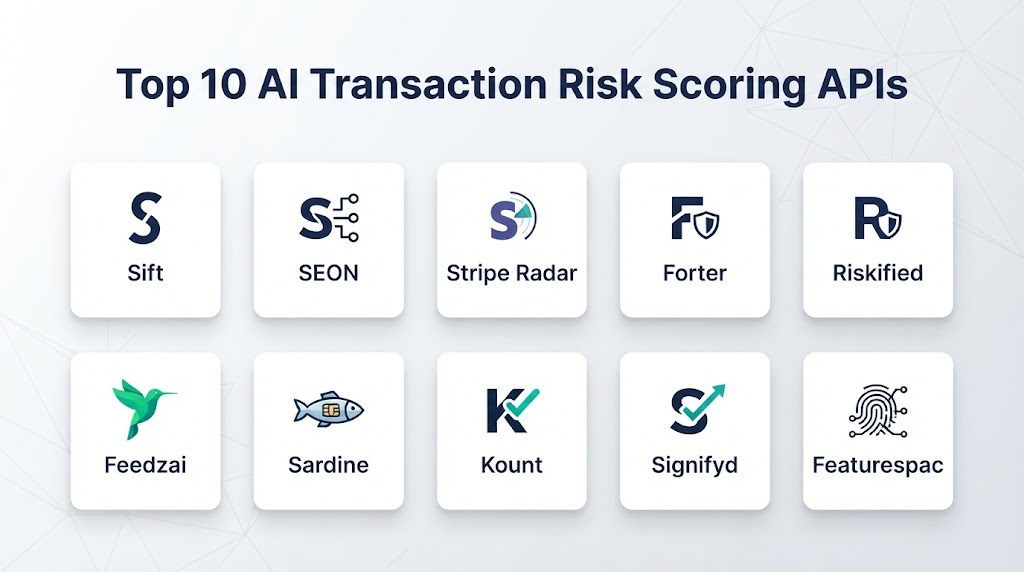
Top 10 AI Transaction Risk Scoring APIs
1. Sift
Sift provides digital trust and fraud prevention capabilities that can be integrated into applications for transaction and user-risk evaluation.
Key Features
- Risk scoring
- Machine learning
- Behavioral analytics
- Payment fraud detection
- Account protection
- API-based integration
Pros
- Broad digital fraud coverage
- Strong behavioral intelligence
- Flexible risk evaluation
- Enterprise capabilities
Cons
- Advanced implementations can require integration work
- Organizations may need time to optimize decision policies
2. Forter
Forter provides identity-based transaction protection and real-time trust decisions for digital commerce.
Key Features
- Transaction risk scoring
- Identity intelligence
- Real-time decisions
- Account protection
- Behavioral signals
- API integration
Pros
- Strong identity-focused approach
- Real-time decisioning
- Good digital-commerce coverage
- Useful fraud intelligence
Cons
- Enterprise implementations can require significant integration
- Best suited to organizations with substantial transaction volumes
3. SEON
SEON provides fraud prevention APIs and risk intelligence using digital footprint, device, behavioral, and identity signals.
Key Features
- Transaction risk scoring
- Device intelligence
- Digital footprint analysis
- Risk signals
- Identity intelligence
- API integration
Pros
- Broad risk signals
- Developer-friendly integration approach
- Useful for online businesses
- Flexible fraud analysis
Cons
- Risk quality depends on available signals
- Advanced workflows may require configuration
4. Stripe Radar
Stripe Radar provides fraud detection and risk controls integrated with Stripe payment processing.
Key Features
- Transaction risk evaluation
- Machine learning
- Fraud detection
- Custom rules
- Payment monitoring
- Automated blocking
Pros
- Strong payment integration
- Real-time risk evaluation
- Convenient for Stripe users
- Automated fraud controls
Cons
- Most useful within the Stripe ecosystem
- Organizations needing broader cross-platform fraud intelligence may require additional infrastructure
5. Riskified
Riskified provides ecommerce risk-management and transaction decisioning capabilities.
Key Features
- Transaction risk scoring
- Payment fraud detection
- Chargeback protection
- Customer behavior analysis
- Automated decisions
- API integration
Pros
- Strong ecommerce specialization
- Focus on transaction approval
- Automated risk decisions
- Useful customer intelligence
Cons
- Primarily designed around ecommerce
- May not cover every financial-risk use case
6. Feedzai
Feedzai provides AI-powered fraud and financial-crime prevention capabilities for financial institutions and payment organizations.
Key Features
- Real-time risk scoring
- Payment fraud detection
- Machine learning
- Transaction monitoring
- Financial crime analytics
- API integration
Pros
- Strong financial-services capabilities
- Real-time risk analysis
- Enterprise scalability
- Broad fraud coverage
Cons
- Implementation can be complex
- Better suited to mature fraud operations
7. Featurespace
Featurespace uses adaptive behavioral analytics to identify suspicious payment and financial activity.
Key Features
- Adaptive machine learning
- Transaction monitoring
- Risk scoring
- Payment fraud detection
- Behavioral analytics
- Real-time analysis
Pros
- Strong behavioral modeling
- Financial-services focus
- Good real-time capabilities
- Adaptive detection
Cons
- Enterprise-oriented
- Implementation may require specialized expertise
8. DataVisor
DataVisor provides AI-powered fraud detection and risk-management capabilities, including approaches designed to identify previously unseen patterns.
Key Features
- Risk scoring
- Unsupervised machine learning
- Transaction monitoring
- Fraud detection
- Account protection
- API integration
Pros
- Strong machine-learning capabilities
- Useful for emerging fraud patterns
- Good transaction monitoring
- Broad fraud coverage
Cons
- Advanced implementations require integration work
- Specialized fraud expertise can be beneficial
9. Kount
Kount provides digital fraud and identity protection capabilities for ecommerce and payment environments.
Key Features
- Transaction risk scoring
- Identity intelligence
- Fraud prevention
- Device intelligence
- Risk analytics
- API capabilities
Pros
- Strong ecommerce capabilities
- Useful identity signals
- Real-time risk evaluation
- Broad transaction intelligence
Cons
- Strongest in digital commerce
- Complex enterprise environments may require additional integration
10. Signifyd
Signifyd provides ecommerce transaction protection, fraud prevention, and automated risk decisioning.
Key Features
- Transaction risk analysis
- Fraud detection
- Automated decisioning
- Chargeback protection
- Identity signals
- API integration
Pros
- Strong ecommerce focus
- Automated decisions
- Useful payment protection
- Customer-experience focus
Cons
- Primarily ecommerce-oriented
- Broader financial crime use cases may require complementary platforms
Comparison Table
| Platform | Risk Scoring | Real-Time API | AI/ML | Behavioral Analytics | Identity Intelligence | Rules | Developer Integration |
|---|---|---|---|---|---|---|---|
| Sift | Strong | Strong | Strong | Strong | Strong | Strong | Strong |
| Forter | Strong | Strong | Strong | Strong | Strong | Strong | Strong |
| SEON | Strong | Strong | Strong | Strong | Strong | Strong | Strong |
| Stripe Radar | Strong | Strong | Strong | Strong | Strong | Strong | Strong |
| Riskified | Strong | Strong | Strong | Strong | Strong | Strong | Strong |
| Feedzai | Strong | Strong | Strong | Strong | Strong | Strong | Strong |
| Featurespace | Strong | Strong | Strong | Strong | Strong | Strong | Strong |
| DataVisor | Strong | Strong | Strong | Strong | Strong | Strong | Strong |
| Kount | Strong | Strong | Strong | Strong | Strong | Strong | Strong |
| Signifyd | Strong | Strong | Strong | Strong | Strong | Strong | Strong |
Weighted Evaluation Table
| Platform | Risk Scoring 20% | AI/ML 15% | Real-Time Decisioning 15% | Behavioral Analytics 15% | Identity Intelligence 10% | API Integration 10% | Ease of Integration 5% | Scalability 10% | Total |
|---|---|---|---|---|---|---|---|---|---|
| Sift | 20 | 15 | 15 | 15 | 10 | 10 | 4 | 10 | 99 |
| Forter | 20 | 15 | 15 | 15 | 10 | 10 | 4 | 10 | 99 |
| SEON | 19 | 14 | 15 | 14 | 10 | 10 | 5 | 9 | 96 |
| Stripe Radar | 19 | 14 | 15 | 14 | 9 | 10 | 5 | 10 | 96 |
| Riskified | 20 | 15 | 15 | 14 | 10 | 10 | 4 | 10 | 98 |
| Feedzai | 20 | 15 | 15 | 15 | 10 | 10 | 4 | 10 | 99 |
| Featurespace | 20 | 15 | 15 | 15 | 10 | 10 | 4 | 10 | 99 |
| DataVisor | 19 | 15 | 15 | 15 | 10 | 10 | 4 | 10 | 98 |
| Kount | 19 | 14 | 15 | 14 | 10 | 10 | 4 | 10 | 96 |
| Signifyd | 19 | 14 | 15 | 14 | 10 | 10 | 5 | 10 | 97 |
How to Choose the Right AI Transaction Risk Scoring API
Choose Sift if you need broad digital fraud detection and behavioral risk intelligence across payments and accounts.
Choose Forter if identity-based transaction trust and real-time decisioning are your primary priorities.
Choose SEON if device intelligence, digital-footprint analysis, and flexible fraud signals are important.
Choose Stripe Radar if your payment infrastructure is already built around Stripe.
Choose Riskified if ecommerce transaction approval and chargeback protection are central requirements.
Choose Feedzai for enterprise payment fraud and financial-crime risk scoring.
Choose Featurespace if adaptive behavioral analytics are particularly important.
Choose DataVisor if detecting emerging and previously unseen fraud patterns is a priority.
Choose Kount for ecommerce-focused identity and transaction risk intelligence.
Choose Signifyd if automated ecommerce transaction protection and chargeback coverage are major priorities.
Common Mistakes
- Choosing an API based only on its risk-score accuracy
- Ignoring API latency requirements
- Failing to evaluate false-positive rates
- Sending insufficient transaction context
- Ignoring data privacy requirements
- Treating risk scores as definitive fraud decisions
- Failing to monitor model performance
- Not creating appropriate decision thresholds
- Ignoring fallback behavior when an API is unavailable
- Failing to test risk scoring against real transaction scenarios
FAQs
1. What are AI Transaction Risk Scoring APIs?
They are APIs that use AI, machine learning, behavioral data, and transaction intelligence to evaluate the risk associated with a transaction.
2. How does a transaction risk scoring API work?
An application sends relevant transaction and contextual information to the API, which evaluates the available signals and returns a risk score, decision, or related indicators.
3. Can transaction risk scoring APIs work in real time?
Yes. Many are designed for real-time or near-real-time transaction decisioning.
4. What data is commonly used for transaction risk scoring?
Common signals include transaction amount, payment method, customer history, device information, IP data, location, account behavior, and transaction velocity.
5. Can risk scoring APIs detect account takeover?
Yes. Many platforms evaluate behavioral and identity signals that can indicate suspicious account activity.
6. Can these APIs reduce false positives?
They can potentially reduce unnecessary declines by incorporating behavioral and contextual information instead of relying only on static rules.
7. Should AI risk scores automatically decline transactions?
Not necessarily. Organizations can use risk thresholds to approve, challenge, review, or decline transactions based on their risk tolerance.
8. Can transaction risk APIs integrate with payment gateways?
Yes. APIs can generally be integrated into payment gateways, checkout systems, marketplaces, banking applications, and other transaction workflows.
9. What should developers evaluate when choosing a risk scoring API?
Important factors include latency, accuracy, API reliability, documentation, data requirements, explainability, scalability, pricing, privacy, and integration complexity.
10. What is the future of transaction risk scoring APIs?
The market is moving toward adaptive machine learning, behavioral intelligence, graph-based risk analysis, real-time decisioning, identity-aware scoring, and increasingly automated fraud investigation.
Conclusion
AI Transaction Risk Scoring APIs provide organizations with a flexible way to embed fraud intelligence directly into payment and transaction workflows. Instead of building every risk-detection capability internally, businesses can use APIs to access machine learning, behavioral analytics, identity signals, and transaction intelligence.Sift, Forter, SEON, Stripe Radar, Riskified, Feedzai, Featurespace, DataVisor, Kount, and Signifyd each provide different approaches to transaction risk scoring and fraud prevention.The right API depends on transaction volume, payment infrastructure, fraud types, required response time, available customer data, geographic coverage, and the complexity of the organization’s decisioning workflow.API performance should be evaluated alongside fraud-detection quality. A highly accurate model that introduces excessive latency can negatively affect payment conversion, while an aggressive model can create unnecessary customer friction.
Another practical concern is regional behavior differences. Transaction patterns, payment methods, and fraud signals can vary significantly between markets. Validating a risk model separately across major regions can expose performance gaps hidden by one global accuracy number.