Introduction
AI Fraud Detection for Payments is becoming an essential capability for organizations processing large volumes of digital transactions. As businesses expand their use of cards, bank transfers, digital wallets, account-to-account payments, and online checkout systems, fraudsters have more opportunities to exploit payment workflows.Traditional fraud detection systems often rely heavily on predefined rules, transaction thresholds, blocklists, and manually configured risk conditions. These controls remain valuable, but sophisticated fraud can evolve quickly and may not always match previously identified patterns.AI-powered payment fraud detection platforms use machine learning, behavioral analytics, transaction intelligence, device signals, network relationships, and risk scoring to identify potentially fraudulent activity. Instead of evaluating transactions only against fixed rules, AI can analyze patterns across large datasets and detect relationships that may be difficult to identify manually.
These systems can examine factors such as transaction amount, location, device, customer behavior, payment history, account activity, transaction velocity, merchant characteristics, and relationships among different entities. The resulting risk scores can help payment teams determine whether a transaction should be approved, challenged, reviewed, or declined.
What Is AI Fraud Detection for Payments?
AI Fraud Detection for Payments uses machine learning, artificial intelligence, behavioral analytics, and transaction intelligence to identify potentially fraudulent payment activity.
It can analyze:
- Transaction amount
- Transaction frequency
- Payment method
- Customer behavior
- Device information
- IP and network signals
- Geographic patterns
- Account activity
- Merchant behavior
- Historical transactions
- Chargeback information
- Identity signals
The system generates risk scores or decisions that can help payment teams determine how a transaction should be handled.
Why AI Payment Fraud Detection Matters
AI-powered fraud detection can help organizations:
- Detect suspicious transactions
- Reduce payment fraud losses
- Identify account takeover activity
- Detect unusual transaction behavior
- Reduce false positives
- Improve payment approval rates
- Automate fraud decisions
- Monitor transactions in real time
- Identify emerging fraud patterns
- Strengthen payment security
Key Features
Real-Time Risk Scoring
Evaluate payment risk while a transaction is being processed.
Behavioral Analysis
Compare current behavior with historical customer activity.
Machine Learning Models
Use historical and real-time data to identify suspicious patterns.
Device Intelligence
Analyze device characteristics and behavioral signals.
Transaction Velocity Monitoring
Identify unusually frequent payment attempts.
Account Takeover Detection
Identify behavioral changes that may indicate compromised accounts.
Identity Verification
Evaluate identity-related signals during payment activity.
Chargeback Detection
Identify transaction patterns associated with potential chargebacks.
Rules Engine
Combine AI predictions with configurable fraud rules.
Case Management
Provide workflows for investigating suspicious activity.
Automated Decisioning
Approve, challenge, review, or decline transactions based on risk.
Network Analysis
Identify relationships between accounts, devices, payment instruments, and transactions.
Common Use Cases
Card Payment Fraud
Identify suspicious card transactions.
Account Takeover
Detect unusual behavior associated with compromised accounts.
Payment Account Fraud
Identify suspicious changes or activities involving payment accounts.
Digital Wallet Fraud
Monitor wallet transactions and account behavior.
E-Commerce Fraud
Evaluate online checkout transactions in real time.
Marketplace Fraud
Monitor transactions across buyers and sellers.
Bank Transfer Fraud
Identify suspicious account-to-account payment activity.
Refund Fraud
Detect unusual refund behavior.
Promotion Abuse
Identify suspicious patterns involving coupons, incentives, or promotional offers.
Benefits
Real-Time Protection
AI can evaluate transactions quickly enough to support real-time payment decisions.
Improved Detection
Machine learning can identify patterns that fixed rules may miss.
Reduced False Positives
Behavioral context can help distinguish legitimate unusual activity from genuine fraud.
Automated Decisioning
Fraud teams can automate a portion of transaction-review decisions.
Scalable Monitoring
AI can analyze high transaction volumes without requiring proportional increases in manual review.
Adaptive Detection
Machine-learning systems can be updated as fraud patterns evolve.
Challenges
AI payment fraud detection also presents several challenges:
- False positives
- Model drift
- Adversarial behavior
- Data quality problems
- Privacy requirements
- Explainability concerns
- Integration complexity
- Real-time latency requirements
- Fraud patterns changing rapidly
Organizations should continuously monitor model performance and adjust detection strategies as fraud techniques evolve.
Key Trends
Behavioral Biometrics
Fraud platforms increasingly analyze how users interact with digital services.
Graph-Based Fraud Detection
Platforms can examine relationships between accounts, devices, payment methods, and transactions.
Real-Time Decisioning
Fraud decisions increasingly occur during payment authorization.
Adaptive Machine Learning
Models are increasingly designed to respond to changing fraud patterns.
Identity and Fraud Convergence
Fraud detection is becoming increasingly connected with identity verification and authentication.
Automated Fraud Investigations
AI is increasingly being used to summarize suspicious activity and support investigator workflows.
Methodology
The platforms below were selected based on their relevance to payment fraud detection, transaction risk scoring, machine learning, behavioral analytics, real-time decisioning, identity intelligence, and fraud investigation.
The evaluation considers:
- Fraud detection
- Real-time decisioning
- AI and machine learning
- Behavioral analysis
- Risk scoring
- Rules management
- Case management
- Integrations
- Scalability
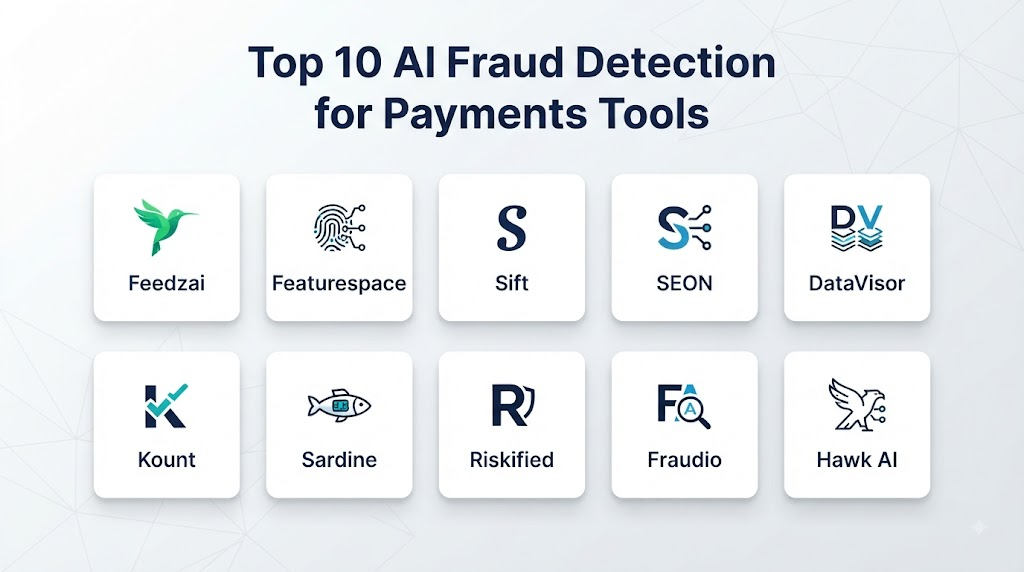
Top 10 AI Fraud Detection for Payments Tools
1. Stripe Radar
Stripe Radar provides automated fraud prevention and transaction-risk evaluation for businesses using Stripe payment infrastructure.
Key Features
- Machine learning fraud detection
- Transaction risk scoring
- Rules
- Payment monitoring
- Fraud analytics
- Automated blocking
Pros
- Integrated payment ecosystem
- Real-time transaction analysis
- Automated fraud controls
- Useful for online businesses
Cons
- Most valuable within the Stripe ecosystem
- Advanced requirements may require additional fraud infrastructure
2. Sift
Sift provides digital trust and fraud prevention capabilities covering payment fraud, account takeover, and abuse.
Key Features
- Payment fraud detection
- Account takeover detection
- Behavioral analysis
- Risk scoring
- Machine learning
- Fraud investigation
Pros
- Broad digital fraud coverage
- Strong behavioral analytics
- Useful risk intelligence
- Enterprise capabilities
Cons
- Advanced deployments can require integration work
- Fraud teams may need time to tune workflows
3. Riskified
Riskified provides AI-powered ecommerce fraud and risk-management solutions focused on transaction approval, fraud prevention, and customer experience.
Key Features
- Payment fraud detection
- Chargeback protection
- Risk decisioning
- Customer behavior analysis
- Ecommerce fraud prevention
- Automated decisions
Pros
- Strong ecommerce focus
- Emphasis on approval optimization
- Automated decisioning
- Useful fraud analytics
Cons
- Best suited to ecommerce environments
- Pricing and implementation may vary according to transaction volume and requirements
4. Forter
Forter provides identity-based fraud prevention and trust solutions for digital commerce and payment environments.
Key Features
- Payment fraud detection
- Identity intelligence
- Account protection
- Transaction risk analysis
- Fraud decisioning
- Behavioral signals
Pros
- Strong identity-based approach
- Real-time decisioning
- Broad digital commerce coverage
- Useful account protection
Cons
- Enterprise deployments may require substantial integration
- Best suited to organizations with significant digital transaction volumes
5. Feedzai
Feedzai provides AI-powered financial crime and fraud prevention technology for payment providers, banks, and financial organizations.
Key Features
- Payment fraud detection
- Real-time risk scoring
- Machine learning
- Financial crime monitoring
- Transaction intelligence
- Risk management
Pros
- Strong financial-services focus
- Real-time analytics
- Broad fraud capabilities
- Enterprise scalability
Cons
- Implementation can be complex
- Best suited to organizations with mature fraud operations
6. Featurespace
Featurespace provides machine-learning technology for payment fraud and financial crime detection.
Key Features
- Adaptive behavioral analytics
- Payment fraud detection
- Transaction monitoring
- Risk scoring
- Financial crime analytics
- Real-time detection
Pros
- Strong behavioral analytics
- Designed for financial services
- Good real-time capabilities
- Useful adaptive detection
Cons
- Enterprise-focused
- Implementation can require specialized expertise
7. DataVisor
DataVisor provides AI-driven fraud and risk management technology for identifying suspicious transactions and coordinated fraudulent behavior.
Key Features
- Fraud detection
- Unsupervised machine learning
- Risk scoring
- Transaction monitoring
- Account protection
- Fraud intelligence
Pros
- Strong machine-learning capabilities
- Useful for previously unseen fraud patterns
- Good real-time monitoring
- Broad fraud coverage
Cons
- Advanced implementations require integration
- Fraud teams may need specialized knowledge
8. SEON
SEON provides fraud prevention and risk intelligence capabilities for digital businesses.
Key Features
- Transaction monitoring
- Device intelligence
- Digital footprint analysis
- Risk scoring
- Identity intelligence
- Fraud investigation
Pros
- Strong digital-risk signals
- Useful for online businesses
- Flexible fraud analysis
- Good investigation capabilities
Cons
- Effectiveness depends on available signals and integration
- Advanced enterprise workflows may require configuration
9. Kount
Kount provides fraud and identity protection capabilities for digital commerce and payment environments.
Key Features
- Payment fraud prevention
- Identity intelligence
- Transaction monitoring
- Risk scoring
- Digital footprint analysis
- Fraud analytics
Pros
- Strong ecommerce capabilities
- Useful identity intelligence
- Real-time fraud analysis
- Broad transaction coverage
Cons
- Best suited to digital commerce environments
- Complex requirements may need implementation support
10. Signifyd
Signifyd provides ecommerce fraud protection, payment optimization, and commerce risk-management capabilities.
Key Features
- Payment fraud detection
- Chargeback protection
- Automated decisions
- Identity analysis
- Transaction risk assessment
- Ecommerce protection
Pros
- Strong ecommerce focus
- Automated fraud decisions
- Chargeback protection
- Customer experience focus
Cons
- Primarily focused on ecommerce
- May require complementary systems for broader financial crime monitoring
Comparison Table
| Platform | Payment Fraud Detection | Real-Time Scoring | Behavioral Analysis | Identity Intelligence | Rules | Case Management | Scalability |
|---|---|---|---|---|---|---|---|
| Stripe Radar | Strong | Strong | Strong | Strong | Strong | Moderate | Strong |
| Sift | Strong | Strong | Strong | Strong | Strong | Strong | Strong |
| Riskified | Strong | Strong | Strong | Strong | Strong | Strong | Strong |
| Forter | Strong | Strong | Strong | Strong | Strong | Strong | Strong |
| Feedzai | Strong | Strong | Strong | Strong | Strong | Strong | Strong |
| Featurespace | Strong | Strong | Strong | Strong | Strong | Strong | Strong |
| DataVisor | Strong | Strong | Strong | Strong | Strong | Strong | Strong |
| SEON | Strong | Strong | Strong | Strong | Strong | Strong | Strong |
| Kount | Strong | Strong | Strong | Strong | Strong | Strong | Strong |
| Signifyd | Strong | Strong | Strong | Strong | Strong | Strong | Strong |
Weighted Evaluation Table
| Platform | Fraud Detection 20% | AI/ML 15% | Real-Time Scoring 15% | Behavioral Analytics 15% | Identity Intelligence 10% | Integrations 10% | Ease of Use 5% | Scalability 10% | Total |
|---|---|---|---|---|---|---|---|---|---|
| Stripe Radar | 19 | 14 | 15 | 14 | 9 | 10 | 5 | 10 | 96 |
| Sift | 20 | 15 | 15 | 15 | 10 | 10 | 4 | 10 | 99 |
| Riskified | 20 | 15 | 15 | 14 | 10 | 10 | 5 | 10 | 99 |
| Forter | 20 | 15 | 15 | 15 | 10 | 10 | 4 | 10 | 99 |
| Feedzai | 20 | 15 | 15 | 15 | 10 | 10 | 4 | 10 | 99 |
| Featurespace | 20 | 15 | 15 | 15 | 10 | 10 | 4 | 10 | 99 |
| DataVisor | 19 | 15 | 15 | 15 | 10 | 10 | 4 | 10 | 98 |
| SEON | 19 | 14 | 15 | 14 | 10 | 9 | 5 | 9 | 95 |
| Kount | 19 | 14 | 15 | 14 | 10 | 10 | 4 | 10 | 96 |
| Signifyd | 19 | 14 | 15 | 14 | 10 | 10 | 5 | 10 | 97 |
How to Choose the Right AI Payment Fraud Detection Tool
Choose Stripe Radar if your payment infrastructure already relies heavily on Stripe and you want integrated fraud controls.
Choose Sift for broad digital fraud prevention covering payments, accounts, and user behavior.
Choose Riskified if ecommerce transaction approval and chargeback protection are major priorities.
Choose Forter if identity intelligence and real-time digital-commerce trust decisions are important.
Choose Feedzai for enterprise financial-services fraud prevention and real-time transaction monitoring.
Choose Featurespace if adaptive behavioral analytics are central to your fraud strategy.
Choose DataVisor if detecting previously unseen or coordinated fraud patterns is particularly important.
Choose SEON for digital footprint, device, and identity-related fraud signals.
Choose Kount for ecommerce-focused transaction and identity protection.
Choose Signifyd if automated ecommerce fraud protection and chargeback coverage are major priorities.
Common Mistakes
- Relying exclusively on static fraud rules
- Blocking too many legitimate customers
- Ignoring false-positive rates
- Failing to monitor fraud-model performance
- Using incomplete transaction data
- Ignoring account takeover signals
- Not monitoring transaction velocity
- Failing to investigate coordinated fraud
- Treating every high-risk transaction as fraudulent
- Not continuously adapting fraud controls
FAQs
1. What is AI Fraud Detection for Payments?
It uses AI, machine learning, behavioral analytics, and transaction data to identify potentially fraudulent payment activity.
2. Can AI detect payment fraud in real time?
Yes. Many modern platforms are designed to evaluate transactions during the payment process and generate real-time risk decisions.
3. What signals are used for payment fraud detection?
Common signals include transaction history, device information, location, payment behavior, transaction velocity, account activity, and identity indicators.
4. Can AI reduce false payment declines?
AI can use broader behavioral and contextual information to distinguish legitimate unusual transactions from suspicious activity, potentially reducing unnecessary declines.
5. Can AI detect account takeover?
Yes. Behavioral changes, unusual devices, login patterns, transaction behavior, and other signals can help identify potential account takeover activity.
6. Can AI detect new fraud patterns?
Some machine-learning systems can identify previously unseen patterns by analyzing relationships and behavioral anomalies across transactions.
7. Do payment fraud platforms use rules and AI together?
Yes. Many organizations use a combination of machine-learning models, configurable rules, risk scores, and human review.
8. Can these tools integrate with payment gateways?
Many payment fraud platforms provide integrations or APIs that allow them to evaluate transaction and customer data during payment workflows.
9. Does AI completely prevent payment fraud?
No. Fraud techniques continually evolve, and no system can guarantee complete prevention. Organizations need layered security and ongoing monitoring.
10. What is the future of AI payment fraud detection?
The market is moving toward adaptive real-time models, behavioral biometrics, graph-based fraud detection, identity intelligence, automated investigations, and increasingly contextual risk decisions.
Conclusion
AI Fraud Detection for Payments is becoming a critical component of modern payment security as transaction volumes and fraud techniques continue to evolve. Machine learning and behavioral analytics allow organizations to evaluate payment activity using more contextual information than traditional rules alone.Stripe Radar, Sift, Riskified, Forter, Feedzai, Featurespace, DataVisor, SEON, Kount, and Signifyd provide different approaches to payment fraud prevention, transaction risk scoring, identity intelligence, and digital-commerce protection.The right solution depends on transaction volume, payment methods, industry, customer experience requirements, fraud types, geographic markets, and existing payment infrastructure.
A useful operational metric is the business impact of blocked transactions, not just fraud prevented. Every incorrectly declined payment can mean lost revenue or customer frustration. Tracking approval quality alongside fraud-loss reduction gives a more balanced view of system performance.