Introduction
AI Anomaly Detection for Accounting is helping finance teams identify unusual transactions, accounting errors, suspicious activities, and potential control issues more efficiently. Traditional accounting reviews often depend on predefined rules, manual sampling, spreadsheet analysis, and periodic reconciliations. These methods remain important, but they can make it difficult to identify subtle or previously unknown patterns across large transaction volumes.Modern AI anomaly detection systems use machine learning, statistical analysis, pattern recognition, and continuous monitoring to examine accounting data and highlight transactions that differ from expected behavior. Instead of reviewing every transaction manually, finance professionals can focus their attention on records that require investigation.Accounting anomalies can take many forms. Examples include duplicate journal entries, unusual transaction amounts, unexpected account combinations, abnormal posting times, unusual supplier activity, irregular expense claims, inconsistent revenue entries, or transactions outside normal organizational patterns.
AI can help identify these situations by learning from historical accounting behavior and comparing new transactions against expected patterns. Some platforms combine machine learning with configurable business rules, making it possible to detect both known control violations and unusual activity that may not have been anticipated in advance.
What Is AI Anomaly Detection for Accounting?
AI Anomaly Detection for Accounting uses machine learning, statistical techniques, rules, and pattern recognition to identify accounting transactions or activities that differ from expected behavior.
It can analyze:
- General ledger transactions
- Journal entries
- Accounts payable
- Accounts receivable
- Expense transactions
- Supplier activity
- Customer transactions
- Account balances
- Transaction timing
- User activity
- Historical accounting patterns
The system identifies unusual patterns and assigns alerts, scores, or risk indicators that finance and audit teams can investigate.
Why Accounting Anomaly Detection Matters
AI-powered anomaly detection can help organizations:
- Detect unusual transactions earlier
- Reduce manual audit sampling
- Identify potential accounting errors
- Improve financial controls
- Detect duplicate transactions
- Identify unusual journal entries
- Strengthen audit procedures
- Improve continuous monitoring
- Reduce financial risk
- Improve visibility into accounting activity
Key Features
Journal Entry Analysis
Analyze journal entries for unusual amounts, accounts, timing, users, or combinations.
Duplicate Detection
Identify potentially duplicated transactions.
Statistical Anomaly Detection
Compare transactions against historical statistical patterns.
Machine Learning Detection
Identify unusual activity without relying entirely on predefined rules.
Rule-Based Monitoring
Apply organization-specific accounting and control rules.
Risk Scoring
Assign risk levels to transactions based on multiple indicators.
Continuous Controls Monitoring
Monitor accounting transactions continuously rather than only during periodic audits.
User Behavior Analysis
Identify unusual transaction activity associated with specific users or roles.
Vendor Monitoring
Detect unusual supplier transactions, amounts, frequency, or changes.
Exception Management
Route suspicious or unusual transactions for investigation.
Audit Trails
Maintain evidence of alerts, investigations, decisions, and remediation.
ERP Integration
Connect with accounting and enterprise resource planning systems.
Common Use Cases
Journal Entry Testing
Identify unusual journal entries that may require review.
Fraud Risk Detection
Highlight transactions with characteristics associated with elevated risk.
Accounts Payable Monitoring
Identify unusual supplier transactions and duplicate invoices.
Expense Auditing
Detect abnormal employee expense activity.
Financial Close
Identify unusual accounting activity before financial statements are finalized.
Internal Audit
Improve audit testing and transaction-level analysis.
Continuous Controls Monitoring
Monitor financial controls throughout the year.
Revenue Monitoring
Identify unusual revenue transactions or posting patterns.
Benefits
Faster Reviews
AI can analyze large volumes of accounting transactions much faster than manual sampling.
Broader Transaction Coverage
Organizations can analyze a larger percentage of their accounting data.
Earlier Risk Identification
Potentially problematic transactions can be flagged before they become larger issues.
Reduced Manual Work
Auditors and accountants can focus on high-risk transactions rather than reviewing everything.
Better Control Monitoring
Continuous analysis provides greater visibility into accounting processes.
Improved Audit Efficiency
AI can help prioritize transactions and areas requiring deeper investigation.
Challenges and Risks
AI anomaly detection also has limitations:
- False positives can create unnecessary investigations.
- New legitimate business activity may appear anomalous.
- Poor accounting data can reduce detection quality.
- Models can become less effective when business processes change.
- Some AI-generated alerts may be difficult to explain.
- Fraudsters can adapt their behavior.
- Integration with legacy ERP systems can be complicated.
Organizations should therefore combine AI detection with accounting expertise, investigation procedures, and strong governance.
Key Trends
Continuous Accounting Monitoring
Organizations are moving from periodic transaction reviews toward continuous monitoring.
Explainable AI
Finance and audit teams increasingly need explanations for why a transaction was flagged.
Hybrid Detection
Modern systems increasingly combine machine learning with deterministic accounting rules.
Risk-Based Auditing
Audit teams are using anomaly scores to prioritize higher-risk transactions.
Automated Investigation
AI is increasingly helping investigators summarize transaction history and identify related records.
Cross-Transaction Analysis
Systems can evaluate relationships among suppliers, employees, accounts, amounts, dates, and transaction patterns.
Methodology
The platforms below were selected based on their relevance to accounting anomaly detection, audit analytics, continuous controls monitoring, journal-entry analysis, financial-risk detection, and transaction monitoring.
The evaluation considers:
- Anomaly detection
- AI analytics
- Journal-entry analysis
- Continuous monitoring
- Fraud-risk capabilities
- Accounting integrations
- Reporting
- Investigation workflows
- Scalability
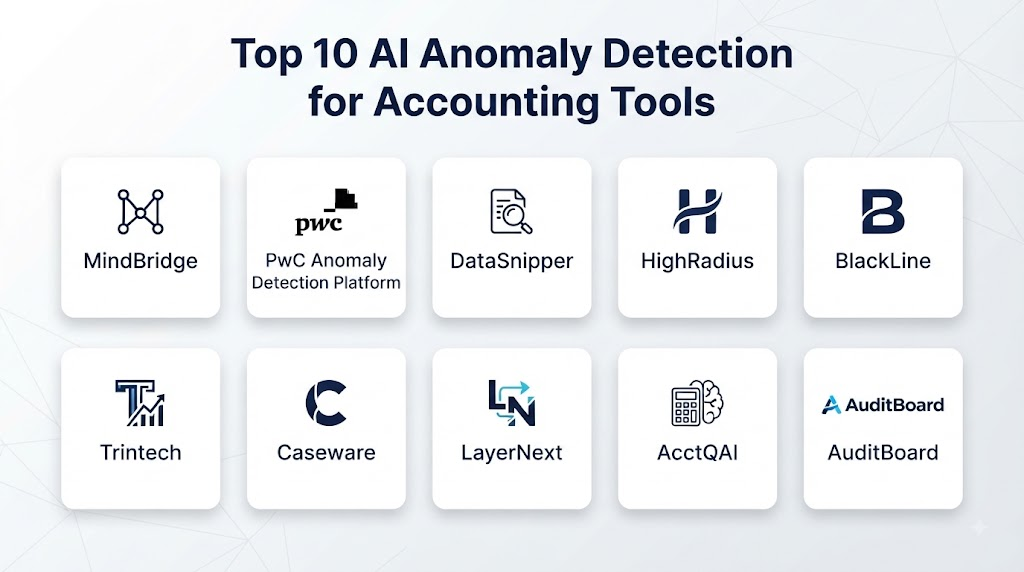
Top 10 AI Anomaly Detection for Accounting Tools
1. MindBridge
MindBridge provides AI-powered financial risk analytics designed to help audit and finance teams analyze transactions and identify unusual activity.
Key Features
- AI transaction analysis
- Journal-entry analytics
- Risk scoring
- Anomaly detection
- Audit analytics
- Continuous monitoring
Pros
- Strong accounting analytics focus
- Designed for transaction-level analysis
- Useful risk scoring
- Supports audit workflows
Cons
- Primarily suited to organizations with mature audit processes
- Implementation may require data preparation
2. BlackLine
BlackLine provides accounting and financial close automation with capabilities that support transaction monitoring, reconciliation, and financial controls.
Key Features
- Accounting automation
- Reconciliation
- Transaction monitoring
- Journal-entry workflows
- Financial controls
- Financial reporting
Pros
- Broad accounting automation
- Strong financial-close capabilities
- Enterprise scalability
- Useful control workflows
Cons
- Broader platform can require significant implementation
- Advanced functionality may require specialist configuration
3. DataSnipper
DataSnipper provides audit and financial data automation capabilities that help auditors extract, analyze, and validate financial information.
Key Features
- Audit automation
- Data extraction
- Transaction analysis
- Financial-document analysis
- Audit evidence management
- Excel integration
Pros
- Strong audit workflow integration
- Useful data-analysis capabilities
- Familiar environment for spreadsheet-oriented audit teams
- Reduces repetitive audit procedures
Cons
- More focused on audit productivity than continuous accounting monitoring
- Advanced analytics depend on available data
4. HighRadius
HighRadius provides AI-powered finance automation across accounts receivable, accounts payable, treasury, and financial operations.
Key Features
- Transaction monitoring
- Payment analytics
- Fraud-risk detection
- AR analytics
- AP automation
- Financial controls
Pros
- Broad finance automation
- Strong enterprise capabilities
- Useful transaction intelligence
- Good integration with financial workflows
Cons
- Broad platform may be more than smaller organizations need
- Implementation can be complex
5. Caseware
Caseware provides audit, accounting, financial reporting, and assurance technology that supports data analysis and audit workflows.
Key Features
- Audit analytics
- Financial analysis
- Accounting workflows
- Risk assessment
- Working-paper automation
- Reporting
Pros
- Strong audit ecosystem
- Useful accounting workflows
- Good financial analysis
- Established audit technology
Cons
- Advanced anomaly detection may require configuration
- Primarily oriented toward audit and assurance processes
6. Diligent
Diligent provides governance, risk, compliance, audit, and analytics capabilities that can support financial control monitoring.
Key Features
- Audit management
- Risk monitoring
- Compliance
- Data analytics
- Internal controls
- Reporting
Pros
- Strong governance ecosystem
- Useful risk-management capabilities
- Good audit workflows
- Enterprise functionality
Cons
- Broader governance platform
- Accounting-specific anomaly detection may require configuration
7. AuditBoard
AuditBoard provides audit, risk, compliance, and financial-control management capabilities.
Key Features
- Internal audit
- Risk management
- Controls monitoring
- Audit analytics
- Compliance
- Reporting
Pros
- Strong audit-management ecosystem
- Good risk and control workflows
- Useful collaboration capabilities
- Enterprise-oriented
Cons
- More focused on audit and controls than pure accounting anomaly detection
- Implementation can require process configuration
8. TeamMate Analytics
TeamMate Analytics provides audit analytics capabilities for examining financial data and identifying unusual transactions.
Key Features
- Data analysis
- Audit testing
- Transaction analysis
- Exception identification
- Sampling
- Continuous audit support
Pros
- Strong audit focus
- Useful transaction testing
- Good analytical capabilities
- Helps reduce manual audit procedures
Cons
- Primarily designed for audit teams
- Advanced AI capabilities may vary by workflow
9. AppZen
AppZen provides AI-powered finance automation with capabilities for reviewing expenses, invoices, and financial transactions.
Key Features
- AI transaction review
- Expense auditing
- Invoice auditing
- Fraud detection
- Compliance monitoring
- Financial controls
Pros
- Strong AI-driven transaction review
- Good AP and expense coverage
- Useful compliance capabilities
- Automated auditing
Cons
- Strongest in specific financial workflows
- Broader accounting monitoring may require complementary systems
10. Oversight
Oversight focuses on automated expense and payment monitoring, helping organizations identify potentially unusual or inappropriate financial activity.
Key Features
- Expense monitoring
- Payment monitoring
- Risk detection
- Anomaly detection
- Compliance monitoring
- Investigation workflows
Pros
- Strong transaction-monitoring focus
- Useful expense analytics
- Good risk detection
- Automated monitoring
Cons
- More focused on expense and payment activity
- General-ledger anomaly detection may require additional systems
Comparison Table
| Platform | Anomaly Detection | Journal Analysis | Fraud Risk | Continuous Monitoring | Audit Analytics | Financial Controls | Integrations |
|---|---|---|---|---|---|---|---|
| MindBridge | Strong | Strong | Strong | Strong | Strong | Strong | Strong |
| BlackLine | Strong | Strong | Moderate | Strong | Strong | Strong | Strong |
| DataSnipper | Strong | Moderate | Moderate | Moderate | Strong | Strong | Strong |
| HighRadius | Strong | Moderate | Strong | Strong | Strong | Strong | Strong |
| Caseware | Strong | Strong | Strong | Moderate | Strong | Strong | Strong |
| Diligent | Strong | Moderate | Strong | Strong | Strong | Strong | Strong |
| AuditBoard | Strong | Moderate | Strong | Strong | Strong | Strong | Strong |
| TeamMate Analytics | Strong | Strong | Strong | Strong | Strong | Strong | Strong |
| AppZen | Strong | Moderate | Strong | Strong | Strong | Strong | Strong |
| Oversight | Strong | Moderate | Strong | Strong | Strong | Strong | Strong |
Weighted Evaluation Table
| Platform | Anomaly Detection 20% | AI Analytics 15% | Journal Analysis 15% | Continuous Monitoring 15% | Fraud Risk 10% | Integrations 10% | Ease of Use 5% | Scalability 10% | Total |
|---|---|---|---|---|---|---|---|---|---|
| MindBridge | 20 | 15 | 15 | 15 | 10 | 10 | 4 | 10 | 99 |
| BlackLine | 19 | 14 | 15 | 15 | 9 | 10 | 4 | 10 | 96 |
| DataSnipper | 18 | 14 | 13 | 12 | 8 | 9 | 5 | 9 | 88 |
| HighRadius | 19 | 15 | 13 | 15 | 10 | 10 | 4 | 10 | 96 |
| Caseware | 19 | 14 | 15 | 12 | 9 | 9 | 4 | 9 | 91 |
| Diligent | 18 | 14 | 13 | 14 | 10 | 10 | 4 | 10 | 93 |
| AuditBoard | 18 | 14 | 13 | 14 | 9 | 10 | 4 | 10 | 92 |
| TeamMate Analytics | 19 | 14 | 15 | 14 | 9 | 9 | 4 | 9 | 93 |
| AppZen | 19 | 15 | 13 | 15 | 10 | 9 | 5 | 9 | 95 |
| Oversight | 19 | 14 | 13 | 15 | 10 | 9 | 5 | 9 | 94 |
How to Choose the Right AI Accounting Anomaly Detection Tool
Choose MindBridge if transaction-level financial risk analytics and AI-powered audit analysis are your primary priorities.
Choose BlackLine if anomaly detection needs to operate alongside financial close, reconciliation, and accounting automation.
Choose DataSnipper if audit productivity, financial-data analysis, and evidence workflows are your main requirements.
Choose HighRadius if transaction intelligence needs to be integrated with broader finance and working-capital automation.
Choose Caseware for audit-focused financial analysis and assurance workflows.
Choose Diligent if anomaly monitoring needs to operate within a broader governance, risk, and compliance environment.
Choose AuditBoard when internal audit, controls, risk, and compliance management are central requirements.
Choose TeamMate Analytics for transaction analysis and data-driven audit testing.
Choose AppZen if automated expense, invoice, and financial transaction review is your primary requirement.
Choose Oversight if expense and payment monitoring are the main areas where you need automated anomaly detection.
Common Mistakes
- Treating every anomaly as fraud
- Ignoring false positives
- Using poor-quality accounting data
- Failing to investigate high-risk alerts
- Relying only on predefined rules
- Ignoring legitimate business changes
- Failing to document investigation outcomes
- Not monitoring model performance
- Giving AI systems excessive decision-making authority
- Failing to integrate anomaly detection with existing controls
FAQs
1. What is AI anomaly detection in accounting?
It uses AI, machine learning, statistical analysis, and accounting rules to identify transactions or activities that differ from expected financial patterns.
2. Can AI detect accounting errors?
Yes. AI can identify unusual amounts, duplicate transactions, unexpected account combinations, abnormal posting patterns, and other potential errors.
3. Can AI anomaly detection identify fraud?
It can identify suspicious patterns that may indicate fraud, but an anomaly does not automatically mean fraudulent activity. Human investigation remains important.
4. What accounting data can AI analyze?
Systems can analyze journal entries, general-ledger transactions, invoices, expenses, supplier transactions, customer activity, and other financial records.
5. Can AI analyze every accounting transaction?
Many systems can analyze very large transaction datasets, allowing organizations to move beyond traditional sample-based review.
6. What is continuous controls monitoring?
Continuous controls monitoring involves automatically analyzing transactions and activities on an ongoing basis to identify potential control violations or unusual behavior.
7. Can anomaly detection integrate with ERP systems?
Yes. Many platforms can connect with ERP and accounting systems to access transaction data.
8. Why do AI anomaly detection systems produce false positives?
Legitimate transactions can differ from historical patterns because of acquisitions, new suppliers, unusual business events, seasonal activity, or accounting adjustments.
9. Can AI replace internal auditors?
No. AI can automate data analysis and help prioritize risks, while auditors remain responsible for investigation, professional judgment, controls evaluation, and conclusions.
10. What is the future of AI anomaly detection for accounting?
The market is moving toward continuous transaction monitoring, explainable AI, automated investigations, predictive risk scoring, cross-system analysis, and increasingly proactive financial-control management.
Conclusion
AI Anomaly Detection for Accounting is becoming an important capability for finance, audit, and risk teams dealing with increasingly large volumes of financial transactions. Machine learning and advanced analytics can help identify unusual journal entries, duplicate transactions, abnormal expenses, supplier irregularities, and other activities that may deserve investigation.MindBridge, BlackLine, DataSnipper, HighRadius, Caseware, Diligent, AuditBoard, TeamMate Analytics, AppZen, and Oversight provide different approaches to financial anomaly detection, audit analytics, transaction monitoring, and continuous controls.The right platform depends on whether the primary objective is journal-entry analysis, internal audit, accounts payable monitoring, expense auditing, financial controls, fraud-risk detection, or broader accounting automation.
Accounting anomaly systems should also handle late corrections carefully. A transaction may appear suspicious initially but later be modified through an approved adjustment. Keeping the original and corrected records linked can prevent duplicate or misleading alerts.