Introduction
AI FP&A Scenario Modeling Tools are transforming how finance teams plan, forecast, and evaluate different business outcomes. Financial Planning and Analysis teams traditionally rely on spreadsheets, static budgets, historical assumptions, and manually maintained forecasting models. These methods can become difficult to manage when organizations have multiple departments, business units, products, markets, currencies, and constantly changing financial conditions.Scenario modeling allows finance teams to examine how different assumptions could affect revenue, expenses, profitability, cash flow, headcount, investments, and other financial metrics. Instead of relying on a single forecast, organizations can compare multiple possible futures and understand the financial consequences of different decisions.AI adds another layer to this process by helping finance teams identify patterns, generate forecasts, detect anomalies, automate repetitive analysis, and evaluate assumptions. Modern FP&A platforms can connect operational and financial data, allowing finance professionals to create models that reflect business drivers rather than relying solely on manually entered spreadsheet values.
What Are AI FP&A Scenario Modeling Tools?
AI FP&A Scenario Modeling Tools use artificial intelligence, predictive analytics, financial modeling, and connected planning capabilities to help finance teams evaluate alternative business scenarios.
They can model changes involving:
- Revenue
- Pricing
- Sales volume
- Operating expenses
- Headcount
- Compensation
- Marketing spending
- Capital expenditure
- Cash flow
- Profitability
- Business-unit performance
- Market conditions
- Foreign exchange rates
A typical scenario-modeling workflow involves establishing a baseline forecast, changing one or more assumptions, calculating the financial impact, and comparing the result against alternative scenarios.
Key Features
Driver-Based Modeling
Build forecasts around business drivers such as units sold, pricing, headcount, customer acquisition, or operating costs.
Scenario Planning
Create multiple financial scenarios and compare potential outcomes.
AI Forecasting
Use historical and operational data to generate predictive forecasts.
Sensitivity Analysis
Determine how changes in specific assumptions affect financial results.
Budgeting
Create and manage departmental and organizational budgets.
Rolling Forecasts
Continuously update financial projections as new information becomes available.
Variance Analysis
Compare actual performance with budgets and forecasts.
Workforce Planning
Model the financial impact of hiring, compensation, turnover, and organizational changes.
Revenue Modeling
Evaluate pricing, volume, customer growth, and sales assumptions.
Cash-Flow Modeling
Understand how operational scenarios may affect liquidity.
Consolidation
Combine financial information across business units, subsidiaries, and entities.
Collaboration
Allow finance and operational teams to contribute assumptions and review scenarios.
Benefits
Faster Financial Planning
Automation reduces the amount of manual work involved in building and updating models.
Better Decision Support
Finance teams can evaluate the financial consequences of different business decisions before implementation.
Improved Forecasting
AI and connected data can provide more dynamic forecasts than static spreadsheets.
Greater Scenario Visibility
Organizations can compare optimistic, conservative, and downside scenarios.
Reduced Spreadsheet Dependency
Centralized models reduce the risk of disconnected spreadsheets and inconsistent assumptions.
Better Cross-Department Collaboration
Finance can connect operational assumptions from sales, HR, marketing, and other departments with financial forecasts.
Improved Risk Management
Scenario analysis helps organizations understand potential financial vulnerabilities.
Challenges
AI FP&A scenario modeling also presents several challenges:
- Poor-quality source data
- Complex financial structures
- Difficult ERP integrations
- Inconsistent business assumptions
- Model governance requirements
- User adoption challenges
- Limited AI explainability
- Complex implementation processes
- Risk of overreliance on automated forecasts
Organizations should establish clear ownership of assumptions, model governance, access controls, and review processes before deploying AI-driven planning.
Key Trends
AI-Assisted Forecast Creation
Finance teams are increasingly using AI to accelerate forecasting and identify trends.
Continuous Planning
Organizations are moving away from annual-only budgeting toward continuously updated financial plans.
Driver-Based Planning
Modern FP&A increasingly connects financial models with operational drivers.
Automated Scenario Generation
AI can help finance teams explore potential scenarios based on historical patterns and changing assumptions.
Workforce Scenario Modeling
Headcount, compensation, hiring plans, and organizational structures are becoming increasingly integrated into financial planning.
Integrated Business Planning
FP&A platforms are connecting financial planning with sales, workforce, supply chain, and operational planning.
Natural-Language Analytics
Some platforms allow users to query financial data and generate insights using natural-language interfaces.
Methodology
The platforms below were selected based on their relevance to FP&A, scenario modeling, financial planning, budgeting, forecasting, predictive analytics, driver-based planning, and enterprise performance management.
The comparison considers:
- Scenario modeling
- AI and predictive analytics
- Financial planning
- Budgeting
- Forecasting
- Reporting
- Integrations
- Collaboration
- Scalability
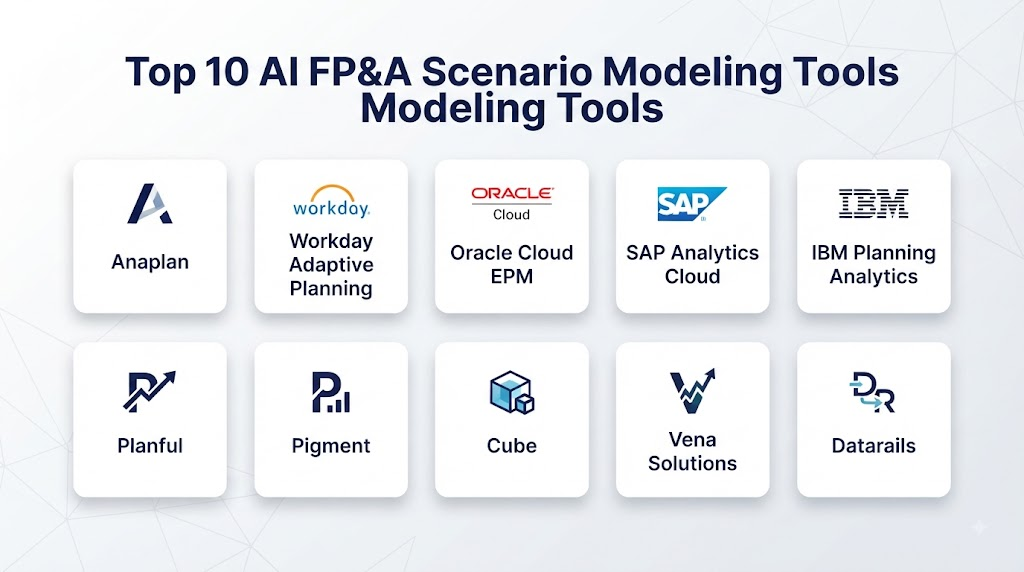
Top 10 AI FP&A Scenario Modeling Tools
1. Anaplan
Anaplan is an enterprise connected-planning platform designed for complex financial and operational planning. It enables organizations to build interconnected models across finance and business functions.
Key Features
- Scenario modeling
- Driver-based planning
- Financial forecasting
- Budgeting
- Workforce planning
- Revenue planning
- Enterprise modeling
- Performance management
Pros
- Highly flexible modeling
- Strong enterprise scalability
- Excellent cross-functional planning
- Extensive scenario capabilities
Cons
- Implementation can be complex
- Advanced deployments may require specialized expertise
2. Planful
Planful provides financial planning and performance-management capabilities for budgeting, forecasting, reporting, consolidation, and scenario analysis.
Key Features
- Scenario planning
- Financial forecasting
- Budgeting
- Workforce planning
- Financial consolidation
- Reporting
- Predictive analytics
Pros
- Strong FP&A capabilities
- Good scenario-planning workflows
- Useful reporting functionality
- Suitable for growing and enterprise organizations
Cons
- Implementation may require planning
- Complex models can require configuration
3. Pigment
Pigment is a connected planning platform that enables finance teams and business departments to build financial models, forecasts, budgets, and scenarios.
Key Features
- Scenario modeling
- Financial planning
- Budgeting
- Forecasting
- Workforce planning
- Revenue planning
- Dashboards
Pros
- Flexible modeling environment
- Modern interface
- Strong collaborative planning
- Good scenario analysis
Cons
- Requires well-structured data
- Advanced enterprise models may require configuration
4. Workday Adaptive Planning
Workday Adaptive Planning provides budgeting, forecasting, reporting, workforce planning, and scenario analysis capabilities.
Key Features
- FP&A
- Scenario planning
- Budgeting
- Forecasting
- Workforce planning
- Financial reporting
- Management reporting
Pros
- Strong financial planning capabilities
- Useful workforce modeling
- Good integration with broader enterprise planning
- Suitable for complex organizations
Cons
- Implementation can require significant planning
- Advanced functionality may require experienced administrators
5. Oracle Cloud EPM
Oracle Cloud Enterprise Performance Management provides financial planning, budgeting, forecasting, consolidation, and enterprise performance-management capabilities.
Key Features
- Financial planning
- Scenario modeling
- Budgeting
- Forecasting
- Profitability analysis
- Financial consolidation
- Workforce planning
Pros
- Strong enterprise capabilities
- Broad financial-management ecosystem
- Advanced modeling
- Good scalability
Cons
- Enterprise implementation can be complex
- May require specialized Oracle expertise
6. SAP Analytics Cloud
SAP Analytics Cloud combines analytics, planning, forecasting, and business intelligence capabilities.
Key Features
- Financial planning
- Scenario modeling
- Forecasting
- Budgeting
- Business intelligence
- Predictive analytics
- Data visualization
Pros
- Strong analytics capabilities
- Good SAP ecosystem integration
- Broad enterprise functionality
- Useful predictive features
Cons
- Best suited to organizations with sophisticated analytics requirements
- Implementation may require SAP expertise
7. OneStream
OneStream provides financial consolidation, reporting, planning, budgeting, forecasting, and performance-management capabilities.
Key Features
- FP&A
- Scenario planning
- Budgeting
- Forecasting
- Financial consolidation
- Reporting
- Financial analytics
Pros
- Strong financial-management platform
- Good consolidation capabilities
- Enterprise scalability
- Unified financial data environment
Cons
- Implementation can be complex
- May be more functionality than smaller organizations need
8. Vena
Vena provides FP&A capabilities focused on budgeting, forecasting, reporting, and financial planning.
Key Features
- Budgeting
- Forecasting
- Scenario modeling
- Financial reporting
- Variance analysis
- Workforce planning
Pros
- Strong FP&A focus
- Familiar spreadsheet-oriented approach
- Useful planning workflows
- Good reporting capabilities
Cons
- Complex enterprise models may require configuration
- Advanced analytics may require additional setup
9. Board
Board provides enterprise planning and decision-support capabilities across finance and operational functions.
Key Features
- Scenario planning
- Financial modeling
- Budgeting
- Forecasting
- Profitability analysis
- Workforce planning
- Business intelligence
Pros
- Strong planning flexibility
- Supports finance and operational planning
- Good scenario capabilities
- Enterprise-oriented platform
Cons
- Implementation can require technical expertise
- Complex models may require specialist configuration
10. Cube
Cube provides FP&A capabilities designed to connect financial planning with existing spreadsheets, accounting systems, and business applications.
Key Features
- Budgeting
- Forecasting
- Scenario modeling
- Financial reporting
- Variance analysis
- Spreadsheet integration
Pros
- Strong spreadsheet integration
- Useful for modern FP&A teams
- Flexible financial modeling
- Relatively accessible approach
Cons
- May not provide the same breadth as large enterprise EPM platforms
- Advanced requirements may require additional tools
Comparison Table
| Platform | Scenario Modeling | AI/Predictive Analytics | Budgeting | Forecasting | Workforce Planning | Reporting | Integrations | Scalability |
|---|---|---|---|---|---|---|---|---|
| Anaplan | Strong | Strong | Strong | Strong | Strong | Strong | Strong | Strong |
| Planful | Strong | Strong | Strong | Strong | Strong | Strong | Strong | Strong |
| Pigment | Strong | Strong | Strong | Strong | Strong | Strong | Strong | Strong |
| Workday Adaptive Planning | Strong | Strong | Strong | Strong | Strong | Strong | Strong | Strong |
| Oracle Cloud EPM | Strong | Strong | Strong | Strong | Strong | Strong | Strong | Strong |
| SAP Analytics Cloud | Strong | Strong | Strong | Strong | Strong | Strong | Strong | Strong |
| OneStream | Strong | Strong | Strong | Strong | Strong | Strong | Strong | Strong |
| Vena | Strong | Moderate | Strong | Strong | Strong | Strong | Strong | Strong |
| Board | Strong | Strong | Strong | Strong | Strong | Strong | Strong | Strong |
| Cube | Strong | Moderate | Strong | Strong | Moderate | Strong | Strong | Strong |
Weighted Evaluation Table
| Platform | Scenario Modeling 20% | AI & Prediction 15% | FP&A 15% | Forecasting 15% | Integrations 10% | Reporting 10% | Ease of Use 5% | Scalability 10% | Total |
|---|---|---|---|---|---|---|---|---|---|
| Anaplan | 20 | 15 | 15 | 15 | 10 | 10 | 4 | 10 | 99 |
| Planful | 19 | 14 | 15 | 15 | 10 | 10 | 5 | 10 | 98 |
| Pigment | 20 | 14 | 15 | 14 | 9 | 9 | 5 | 9 | 95 |
| Workday Adaptive Planning | 19 | 14 | 15 | 15 | 10 | 10 | 4 | 10 | 97 |
| Oracle Cloud EPM | 20 | 15 | 15 | 15 | 10 | 10 | 3 | 10 | 98 |
| SAP Analytics Cloud | 19 | 15 | 14 | 14 | 10 | 10 | 4 | 10 | 96 |
| OneStream | 19 | 14 | 15 | 15 | 10 | 10 | 4 | 10 | 97 |
| Vena | 18 | 13 | 15 | 14 | 9 | 9 | 5 | 9 | 92 |
| Board | 20 | 14 | 15 | 14 | 9 | 9 | 4 | 10 | 95 |
| Cube | 18 | 13 | 14 | 14 | 9 | 9 | 5 | 8 | 90 |
How to Choose the Right AI FP&A Scenario Modeling Tool
Choose Anaplan if your organization needs highly flexible enterprise scenario modeling across finance and operational functions.
Choose Planful for comprehensive FP&A, budgeting, forecasting, reporting, and scenario planning.
Choose Pigment if collaborative planning and flexible financial modeling are important priorities.
Choose Workday Adaptive Planning if workforce planning and financial planning need to operate together.
Choose Oracle Cloud EPM for complex enterprise financial planning, consolidation, and scenario modeling.
Choose SAP Analytics Cloud if your organization already relies heavily on the SAP ecosystem and requires integrated analytics and planning.
Choose OneStream when financial consolidation and enterprise performance management are major requirements alongside FP&A.
Choose Vena if your finance team wants strong FP&A capabilities with a spreadsheet-friendly approach.
Choose Board if you need flexible financial and operational scenario modeling.
Choose Cube if you want modern FP&A capabilities with strong spreadsheet and financial-system connectivity.
Common Mistakes
- Building scenarios without clear business drivers
- Using outdated financial assumptions
- Creating too many unnecessary scenarios
- Failing to establish a baseline forecast
- Ignoring operational data
- Treating AI forecasts as guaranteed outcomes
- Not documenting assumptions
- Failing to compare scenarios against actual results
- Ignoring workforce and cash-flow implications
- Allowing uncontrolled changes to financial models
FAQs
1. What are AI FP&A Scenario Modeling Tools?
They are financial planning platforms that use AI, predictive analytics, and connected financial data to help organizations model different business outcomes.
2. What can FP&A scenario models analyze?
They can analyze changes in revenue, expenses, headcount, pricing, investments, cash flow, profitability, and other business drivers.
3. Can AI automatically create financial forecasts?
Many platforms can use historical and operational data to assist with forecast generation, although finance teams should review and validate the resulting assumptions.
4. What is scenario modeling in FP&A?
Scenario modeling involves changing selected business assumptions and analyzing how those changes affect financial results.
5. Can these tools model workforce changes?
Yes. Many modern FP&A platforms support headcount, compensation, hiring, turnover, and workforce-cost scenarios.
6. Can FP&A scenario tools integrate with ERP systems?
Yes. Enterprise platforms commonly connect with ERP, accounting, HR, CRM, and other business systems.
7. What is driver-based planning?
Driver-based planning links financial forecasts to operational factors such as sales volume, pricing, headcount, customer growth, or production levels.
8. Can AI FP&A tools reduce spreadsheet usage?
Yes. Centralized models and automated data connections can reduce the need for manually maintained spreadsheets.
9. Are AI-generated scenarios reliable?
They can provide useful decision-support insights, but their reliability depends on data quality, assumptions, model design, and changing business conditions.
10. What is the future of AI FP&A scenario modeling?
The future is moving toward continuous planning, automated scenario generation, predictive forecasting, natural-language financial analysis, integrated workforce planning, and increasingly intelligent decision-support systems.
Conclusion
AI FP&A Scenario Modeling Tools are helping finance teams move beyond static annual budgets toward dynamic financial planning and continuous decision support. By connecting financial and operational data, these platforms allow organizations to evaluate alternative assumptions and understand their potential effects on revenue, expenses, profitability, cash flow, and workforce costs.Anaplan, Planful, Pigment, Workday Adaptive Planning, Oracle Cloud EPM, SAP Analytics Cloud, OneStream, Vena, Board, and Cube provide different approaches to modern FP&A and scenario modeling.The best choice depends on organizational complexity, planning requirements, existing financial systems, data architecture, workforce-planning needs, and the level of scenario analysis required.Successful implementation requires more than sophisticated software. Finance teams need reliable data, clearly defined business drivers, documented assumptions, model governance, and a consistent process for reviewing forecasts.