Introduction
AI Cash Flow Forecasting Platforms are becoming increasingly important for finance teams that need a clearer and more predictive view of future cash positions. Businesses must continuously understand how much cash they have available, when money is expected to arrive, which payments are approaching, and whether future cash balances can support operational and strategic requirements.Traditional cash-flow forecasting often relies on spreadsheets, manually collected financial data, historical averages, and assumptions created by finance professionals. While these approaches can be useful, they become difficult to maintain when organizations have multiple bank accounts, currencies, entities, customers, suppliers, payment schedules, and constantly changing financial conditions.AI-powered forecasting platforms use historical transactions, accounts receivable, accounts payable, bank activity, sales information, payment behavior, budgets, and other financial signals to generate forecasts. Machine learning can identify patterns in financial data and continuously improve forecasts as new information becomes available.
Modern platforms can also provide scenario analysis. Finance teams can evaluate potential outcomes based on changes in revenue, expenses, collections, supplier payments, hiring, investments, or other business conditions. This makes cash forecasting useful not only for reporting but also for financial planning and decision-making.
What Are AI Cash Flow Forecasting Platforms?
AI Cash Flow Forecasting Platforms use artificial intelligence, machine learning, predictive analytics, and financial data to estimate future cash inflows, cash outflows, and cash balances.
They can analyze:
- Bank transactions
- Accounts receivable
- Accounts payable
- Invoice history
- Customer payment behavior
- Supplier payment schedules
- Revenue forecasts
- Operating expenses
- Payroll
- Budgets
- Historical cash movements
- Credit facilities
- Business scenarios
The system can then estimate future cash positions across different time periods.
Why AI Cash Flow Forecasting Matters
Accurate cash forecasting helps organizations:
- Identify potential cash shortages
- Improve working-capital management
- Plan payments more effectively
- Understand future liquidity
- Optimize cash reserves
- Improve investment decisions
- Prepare for unexpected expenses
- Evaluate business scenarios
- Improve financial planning
- Support strategic decision-making
Key Features
AI-Powered Forecasting
Use historical and current financial data to generate projected cash positions.
Automated Data Collection
Connect financial systems, bank accounts, ERP platforms, and other data sources.
Accounts Receivable Forecasting
Estimate when outstanding customer invoices are likely to generate cash.
Accounts Payable Forecasting
Estimate upcoming supplier and operational payments.
Scenario Planning
Model potential changes in revenue, costs, hiring, investments, and other assumptions.
Rolling Forecasts
Continuously update forecasts as new financial information becomes available.
Variance Analysis
Compare actual cash performance against previous forecasts.
Liquidity Monitoring
Track available cash and potential liquidity requirements.
Multi-Entity Forecasting
Forecast cash across subsidiaries, business units, and legal entities.
Multi-Currency Support
Manage forecasts across different currencies.
Dashboard Analytics
Provide visual financial insights for finance teams and executives.
Alerts
Notify users about potential cash shortages, unexpected movements, or forecast changes.
Benefits
Better Cash Visibility
Finance teams gain a clearer view of expected future cash positions.
Faster Forecasting
Automation reduces the amount of manual spreadsheet work.
Improved Accuracy
Machine learning can identify patterns that may be difficult to detect manually.
Better Working-Capital Management
Businesses can identify collection and payment timing opportunities.
Improved Scenario Planning
Finance teams can evaluate multiple possible business outcomes.
Reduced Spreadsheet Dependency
Automated data collection and forecasting reduce repetitive spreadsheet maintenance.
Better Decision-Making
Executives can make decisions using more current financial information.
Challenges
AI cash forecasting also has limitations.
- Poor-quality financial data can produce unreliable forecasts.
- Unexpected business events can invalidate historical patterns.
- New businesses may have insufficient historical data.
- Complex organizations may require significant integration work.
- Forecast models can be difficult to explain without proper transparency.
- Different entities may use inconsistent accounting processes.
- AI predictions should still be reviewed by finance professionals.
Key Trends
Continuous Cash Forecasting
Forecasts are increasingly updated continuously instead of being produced only weekly or monthly.
Predictive Accounts Receivable
Platforms are incorporating customer payment behavior into expected cash-inflow forecasts.
Integrated Accounts Payable
Expected supplier payments are increasingly incorporated into liquidity forecasts.
Scenario-Based Planning
Finance teams can compare multiple possible cash-flow outcomes.
Treasury Automation
Cash forecasting is becoming increasingly connected to liquidity management and treasury operations.
Real-Time Financial Data
More platforms are connecting directly to banking and financial systems for fresher forecasting inputs.
AI-Powered Anomaly Detection
Systems can identify unexpected transactions and cash movements that may affect forecasts.
Methodology
The platforms below were selected based on their relevance to cash-flow forecasting, AI-powered financial planning, liquidity management, scenario modeling, treasury analytics, and business forecasting.
The evaluation considers:
- Cash-flow forecasting
- AI and predictive analytics
- Scenario planning
- Financial data integration
- Treasury capabilities
- Reporting
- Ease of use
- Scalability
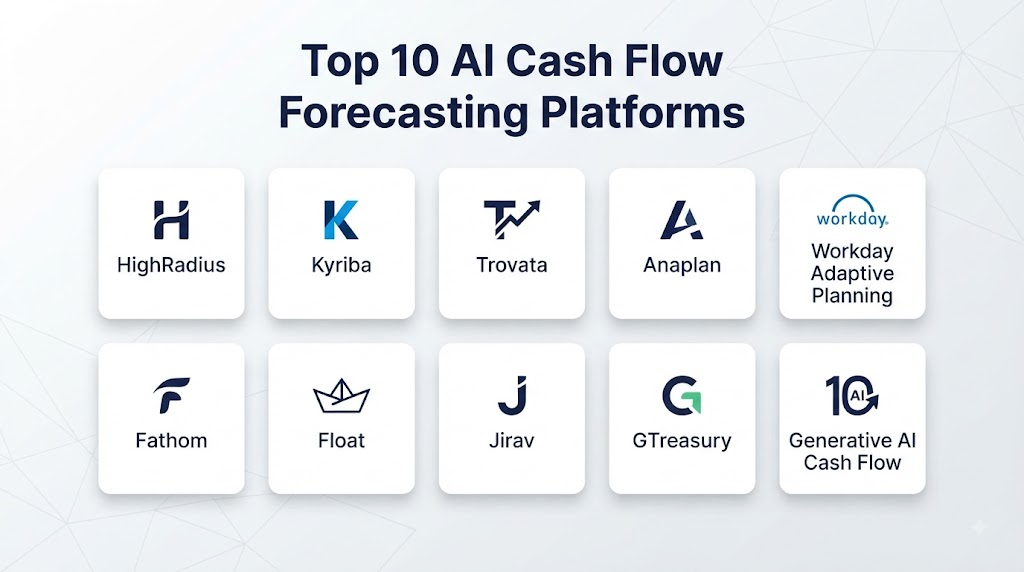
Top 10 AI Cash Flow Forecasting Platforms
1. CashAnalytics
CashAnalytics focuses on cash-flow forecasting and treasury visibility, helping organizations understand future liquidity positions.
Key Features
- Cash-flow forecasting
- Liquidity reporting
- Bank integration
- Forecast automation
- Variance analysis
- Treasury reporting
Pros
- Strong cash forecasting focus
- Useful treasury capabilities
- Automated financial data collection
- Good liquidity visibility
Cons
- Primarily focused on cash and treasury processes
- Advanced enterprise implementations may require configuration
2. Tesorio
Tesorio provides cash-flow forecasting and working-capital management capabilities with a strong focus on receivables and expected customer payments.
Key Features
- Cash forecasting
- Payment prediction
- AR analytics
- Customer payment intelligence
- Working-capital insights
- Financial dashboards
Pros
- Strong cash-flow focus
- Useful predictive analytics
- Good AR integration
- Finance-oriented dashboards
Cons
- Data quality can influence forecasting performance
- Organizations requiring comprehensive FP&A may need additional tools
3. HighRadius
HighRadius provides financial automation across accounts receivable, treasury, collections, cash management, and order-to-cash operations.
Key Features
- Cash forecasting
- Payment prediction
- Collections automation
- Treasury management
- AR analytics
- Working-capital optimization
Pros
- Broad financial automation
- Strong enterprise capabilities
- Advanced AR and cash-management functionality
- Useful predictive analytics
Cons
- Implementation can be complex
- Best suited to organizations with mature finance operations
4. Jirav
Jirav provides financial planning, forecasting, budgeting, and reporting capabilities designed for finance teams and growing organizations.
Key Features
- Cash-flow forecasting
- Budgeting
- Financial planning
- Scenario analysis
- Dashboards
- Financial reporting
Pros
- Strong FP&A capabilities
- Useful scenario planning
- Accessible financial dashboards
- Good forecasting workflows
Cons
- May require configuration for complex financial environments
- Advanced treasury functionality may require additional systems
5. Planful
Planful provides financial planning and performance-management capabilities that can support cash-flow forecasting and scenario analysis.
Key Features
- Cash forecasting
- Financial planning
- Budgeting
- Scenario modeling
- Reporting
- Financial consolidation
Pros
- Strong FP&A platform
- Good planning capabilities
- Useful scenario analysis
- Enterprise scalability
Cons
- Implementation may require specialist knowledge
- Broader platform can require significant configuration
6. Pigment
Pigment provides connected planning and financial modeling capabilities that can support cash-flow forecasting and scenario planning.
Key Features
- Financial forecasting
- Cash-flow planning
- Scenario modeling
- Budgeting
- Business planning
- Dashboards
Pros
- Flexible planning environment
- Strong scenario modeling
- Modern user experience
- Useful collaborative planning
Cons
- Requires well-structured financial data
- More focused on planning than dedicated treasury management
7. Anaplan
Anaplan provides enterprise planning and modeling capabilities for finance and business operations.
Key Features
- Financial forecasting
- Cash-flow planning
- Scenario analysis
- Enterprise planning
- Workforce planning
- Financial modeling
Pros
- Highly flexible planning platform
- Strong enterprise scalability
- Extensive scenario capabilities
- Supports complex business models
Cons
- Implementation can be complex
- Requires skilled configuration and administration
8. Kyriba
Kyriba provides treasury and financial management capabilities, including cash forecasting, liquidity management, risk management, and payments.
Key Features
- Cash forecasting
- Liquidity management
- Treasury management
- Risk management
- Bank connectivity
- Financial analytics
Pros
- Strong treasury capabilities
- Excellent liquidity management focus
- Enterprise-grade functionality
- Extensive financial connectivity
Cons
- More complex than basic forecasting platforms
- Enterprise implementations may require significant resources
9. Runway
Runway provides financial planning and forecasting capabilities designed to help companies model financial performance and business scenarios.
Key Features
- Cash-flow forecasting
- Financial modeling
- Scenario planning
- Budgeting
- Reporting
- Business planning
Pros
- Strong financial planning capabilities
- Useful scenario modeling
- Good collaboration
- Modern planning experience
Cons
- Primarily focused on financial planning
- Treasury-specific requirements may require additional tools
10. Float
Float provides cash-flow forecasting, budgeting, and financial planning capabilities for businesses seeking greater visibility into future cash positions.
Key Features
- Cash-flow forecasting
- Budgeting
- Scenario planning
- Financial dashboards
- Forecast comparison
- Reporting
Pros
- Easy-to-understand forecasting
- Useful cash-flow visibility
- Good budgeting capabilities
- Suitable for growing businesses
Cons
- Advanced enterprise treasury requirements may exceed its focus
- Forecast quality depends on underlying financial data
Comparison Table
| Platform | Cash Forecasting | AI/Prediction | Scenario Planning | Treasury | AR/AP Integration | Reporting | Scalability |
|---|---|---|---|---|---|---|---|
| CashAnalytics | Strong | Strong | Strong | Strong | Strong | Strong | Strong |
| Tesorio | Strong | Strong | Strong | Moderate | Strong | Strong | Strong |
| HighRadius | Strong | Strong | Strong | Strong | Strong | Strong | Strong |
| Jirav | Strong | Strong | Strong | Moderate | Strong | Strong | Strong |
| Planful | Strong | Strong | Strong | Moderate | Strong | Strong | Strong |
| Pigment | Strong | Strong | Strong | Moderate | Strong | Strong | Strong |
| Anaplan | Strong | Strong | Strong | Strong | Strong | Strong | Strong |
| Kyriba | Strong | Strong | Strong | Strong | Strong | Strong | Strong |
| Runway | Strong | Strong | Moderate | Moderate | Strong | Strong | Strong |
| Float | Strong | Strong | Strong | Moderate | Strong | Strong | Moderate |
Weighted Evaluation Table
| Platform | Forecasting 20% | AI Prediction 15% | Scenario Planning 15% | Treasury 15% | Integrations 10% | Reporting 10% | Ease of Use 5% | Scalability 10% | Total |
|---|---|---|---|---|---|---|---|---|---|
| CashAnalytics | 20 | 15 | 14 | 15 | 10 | 9 | 4 | 10 | 97 |
| Tesorio | 20 | 15 | 13 | 12 | 10 | 9 | 5 | 9 | 93 |
| HighRadius | 20 | 15 | 15 | 15 | 10 | 10 | 4 | 10 | 99 |
| Jirav | 19 | 14 | 15 | 11 | 9 | 9 | 5 | 9 | 91 |
| Planful | 19 | 14 | 15 | 12 | 10 | 10 | 4 | 10 | 94 |
| Pigment | 19 | 14 | 15 | 11 | 9 | 9 | 5 | 9 | 91 |
| Anaplan | 20 | 14 | 15 | 14 | 10 | 10 | 3 | 10 | 96 |
| Kyriba | 20 | 15 | 14 | 15 | 10 | 10 | 3 | 10 | 97 |
| Runway | 18 | 14 | 14 | 10 | 9 | 9 | 5 | 9 | 88 |
| Float | 18 | 13 | 14 | 10 | 9 | 9 | 5 | 8 | 86 |
How to Choose the Right AI Cash Flow Forecasting Platform
Choose CashAnalytics if dedicated cash forecasting and treasury visibility are your main priorities.
Choose Tesorio if you want cash forecasting closely connected with accounts receivable and customer payment intelligence.
Choose HighRadius if you need enterprise cash forecasting integrated with AR, collections, treasury, and broader financial automation.
Choose Jirav if financial planning, budgeting, forecasting, and scenario analysis are your main requirements.
Choose Planful for enterprise FP&A, financial planning, and cash-flow modeling.
Choose Pigment if collaborative planning and flexible financial modeling are important.
Choose Anaplan if your organization requires highly flexible enterprise planning and complex scenario modeling.
Choose Kyriba if treasury, liquidity, cash management, and financial risk are central to your requirements.
Choose Runway if you need modern financial planning and scenario modeling capabilities.
Choose Float if straightforward cash-flow forecasting and budgeting are your primary needs.
Common Mistakes
- Relying entirely on historical data
- Ignoring accounts receivable payment behavior
- Ignoring accounts payable timing
- Failing to update forecasts regularly
- Treating AI predictions as guaranteed outcomes
- Using inaccurate or incomplete financial data
- Ignoring seasonality
- Failing to model different business scenarios
- Not comparing forecasts with actual results
- Failing to investigate major forecast variances
FAQs
1. What are AI Cash Flow Forecasting Platforms?
They use AI, machine learning, predictive analytics, and financial data to estimate future cash inflows, outflows, and balances.
2. Can AI predict future cash balances?
Yes. AI can analyze historical transactions, expected receivables, planned payments, and other financial information to estimate future cash positions.
3. Can AI cash forecasting replace spreadsheets?
It can significantly reduce spreadsheet dependency by automating financial data collection, forecasting, reporting, and scenario analysis.
4. What data is needed for AI cash forecasting?
Common data sources include bank transactions, accounts receivable, accounts payable, invoices, payment histories, budgets, expenses, and revenue forecasts.
5. Can these platforms forecast cash across multiple entities?
Many enterprise platforms support multi-entity forecasting and consolidated liquidity analysis.
6. Can AI cash forecasting account for late customer payments?
Yes. Platforms that incorporate payment behavior can adjust expected cash inflows based on historical customer payment patterns.
7. How does scenario planning help cash forecasting?
Scenario planning allows finance teams to evaluate the potential impact of changes in revenue, costs, collections, hiring, investments, or other business assumptions.
8. Can cash-flow forecasting tools integrate with ERP systems?
Yes. Many platforms integrate with ERP, accounting, banking, and financial-management systems.
9. Are AI cash-flow forecasts always accurate?
No. Forecast accuracy depends on data quality, historical patterns, assumptions, and unexpected business events.
10. What is the future of AI cash-flow forecasting?
The market is moving toward continuous forecasting, real-time financial data, predictive payment intelligence, autonomous scenario analysis, liquidity optimization, and integrated treasury management.
Conclusion
AI Cash Flow Forecasting Platforms are helping finance teams move from static, spreadsheet-driven forecasts toward more dynamic and predictive financial planning. By analyzing historical transactions, customer payment behavior, supplier obligations, bank activity, budgets, and other financial information, these platforms can provide a more comprehensive view of future liquidity.CashAnalytics, Tesorio, HighRadius, Jirav, Planful, Pigment, Anaplan, Kyriba, Runway, and Float serve different organizational requirements, from dedicated cash forecasting to comprehensive enterprise planning and treasury management.The best choice depends on business size, financial complexity, forecasting horizon, ERP environment, treasury requirements, number of entities, and the level of scenario modeling required.Organizations should also recognize that AI forecasting is only as reliable as the financial information and assumptions behind it. Finance teams should continuously compare predicted results with actual cash movements and refine their models accordingly.