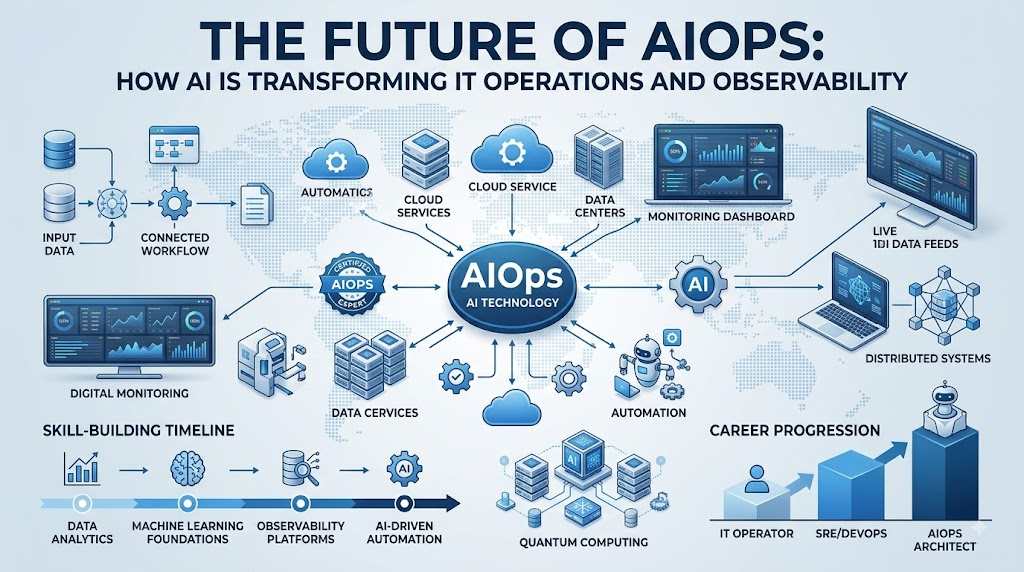
Modern enterprise IT systems have transformed drastically over the past decade. Today, organizations operate distributed cloud infrastructures, hybrid environments, multi-cloud platforms, microservices, container clusters, complex APIs, real-time data pipelines, and third-party SaaS integrations. These environments generate an overwhelming volume of operational telemetry: logs, metrics, traces, events, and alerts. Traditional monitoring tools can indicate that a component is failing, but they rarely explain why or what might happen next. Understanding the future of AIOps in IT operations is essential for engineering teams navigating this shift. As outlined across practical training platforms like AIOpsSchool.com, modern AIOps combines telemetry ingestion, statistical analytics, machine learning, event correlation, and policy-driven automation to reduce noise and accelerate remediation. This guide examines the core concepts of AIOps, its current production capabilities, and emerging trends—such as generative AI interfaces, agentic operational loops, and predictive capacity planning.
What Is AIOps?
AIOps stands for Artificial Intelligence for IT Operations. It applies artificial intelligence, machine learning (ML), statistical modeling, advanced data analytics, and automation to modern IT operational workflows.
+-------------+      +------------------+      +-------------+      +------------------+      +------------+
|   IT Data   | ---> |  AI/ML Analysis  | ---> |   Insight   | ---> | Decision Support | ---> | Automation |
+-------------+      +------------------+      +-------------+      +------------------+      +------------+
- IT Data: Unified collection of metrics, events, logs, and distributed traces.
- AI/ML Analysis: Pattern recognition, statistical baselining, and event grouping.
- Insight: Identification of true anomalies and filtered incidents.
- Decision Support: Probable root-cause ranking and remediation recommendations.
- Automation: Policy-governed execution of runbooks and self-healing scripts.
AIOps is not a single off-the-shelf software product, nor is it an immediate replacement for IT engineers. It is an evolving set of architectures, practices, and data pipelines designed to augment human operators by handling high-volume telemetry processing.
Why the Future of AIOps Matters
IT operations are growing increasingly difficult to manage manually due to several converging pressures:
- Infrastructure Complexity: Ephemeral containers, serverless functions, and microservice meshes create dynamic dependencies that render static configuration maps obsolete.
- Telemetry Volume: Modern systems produce millions of telemetry records every minute, far exceeding human cognitive capacity.
- Rapid Deployment Cycles: Continuous Integration and Continuous Deployment (CI/CD) pipelines push updates continuously, introducing frequent environmental variables.
- Alert Fatigue: On-call engineers are inundated with redundant notifications, leading to delayed responses to critical outages.
- Cost & SLA Pressures: Businesses demand near-zero downtime while optimizing cloud infrastructure budgets.
The primary objective of AIOps is not to deploy additional monitoring dashboards, but to extract actionable intelligence from the operational data already being collected.
Evolution of IT Operations
IT operations have progressed through several distinct evolutionary stages:
+-----------------------------------------------------------------------------------+
| Stage 1: Manual Operations (Log inspection, manual triage)                        |
+-----------------------------------------------------------------------------------+
                                          │
                                          ▼
+-----------------------------------------------------------------------------------+
| Stage 2: Traditional Monitoring (Static thresholds, component-level alerts)       |
+-----------------------------------------------------------------------------------+
                                          │
                                          ▼
+-----------------------------------------------------------------------------------+
| Stage 3: Observability (Correlated telemetry: MELT, distributed tracing)          |
+-----------------------------------------------------------------------------------+
                                          │
                                          ▼
+-----------------------------------------------------------------------------------+
| Stage 4: AIOps (Anomaly detection, noise reduction, probable root-cause ranking)  |
+-----------------------------------------------------------------------------------+
                                          │
                                          ▼
+-----------------------------------------------------------------------------------+
| Stage 5: Intelligent & Agentic Operations (Interactive assistants, autonomous loops)|
+-----------------------------------------------------------------------------------+
- Stage 1 – Manual Operations: Engineers manually log into individual servers, inspect files, and diagnose outages after receiving user reports.
- Stage 2 – Traditional Monitoring: Toolsets generate alerts when individual components cross static thresholds (e.g., CPU utilization exceeds 85%).
- Stage 3 – Observability: Teams correlate metrics, events, logs, and traces (MELT) to understand external system outputs and internal states.
- Stage 4 – Modern AIOps: Machine learning algorithms aggregate alerts, detect multi-metric anomalies, identify probable root causes, and trigger predefined runbooks.
- Stage 5 – Intelligent / Agentic Operations (Emerging): AI systems assist engineers with multi-step incident investigations, draft remediation plans, and execute controlled actions within strict governance boundaries.
Most organizations manage systems across multiple stages simultaneously, using traditional monitoring for legacy workloads alongside observability and AIOps platforms for cloud-native applications.
AIOps Today vs. Future AIOps
| Operational Capability | AIOps Today (Current Production Reality) | Future Direction (Emerging Possibilities) |
| Monitoring | Centralized aggregation of multi-cloud metrics, logs, and traces. | Continuous semantic understanding of full-stack application health. |
| Anomaly Detection | Statistical baselines dynamic to historical single-metric behavior. | Deep multivariate anomaly correlation across distributed services. |
| Event Correlation | Rule-assisted and algorithmic clustering of related alerts. | Topology-aware causal graphs constructed dynamically in real time. |
| Root-Cause Analysis | Ranks candidate explanations and probable causal factors. | Automated hypothesis generation combining telemetry, code diffs, and change logs. |
| Incident Response | Triggers static runbooks, webhook alerts, and ticketing workflows. | Proactively generates remediation blueprints and blast-radius assessments. |
| Automation | Deterministic scripts triggered by verified threshold events. | Policy-bounded agentic workflows executing multi-stage mitigations. |
| Interaction | Dashboards, structured queries, and basic chat notifications. | Context-aware natural language interfaces for real-time querying. |
| Self-Healing | Low-risk actions (e.g., pod restarts, cache invalidations). | Complex, verified state recovery across distributed dependencies. |
| Predictive Analytics | Basic threshold forecasting for capacity and disk usage. | Early degradation forecasting across multi-service business paths. |
| AI Agents | Narrow, single-task automated bots. | Coordinated, multi-agent systems observing, planning, and verifying actions. |
| Human Involvement | Continuous human-in-the-loop triage, approval, and execution. | Strategic oversight, policy definition, and validation of high-impact decisions. |
Intelligent Observability
Observability and AIOps serve complementary roles in modern IT reliability:
+------------------------------------------------------------------+
|                   Observability Pipeline                         |
|   [Metrics]  [Logs]  [Traces]  [Events]  [Profiles]  [Topology]  |
+------------------------------------------------------------------+
                                 │
                                 ▼ (Raw Structured Telemetry)
+------------------------------------------------------------------+
|                        AIOps Engine                              |
|   [Pattern Recognition]  [Noise Reduction]  [Inference Engine]   |
+------------------------------------------------------------------+
                                 │
                                 ▼
+------------------------------------------------------------------+
|               Actionable Engineering Intelligence                |
+------------------------------------------------------------------+
Observability exposes the internal states of complex systems based on their external telemetry: metrics, logs, traces, profiles, network metadata, and dependency maps.
AIOps applies machine learning and statistical models to this data fabric. While observability provides the operational context, AIOps handles the automated analysis needed to identify system degradation without requiring manual dashboard triage.
Predictive IT Operations
Modern operations are shifting across three major paradigms:
Reactive (Post-Failure)  ───►  Proactive (Early Warning)  ───►  Predictive (Pattern-Based)
"System is down; fix it"       "Memory is high; check it"       "Degradation predicted in 2h"
- Reactive: The system experiences an outage, an alert fires, and engineers assemble to troubleshoot the failure.
- Proactive: Monitoring flags that a metric is approaching a threshold, allowing engineers to intervene before a hard failure occurs.
- Predictive: Machine learning models identify subtle patterns—such as non-linear memory leaks, queuing delays, or seasonal traffic surges—that suggest a failure condition is likely to emerge.
Operational Reality: Predictive models are probabilistic rather than deterministic. A prediction represents a calculated likelihood based on historical patterns, meaning human validation and verification guardrails remain essential.
AI-Powered Anomaly Detection
Traditional monitoring systems rely on static thresholds (e.g., alert if database latency exceeds 200 ms). However, modern workloads fluctuate with normal business cycles:
Traffic Load
   ^
   |        /\            /\   <-- Normal Peak Load
   |       /  \          /  \
   |  /\  /    \    /\  /    \
   | /  \/      \  /  \/      \
   +----------------------------> Time
     Dynamic Baseline Adapts to Seasonality
Static rules generate false positives during regular peak hours and miss real degradation that occurs during off-peak windows.
AIOps platforms construct dynamic baselines using historical time-series data. By factoring in diurnal, weekly, and seasonal cycles, these systems detect true anomalies—such as unusual latency spikes relative to current traffic—while suppressing alerts during predictable load shifts.
Smarter Event Correlation
When an enterprise service degrades, a single underlying failure can trigger an alert storm across multiple layers of the technology stack:
                     +---------------------------+
                     | Database Disk Space Full  |  <-- Root Issue
                     +---------------------------+
                                   │
       ┌───────────────────────────┼───────────────────────────┐
       ▼                           ▼                           ▼
[Database Latency Alert]  [API Timeout Error]      [Microservice Pod Crash]
       │                           │                           │
       ▼                           ▼                           ▼
[Ingress 504 Gateway Alert] [Payment Failure Alert] [Queue Depth Alert]
       └───────────────────────────┬───────────────────────────┘
                                   │
                                   ▼
                      Without AIOps: 6 Pager Alerts
                     With AIOps: 1 Correlated Incident
Without event correlation, on-call engineers receive six separate alerts and may initiate multiple independent triage streams.
AIOps platforms process these incoming telemetry streams through topology-aware correlation engines. By evaluating timestamps, dependency graphs, and historical incident patterns, the platform aggregates hundreds of related signals into a single incident entity, identifying the likely source and reducing alert noise.
AI-Assisted Root Cause Analysis
Modern root cause analysis (RCA) tools combine multiple operational inputs to construct evidence-based hypotheses during an incident:
[System Logs]           ──┐
[Performance Metrics]   ──┤
[Distributed Traces]    ──┼──►  [ AIOps Ingestion & Graph Analysis ]
[Recent Code Commits]   ──┤                    │
[Config Changes]        ──┘                    ▼
                                 Evidence-Based Hypothesis:
                                 "85% confidence: Database connection pool
                                  exhaustion following Deployment v2.4.1"
AIOps platforms evaluate these sources to generate candidate explanations ranked by probability.
Important Boundary: AI systems generate evidence-based hypotheses, not absolute certainties. Operational teams should treat automated RCA outputs as candidate explanations that require validation before executing remediation steps on production systems.
Generative AI in AIOps
Large Language Models (LLMs) and generative AI introduce conversational and contextual capabilities to IT operations workflows.
+--------------------------------------------------------------------------------+
| User: "Why did payment checkout latency spike in region us-east-1 at 14:00?"   |
+--------------------------------------------------------------------------------+
                                       │
                                       ▼
+--------------------------------------------------------------------------------+
| Generative AI Operational Assistant:                                          |
| "Telemetry analysis indicates a 300ms latency increase across the payment-api  |
| service between 14:00 and 14:15 UTC. Correlated events show:                   |
|  1. Deployment #481 completed at 13:58 UTC.                                    |
|  2. Downstream database lock contention increased by 42%.                      |
| Candidate cause: Unindexed query introduced in deployment #481."               |
+--------------------------------------------------------------------------------+
Key applications of Generative AI in IT operations include:
- Telemetry Explanations: Translating complex stack traces and log dumps into plain-language incident briefs.
- Contextual Querying: Allowing engineers to query system status and telemetry using natural language.
- Runbook Generation: Drafting step-by-step remediation procedures based on historical post-mortems and system documentation.
- Post-Mortem Summaries: Compiling timelines, affected services, and mitigation steps into draft incident reports.
All AI-generated explanations and remediation scripts should be reviewed by qualified engineers prior to production execution.
Agentic AIOps
Agentic operations represent a structural evolution beyond passive query-and-response interfaces. An operational AI agent operates within a continuous reasoning loop:
  +----------> [ Observe: Ingest telemetry, alerts, and topology ]
  |                                   │
  |                                   ▼
  |            [ Reason: Formulate evidence-based hypothesis ]
  |                                   │
  |                                   ▼
  |            [ Plan: Construct multi-step remediation path ]
  |                                   │
  |                                   ▼
  |            [ Act: Execute policy-approved runbook actions ]
  |                                   │
  |                                   ▼
  +----------- [ Verify: Confirm metric recovery; escalate if failed ]
Operational Autonomy Levels
- AI-Assisted Operations (Standard Practice): The AI gathers telemetry, correlates alerts, and presents findings. Human engineers make all decisions and execute every action.
- Controlled Autonomous Operations (Emerging): The AI executes predefined, low-risk operational runbooks within strict policy boundaries (e.g., cycling unhealthy container replicas).
- Highly Autonomous Operations (Future Direction): The AI autonomously reasons through novel multi-service incidents, formulates complex mitigation plans, and adapts execution based on dynamic feedback. This remains an area of ongoing research and development.
Self-Healing IT Infrastructure
Self-healing infrastructure uses closed-loop automation to resolve routine, well-understood operational faults without requiring manual intervention:
[ 1. Anomaly Detected ] ──► [ 2. Verification & Blast Analysis ]
                                         │
                                         ▼
[ 4. Health Confirmation ] ◄── [ 3. Safe Remediation Execution ]
          │
          └──► (If verification fails) ──► [ Immediate Human Escalation ]
Common examples of self-healing automation in production include:
- Restarting stalled worker threads or failed container pods.
- Scaling compute capacity in response to transient queue backlogs.
- Removing unhealthy instances from load balancer target groups.
- Purging temporary caches when storage thresholds are crossed.
Mature self-healing requires reliable telemetry, verified rollback steps, and clear escalation policies. Automated systems should escalate to human operators whenever an action fails to restore normal operation.
Predictive Capacity Management
Capacity planning has traditionally relied on static spreadsheets and periodic manual reviews. AIOps introduces automated forecasting across compute, memory, storage, and network resources:
Historical Telemetry ──► Trend & Seasonality Analysis ──► Predictive Forecast ──► Automated Scaling Advice
- Resource Shortage Prevention: Detects non-linear storage consumption patterns weeks before disks reach capacity.
- Cost Optimization: Flags over-provisioned cloud instances and suggests rightsizing adjustments based on actual workload metrics.
- Workload-Aware Scaling: Aligns capacity provisioning with anticipated business events and seasonal traffic spikes.
Because automated projections can be affected by unexpected business changes or data anomalies, capacity forecasts should be regularly reviewed against actual operational requirements.
Intelligent Cloud Operations
Managing hybrid and multi-cloud architectures introduces significant operational complexity:
- Telemetry Silos: AWS, Azure, Google Cloud, and on-premises systems generate telemetry in different formats.
- Cross-Cloud Dependencies: An application hosted in one cloud may depend on databases or APIs hosted in another.
- Dynamic Cost Structures: Ephemeral resources and variable pricing make operational expenditures hard to track.
AIOps bridges these platforms by normalizing multi-cloud data streams into a unified operational view. This provides cross-platform dependency mapping, centralized anomaly detection, and unified performance optimization.
AIOps and DevOps
+------------------------------------+------------------------------------+
|               DevOps               |               AIOps                |
|  "Build, Test, and Deploy Fast"    |   "Observe, Understand, and Scale" |
+------------------------------------+------------------------------------+
| • Continuous Integration (CI)      | • Noise reduction & correlation    |
| • Continuous Delivery (CD)         | • Real-time anomaly detection      |
| • Infrastructure as Code (IaC)     | • Automated incident intelligence  |
| • Culture of shared delivery       | • Production reliability analysis  |
+------------------------------------+------------------------------------+
AIOps does not replace DevOps. Instead, the two disciplines complement each other: DevOps provides the practices for continuous software delivery, while AIOps provides the operational intelligence needed to monitor and stabilize complex production environments.
AIOps and SRE
Site Reliability Engineering (SRE) applies software engineering principles to infrastructure and operations problems. AIOps complements SRE workflows by:
- Protecting Error Budgets: Identifying early service degradation before Service Level Objectives (SLOs) are breached.
- Toil Reduction: Automating repetitive diagnostic steps, alert triage, and low-risk remediation runbooks.
- Incident Analysis: Correlating telemetry across distributed systems to accelerate Mean Time to Resolution (MTTR).
AIOps provides the analytical tooling to process telemetry at scale, allowing SREs to focus on architectural improvements, resilience engineering, and governance.
AIOps and ITSM
Modern IT Service Management (ITSM) systems benefit directly from AIOps integration:
[ AIOps Ingestion & Correlation ]
               │
               ▼
[ Deduplicate Alerts into Single Incident ]
               │
               ▼
[ Auto-Enrich ITSM Ticket with Logs, Traces, & Impacted Users ]
               │
               ▼
[ Route to Correct Team with Ranked Solution Recommendations ]
- Automated Ticket Categorization: Groups related alerts into a single incident record to prevent service desk duplication.
- Context Enrichment: Automatically attaches relevant logs, metrics, topology maps, and change histories to incident tickets.
- Problem Management: Identifies recurring operational patterns across historical records to support proactive problem investigations.
Business-Aware AIOps
IT operations are increasingly evaluated based on business outcomes rather than infrastructure metrics alone.
Traditional Technical Alert:
"Warning: Host-04b reporting 94% storage utilization and 220ms disk latency."

Business-Aware AIOps Context:
"Warning: Database storage exhaustion is delaying credit-card transaction processing,
 impacting an estimated 450 customer checkouts per minute ($12,000/min business exposure)."
By correlating infrastructure telemetry with business key performance indicators (KPIs)—such as cart conversion rates, checkout latencies, and transaction volumes—AIOps helps engineering teams prioritize incidents based on direct customer and revenue impact.
AIOps for Cybersecurity and SecOps
AIOps and Security Operations (SecOps) share foundational analytical techniques:
- Behavioral Anomaly Detection: Identifies abnormal user activity, unexpected outbound traffic, or unauthorized configuration changes.
- Signal Correlation: Combines infrastructure alerts with security event logs to surface multi-vector incidents.
- Investigation Context: Provides security analysts with infrastructure topology and execution traces to accelerate threat triage.
While AIOps tools surface operational and telemetry anomalies, dedicated Security Information and Event Management (SIEM) and Extended Detection and Response (XDR) platforms remain necessary for comprehensive threat defense and policy enforcement.
AIOps and FinOps
Cloud financial operations (FinOps) requires balancing cost, performance, and reliability:
                    [ Optimal System Health ]
                               /\
                              /  \
                             /    \
                            /      \
       [ Cost Efficiency ] /________\ [ Performance & Reliability ]
- Idle Asset Detection: Highlights unattached storage volumes, idle load balancers, and over-provisioned clusters.
- Performance-Aware Rightsizing: Recommends instance optimizations based on actual CPU, memory, and network usage profiles.
- Cost Anomaly Detection: Alerts teams to unexpected spending spikes caused by misconfigured jobs or runaway microservice deployments.
Human-in-the-Loop AIOps
The future of AIOps is not an unmonitored autopilot; it is a system designed around human-in-the-loop governance.
+-------------------------------------------------------------------------+
|                              AIOps Layer                                |
|  Telemetry Processing  •  Anomaly Detection  •  Hypothesis Formulation  |
+-------------------------------------------------------------------------+
                                    │
                                    ▼ (Proposes Candidates)
+-------------------------------------------------------------------------+
|                           Human Engineering                             |
|    Critical Thinking  •  Risk Evaluation  •  Strategic Governance       |
+-------------------------------------------------------------------------+
High-impact operational actions—such as schema migrations, network routing changes, or rolling back core production deployments—require human review. The AIOps platform correlates evidence and estimates blast radiuses, enabling engineers to make informed decisions quickly.
Explainability and Trust
For engineering teams to trust automated recommendations, AIOps platforms must provide explainable insights rather than opaque outputs:
- Evidence Tracing: Clear links to the specific logs, metrics, and timestamps that led to a conclusion.
- Confidence Scoring: Explicit probability ratings for candidate explanations (e.g., “78% confidence based on deployment #302”).
- Audit Trails: Comprehensive logging of all automated actions, inputs, and policy evaluations.
Clear explainability ensures that engineers can review, understand, and validate recommendations before taking action on production infrastructure.
Data Quality Challenges
AIOps platforms depend directly on the quality of their input data:
Garbage In ──► Corrupted Feature Maps ──► Faulty Inferences ──► Operational Disruption
Common data issues include:
- Missing Telemetry: Services running without standardized tracing or structured logging.
- Clock Skew: Desynchronized timestamps across multi-cloud regions that break event sequencing.
- Inconsistent Schemas: Differing log formats across services that prevent automated parsing.
- Stale Topology Maps: Outdated dependency graphs resulting from unmonitored infrastructure changes.
Maintaining data quality through structured logging and continuous telemetry validation is a foundational prerequisite for AIOps success.
12 Challenges in the Future of AIOps
+------------------------+------------------------+------------------------+
| 1. Data Quality        | 2. Model Accuracy      | 3. False Positives     |
+------------------------+------------------------+------------------------+
| 4. False Negatives     | 5. Explainability      | 6. Automation Risk     |
+------------------------+------------------------+------------------------+
| 7. Security Concerns   | 8. Data Privacy        | 9. Integration Gaps    |
+------------------------+------------------------+------------------------+
| 10. Skills Shortages   | 11. Vendor Lock-In     | 12. Organizational Trust|
+------------------------+------------------------+------------------------+
- Data Quality: Fragmented, noisy, or unformatted logs degrade model accuracy.
- Model Accuracy: Models trained on normal traffic patterns can fail during novel failure modes.
- False Positives: Frequent non-critical alerts cause engineer fatigue and reduce platform trust.
- False Negatives: Over-tuned filters can miss subtle, high-impact failure indicators.
- Explainability: Opaque recommendations make it difficult for engineers to validate automated suggestions.
- Automation Risk: Faulty runbooks executed at scale can worsen an existing outage.
- Security Concerns: AIOps platforms require broad telemetry access, making them high-value targets.
- Data Privacy: Telemetry pipelines must prevent personally identifiable information (PII) from being ingested.
- Integration Complexity: Unifying legacy systems, modern clouds, and distinct tooling requires ongoing maintenance.
- Skills Shortages: AIOps requires a blended understanding of software engineering, infrastructure, and data science.
- Vendor Lock-In: Proprietary analytics engines can make migrating between observability backends difficult.
- Organizational Trust: Adopting automation requires cultural alignment, transparent guardrails, and gradual rollout phases.
Risks of Excessive Automation
Unchecked automation in complex distributed systems can introduce compounding failures:
- Compounding Failures: An automated reboot script executed across multiple nodes during a network partition can cause a full cluster outage.
- Flapping States: Misconfigured automation can cause resources to continuously scale up and down in an unstable loop.
- Masked Root Causes: Automated self-healing can repeatedly clean up symptoms (such as clearing a full disk) while leaving the underlying leak unresolved.
Safe automation requires strict rate limits, approval guardrails, blast-radius boundaries, and automated health verification checks.
AIOps Architecture of the Future
+-------------------------------------------------------------------------------+
| Layer 1: Telemetry Sources (Hybrid Cloud, Kubernetes, APIs, Microservices)    |
+-------------------------------------------------------------------------------+
                                       │
                                       ▼
+-------------------------------------------------------------------------------+
| Layer 2: Ingestion, Normalization, and OpenTelemetry Processing               |
+-------------------------------------------------------------------------------+
                                       │
                                       ▼
+-------------------------------------------------------------------------------+
| Layer 3: Observability Platform & Unified Data Lake                           |
+-------------------------------------------------------------------------------+
                                       │
                                       ▼
+-------------------------------------------------------------------------------+
| Layer 4: AI/ML Analytics, Correlation, and Anomaly Detection Engine          |
+-------------------------------------------------------------------------------+
                                       │
                                       ▼
+-------------------------------------------------------------------------------+
| Layer 5: Generative AI & Agentic Reasoning Layer                             |
+-------------------------------------------------------------------------------+
                                       │
                                       ▼
+-------------------------------------------------------------------------------+
| Layer 6: Policy, Governance, and Human Approval Interface                     |
+-------------------------------------------------------------------------------+
                                       │
                                       ▼
+-------------------------------------------------------------------------------+
| Layer 7: Automation Execution (Runbooks, Orchestrators, APIs)                 |
+-------------------------------------------------------------------------------+
                                       │
                                       ▼
+-------------------------------------------------------------------------------+
| Layer 8: Verification, Observability Feedback, and Continuous Model Training  |
+-------------------------------------------------------------------------------+
- Layer 1 (Sources): All infrastructure, platforms, applications, and networks emitting operational signals.
- Layer 2 (Ingestion & Normalization): Edge pipelines that clean, structure, and standardize telemetry using open standards like OpenTelemetry.
- Layer 3 (Data Platform): High-throughput data storage providing unified access to real-time and historical telemetry.
- Layer 4 (AI/ML Engine): Statistical and machine learning models performing event grouping, noise reduction, and anomaly detection.
- Layer 5 (Generative & Agentic Layer): Contextual models providing natural language querying, synthesis, and workflow planning.
- Layer 6 (Governance Engine): Policy frameworks defining execution permissions, required human sign-offs, and blast-radius constraints.
- Layer 7 (Automation Layer): Orchestration engines that execute configuration updates, pod restarts, and runbook tasks.
- Layer 8 (Feedback & Learning): Continuous monitoring of automated actions to verify recovery and refine future model accuracy.
AIOps Maturity Model
+-------------------------------------------------------------------------+
| Level 5: Controlled Autonomous Operations (Policy-bounded auto-healing) |
+-------------------------------------------------------------------------+
                                    ▲
+-------------------------------------------------------------------------+
| Level 4: Predictive Operations (Proactive capacity & risk modeling)     |
+-------------------------------------------------------------------------+
                                    ▲
+-------------------------------------------------------------------------+
| Level 3: Intelligent Detection (Dynamic baselines & noise reduction)    |
+-------------------------------------------------------------------------+
                                    ▲
+-------------------------------------------------------------------------+
| Level 2: Automated Monitoring (Threshold alerting & scripted workflows) |
+-------------------------------------------------------------------------+
                                    ▲
+-------------------------------------------------------------------------+
| Level 1: Manual Operations (Static checks, reactive log inspection)     |
+-------------------------------------------------------------------------+
- Level 1 – Manual: Reactive firefighting relying on manual log searches and user-reported outages.
- Level 2 – Automated Monitoring: Basic infrastructure monitors with static thresholds and disconnected alert tools.
- Level 3 – Intelligent Detection: Centralized observability with dynamic baselines, anomaly detection, and automated alert correlation.
- Level 4 – Predictive Operations: Proactive trend analysis, evidence-based root-cause assistance, and automated incident enrichment.
- Level 5 – Controlled Autonomous Operations: Policy-governed agentic workflows and closed-loop self-healing for standard operational scenarios.
Skills Needed for the Future of AIOps
Succeeding in an AIOps-driven organization requires combining systems operations knowledge with data and automation skills:
- Core Infrastructure: Linux internals, networking fundamentals, and container orchestration (e.g., Kubernetes).
- Cloud & DevOps: Terraform, CI/CD pipelines, GitOps workflows, and cloud architecture patterns.
- Observability Engineering: OpenTelemetry instrumentation, structured logging, distributed tracing, and metric collection.
- Scripting & Data Analysis: Python, SQL, REST APIs, and time-series data analysis.
- AI & Machine Learning Concepts: Understanding classification, clustering, anomaly detection, and statistical baselining.
- Operational Governance: SLO/SLA management, incident management frameworks, and safe automation practices.
Beginner Roadmap for Learning Future AIOps
[ Step 1: IT & Systems Fundamentals (Linux, Networking, Storage) ]
                            │
                            ▼
[ Step 2: Cloud Infrastructure & Containerization (Docker, Kubernetes) ]
                            │
                            ▼
[ Step 3: Observability Concepts (OpenTelemetry, Prometheus, Logs, Traces) ]
                            │
                            ▼
[ Step 4: Python Scripting, APIs, & Automation Frameworks ]
                            │
                            ▼
[ Step 5: Applied Data Analysis & Machine Learning Fundamentals ]
                            │
                            ▼
[ Step 6: Anomaly Detection, Event Correlation, & AIOps Architectures ]
                            │
                            ▼
[ Step 7: LLMs, Operational Agents, & Policy-Governed Automation ]
- Step 1: IT Fundamentals: Master Linux administration, shell scripting, TCP/IP networking, and distributed systems basics.
- Step 2: Cloud & Containers: Learn container deployment with Docker and orchestration with Kubernetes.
- Step 3: DevOps & Observability: Study CI/CD pipelines, metric collection, structured logging, and distributed tracing.
- Step 4: Scripting & Automation: Learn Python to interact with REST APIs, parse operational logs, and automate tasks.
- Step 5: Machine Learning Basics: Understand core statistical concepts, regression, clustering, and time-series analysis.
- Step 6: Anomaly Detection & Correlation: Learn how machine learning models detect outliers and correlate multi-metric events.
- Step 7: Advanced AIOps & Agentic Systems: Explore LLM integration, prompt engineering for operations, and automated runbook governance.
Practical AIOps Projects for Learners
Note: Complete all learning projects in isolated local or sandbox environments.
- Project 1: Time-Series Metric Anomaly Detector: Write a Python script using standard libraries to ingest CPU metrics and flag statistical outliers outside a rolling standard deviation.
- Project 2: Log Clustering and Classifier: Build a pipeline that groups unstructured application logs into distinct semantic patterns to identify novel error messages.
- Project 3: Rule- and ML-Assisted Alert Correlator: Create an ingestion script that groups alerts sharing common hostnames, network paths, and timestamps into single incident summaries.
- Project 4: AI-Powered Incident Summarizer: Build a script using an LLM API that ingests multi-source error logs and generates a concise post-mortem timeline.
- Project 5: Predictive Disk Capacity Dashboard: Construct a time-series model that forecasts disk space exhaustion based on historical growth patterns.
- Project 6: Closed-Loop Self-Healing Demo: Configure an automation pipeline that monitors a local container, flags an unhealthy endpoint, and triggers a controlled container restart with verified status checks.
Preparing Organizations for the Future of AIOps
- Start with Specific Operational Bottlenecks: Focus on high-friction areas such as alert noise or prolonged diagnostic times rather than attempting an immediate enterprise-wide rollout.
- Standardize Telemetry: Adopt vendor-neutral standards like OpenTelemetry to ensure clean, structured telemetry across all services.
- Improve Data Quality: Ensure accurate timestamps, consistent logging formats, and up-to-date dependency mappings.
- Automate Low-Risk Tasks First: Begin automation with safe actions—such as clearing temporary caches or gathering diagnostic logs—before automating remediations.
- Establish Clear Governance: Define which operations require manual approval and implement automated rollback safeguards.
- Measure Operational Outcomes: Track business and operational metrics to validate platform improvements over time.
Metrics for Measuring AIOps Success
- Mean Time to Detect (MTTD): How quickly anomalies are identified relative to previous baseline averages.
- Mean Time to Resolution (MTTR): The average duration required to resolve production outages.
- Alert-to-Incident Ratio: The percentage reduction of raw alerts achieved through correlation and filtering.
- False-Positive Rate: The frequency of non-actionable alerts generated by dynamic baselines.
- Automated Remediation Success Rate: The proportion of routine operational tasks successfully resolved by policy-governed automation.
- Operational Toil Reduction: Engineering hours saved by automating routine triage and data-gathering workflows.
Future Trends in AIOps
+--------------------------------------------------------------------------+
| Emerging & Active Production Trends                                      |
| • OpenTelemetry Standardization       • Dynamic Anomaly Baselining       |
| • Algorithmic Noise Reduction         • Natural Language Post-Mortems    |
+--------------------------------------------------------------------------+
                                     │
                                     ▼
+--------------------------------------------------------------------------+
| Future-Oriented Capabilities (Active Research & Development)             |
| • Multi-Agent Operational Loops       • Business-Impact Path Analysis    |
| • Autonomous Cross-System Healing     • Continuous Multi-Cloud Rightsizing|
+--------------------------------------------------------------------------+
- Generative Operational Interfaces (Emerging): Natural-language interfaces that simplify telemetry queries and summarize active incidents in real time.
- Agentic Workflows (Future-Oriented): Multi-agent systems that autonomously investigate issues, formulate mitigation plans, and execute approved workflows.
- Advanced Self-Healing (Future-Oriented): Closed-loop automation that safely handles complex, multi-service recovery scenarios.
- Predictive Degradation Modeling (Emerging): Advanced time-series analysis that forecasts system failures before they cause user-facing outages.
- Standardized Observability Ingestion (Emerging): Unified ingestion pipelines built on vendor-neutral frameworks like OpenTelemetry.
- Business-Impact Correlation (Future-Oriented): Real-time mapping that connects infrastructure health directly to transaction volumes and customer impact.
- Human-Governed Autonomous Systems (Future-Oriented): Policy and governance engines that provide guardrails for increasingly autonomous IT operations.
AIOps Education with AIOpsSchool.com
As organizations adopt cloud-native architectures, distributed microservices, and AI-assisted workflows, the demand for engineers with practical operational intelligence skills continues to grow.
AIOpsSchool.com provides structured educational resources designed to help engineers understand and implement modern operational practices:
- Core Competencies: Foundational training spanning AIOps principles, MLOps, observability, dynamic anomaly detection, and automated event correlation.
- Practical Learning Paths: Step-by-step curricula covering foundational concepts, engineering practices, and architectural design.
- Modern Operational Paradigms: Educational content exploring the transition from traditional static monitoring to intelligent observability, generative AI interfaces, and safe self-healing architectures.
Frequently Asked Questions (FAQs)
What is the future of AIOps?
The future of AIOps centers on moving from reactive alerting to predictive intelligence, contextual observability, and policy-governed automation. This includes using machine learning for noise reduction, generative AI for natural-language querying, and agentic workflows for automated investigations.
How will AI change IT operations?
AI changes IT operations by automating the collection and analysis of massive telemetry datasets. Instead of manually searching through logs and metrics, engineers receive correlated incident summaries, ranked root-cause hypotheses, and actionable remediation options.
Will AIOps replace IT engineers?
No. AIOps augments engineers by handling repetitive data analysis, reducing alert noise, and automating routine tasks. Human expertise remains necessary for architectural design, critical decision-making, policy governance, and resolving complex edge cases.
What is predictive AIOps?
Predictive AIOps uses statistical and machine learning models to identify patterns that indicate potential failures—such as resource exhaustion, memory leaks, or capacity limits—before they impact end users.
How does Generative AI improve AIOps?
Generative AI provides natural-language interfaces for querying telemetry, translates complex stack traces into clear incident briefs, drafts runbooks, and accelerates post-mortem reporting.
What is agentic AIOps?
Agentic AIOps refers to AI systems that follow an observe-reason-plan-act-verify loop. These agents investigate incidents, gather relevant context, propose remediation steps, and execute policy-approved actions within defined boundaries.
What is self-healing infrastructure?
Self-healing infrastructure uses closed-loop automation to detect, isolate, and remediate known, low-risk failures—such as restarting a stalled pod or cycling an unhealthy instance—and verifies system recovery without requiring manual intervention.
How does AIOps work with DevOps and SRE?
AIOps provides the telemetry analysis and automated intelligence that DevOps and SRE teams need to maintain reliability. It helps protect error budgets, reduces operational toil, and delivers the operational insights needed to support rapid deployment cycles.
What skills are needed for a future AIOps career?
Key skills include Linux administration, networking fundamentals, cloud platforms, Kubernetes, observability tools (such as OpenTelemetry), Python scripting, and a solid understanding of machine learning and time-series data analysis.
Conclusion
The evolution of IT operations moves from reactive monitoring and static thresholds toward unified observability, predictive intelligence, and policy-governed automation. Rather than replacing engineers, modern AIOps provides the critical context and automated correlation teams need to manage complex, distributed architectures at scale. Realizing this potential depends on high-quality telemetry, robust data engineering, dependable guardrails, and strong human governance—making foundational education in observability, machine learning, and automation essential for the next generation of IT operations.