Introduction
AI Employee Attrition Prediction Tools help organizations analyze workforce data to identify patterns associated with employee turnover and potential retention risks. By combining machine learning, predictive analytics, people analytics, and HR data, these platforms can help HR teams understand where workforce stability may be at risk and investigate the factors contributing to employee turnover.These tools are designed to support proactive workforce planning rather than simply reporting historical attrition.AI-based attrition prediction should be used carefully. Predictions should support human investigation and retention planning rather than automatically labeling employees as likely to leave or making employment decisions solely from algorithmic scores.
What Are AI Employee Attrition Prediction Tools?
AI Employee Attrition Prediction Tools use statistical models, machine learning, workforce analytics, and employee data to estimate patterns associated with employee turnover.
Depending on the platform, models may analyze information such as:
- Employee tenure
- Role and department
- Compensation
- Promotion history
- Work location
- Engagement
- Absence patterns
- Manager relationships
- Career progression
- Skills
- Workload
- Historical turnover
The goal is to identify workforce-level patterns and potential drivers of attrition.
For example, an organization might discover that turnover is significantly higher in a particular job family, location, tenure range, or organizational unit. HR leaders can then investigate the underlying causes and design appropriate retention initiatives.
Why Employee Attrition Prediction Matters
Employee turnover can affect recruiting costs, productivity, institutional knowledge, team stability, and workforce planning.
Traditional HR reporting often explains what has already happened. Predictive analytics attempts to provide additional insight into where risks or patterns may emerge.
Potential benefits include:
- Earlier identification of retention challenges
- Better workforce forecasting
- More targeted retention programs
- Improved workforce planning
- Better understanding of turnover drivers
- Identification of organizational hotspots
- Improved HR decision-making
Key Features
Attrition Risk Modeling
AI models can identify patterns associated with employee turnover.
Predictive Workforce Analytics
Platforms can analyze workforce trends and estimate potential future changes.
Turnover Driver Analysis
HR teams can investigate factors correlated with employee departures.
Workforce Segmentation
Organizations can analyze attrition patterns across teams, departments, locations, roles, and other workforce groups.
Retention Analytics
Platforms can help identify areas where retention programs may have the greatest impact.
Employee Engagement Analysis
Some platforms connect engagement information with workforce outcomes.
Scenario Analysis
Organizations can evaluate how changes in workforce conditions may affect retention.
Workforce Dashboards
HR leaders can monitor turnover trends, risk indicators, and workforce patterns.
Predictive Alerts
Some systems can notify HR teams when certain workforce patterns change.
HR System Integration
Platforms can connect information from HRIS, payroll, engagement, recruiting, and workforce systems.
Explainability
More mature systems can provide information about which factors contributed to a prediction or workforce-level risk pattern.
Reporting
HR teams can analyze historical and predicted workforce trends through dashboards and reports.
Common Use Cases
Retention Planning
HR teams can identify departments or workforce segments experiencing elevated turnover patterns.
Workforce Planning
Attrition forecasts can be incorporated into future hiring and capacity planning.
Organizational Analysis
Leaders can investigate whether particular organizational structures or workforce conditions correlate with higher turnover.
Compensation Analysis
Organizations can examine relationships between compensation patterns and employee turnover.
Career Development
HR teams can investigate whether limited career progression is associated with attrition.
Manager Effectiveness
Workforce analytics can help organizations investigate differences in retention patterns across teams.
Engagement Analysis
Employee engagement information can be analyzed alongside turnover patterns.
Strategic HR
People leaders can use predictive workforce intelligence to prioritize retention initiatives.
Benefits
Proactive Workforce Management
Predictive analytics can help organizations identify emerging workforce patterns earlier.
Better Retention Planning
HR teams can focus retention resources on areas where turnover patterns are most concerning.
Improved Workforce Forecasting
Attrition predictions can contribute to workforce demand and hiring forecasts.
Data-Driven Decision Making
HR leaders can supplement traditional workforce reports with predictive analysis.
Identification of Turnover Drivers
Organizations can investigate factors associated with employee departures.
Better Resource Allocation
Retention programs can be prioritized based on measurable workforce patterns.
Challenges
Privacy
Employee data is sensitive and requires appropriate governance and security.
Prediction Accuracy
No predictive model can perfectly determine whether an individual employee will leave.
Bias
Historical workforce data can contain existing organizational biases that models may reproduce.
Explainability
HR leaders need to understand how predictions are generated and what assumptions they depend on.
False Positives
A model may identify an employee or group as high risk even when turnover does not occur.
False Negatives
Employees who eventually leave may not be identified by the model.
Employee Trust
Using predictive employee analytics without transparency can damage trust.
Ethical Concerns
Individual-level predictions can create risks if they are used to treat employees differently.
Data Quality
Incomplete or inconsistent HR data can reduce model reliability.
Over-Reliance on Predictions
AI should support human investigation rather than replace HR judgment.
Evaluation Criteria
AI Employee Attrition Prediction Tools can be evaluated using:
- Predictive analytics
- Attrition forecasting
- Driver analysis
- Workforce segmentation
- Engagement analytics
- Scenario modeling
- Explainability
- Data integration
- Security
- Privacy controls
- Reporting
- Ease of use
- Scalability
- Governance
Key Trends
Predictive People Analytics
HR teams are increasingly moving beyond historical reporting toward predictive workforce analytics.
Explainable AI
Organizations increasingly want to understand the factors behind predictive workforce insights.
Workforce-Level Risk Analysis
Responsible organizations are emphasizing team, department, and organizational patterns rather than automatically labeling individual employees.
Skills-Based Retention
Skills intelligence is increasingly being connected with career development, mobility, and retention strategies.
Engagement and Attrition Correlation
Organizations are analyzing employee engagement alongside turnover trends.
Continuous Monitoring
Modern workforce analytics can support more frequent monitoring instead of annual attrition analysis.
Integrated Workforce Intelligence
Attrition analytics is increasingly connected with workforce planning, talent management, compensation, and employee development.
Responsible Employee Analytics
Privacy, fairness, transparency, access controls, and appropriate use policies are becoming increasingly important.
Methodology
The platforms below were selected based on their relevance to employee attrition analytics, predictive people analytics, workforce intelligence, employee engagement, retention analysis, and HR decision support.
The comparison considers:
- Attrition analytics
- Predictive capabilities
- Workforce intelligence
- Driver analysis
- Reporting
- Integrations
- Explainability
- Ease of use
- Scalability
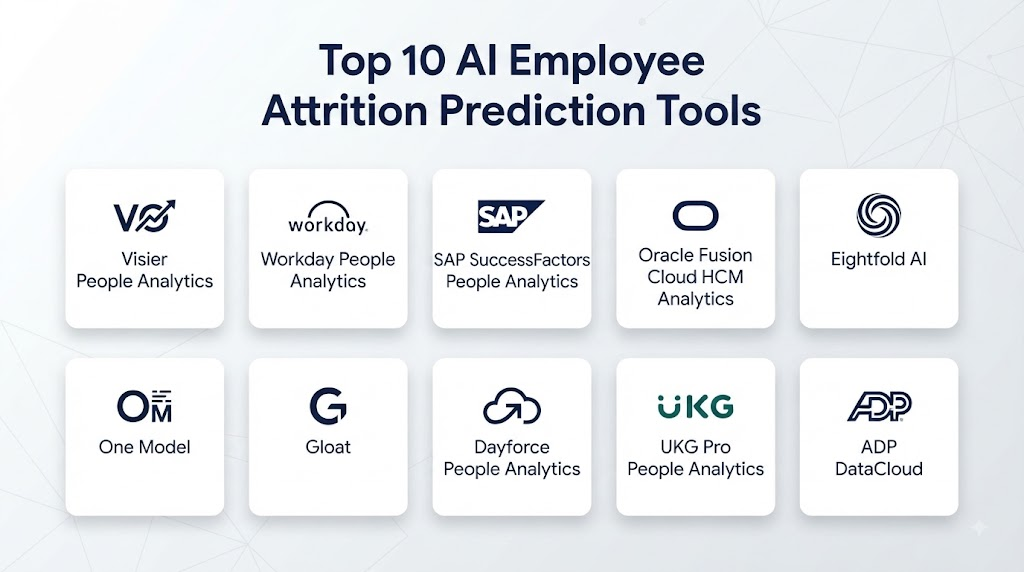
Top 10 AI Employee Attrition Prediction Tools
1. Visier
Visier provides people analytics and workforce intelligence designed to help organizations understand workforce trends, including employee turnover and retention.
Key Features
- Attrition analytics
- Workforce analytics
- Predictive insights
- Employee segmentation
- Retention analysis
- People dashboards
Pros
- Strong people analytics
- Advanced workforce insights
- Useful attrition analysis
- Strong visualization capabilities
Cons
- Advanced analytics can require implementation expertise
- Organizations need reliable HR data for useful predictions
2. Culture Amp
Culture Amp provides employee experience, engagement, performance, and people analytics capabilities that can help organizations investigate factors related to employee retention.
Key Features
- Employee engagement analytics
- Retention insights
- People analytics
- Employee surveys
- Performance insights
- Workforce reporting
Pros
- Strong employee experience capabilities
- Useful engagement analysis
- Good people analytics
- Connects engagement with workforce outcomes
Cons
- More focused on employee experience than dedicated attrition prediction
- Predictive capabilities depend on available workforce data
3. Workday People Analytics
Workday provides people analytics capabilities within its broader human capital management ecosystem.
Key Features
- Workforce analytics
- Attrition analysis
- Employee data analysis
- Workforce reporting
- Talent analytics
- HR dashboards
Pros
- Strong HCM ecosystem
- Broad workforce data access
- Useful enterprise analytics
- Good integration with HR processes
Cons
- Works best within a broader Workday environment
- Advanced analytics may require configuration
4. Oracle Analytics for HCM
Oracle provides workforce analytics and predictive capabilities through its HCM and analytics ecosystem.
Key Features
- Workforce analytics
- Attrition analysis
- Predictive analytics
- Employee insights
- HR dashboards
- HCM integration
Pros
- Strong enterprise ecosystem
- Broad HR data capabilities
- Useful workforce analytics
- Good integration options
Cons
- Enterprise deployment can be complex
- May be more comprehensive than smaller organizations require
5. SAP SuccessFactors People Analytics
SAP SuccessFactors provides people analytics capabilities within its broader HCM platform.
Key Features
- Workforce analytics
- Employee turnover analysis
- HR reporting
- Talent analytics
- Workforce insights
- HCM integration
Pros
- Strong HCM integration
- Suitable for large organizations
- Broad workforce analytics
- Useful reporting capabilities
Cons
- Implementation can require specialist expertise
- Advanced analytics may require configuration
6. One Model
One Model provides workforce analytics and people data modeling capabilities that can support analysis of employee turnover and retention.
Key Features
- Workforce analytics
- Attrition analysis
- People data modeling
- Workforce forecasting
- Employee segmentation
- HR dashboards
Pros
- Strong workforce data model
- Flexible analytics
- Useful for complex HR environments
- Supports detailed workforce analysis
Cons
- Can require technical implementation expertise
- Data integration is important for accurate analysis
7. Crunchr
Crunchr provides people analytics and workforce intelligence capabilities designed to help organizations analyze workforce trends.
Key Features
- Attrition analytics
- Workforce dashboards
- People analytics
- Employee segmentation
- Workforce reporting
- HR data integration
Pros
- Strong HR analytics focus
- Useful workforce dashboards
- Good employee segmentation
- Supports data-driven HR decisions
Cons
- Requires quality workforce data
- Advanced analytics may require configuration
8. Peakon
Peakon, part of Workday, focuses on employee listening and engagement analytics that can help organizations understand workforce sentiment and potential retention challenges.
Key Features
- Employee engagement analytics
- Employee surveys
- Sentiment analysis
- Workforce insights
- Engagement trends
- HR analytics
Pros
- Strong employee listening
- Useful engagement analysis
- Good workforce sentiment insights
- Supports retention initiatives
Cons
- More focused on engagement than dedicated attrition prediction
- Retention analysis benefits from combining engagement with broader HR data
9. ActivTrak
ActivTrak provides workforce analytics focused on productivity, work patterns, capacity, and employee experience.
Key Features
- Workforce analytics
- Productivity analysis
- Capacity insights
- Work pattern analysis
- Employee experience analytics
- Workforce dashboards
Pros
- Detailed workforce activity insights
- Useful capacity analytics
- Strong productivity visibility
- Can complement broader retention analysis
Cons
- Not primarily an employee attrition prediction platform
- Organizations need clear governance around employee monitoring data
10. Lattice
Lattice provides employee performance, engagement, goals, feedback, and people-management capabilities that can contribute to retention analysis.
Key Features
- Employee engagement
- Performance management
- Feedback
- People analytics
- Employee development
- Workforce insights
Pros
- Strong employee development capabilities
- Useful performance and engagement data
- Supports retention strategies
- Good manager workflows
Cons
- Primarily a people-management platform
- Dedicated predictive attrition functionality may require complementary analytics
Comparison Table: AI Employee Attrition Prediction Tools
| No. | Platform | Best For | Attrition Analytics | Predictive Insights | Engagement Data | Workforce Analytics | HR Integration |
|---|---|---|---|---|---|---|---|
| 1 | Visier | People analytics | Strong | Strong | Strong | Strong | Strong |
| 2 | Culture Amp | Engagement + retention | Strong | Moderate | Strong | Strong | Strong |
| 3 | Workday People Analytics | Enterprise HCM analytics | Strong | Strong | Strong | Strong | Strong |
| 4 | Oracle Analytics for HCM | Enterprise workforce analytics | Strong | Strong | Strong | Strong | Strong |
| 5 | SAP SuccessFactors | Enterprise HCM | Strong | Strong | Strong | Strong | Strong |
| 6 | One Model | Workforce data analytics | Strong | Strong | Strong | Strong | Strong |
| 7 | Crunchr | People analytics | Strong | Strong | Strong | Strong | Strong |
| 8 | Peakon | Employee listening | Moderate | Moderate | Strong | Strong | Strong |
| 9 | ActivTrak | Workforce activity analytics | Moderate | Moderate | Moderate | Strong | Moderate |
| 10 | Lattice | Performance + retention | Moderate | Moderate | Strong | Strong | Strong |
Weighted Evaluation Table
| No. | Platform | Predictive Analytics 20% | Attrition Analysis 20% | Workforce Intelligence 15% | Engagement Analytics 15% | Integrations 10% | Ease of Use 10% | Scalability 10% | Total Score |
|---|---|---|---|---|---|---|---|---|---|
| 1 | Visier | 20 | 20 | 15 | 14 | 10 | 9 | 10 | 98 |
| 2 | Culture Amp | 16 | 17 | 14 | 15 | 10 | 10 | 9 | 91 |
| 3 | Workday People Analytics | 20 | 19 | 15 | 14 | 10 | 8 | 10 | 96 |
| 4 | Oracle Analytics for HCM | 20 | 19 | 15 | 14 | 10 | 8 | 10 | 96 |
| 5 | SAP SuccessFactors | 19 | 19 | 15 | 14 | 10 | 8 | 10 | 95 |
| 6 | One Model | 20 | 19 | 15 | 14 | 10 | 8 | 10 | 96 |
| 7 | Crunchr | 19 | 19 | 15 | 14 | 10 | 9 | 9 | 95 |
| 8 | Peakon | 16 | 16 | 13 | 15 | 10 | 10 | 9 | 89 |
| 9 | ActivTrak | 15 | 14 | 14 | 12 | 9 | 9 | 9 | 82 |
| 10 | Lattice | 15 | 15 | 13 | 14 | 10 | 10 | 9 | 86 |
Which AI Employee Attrition Prediction Tool Is Right for You?
Choose Visier if predictive people analytics and workforce intelligence are your primary requirements.
Choose Culture Amp if employee engagement, experience, and retention analysis are your main priorities.
Choose Workday People Analytics if you need workforce analytics within a broader enterprise HCM environment.
Choose Oracle Analytics for HCM if your organization requires enterprise-scale workforce analytics connected to Oracle HCM.
Choose SAP SuccessFactors if workforce analytics needs to operate within a large-scale SAP HR environment.
Choose One Model if you need detailed workforce data modeling and advanced people analytics.
Choose Crunchr if your primary focus is HR analytics, workforce dashboards, and employee turnover analysis.
Choose Peakon if employee listening and engagement data are central to your retention strategy.
Choose ActivTrak if workforce activity, productivity, and capacity analytics are important inputs into your broader workforce strategy.
Choose Lattice if performance management, employee development, engagement, and retention work together in your HR strategy.
Common Mistakes
- Treating an attrition prediction as a certainty
- Automatically labeling individual employees as flight risks
- Using predictions to make adverse employment decisions
- Ignoring employee privacy
- Failing to explain how predictive models are used
- Training models on biased historical data
- Ignoring false positives and false negatives
- Using incomplete HR data
- Focusing only on individual employees rather than organizational patterns
- Failing to investigate the actual causes of turnover
- Treating compensation as the only retention factor
- Ignoring career development and manager effectiveness
- Failing to establish governance for employee analytics
FAQs
1. What are AI Employee Attrition Prediction Tools?
These tools use AI, machine learning, and workforce analytics to identify patterns associated with employee turnover and help organizations understand potential retention risks.
2. Can AI accurately predict which employees will leave?
No predictive system can guarantee that an employee will leave. AI can identify patterns and probabilities, but employee decisions are influenced by many factors that may not be present in HR data.
3. What data is used for attrition prediction?
Depending on the platform, data can include tenure, role, department, compensation, career progression, engagement, absence, organizational structure, location, and historical workforce information.
4. Can attrition analytics improve employee retention?
Yes. Organizations can use workforce-level insights to investigate turnover drivers and design targeted retention initiatives.
5. Can AI identify why employees leave?
AI can identify statistical relationships and potential drivers associated with turnover, but organizations should validate those findings through employee feedback and other qualitative evidence.
6. Is employee attrition prediction ethical?
It can be used responsibly when organizations have appropriate transparency, privacy protections, governance, human oversight, and clear limitations on how predictions are used.
7. Should companies predict attrition for individual employees?
Organizations should carefully consider whether individual-level predictions are necessary. Workforce- and team-level analysis can often provide useful retention insights while reducing privacy and fairness risks.
8. How can organizations reduce bias in attrition models?
Organizations can evaluate training data, monitor model outcomes across relevant workforce groups, document assumptions, test model performance, and maintain meaningful human oversight.
9. Can attrition prediction integrate with workforce planning?
Yes. Attrition insights can contribute to headcount forecasting, hiring plans, succession planning, capacity planning, and broader workforce strategy.
10. What is the future of AI employee attrition analytics?
The market is moving toward more explainable workforce intelligence, skills-based retention analysis, continuous workforce monitoring, scenario modeling, integrated people analytics, and stronger responsible-AI governance.
Conclusion
AI Employee Attrition Prediction Tools can help organizations move beyond historical turnover reporting toward more proactive workforce analysis. By identifying patterns associated with employee departures, these platforms can help HR leaders investigate retention challenges and improve workforce planning.Visier, Culture Amp, Workday, Oracle, SAP SuccessFactors, One Model, Crunchr, Peakon, ActivTrak, and Lattice offer different approaches to workforce analytics, engagement intelligence, employee insights, and retention analysis.The right platform depends on whether the organization prioritizes predictive analytics, employee engagement, workforce planning, HCM integration, productivity analysis, or broader people intelligence.Organizations should evaluate data quality, predictive performance, explainability, privacy, fairness, integration capabilities, and governance before deploying employee attrition analytics.