Introduction
AI Revenue Operations Analytics platforms help organizations bring together sales, marketing, customer, and revenue data to understand business performance and improve revenue decisions. By applying artificial intelligence, machine learning, predictive analytics, and automation to revenue data, these platforms can identify trends, uncover pipeline risks, measure performance, and support more informed decision-making.Revenue operations teams often work with information distributed across CRM systems, marketing platforms, sales engagement tools, customer success applications, billing systems, and other business applications. Bringing this information together can be difficult when organizations depend on disconnected reports and spreadsheets.
What Is AI Revenue Operations Analytics?
AI Revenue Operations Analytics refers to the use of artificial intelligence and advanced analytics to analyze data across the revenue lifecycle.
Revenue operations typically connects multiple business functions, including:
- Marketing
- Sales
- Customer success
- Revenue management
- Finance
- Business operations
AI analytics platforms can bring information from these functions together and use it to identify relationships between activities and revenue outcomes.
For example, an organization may discover that certain marketing channels consistently generate higher-quality opportunities, particular sales activities correlate with successful deals, or certain customer segments have higher expansion potential.
Why AI Revenue Operations Analytics Matters
Revenue organizations generate large amounts of data every day.
This data can include:
- Leads
- Opportunities
- Customer interactions
- Sales activities
- Pipeline stages
- Campaign activity
- Customer renewals
- Expansion revenue
- Contract information
- Forecasts
- Product usage
Manually analyzing all these signals can be time-consuming.
AI can continuously process revenue information and surface important patterns for revenue leaders.
This can help organizations move from simply reporting what happened to identifying why it happened, what may happen next, and where action may be required.
Key Features of AI Revenue Operations Analytics Platforms
Revenue Dashboards
Centralized dashboards provide visibility into revenue performance and operational metrics.
Pipeline Analytics
Teams can analyze pipeline volume, movement, velocity, conversion, and potential risks.
Forecasting
AI can support revenue forecasts by analyzing historical and current pipeline information.
Deal Intelligence
Platforms can identify opportunities that may require attention.
Sales Performance Analytics
Revenue teams can analyze representative and team-level performance.
Marketing Attribution
AI can help connect marketing activities with opportunities and revenue.
Customer Analytics
Organizations can analyze customer behavior, retention, expansion, and revenue potential.
Anomaly Detection
Machine learning can identify unusual changes in revenue or operational data.
Predictive Analytics
AI can identify patterns that may indicate future revenue outcomes.
Data Unification
Platforms can bring information together from multiple revenue systems.
Workflow Automation
Analytics insights can trigger operational actions or alerts.
Revenue Planning
Teams can use historical and predictive information for planning.
Common Use Cases
Sales Performance Management
Revenue leaders can identify high-performing teams, activities, and sales behaviors.
Pipeline Management
AI can identify pipeline gaps, stalled opportunities, and potential risks.
Forecasting
Organizations can improve visibility into expected revenue.
Marketing Performance
Teams can analyze which campaigns and channels contribute to revenue.
Customer Expansion
AI can identify customers with potential upsell or cross-sell opportunities.
Churn Analysis
Organizations can identify behavioral patterns associated with customer retention risks.
Revenue Planning
Leadership teams can use analytics to support business planning and resource allocation.
Revenue Leakage Detection
Analytics can identify discrepancies, missed opportunities, discounting patterns, or other revenue risks.
Benefits of AI Revenue Operations Analytics
Better Revenue Visibility
Organizations can gain a more complete view of their revenue lifecycle.
Faster Decision-Making
AI can surface relevant information without requiring extensive manual analysis.
Improved Forecasting
Machine learning can identify patterns across historical and current revenue data.
Better Pipeline Management
Revenue leaders can identify potential problems earlier.
Cross-Functional Alignment
A shared analytics environment can help marketing, sales, customer success, and finance work from consistent information.
Operational Efficiency
Automation can reduce repetitive reporting and data-analysis tasks.
Predictive Insights
AI can help teams understand potential future outcomes instead of relying only on historical reporting.
Data-Driven Strategy
Revenue leaders can make decisions using measurable patterns rather than intuition alone.
Challenges
Data Quality
AI analytics are only as reliable as the data being analyzed.
Data Silos
Revenue information may exist across many disconnected systems.
Integration Complexity
Connecting CRM, marketing, customer success, billing, and other applications can require substantial effort.
Attribution Challenges
Revenue attribution can be difficult when multiple teams and touchpoints contribute to a deal.
Model Explainability
Revenue leaders may need to understand how AI generated a prediction or recommendation.
Privacy
Revenue platforms may process sensitive customer and business information.
Organizational Adoption
Teams need confidence in analytics before changing established revenue processes.
Over-Analysis
Too many dashboards and metrics can make decision-making harder instead of easier.
Evaluation Criteria
AI Revenue Operations Analytics platforms can be evaluated using:
- AI capabilities
- Revenue analytics
- Pipeline intelligence
- Forecasting
- Data integration
- Predictive analytics
- Attribution
- Customer analytics
- Anomaly detection
- Automation
- Reporting
- Ease of use
- Scalability
Key Trends
AI Revenue Assistants
AI assistants are increasingly helping revenue leaders interpret complex business data and answer questions using natural language.
Predictive Revenue Analytics
Organizations are moving beyond historical dashboards toward predictive insights.
Unified Revenue Data
Revenue teams increasingly want a connected view of marketing, sales, customer success, and financial information.
Automated Revenue Insights
AI can automatically surface important trends, anomalies, and risks instead of requiring users to search through dashboards.
Natural Language Analytics
Revenue professionals can increasingly ask questions in natural language rather than building complex reports manually.
Revenue Intelligence
Sales conversations, pipeline activity, customer engagement, and business performance are increasingly analyzed together.
AI-Powered Forecasting
Machine learning is becoming a larger part of sales and revenue forecasting processes.
Automated Workflow Activation
Analytics platforms are increasingly connecting insights directly to operational workflows.
Methodology
The platforms below were selected based on their relevance to revenue operations, revenue intelligence, sales analytics, forecasting, pipeline analysis, customer intelligence, and AI-powered business analytics.
The comparison considers:
- AI capabilities
- Revenue analytics
- Pipeline intelligence
- Forecasting
- Data integration
- Predictive analytics
- Automation
- Reporting
- Ease of use
- Scalability
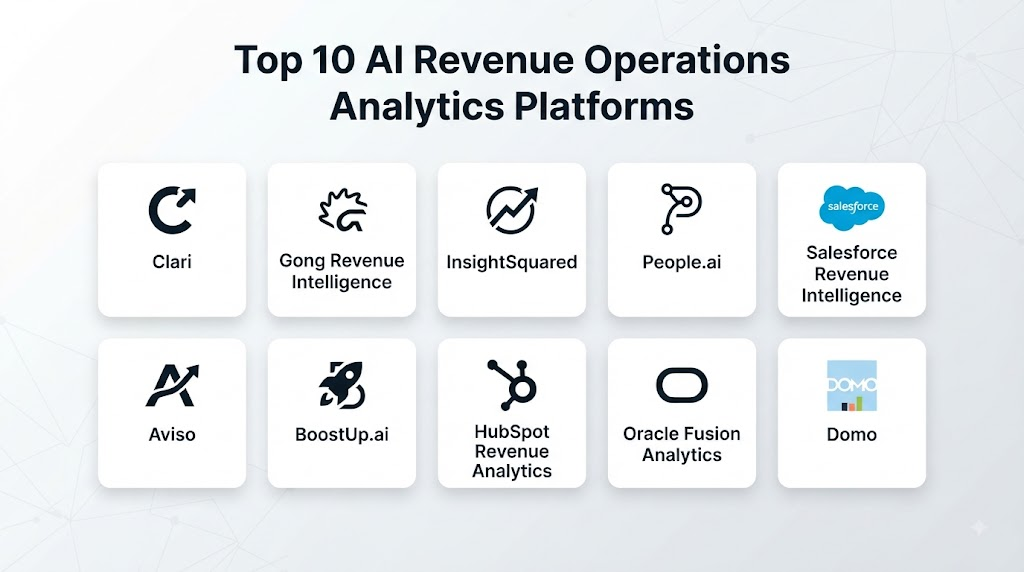
Top 10 AI Revenue Operations Analytics Platforms
1. Clari
Clari provides revenue intelligence capabilities designed to help organizations understand pipeline performance, forecasting, deal health, and revenue operations.
Key Features
- Revenue analytics
- AI forecasting
- Pipeline inspection
- Deal intelligence
- Revenue planning
- Performance analytics
Pros
- Strong revenue intelligence
- Excellent pipeline visibility
- Strong forecasting capabilities
- Enterprise-oriented functionality
Cons
- Can require significant implementation
- Best suited to structured revenue organizations
2. Gong
Gong combines conversation intelligence, revenue intelligence, deal insights, and sales analytics to provide visibility across customer-facing activities.
Key Features
- Revenue intelligence
- Conversation analytics
- Deal intelligence
- Pipeline insights
- Forecasting support
- AI summaries
Pros
- Strong customer interaction data
- Excellent conversation analytics
- Useful deal insights
- Strong enterprise capabilities
Cons
- Broader platform than analytics alone
- Implementation can require planning
3. Salesforce Revenue Intelligence
Salesforce provides revenue intelligence and analytics capabilities within its broader CRM and revenue ecosystem.
Key Features
- Revenue analytics
- Sales forecasting
- Pipeline analysis
- AI insights
- Opportunity analytics
- CRM integration
Pros
- Strong CRM ecosystem
- Extensive revenue data
- Broad integration capabilities
- Strong enterprise scalability
Cons
- Can be complex
- Advanced capabilities may require configuration
4. HubSpot
HubSpot provides CRM, marketing, sales, customer service, reporting, and analytics capabilities that can support revenue operations.
Key Features
- Revenue reporting
- Sales analytics
- Marketing analytics
- Pipeline management
- AI capabilities
- Customer analytics
Pros
- User-friendly
- Broad business platform
- Strong CRM connectivity
- Good for growing organizations
Cons
- Advanced analytics depend on configuration and plan
- Highly complex revenue environments may require additional systems
5. 6sense
6sense combines predictive intelligence, account intelligence, intent data, and revenue analytics to help B2B organizations understand buying activity and revenue opportunities.
Key Features
- Predictive analytics
- Account intelligence
- Intent data
- Revenue insights
- Pipeline analytics
- AI recommendations
Pros
- Strong B2B predictive capabilities
- Useful account intelligence
- Good intent signals
- Strong revenue use cases
Cons
- Primarily focused on B2B organizations
- Implementation can require planning
6. People.ai
People.ai captures revenue activity and transforms it into intelligence that can help organizations understand sales performance, account engagement, and pipeline behavior.
Key Features
- Activity intelligence
- Revenue analytics
- Pipeline insights
- Account intelligence
- CRM enrichment
- Sales performance analytics
Pros
- Strong activity capture
- Useful CRM enrichment
- Good revenue visibility
- Enterprise capabilities
Cons
- More focused on revenue operations and sales activity
- Requires integration with revenue systems
7. BoostUp.ai
BoostUp.ai focuses on revenue intelligence, forecasting, pipeline inspection, and sales analytics.
Key Features
- AI forecasting
- Pipeline analytics
- Deal intelligence
- Revenue analytics
- Risk detection
- Sales performance
Pros
- Strong predictive capabilities
- Good pipeline analytics
- Useful forecasting
- Revenue-focused approach
Cons
- Primarily suited to B2B revenue teams
- Requires high-quality CRM data
8. Aviso
Aviso provides AI-powered revenue intelligence, forecasting, pipeline analytics, and sales performance insights.
Key Features
- AI revenue analytics
- Forecasting
- Pipeline management
- Deal intelligence
- Revenue planning
- Predictive insights
Pros
- Strong AI capabilities
- Good forecasting
- Useful pipeline visibility
- Enterprise functionality
Cons
- Requires structured revenue data
- Implementation may require planning
9. InsightSquared
InsightSquared provides sales analytics, forecasting, pipeline reporting, and revenue performance insights.
Key Features
- Sales analytics
- Revenue reporting
- Forecasting
- Pipeline analytics
- Performance dashboards
- Historical analysis
Pros
- Strong sales analytics
- Useful reporting
- Good forecasting capabilities
- Accessible insights
Cons
- Advanced use cases may require configuration
- Data quality remains important
10. Revenue.io
Revenue.io combines sales engagement, conversation intelligence, revenue analytics, and sales performance capabilities.
Key Features
- Revenue intelligence
- Sales analytics
- Conversation intelligence
- Pipeline insights
- Sales engagement
- Performance analytics
Pros
- Broad revenue capabilities
- Strong activity intelligence
- Useful analytics
- Good sales workflow integration
Cons
- Broader platform can require configuration
- Organizations may need to integrate multiple data sources
Comparison Table: AI Revenue Operations Analytics Platforms
| No. | Platform | Best For | Revenue Analytics | AI Insights | Pipeline Analytics | Forecasting | Data Integration |
|---|---|---|---|---|---|---|---|
| 1 | Clari | Revenue intelligence | Strong | Strong | Strong | Strong | Strong |
| 2 | Gong | Conversation and revenue intelligence | Strong | Strong | Strong | Strong | Strong |
| 3 | Salesforce Revenue Intelligence | CRM-based revenue analytics | Strong | Strong | Strong | Strong | Strong |
| 4 | HubSpot | Unified CRM analytics | Strong | Strong | Strong | Strong | Strong |
| 5 | 6sense | Predictive B2B intelligence | Strong | Strong | Strong | Strong | Strong |
| 6 | People.ai | Activity intelligence | Strong | Strong | Strong | Moderate | Strong |
| 7 | BoostUp.ai | Revenue forecasting | Strong | Strong | Strong | Strong | Strong |
| 8 | Aviso | AI revenue intelligence | Strong | Strong | Strong | Strong | Strong |
| 9 | InsightSquared | Sales analytics | Strong | Strong | Strong | Strong | Strong |
| 10 | Revenue.io | Revenue intelligence and engagement | Strong | Strong | Strong | Strong | Strong |
Weighted Evaluation Table
| No. | Platform | AI Capabilities 20% | Revenue Analytics 20% | Pipeline Intelligence 15% | Forecasting 15% | Integrations 10% | Ease of Use 10% | Scalability 10% | Total Score |
|---|---|---|---|---|---|---|---|---|---|
| 1 | Clari | 20 | 20 | 15 | 15 | 10 | 9 | 10 | 99 |
| 2 | Gong | 20 | 19 | 15 | 15 | 10 | 9 | 10 | 98 |
| 3 | Salesforce Revenue Intelligence | 20 | 20 | 15 | 15 | 10 | 8 | 10 | 98 |
| 4 | HubSpot | 18 | 18 | 14 | 14 | 10 | 10 | 9 | 93 |
| 5 | 6sense | 20 | 19 | 15 | 15 | 9 | 8 | 10 | 96 |
| 6 | People.ai | 18 | 18 | 14 | 13 | 10 | 8 | 10 | 91 |
| 7 | BoostUp.ai | 20 | 19 | 15 | 15 | 9 | 8 | 10 | 96 |
| 8 | Aviso | 20 | 19 | 15 | 15 | 9 | 8 | 10 | 96 |
| 9 | InsightSquared | 18 | 18 | 14 | 14 | 9 | 9 | 9 | 91 |
| 10 | Revenue.io | 18 | 18 | 14 | 13 | 10 | 9 | 9 | 91 |
Which AI Revenue Operations Analytics Platform Is Right for You?
Choose Clari if your organization needs comprehensive revenue intelligence, pipeline inspection, and forecasting.
Choose Gong if conversation intelligence and customer interaction data are important parts of your revenue analytics strategy.
Choose Salesforce Revenue Intelligence if you want revenue analytics deeply connected to a Salesforce-based CRM environment.
Choose HubSpot if you want an accessible platform that combines CRM, marketing, sales, customer data, and analytics.
Choose 6sense if predictive B2B account intelligence and intent data are major priorities.
Choose People.ai if sales activity capture, account intelligence, and CRM enrichment are central requirements.
Choose BoostUp.ai if AI-powered forecasting and pipeline intelligence are particularly important.
Choose Aviso for AI-focused revenue intelligence, forecasting, and pipeline analysis.
Choose InsightSquared if sales analytics, reporting, and forecasting visibility are your primary requirements.
Choose Revenue.io if you want revenue analytics combined with sales engagement and conversation intelligence.
Common Mistakes
- Treating dashboards as a replacement for revenue strategy
- Using incomplete or inaccurate CRM data
- Creating too many revenue metrics
- Ignoring data inconsistencies between departments
- Failing to define common revenue terminology
- Relying exclusively on historical analytics
- Ignoring customer success data
- Overlooking marketing contribution
- Treating AI predictions as guaranteed outcomes
- Failing to validate attribution models
- Ignoring data privacy and governance
- Not connecting analytics with operational workflows
FAQs
1. What is AI Revenue Operations Analytics?
AI Revenue Operations Analytics uses artificial intelligence, machine learning, and advanced analytics to analyze revenue data across sales, marketing, customer success, and other business functions.
2. What data can revenue operations analytics platforms analyze?
They can analyze CRM records, sales activities, marketing campaigns, customer interactions, pipeline data, forecasts, contracts, customer behavior, and other revenue-related information.
3. How does AI improve revenue operations?
AI can identify patterns, predict potential outcomes, detect anomalies, highlight pipeline risks, and automate portions of revenue analysis.
4. Can AI revenue analytics improve sales forecasting?
Yes. Machine learning can analyze historical performance and current pipeline information to provide additional forecasting insights.
5. Can these platforms analyze marketing performance?
Yes. Revenue operations analytics can connect marketing activity with leads, opportunities, pipeline, and revenue outcomes.
6. Can AI identify revenue risks?
AI can identify unusual patterns, pipeline deterioration, declining customer activity, forecast changes, and other signals that may indicate revenue risk.
7. Why is data integration important?
Revenue operations depends on information from multiple systems. Integrating those sources helps create a more complete view of the customer and revenue lifecycle.
8. Can AI revenue analytics replace revenue operations teams?
No. AI can automate analysis and surface insights, but revenue operations professionals are still needed to interpret information, design processes, manage systems, and make strategic decisions.
9. How should organizations evaluate AI revenue analytics platforms?
Organizations should evaluate AI capabilities, data integration, forecasting, pipeline analytics, reporting, scalability, security, usability, and compatibility with existing revenue systems.
10. What is the future of AI Revenue Operations Analytics?
The future is likely to include natural-language analytics, autonomous revenue insights, predictive forecasting, unified customer data, automated anomaly detection, AI revenue assistants, and tighter connections between analytics and operational workflows.
Conclusion
AI Revenue Operations Analytics platforms help organizations transform fragmented revenue data into actionable business intelligence. By connecting sales, marketing, customer, and operational information, these systems can provide a broader view of revenue performance.Clari, Gong, Salesforce Revenue Intelligence, HubSpot, 6sense, People.ai, BoostUp.ai, Aviso, InsightSquared, and Revenue.io offer different approaches to revenue analytics, forecasting, pipeline intelligence, and sales performance.The right solution depends on an organization’s revenue model, technology environment, data maturity, team structure, and analytical requirements.Successful implementation requires more than selecting an AI platform. Organizations need reliable data, clearly defined metrics, strong governance, cross-functional alignment, and processes that turn insights into action.