Introduction
AI Pricing Optimization Platforms help businesses make smarter pricing decisions by analyzing customer behavior, transaction history, market conditions, product demand, competitive information, and other commercial signals. Instead of relying entirely on static pricing rules or manual analysis, these platforms use artificial intelligence, machine learning, and advanced analytics to recommend prices that can balance revenue, profitability, competitiveness, and customer demand.Pricing is one of the most important decisions for any organization. A price that is too high can reduce demand, while a price that is too low can reduce margins. For businesses with thousands of products, customers, markets, or transactions, manually identifying the right price for every situation can be extremely difficult.
What Are AI Pricing Optimization Platforms?
AI Pricing Optimization Platforms use machine learning, predictive analytics, optimization algorithms, and business data to recommend or determine pricing strategies.
These platforms can analyze variables such as:
- Historical transactions
- Customer segments
- Product demand
- Price elasticity
- Discounts
- Competitor prices
- Market conditions
- Inventory
- Purchase frequency
- Customer behavior
- Geographic markets
- Sales performance
- Profit margins
The platform can use these signals to identify pricing patterns and recommend actions.
For example, an AI system may identify that a particular customer segment is highly price-sensitive while another segment is less sensitive. The organization can then develop different pricing strategies while maintaining appropriate business controls.
Why AI Pricing Optimization Matters
Traditional pricing processes often rely on spreadsheets, historical averages, manually defined rules, and individual judgment.
These approaches may work for smaller product catalogs, but complexity increases significantly when businesses manage:
- Thousands of products
- Multiple customer segments
- Different geographic markets
- Complex discount structures
- Frequent market changes
- Multiple sales channels
- Large volumes of transactions
AI can process large amounts of pricing information and identify patterns more quickly.
This can help organizations make more informed pricing decisions while reducing repetitive analysis.
Key Features of AI Pricing Optimization Platforms
Price Recommendations
AI can recommend prices based on customer, product, market, and transaction characteristics.
Price Elasticity Analysis
Platforms can estimate how demand may respond to price changes.
Demand Forecasting
Machine learning can help predict future demand under different pricing conditions.
Competitive Pricing Intelligence
Some platforms analyze competitor pricing information to support pricing decisions.
Discount Optimization
AI can help organizations determine appropriate discount levels while considering profitability.
Customer Segmentation
Pricing recommendations can be tailored to different customer groups.
Dynamic Pricing
Businesses can adjust prices based on changing demand, inventory, market conditions, or other signals.
Margin Optimization
AI can consider profitability alongside revenue and demand.
Deal Pricing
Sales organizations can use AI to support pricing decisions for individual customer deals.
Scenario Modeling
Pricing teams can evaluate potential outcomes from different pricing strategies.
Price Waterfall Analysis
Organizations can understand how list prices turn into actual realized prices after discounts, rebates, and other adjustments.
Pricing Analytics
Dashboards can help teams monitor pricing performance and identify opportunities.
Common Use Cases
Retail
Retailers can optimize prices based on demand, inventory, seasonality, and customer behavior.
E-Commerce
Online businesses can use AI to support dynamic pricing and product-level optimization.
Manufacturing
Manufacturers can optimize complex B2B pricing and discount structures.
Distribution
Distributors can analyze customer-specific pricing and product-level margins.
SaaS
Software companies can analyze packaging, discounting, customer segments, and pricing structures.
Travel and Hospitality
Businesses can use demand signals to support pricing decisions for rooms, services, or bookings.
Telecommunications
Companies can optimize plans, packages, promotions, and customer pricing.
B2B Sales
Sales teams can use pricing intelligence to improve deal-level pricing and discount decisions.
Benefits of AI Pricing Optimization Platforms
Improved Margins
AI can identify opportunities to improve profitability without relying solely on volume growth.
Better Revenue Management
Pricing teams can evaluate the relationship between price, demand, and revenue.
Faster Decision-Making
Automated analytics can reduce the amount of manual pricing analysis.
Better Price Consistency
AI can help organizations apply pricing strategies consistently across products and customers.
Improved Discount Control
Businesses can identify excessive discounting and improve commercial discipline.
More Personalized Pricing
Organizations can incorporate customer and segment-level information into pricing decisions.
Better Demand Understanding
Machine learning can identify patterns between price changes and customer demand.
Scalability
AI can analyze pricing across large catalogs and customer bases.
Challenges
Data Quality
Pricing models depend heavily on accurate transaction, product, customer, and market data.
Model Explainability
Pricing teams may need to understand why an AI system recommends a particular price.
Market Volatility
Unexpected changes in demand, competition, regulations, or economic conditions can affect pricing models.
Organizational Resistance
Sales teams may resist AI recommendations if they do not understand the underlying logic.
Pricing Governance
Organizations need clear policies around pricing limits, approvals, discounts, and exceptions.
Integration Complexity
Pricing platforms often need to connect with CRM, ERP, e-commerce, billing, and product systems.
Customer Perception
Aggressive dynamic pricing can create customer trust concerns if not implemented carefully.
Evaluation Criteria
AI Pricing Optimization Platforms can be evaluated using:
- AI and machine learning
- Price optimization
- Demand forecasting
- Price elasticity
- Competitive intelligence
- Discount optimization
- Deal pricing
- Margin optimization
- Scenario modeling
- Analytics
- Integrations
- Explainability
- Scalability
Key Trends
Dynamic Pricing
Businesses are increasingly using AI to adjust prices based on demand, inventory, market conditions, and other signals.
Personalized Pricing
AI can support pricing strategies that account for customer segments and purchasing behavior.
Predictive Price Elasticity
Machine learning can help businesses understand how customers may respond to price changes.
AI Deal Guidance
Sales representatives can increasingly receive pricing recommendations during customer negotiations.
Automated Discount Management
AI can help organizations identify appropriate discount ranges while protecting margins.
Competitive Price Monitoring
Businesses are increasingly combining pricing optimization with competitor intelligence.
Autonomous Pricing
Some organizations are moving toward automated price recommendations and controlled price adjustments.
Explainable Pricing AI
Pricing teams increasingly require transparency into the factors influencing AI recommendations.
Methodology
The platforms below were selected based on their relevance to AI-powered pricing optimization, price management, commercial intelligence, revenue optimization, deal pricing, and pricing analytics.
The comparison considers:
- AI capabilities
- Price optimization
- Pricing analytics
- Demand intelligence
- Discount optimization
- Deal pricing
- Integrations
- Ease of use
- Scalability
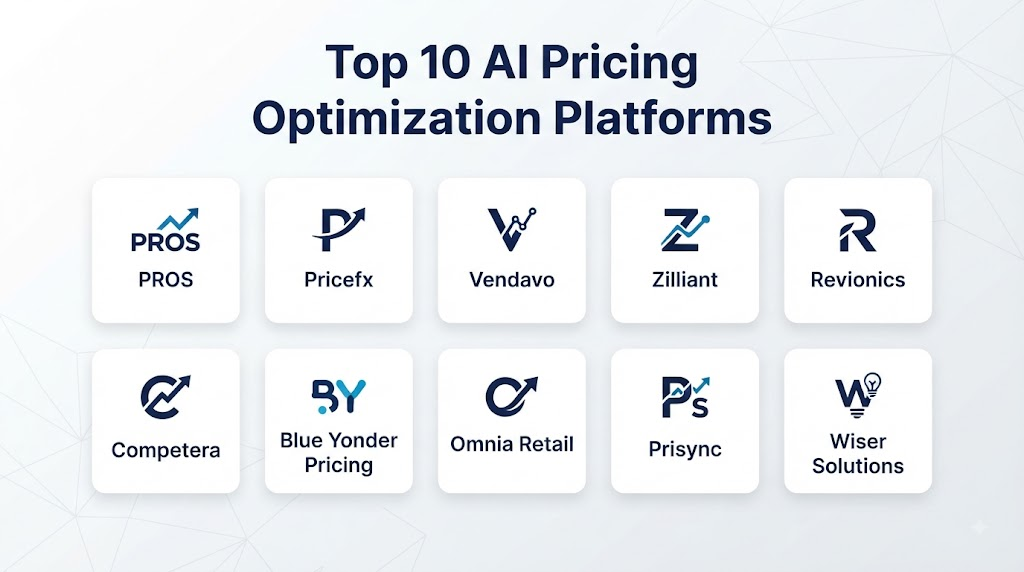
Top 10 AI Pricing Optimization Platforms
1. PROS
PROS provides AI-powered pricing and revenue optimization capabilities for businesses managing complex commercial decisions.
Key Features
- AI pricing optimization
- Price recommendations
- Deal pricing
- Price elasticity
- Revenue optimization
- Pricing analytics
Pros
- Strong AI capabilities
- Good enterprise functionality
- Broad pricing optimization capabilities
- Strong B2B applications
Cons
- Enterprise-oriented
- Implementation can require significant planning
2. Vendavo
Vendavo focuses on B2B pricing, margin optimization, commercial excellence, and pricing management.
Key Features
- Price optimization
- Deal pricing
- Discount management
- Price analytics
- Margin optimization
- Pricing guidance
Pros
- Strong B2B pricing capabilities
- Good margin visibility
- Useful discount optimization
- Strong commercial analytics
Cons
- More focused on complex B2B environments
- Requires high-quality pricing data
3. Zilliant
Zilliant provides AI-powered pricing, sales optimization, and commercial intelligence for organizations with complex product and customer structures.
Key Features
- Price optimization
- Price recommendations
- Customer segmentation
- Deal guidance
- Price elasticity
- Sales intelligence
Pros
- Strong AI pricing capabilities
- Excellent B2B applications
- Useful deal pricing
- Good commercial intelligence
Cons
- Primarily suited to larger organizations
- Implementation can require planning
4. Pricefx
Pricefx provides cloud-based pricing management and optimization capabilities for businesses seeking data-driven pricing strategies.
Key Features
- Price optimization
- Pricing analytics
- Price management
- Discount optimization
- AI capabilities
- Scenario analysis
Pros
- Flexible pricing platform
- Strong analytics
- Good cloud architecture
- Suitable for complex pricing environments
Cons
- Complex implementations may require expertise
- Pricing models depend on reliable data
5. Flintfox
Flintfox provides pricing and rebate management capabilities designed for organizations with complex commercial pricing structures.
Key Features
- Pricing management
- Price optimization
- Rebate management
- Promotion management
- Pricing analytics
- Commercial intelligence
Pros
- Strong pricing management
- Useful for complex B2B pricing
- Good rebate capabilities
- Enterprise functionality
Cons
- More specialized
- Implementation can be complex
6. Revionics
Revionics provides AI-driven retail pricing optimization focused on demand, pricing, promotions, and merchandise decisions.
Key Features
- AI price optimization
- Demand forecasting
- Price elasticity
- Promotion optimization
- Retail analytics
- Pricing recommendations
Pros
- Strong retail focus
- Good demand analytics
- Useful price elasticity modeling
- AI-driven optimization
Cons
- Primarily retail focused
- Requires substantial data for sophisticated optimization
7. Competera
Competera provides AI-powered pricing and assortment optimization for retailers and other organizations managing complex product catalogs.
Key Features
- Price optimization
- AI pricing
- Price elasticity
- Competitive intelligence
- Assortment optimization
- Pricing analytics
Pros
- Strong retail pricing capabilities
- Useful competitive intelligence
- Good AI optimization
- Strong product-level analytics
Cons
- Best suited to complex retail environments
- Implementation requires quality data
8. Omnia Retail
Omnia Retail focuses on pricing intelligence and optimization for retailers and e-commerce organizations.
Key Features
- Dynamic pricing
- Competitive pricing
- Price monitoring
- Price optimization
- Market intelligence
- Pricing analytics
Pros
- Strong retail capabilities
- Useful competitor monitoring
- Good dynamic pricing support
- E-commerce applications
Cons
- Primarily focused on retail
- Requires careful pricing governance
9. BlackCurve
BlackCurve provides pricing optimization and analytics capabilities designed for businesses that need data-driven pricing decisions.
Key Features
- Price optimization
- Pricing analytics
- Dynamic pricing
- Price recommendations
- Demand analysis
- Scenario modeling
Pros
- Flexible pricing capabilities
- Useful analytics
- Good dynamic pricing support
- Data-driven approach
Cons
- Requires suitable pricing data
- Advanced implementation can require expertise
10. Perfect Price
Perfect Price focuses on AI-powered dynamic pricing and revenue optimization, helping businesses adjust pricing based on demand and market conditions.
Key Features
- Dynamic pricing
- AI optimization
- Demand forecasting
- Revenue management
- Price recommendations
- Pricing analytics
Pros
- Strong dynamic pricing capabilities
- Useful demand intelligence
- AI-focused approach
- Good revenue optimization
Cons
- Dynamic pricing requires careful governance
- Results depend on data quality
Comparison Table: AI Pricing Optimization Platforms
| No. | Platform | Best For | AI Pricing | Price Optimization | Demand Analytics | Discount Optimization | Dynamic Pricing |
|---|---|---|---|---|---|---|---|
| 1 | PROS | Enterprise pricing | Strong | Strong | Strong | Strong | Strong |
| 2 | Vendavo | B2B pricing | Strong | Strong | Strong | Strong | Strong |
| 3 | Zilliant | B2B commercial intelligence | Strong | Strong | Strong | Strong | Strong |
| 4 | Pricefx | Cloud pricing management | Strong | Strong | Strong | Strong | Strong |
| 5 | Flintfox | Pricing and rebates | Strong | Strong | Strong | Strong | Strong |
| 6 | Revionics | Retail pricing | Strong | Strong | Strong | Strong | Strong |
| 7 | Competera | Retail optimization | Strong | Strong | Strong | Strong | Strong |
| 8 | Omnia Retail | E-commerce pricing | Strong | Strong | Strong | Strong | Strong |
| 9 | BlackCurve | Dynamic pricing | Strong | Strong | Strong | Moderate | Strong |
| 10 | Perfect Price | Revenue optimization | Strong | Strong | Strong | Moderate | Strong |
Weighted Evaluation Table
| No. | Platform | AI Capabilities 20% | Price Optimization 20% | Demand Intelligence 15% | Margin Optimization 15% | Integrations 10% | Ease of Use 10% | Scalability 10% | Total Score |
|---|---|---|---|---|---|---|---|---|---|
| 1 | PROS | 20 | 20 | 15 | 15 | 10 | 8 | 10 | 98 |
| 2 | Vendavo | 19 | 20 | 14 | 15 | 10 | 8 | 10 | 96 |
| 3 | Zilliant | 20 | 20 | 15 | 15 | 9 | 8 | 10 | 97 |
| 4 | Pricefx | 19 | 19 | 14 | 14 | 10 | 9 | 10 | 95 |
| 5 | Flintfox | 18 | 19 | 14 | 15 | 9 | 8 | 10 | 93 |
| 6 | Revionics | 20 | 20 | 15 | 15 | 9 | 8 | 10 | 97 |
| 7 | Competera | 19 | 20 | 15 | 14 | 9 | 9 | 10 | 96 |
| 8 | Omnia Retail | 18 | 19 | 14 | 14 | 9 | 9 | 9 | 92 |
| 9 | BlackCurve | 18 | 18 | 14 | 13 | 9 | 9 | 9 | 90 |
| 10 | Perfect Price | 19 | 18 | 15 | 14 | 8 | 9 | 9 | 92 |
Which AI Pricing Optimization Platform Is Right for You?
Choose PROS if you need enterprise-level AI pricing and revenue optimization across complex commercial environments.
Choose Vendavo if B2B pricing, discount management, and margin optimization are your primary priorities.
Choose Zilliant if you need AI-powered pricing recommendations and commercial intelligence for complex B2B sales.
Choose Pricefx for a flexible cloud-based pricing management and optimization environment.
Choose Flintfox if pricing, rebates, promotions, and complex commercial structures are important requirements.
Choose Revionics for retail-focused AI pricing, demand analytics, and promotion optimization.
Choose Competera if product-level retail pricing and competitive intelligence are major priorities.
Choose Omnia Retail for e-commerce and retail pricing intelligence with competitive monitoring.
Choose BlackCurve if dynamic pricing and pricing analytics are central requirements.
Choose Perfect Price if AI-driven dynamic pricing and revenue optimization are your main focus.
Common Mistakes
- Optimizing only for revenue instead of profitability
- Using poor-quality transaction data
- Ignoring customer price sensitivity
- Changing prices too frequently
- Relying completely on competitor pricing
- Ignoring inventory conditions
- Applying identical pricing strategies to every customer
- Failing to establish pricing boundaries
- Ignoring sales-team feedback
- Using AI recommendations without human oversight
- Failing to monitor pricing outcomes
- Ignoring customer trust and transparency
FAQs
1. What are AI Pricing Optimization Platforms?
AI Pricing Optimization Platforms use machine learning, predictive analytics, and business data to recommend prices that can improve revenue, margins, competitiveness, or other pricing objectives.
2. How does AI optimize prices?
AI can analyze historical transactions, demand, customer behavior, price elasticity, market conditions, competition, and other variables to identify pricing opportunities.
3. Can AI predict customer price sensitivity?
Yes. Machine learning models can analyze historical purchasing behavior to estimate how different customer segments may respond to price changes.
4. Can AI support dynamic pricing?
Yes. AI can support dynamic pricing by evaluating changing demand, inventory, competition, customer behavior, and other market signals.
5. Can AI optimize discounts?
Yes. Some platforms can recommend discount levels based on customer characteristics, deal conditions, historical outcomes, margins, and pricing policies.
6. Are AI pricing platforms useful for B2B companies?
Yes. B2B organizations can use them for customer-specific pricing, deal guidance, discount management, product-level pricing, and margin optimization.
7. Are AI pricing platforms useful for retailers?
Yes. Retailers can use AI for product pricing, competitive monitoring, demand forecasting, promotions, and dynamic pricing.
8. What data is required for AI pricing optimization?
Typical inputs include transaction history, product information, customer data, pricing history, discounts, demand information, competitor information, and market signals.
9. Can AI pricing recommendations be wrong?
Yes. AI recommendations depend on the quality of the underlying data and assumptions. Market changes, unusual events, incomplete information, or model limitations can affect results.
10. What is the future of AI Pricing Optimization Platforms?
The category is moving toward real-time pricing, predictive elasticity modeling, personalized recommendations, automated discount optimization, AI-assisted negotiations, competitive intelligence, and increasingly autonomous pricing decisions with human governance.
Conclusion
AI Pricing Optimization Platforms can help organizations make more informed pricing decisions by combining machine learning with transaction data, customer behavior, demand patterns, market information, and commercial rules.PROS, Vendavo, Zilliant, Pricefx, Flintfox, Revionics, Competera, Omnia Retail, BlackCurve, and Perfect Price offer different approaches to pricing optimization across B2B, retail, e-commerce, and other commercial environments.The right platform depends on business model, product complexity, pricing structure, data availability, industry requirements, and the level of automation required.Successful pricing optimization requires more than an AI model. Organizations also need reliable data, strong pricing governance, clear business objectives, and appropriate human oversight.