Introduction
AI Lead Scoring Platforms help sales and marketing teams identify prospects that are most likely to become customers. These platforms use artificial intelligence, machine learning, customer data, behavioral signals, and predictive analytics to rank leads based on their potential value or likelihood of conversion.Traditional lead scoring often relies on manually assigned points. A marketer might give a prospect points for opening an email, visiting a pricing page, downloading content, or matching a target industry. AI-powered lead scoring can analyze much larger datasets and identify patterns that may not be obvious through manual scoring.
What Are AI Lead Scoring Platforms?
AI Lead Scoring Platforms use machine learning and predictive analytics to evaluate prospects and determine which leads are most likely to take a desired action.
The systems can analyze information such as:
- Website activity
- Email engagement
- Form submissions
- Content downloads
- Job title
- Company size
- Industry
- Purchase history
- CRM activity
- Product usage
- Sales interactions
- Account engagement
Instead of relying only on predefined rules, machine learning models can identify relationships between prospect behavior and historical conversion outcomes.
Why AI Lead Scoring Matters
Sales teams often have hundreds or thousands of prospects to evaluate. Treating every lead equally can waste valuable sales time.
AI lead scoring can help teams determine:
- Which prospects deserve immediate attention
- Which leads are showing buying intent
- Which accounts resemble successful customers
- Which leads are likely to convert
- Which prospects may need additional nurturing
This can make sales outreach more focused and help marketing teams improve lead-generation strategies.
Key Features of AI Lead Scoring Platforms
Predictive Lead Scoring
Machine learning models can estimate the likelihood that a lead will convert.
Behavioral Scoring
Platforms can analyze actions such as:
- Website visits
- Email clicks
- Content downloads
- Product interactions
- Event participation
Firmographic Scoring
Businesses can evaluate leads using attributes such as:
- Industry
- Company size
- Location
- Revenue
- Job role
Account-Based Scoring
Some platforms score entire accounts instead of evaluating individual leads independently.
Intent Signals
AI can identify signals that may indicate a prospect is actively researching a product or service.
CRM Integration
Lead scores can be connected with CRM records so sales teams can use scoring information during their workflows.
Automated Qualification
AI can automatically identify leads that meet predefined or predictive qualification criteria.
Score Explanation
Some systems provide insights into the factors contributing to a lead’s score.
Common Use Cases
B2B Sales
Sales teams can prioritize prospects based on conversion probability and account fit.
SaaS Companies
Software businesses can use behavioral data and product interactions to identify high-intent prospects.
Ecommerce
Businesses can identify customers or prospects who are likely to purchase.
Account-Based Marketing
Marketing teams can rank accounts based on engagement and buying signals.
Lead Nurturing
Lower-scoring leads can be placed into appropriate nurturing campaigns.
Sales Development
SDRs can use predictive scores to prioritize outreach.
Benefits of AI Lead Scoring Platforms
Better Sales Prioritization
Sales representatives can focus on leads with stronger signals.
Improved Efficiency
Automated scoring reduces manual lead evaluation.
More Consistent Qualification
AI can apply scoring logic consistently across large datasets.
Faster Response
High-intent leads can be identified more quickly.
Better Marketing Alignment
Marketing and sales teams can use shared qualification signals.
Data-Driven Decisions
Lead prioritization becomes more evidence-based.
Scalable Qualification
AI can score large volumes of prospects without requiring proportional increases in manual work.
Challenges
Data Quality
Poor CRM or customer data can reduce scoring accuracy.
Model Bias
Machine learning models can learn from historical patterns that may not always represent future opportunities.
Explainability
Sales teams may hesitate to trust a score if they cannot understand what caused it.
Changing Buyer Behavior
Lead scoring models can become less accurate when markets or customer behavior change.
Integration Complexity
Connecting marketing automation, CRM, website, product, and sales data may require technical work.
False Positives
Some highly engaged prospects may not actually be ready to buy.
False Negatives
Some prospects may convert even when their behavioral signals appear weak.
Evaluation Criteria
AI Lead Scoring Platforms can be evaluated using:
- Predictive scoring
- Behavioral analysis
- Account scoring
- Intent detection
- CRM integrations
- Automation
- Explainability
- Real-time scoring
- Reporting
- AI capabilities
- Scalability
- Ease of use
- Overall value
Key Trends
Predictive Qualification
Businesses are increasingly using predictive models instead of relying only on manually assigned scores.
Account-Level Intelligence
B2B teams are moving from individual lead scoring toward account-level buying signals.
Real-Time Scoring
Lead scores can increasingly change as prospects interact with websites, products, campaigns, and sales teams.
Intent-Based Scoring
AI is being used to combine behavioral data with other buying-intent signals.
Revenue-Based Scoring
More advanced systems focus on potential revenue or customer value rather than simple conversion probability.
Explainable AI
Sales teams increasingly want to understand why a particular prospect received a high or low score.
Methodology
The platforms below were evaluated based on their relevance to predictive lead scoring, machine learning, sales intelligence, customer data, automation, CRM integration, account-based marketing, and lead qualification.
The comparison considers:
- AI capabilities
- Predictive scoring
- Behavioral analysis
- Intent signals
- CRM integration
- Automation
- Account scoring
- Reporting
- Scalability
- Ease of use
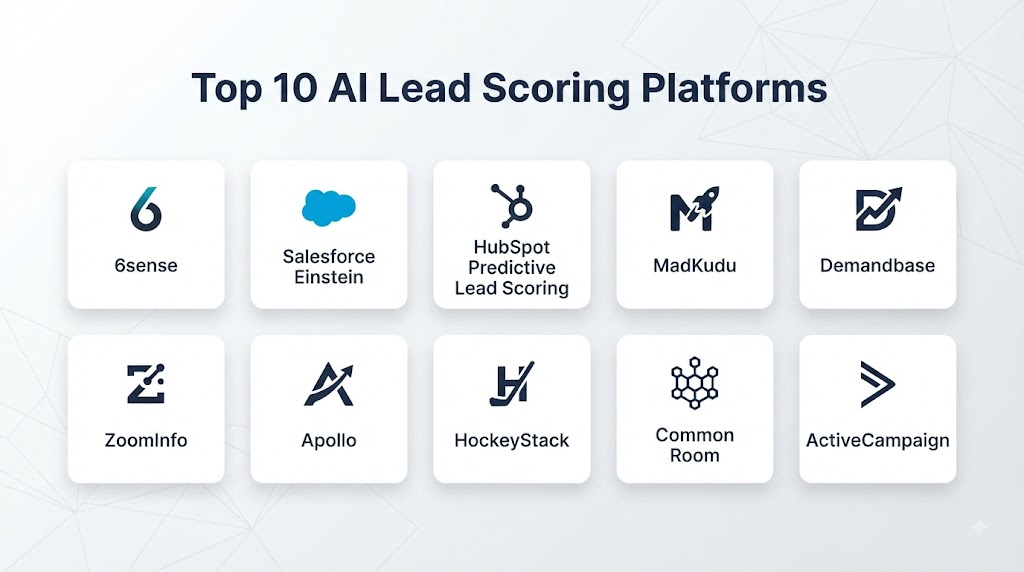
Top 10 AI Lead Scoring Platforms
1. Salesforce Einstein
Salesforce Einstein provides AI capabilities across Salesforce products, including predictive insights that can support lead qualification and prioritization.
Key Features
- Predictive lead insights
- CRM data analysis
- Lead prioritization
- Sales intelligence
- Automation
- Customer data analysis
Pros
- Strong CRM integration
- Broad enterprise capabilities
- Large customer data ecosystem
- Useful sales automation
Cons
- Can be complex for smaller teams
- Advanced functionality may require configuration
2. HubSpot
HubSpot combines CRM, marketing automation, sales tools, and AI capabilities that can support lead qualification and prioritization.
Key Features
- Lead scoring
- Predictive insights
- CRM data
- Marketing automation
- Sales automation
- Customer activity tracking
Pros
- Easy-to-use interface
- Strong marketing and sales integration
- Good automation
- Suitable for growing businesses
Cons
- Advanced functionality may depend on the selected plan
- Complex scoring strategies can require careful configuration
3. 6sense
6sense focuses heavily on B2B revenue intelligence, account identification, buying signals, and predictive analytics.
Key Features
- Predictive analytics
- Account scoring
- Intent data
- Buying-stage identification
- Account-based marketing
- Sales intelligence
Pros
- Strong B2B capabilities
- Excellent account-level intelligence
- Strong intent analysis
- Useful for enterprise sales teams
Cons
- Primarily B2B focused
- Can require significant implementation
4. Adobe Marketo Engage
Adobe Marketo Engage provides marketing automation and lead management capabilities that can support lead scoring and qualification.
Key Features
- Lead scoring
- Marketing automation
- Customer engagement
- Campaign management
- Lead nurturing
- CRM integration
Pros
- Strong marketing automation
- Enterprise capabilities
- Flexible campaign workflows
- Good integration ecosystem
Cons
- Can be complex
- Requires marketing automation expertise for advanced implementations
5. MadKudu
MadKudu focuses on predictive lead and customer qualification using machine learning and behavioral data.
Key Features
- Predictive lead scoring
- Behavioral analysis
- Customer qualification
- Lead prioritization
- CRM integration
Pros
- Strong predictive focus
- Useful for SaaS companies
- Helps automate qualification
Cons
- More specialized than broader CRM platforms
- Requires sufficient historical data for effective modeling
6. Infer
Infer provides predictive analytics for sales and marketing teams, helping organizations identify prospects and accounts with higher conversion potential.
Key Features
- Predictive lead scoring
- Account scoring
- Sales intelligence
- Prospect qualification
- Data analysis
Pros
- Strong predictive capabilities
- Useful for B2B teams
- Supports automated prioritization
Cons
- More specialized
- Requires quality customer and sales data
7. LeanData
LeanData focuses on lead-to-account matching, routing, and revenue operations workflows.
Its capabilities can help organizations connect qualified prospects with appropriate sales processes.
Key Features
- Lead routing
- Account matching
- Lead management
- Revenue operations
- Workflow automation
Pros
- Strong revenue operations capabilities
- Useful for complex B2B workflows
- Strong CRM integration
Cons
- More focused on revenue operations than standalone AI scoring
- Advanced workflows can require configuration
8. Demandbase
Demandbase provides account-based marketing, intent intelligence, audience targeting, and predictive capabilities for B2B organizations.
Key Features
- Account scoring
- Intent data
- Predictive analytics
- Account-based marketing
- Sales intelligence
Pros
- Strong ABM capabilities
- Useful account-level intelligence
- Strong B2B focus
Cons
- Primarily designed for B2B organizations
- Can be complex for smaller teams
9. Leadspace
Leadspace provides B2B customer data, lead qualification, segmentation, and predictive capabilities.
Key Features
- Lead scoring
- Customer data
- Account scoring
- Predictive analytics
- Audience segmentation
- Data enrichment
Pros
- Strong B2B data capabilities
- Useful segmentation
- Supports predictive qualification
Cons
- Enterprise-oriented
- Data implementation can require planning
10. Zoho CRM
Zoho CRM provides lead management, scoring, automation, analytics, and AI capabilities through its broader CRM ecosystem.
Key Features
- Lead scoring
- AI-assisted sales insights
- CRM automation
- Lead qualification
- Customer analytics
- Workflow automation
Pros
- Broad CRM functionality
- Accessible for growing businesses
- Strong automation
- Integrated sales workflows
Cons
- AI capabilities vary by edition
- Advanced implementations require configuration
Comparison Table: AI Lead Scoring Platforms
| No. | Platform | Best For | Predictive Scoring | Behavioral Analysis | Account Scoring | Automation | CRM Integration |
|---|---|---|---|---|---|---|---|
| 1 | Salesforce Einstein | Enterprise CRM | Strong | Strong | Strong | Strong | Strong |
| 2 | HubSpot | Growing businesses | Strong | Strong | Strong | Strong | Strong |
| 3 | 6sense | B2B revenue intelligence | Strong | Strong | Strong | Strong | Strong |
| 4 | Adobe Marketo Engage | Marketing automation | Strong | Strong | Strong | Strong | Strong |
| 5 | MadKudu | SaaS lead qualification | Strong | Strong | Moderate | Strong | Strong |
| 6 | Infer | Predictive B2B analytics | Strong | Strong | Strong | Strong | Strong |
| 7 | LeanData | Revenue operations | Moderate | Strong | Strong | Strong | Strong |
| 8 | Demandbase | Account-based marketing | Strong | Strong | Strong | Strong | Strong |
| 9 | Leadspace | B2B data and qualification | Strong | Strong | Strong | Strong | Strong |
| 10 | Zoho CRM | SMB and mid-market CRM | Moderate | Strong | Strong | Strong | Strong |
Weighted Evaluation Table
| No. | Platform | AI Capabilities 20% | Predictive Scoring 20% | Behavioral Analysis 15% | Automation 15% | Integrations 10% | Ease of Use 10% | Scalability 10% | Total Score |
|---|---|---|---|---|---|---|---|---|---|
| 1 | Salesforce Einstein | 20 | 19 | 15 | 15 | 10 | 8 | 10 | 97 |
| 2 | HubSpot | 18 | 18 | 15 | 15 | 10 | 10 | 9 | 95 |
| 3 | 6sense | 20 | 20 | 15 | 15 | 9 | 8 | 10 | 97 |
| 4 | Adobe Marketo Engage | 19 | 19 | 15 | 15 | 10 | 8 | 10 | 96 |
| 5 | MadKudu | 19 | 20 | 15 | 14 | 9 | 9 | 9 | 95 |
| 6 | Infer | 19 | 20 | 14 | 14 | 9 | 8 | 9 | 93 |
| 7 | LeanData | 17 | 17 | 14 | 15 | 10 | 9 | 10 | 92 |
| 8 | Demandbase | 20 | 20 | 15 | 15 | 10 | 8 | 10 | 98 |
| 9 | Leadspace | 19 | 19 | 15 | 14 | 9 | 8 | 10 | 94 |
| 10 | Zoho CRM | 17 | 17 | 14 | 14 | 9 | 10 | 9 | 90 |
The weighted scores are comparative editorial scores and are not vendor-issued ratings.
Which AI Lead Scoring Platform Is Right for You?
Choose Salesforce Einstein if your organization already operates heavily within the Salesforce ecosystem and needs enterprise CRM intelligence.
Choose HubSpot if you want lead scoring combined with marketing automation, CRM, and sales workflows.
Choose 6sense if account-level intelligence, intent signals, and B2B revenue operations are priorities.
Choose Adobe Marketo Engage if your organization needs sophisticated marketing automation and lead management.
Choose MadKudu if predictive qualification is particularly important for a SaaS-focused sales organization.
Choose Infer for predictive B2B lead and account analysis.
Choose LeanData if lead routing, account matching, and revenue operations are central requirements.
Choose Demandbase for account-based marketing, intent intelligence, and B2B account scoring.
Choose Leadspace for B2B data enrichment, segmentation, and predictive qualification.
Choose Zoho CRM if you need lead scoring within a broader CRM and sales automation environment.
Common Mistakes
- Treating every lead score as equally reliable
- Using outdated CRM information
- Ignoring negative buying signals
- Scoring only website activity
- Creating overly complicated scoring rules
- Failing to update models as buyer behavior changes
- Ignoring account-level signals
- Failing to explain scores to sales teams
- Using insufficient historical data
- Treating a high score as a guaranteed sale
- Not comparing scores with actual conversion outcomes
- Failing to align marketing and sales on qualification criteria
FAQs
1. What are AI Lead Scoring Platforms?
AI Lead Scoring Platforms use machine learning, predictive analytics, behavioral data, and customer information to rank leads according to their likelihood of conversion or business value.
2. How does AI lead scoring work?
AI systems analyze historical customer and prospect data to identify patterns associated with successful conversions and use those patterns to score new leads.
3. What data is used for lead scoring?
Common signals include website activity, email engagement, CRM information, company characteristics, product usage, sales interactions, and purchase behavior.
4. Is AI lead scoring better than rule-based scoring?
AI scoring can identify complex patterns that rule-based systems may miss, but rule-based scoring remains useful when businesses need transparent and highly controlled qualification criteria.
5. Can AI score B2B accounts?
Yes. Many platforms support account-level scoring based on company attributes, engagement, intent, and buying signals.
6. Can AI lead scoring improve sales productivity?
It can help sales teams prioritize prospects that show stronger conversion signals, potentially reducing time spent on lower-priority leads.
7. Does AI lead scoring guarantee conversions?
No. A lead score represents an estimate or prediction, not a guarantee that a prospect will purchase.
8. How often should lead scoring models be reviewed?
Organizations should regularly compare predicted scores with actual outcomes and update scoring approaches when customer behavior, products, markets, or sales processes change.
9. Can small businesses use AI lead scoring?
Yes. Some CRM and marketing platforms provide accessible scoring capabilities for smaller organizations, while advanced predictive systems may be more suitable for businesses with larger datasets.
10. What is the future of AI Lead Scoring Platforms?
The category is moving toward real-time predictive scoring, account-level intelligence, intent analysis, revenue-based prioritization, explainable AI, and automated sales workflows.
Conclusion
AI Lead Scoring Platforms are becoming an important part of modern sales and marketing operations. They help teams analyze large amounts of prospect information and prioritize leads using behavioral, firmographic, predictive, and intent-based signals.Salesforce Einstein, HubSpot, 6sense, Adobe Marketo Engage, MadKudu, Infer, LeanData, Demandbase, Leadspace, and Zoho CRM each approach lead scoring from different perspectives.The best solution depends on company size, sales model, CRM environment, available data, B2B or B2C requirements, and the level of automation needed.AI lead scoring should be treated as a decision-support system rather than an unquestionable source of truth. Regular model validation, clean customer data, transparent scoring logic, and feedback from sales teams are essential for maintaining useful predictions.