Introduction
AI personalization engines for customer experience help businesses tailor content, offers, journeys, recommendations, messages, and support experiences to individual users or customer segments. Instead of giving every customer the same website, email, product suggestion, onboarding flow, or service response, these platforms use behavioral, transactional, profile, and contextual data to decide what experience is most relevant.
Modern personalization engines go beyond simple “customers who bought this also bought that” recommendations. They can combine real-time behavior, customer history, product usage, location, lifecycle stage, channel preference, intent, and account context to personalize experiences across websites, mobile apps, email, support, commerce, and digital journeys.
Common use cases include product recommendations, next-best-action, personalized onboarding, dynamic website content, targeted offers, customer-service personalization, retention campaigns, and account-specific engagement.
What’s Changing in AI Personalization Engines for CX
- Personalization is shifting from static customer segments toward real-time individual decisioning.
- AI can increasingly select the next best content, action, product, or message automatically.
- Customer journeys are becoming more adaptive based on current behavior.
- Real-time behavioral signals are becoming more important than historical profiles alone.
- Product recommendations increasingly combine intent, context, and inventory information.
- Personalization is expanding beyond marketing into customer support and service.
- Customer-success teams can increasingly personalize engagement based on risk or product adoption.
- AI can help decide which channel is most appropriate for a specific customer.
- Context such as location, device, lifecycle stage, subscription, and customer value can influence personalization.
- Reinforcement and continuous-learning approaches are becoming more relevant for decision optimization.
- Experimentation is increasingly connected with personalization.
- Predictive models can help identify which offer or journey is most likely to produce a positive outcome.
- Privacy and consent are becoming central design requirements.
- Identity resolution is increasingly important across web, mobile, CRM, commerce, and service systems.
- Enterprises increasingly need explainability around automated customer decisions.
- Personalization models need guardrails to avoid unfair or inappropriate treatment.
- AI agents can increasingly personalize conversations based on approved customer context.
- Real-time data architecture is becoming more important for high-volume personalization.
- Vendor lock-in is a concern when customer profiles and decision logic live inside one proprietary ecosystem.
- Human oversight remains important for regulated, sensitive, or high-value customer interactions.
Quick Buyer Checklist
Before selecting an AI personalization engine, check whether it can:
- Build customer profiles.
- Use real-time behavioral data.
- Personalize website content.
- Personalize mobile experiences.
- Generate product recommendations.
- Support next-best-action.
- Personalize offers.
- Personalize onboarding.
- Personalize customer-service experiences.
- Use CRM context.
- Use transaction history.
- Use product usage.
- Use customer sentiment.
- Create dynamic customer segments.
- Support anonymous and known users.
- Resolve customer identity.
- Support experimentation.
- Measure uplift.
- Provide decision explanations.
- Support channel orchestration.
- Integrate with CDPs.
- Integrate with CRM.
- Integrate with ecommerce.
- Integrate with marketing systems.
- Provide APIs.
- Support low-latency decisioning.
- Apply consent controls.
- Support RBAC.
- Maintain auditability.
- Allow human overrides where required.
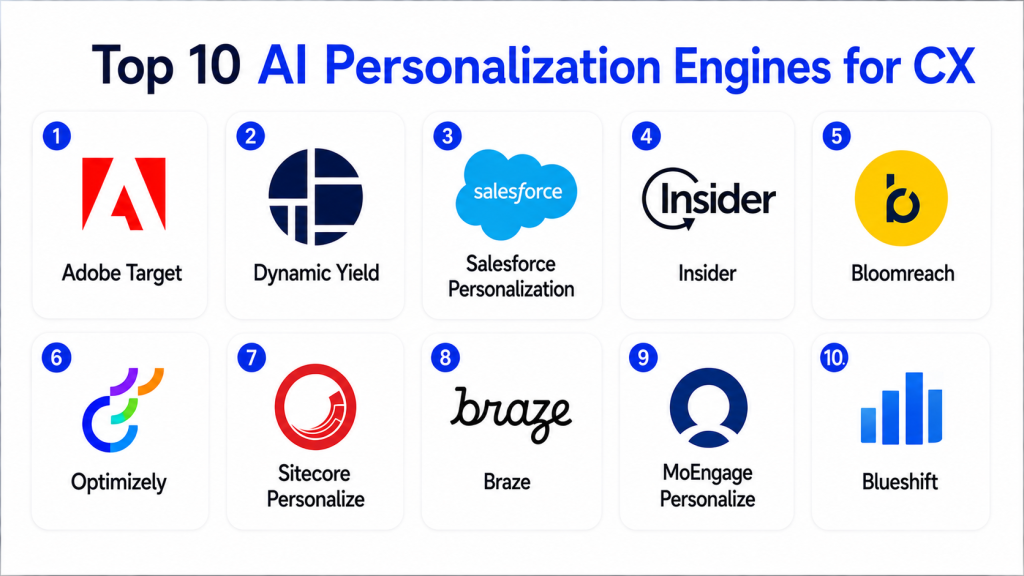
Top 10 AI Personalization Engines for CX
1 — Adobe Target and Adobe Experience Platform
One-line verdict: Best for large enterprises needing real-time personalization across complex digital and marketing experiences.
Adobe provides personalization capabilities across its experience ecosystem, including experimentation, segmentation, customer profiles, decisioning, and content delivery.
Standout Capabilities
- Real-time personalization.
- Experience targeting.
- Product recommendations.
- A/B testing.
- Multivariate testing.
- Audience segmentation.
- Journey personalization.
- Enterprise customer profiles.
AI-Specific Depth
- Model support: Adobe-managed AI capabilities.
- RAG / knowledge integration: Customer and experience context varies.
- Evaluation: Experimentation, uplift measurement, and business outcomes.
- Guardrails: Enterprise identity, permissions, and governance.
- Observability: Campaign, experience, conversion, and journey analytics.
Pros
- Strong enterprise personalization.
- Broad Adobe ecosystem integration.
- Excellent for complex digital experiences.
Cons
- Significant implementation complexity.
- Requires strong data governance.
- Smaller teams may not need the platform breadth.
Security & Compliance
Verify SSO, RBAC, audit logs, retention, encryption, consent management, residency, and required certifications.
Deployment & Platforms
- Cloud: Available.
- Web: Available.
- Mobile personalization: Available.
- Enterprise digital channels: Available.
Integrations & Ecosystem
- Adobe Experience Platform
- Analytics
- Commerce
- Campaign tools
- Customer data
- Web and mobile experiences
- Enterprise applications
Pricing Model
Enterprise commercial pricing.
Best-Fit Scenarios
- Enterprise digital personalization.
- Large ecommerce experiences.
- Cross-channel customer journeys.
2 — Salesforce Personalization
One-line verdict: Best for Salesforce-centered organizations wanting customer-level personalization connected with CRM and unified customer data.
Salesforce Personalization can use customer, behavioral, and CRM data to tailor experiences across digital channels and business workflows.
Standout Capabilities
- Real-time personalization.
- Customer profiles.
- Recommendations.
- Next-best-action.
- Behavioral targeting.
- Journey personalization.
- CRM context.
- Customer segmentation.
AI-Specific Depth
- Model support: Salesforce-managed and supported AI capabilities.
- RAG / knowledge integration: CRM and connected customer data.
- Evaluation: Conversion, engagement, and outcome analysis.
- Guardrails: Salesforce permissions and data governance.
- Observability: Customer, campaign, and decision analytics.
Pros
- Deep CRM integration.
- Strong customer identity context.
- Useful for enterprise customer journeys.
Cons
- Best value requires broader Salesforce adoption.
- Implementation can be complex.
- Licensing can be difficult to plan.
Security & Compliance
Verify SSO, RBAC, auditing, retention, encryption, residency, consent controls, and certifications for selected products.
Deployment & Platforms
- Cloud: Available.
- Web: Available.
- Mobile and digital channels: Available.
- Salesforce ecosystem: Available.
Integrations & Ecosystem
- CRM
- Data Cloud
- Marketing
- Customer service
- Commerce
- Enterprise applications
- Analytics
Pricing Model
Enterprise commercial model.
Best-Fit Scenarios
- CRM-driven personalization.
- Enterprise customer journeys.
- Organizations heavily invested in Salesforce.
3 — Dynamic Yield
One-line verdict: Best for commerce and digital teams needing advanced recommendation, targeting, and experience optimization.
Dynamic Yield is focused on personalization, recommendations, experimentation, and experience optimization across digital channels.
Standout Capabilities
- Product recommendations.
- Website personalization.
- Audience targeting.
- Behavioral segmentation.
- A/B testing.
- Experience optimization.
- Recommendation strategies.
- Real-time decisioning.
AI-Specific Depth
- Model support: Platform-managed AI.
- RAG / knowledge integration: Customer and product data context.
- Evaluation: Experimentation and uplift analysis.
- Guardrails: Business rules and segmentation controls.
- Observability: Recommendation and conversion analytics.
Pros
- Strong ecommerce personalization.
- Good experimentation support.
- Useful real-time recommendations.
Cons
- Less focused on customer-service personalization.
- Best value comes from sufficient traffic and data.
- Complex strategies require experienced teams.
Security & Compliance
Verify SSO, RBAC, retention, encryption, residency, consent, and certifications.
Deployment & Platforms
- Cloud: Available.
- Web: Available.
- Mobile: Available.
- Ecommerce channels: Available.
Integrations & Ecosystem
- Ecommerce
- Customer data
- Analytics
- Marketing
- Web and mobile apps
- APIs
Pricing Model
Commercial enterprise SaaS.
Best-Fit Scenarios
- Ecommerce recommendations.
- Retail personalization.
- Digital conversion optimization.
4 — Optimizely Personalization
One-line verdict: Best for digital product and marketing teams combining personalization with experimentation and content optimization.
Optimizely provides experimentation, digital experience, content, and personalization capabilities. It is useful when teams want to test personalized experiences rather than deploy them without evidence.
Standout Capabilities
- Experience personalization.
- A/B testing.
- Experimentation.
- Audience targeting.
- Content optimization.
- Feature experimentation.
- Behavioral segmentation.
- Digital experience management.
AI-Specific Depth
- Model support: Platform-managed AI capabilities.
- RAG / knowledge integration: Digital experience context.
- Evaluation: Controlled experiments and uplift measurement.
- Guardrails: Experiment and audience controls.
- Observability: Experimentation and conversion analytics.
Pros
- Strong experimentation culture.
- Good fit for digital teams.
- Useful for evidence-based personalization.
Cons
- Requires enough traffic for reliable experiments.
- Broader customer context may require integrations.
- Complex enterprise setup can take time.
Security & Compliance
Verify SSO, RBAC, auditing, encryption, retention, residency, and required certifications.
Deployment & Platforms
- Cloud: Available.
- Web: Available.
- Mobile and product experimentation: Available.
Integrations & Ecosystem
- CMS
- Product applications
- Analytics
- Customer data
- Marketing
- APIs
- Digital experience platforms
Pricing Model
Commercial enterprise SaaS.
Best-Fit Scenarios
- Experiment-driven personalization.
- Digital products.
- Content optimization.
5 — Bloomreach
One-line verdict: Best for ecommerce brands wanting product discovery, recommendations, search, and personalization in one commerce-focused platform.
Bloomreach combines ecommerce search, merchandising, recommendations, customer data, and marketing personalization.
Standout Capabilities
- Product recommendations.
- Personalized search.
- Ecommerce merchandising.
- Customer segmentation.
- Behavioral personalization.
- Campaign personalization.
- Customer data.
- Product discovery.
AI-Specific Depth
- Model support: Bloomreach-managed AI.
- RAG / knowledge integration: Product catalog and customer context.
- Evaluation: Conversion, engagement, and revenue outcomes.
- Guardrails: Merchandising and campaign rules.
- Observability: Search, recommendation, and commerce analytics.
Pros
- Strong ecommerce focus.
- Combines search and recommendations.
- Useful for large product catalogs.
Cons
- Less relevant outside commerce.
- Requires strong product data.
- Implementation can be substantial for large catalogs.
Security & Compliance
Verify SSO, RBAC, auditing, encryption, retention, residency, and certifications.
Deployment & Platforms
- Cloud: Available.
- Web: Available.
- Ecommerce environments: Available.
Integrations & Ecosystem
- Ecommerce platforms
- Product catalogs
- Customer data
- Marketing
- Analytics
- APIs
Pricing Model
Commercial enterprise pricing.
Best-Fit Scenarios
- Ecommerce personalization.
- Product discovery.
- Retail recommendations.
6 — Algolia Recommend and Personalization
One-line verdict: Best for developer-oriented digital products needing fast search, recommendations, and personalized discovery.
Algolia is known for search and discovery infrastructure. Its personalization and recommendation capabilities are useful when businesses need low-latency product or content discovery.
Standout Capabilities
- Personalized search.
- Recommendations.
- Behavioral signals.
- Product discovery.
- Real-time relevance.
- API-first delivery.
- Content recommendations.
- Search analytics.
AI-Specific Depth
- Model support: Platform-managed AI and ranking capabilities.
- RAG / knowledge integration: Product or content index context.
- Evaluation: Search relevance, conversion, and engagement.
- Guardrails: Ranking rules and business controls.
- Observability: Search and recommendation analytics.
Pros
- Developer-friendly.
- Fast response times.
- Strong search infrastructure.
Cons
- Not a complete CX platform.
- CRM and service personalization need other tools.
- Quality depends on good indexing and behavioral signals.
Security & Compliance
Verify access controls, encryption, retention, residency, auditing, and certifications.
Deployment & Platforms
- Cloud: Available.
- Web: Available.
- Mobile: Available.
- APIs and SDKs: Available.
Integrations & Ecosystem
- Websites
- Mobile apps
- Ecommerce
- Content platforms
- APIs
- Developer tools
- Analytics
Pricing Model
Usage-oriented commercial SaaS.
Best-Fit Scenarios
- Search personalization.
- Content recommendations.
- Product discovery in digital applications.
7 — Braze
One-line verdict: Best for lifecycle marketing teams wanting personalized messaging across push, email, in-app, and customer journeys.
Braze focuses on customer engagement and lifecycle communication. It can use customer behavior and segmentation to personalize messages and journeys across multiple channels.
Standout Capabilities
- Personalized messaging.
- Customer segmentation.
- Journey orchestration.
- Push notifications.
- Email personalization.
- In-app messaging.
- Behavioral triggers.
- Experimentation.
AI-Specific Depth
- Model support: Platform-managed AI capabilities.
- RAG / knowledge integration: Customer and campaign context.
- Evaluation: Engagement and conversion metrics.
- Guardrails: Campaign rules and customer permissions.
- Observability: Messaging and journey analytics.
Pros
- Strong lifecycle engagement.
- Excellent mobile and messaging support.
- Useful for real-time triggered communication.
Cons
- Less focused on website personalization.
- Requires reliable event tracking.
- Broader recommendation use cases may need other platforms.
Security & Compliance
Verify SSO, RBAC, auditing, encryption, retention, consent, residency, and certifications.
Deployment & Platforms
- Cloud: Available.
- Mobile: Available.
- Web messaging: Available.
- Email and push channels: Available.
Integrations & Ecosystem
- Mobile apps
- Web applications
- CDPs
- Data warehouses
- Marketing systems
- Analytics
- Customer engagement workflows
Pricing Model
Commercial SaaS.
Best-Fit Scenarios
- Lifecycle marketing.
- Mobile engagement.
- Personalized retention campaigns.
8 — Twilio Segment Personalization Workflows
One-line verdict: Best for data-driven teams wanting unified customer profiles that can feed personalized experiences across multiple tools.
Twilio Segment is primarily a customer data platform rather than a complete personalization application. It becomes valuable when personalization depends on collecting, unifying, and activating customer events across many systems.
Standout Capabilities
- Customer data collection.
- Identity resolution.
- Audience creation.
- Real-time profiles.
- Event streaming.
- Data activation.
- Behavioral segmentation.
- Personalization enablement.
AI-Specific Depth
- Model support: Personalization models usually come from connected tools or custom workflows.
- RAG / knowledge integration: Customer profile and event context.
- Evaluation: Depends on downstream personalization system.
- Guardrails: Data governance and source controls.
- Observability: Customer-data and pipeline analytics.
Pros
- Strong data foundation.
- Useful for cross-tool personalization.
- Flexible developer ecosystem.
Cons
- Not a complete personalization engine by itself.
- Requires downstream tools or custom logic.
- Data architecture can become complex.
Security & Compliance
Verify SSO, RBAC, auditing, encryption, retention, consent, residency, and data-governance controls.
Deployment & Platforms
- Cloud: Available.
- APIs: Available.
- Web and mobile SDKs: Available.
Integrations & Ecosystem
- Data warehouses
- CRM
- Marketing
- Product analytics
- Customer support
- Advertising
- Custom applications
Pricing Model
Commercial and usage-oriented pricing.
Best-Fit Scenarios
- Customer-data unification.
- Multi-tool personalization.
- Developer-led CX infrastructure.
9 — Insider
One-line verdict: Best for marketing and ecommerce teams wanting cross-channel personalization, journey orchestration, and predictive audience targeting.
Insider focuses on customer experience, digital personalization, journey orchestration, and marketing engagement across multiple channels.
Standout Capabilities
- Website personalization.
- Product recommendations.
- Predictive segmentation.
- Journey orchestration.
- Messaging personalization.
- Customer profiles.
- Mobile personalization.
- Conversion optimization.
AI-Specific Depth
- Model support: Platform-managed AI.
- RAG / knowledge integration: Customer and campaign context.
- Evaluation: Conversion and engagement outcomes.
- Guardrails: Campaign and audience controls.
- Observability: Journey, campaign, and recommendation analytics.
Pros
- Broad cross-channel capabilities.
- Strong marketing personalization.
- Useful for ecommerce and retail.
Cons
- Marketing-focused.
- Enterprise configuration can be complex.
- Service personalization is not the primary use case.
Security & Compliance
Verify SSO, RBAC, auditability, encryption, retention, consent, residency, and certifications.
Deployment & Platforms
- Cloud: Available.
- Web: Available.
- Mobile: Available.
- Messaging channels: Available.
Integrations & Ecosystem
- Ecommerce
- CRM
- Marketing
- Mobile apps
- Customer data
- Analytics
- Messaging channels
Pricing Model
Commercial enterprise SaaS.
Best-Fit Scenarios
- Ecommerce personalization.
- Cross-channel marketing journeys.
- Predictive customer engagement.
10 — Custom AI Personalization Engine
One-line verdict: Best for mature organizations needing full control over models, customer profiles, decisioning, privacy, and real-time delivery.
Organizations with strong data and engineering teams can build custom personalization systems using customer events, feature stores, machine learning, recommendation models, CRM data, product behavior, experimentation, and real-time APIs.
Standout Capabilities
- Custom recommendation models.
- Next-best-action.
- Custom customer profiles.
- Multi-model decisioning.
- Real-time personalization.
- Private deployment.
- Custom experimentation.
- Organization-specific business rules.
AI-Specific Depth
- Model support: BYO / open-source / proprietary / multi-model.
- RAG / knowledge integration: Fully customizable.
- Evaluation: Offline evaluation, A/B tests, uplift, and business outcomes.
- Guardrails: Custom rules, fairness controls, consent, and human overrides.
- Observability: Latency, model performance, recommendations, uplift, drift, and cost.
Pros
- Maximum flexibility.
- Strong data ownership.
- Can match unique business logic.
Cons
- High engineering effort.
- Requires sophisticated experimentation.
- Continuous monitoring is essential.
Security & Compliance
Architecture-dependent. Organizations must design identity, consent, access controls, encryption, auditing, retention, residency, and model governance.
Deployment & Platforms
- Cloud: Possible.
- Self-hosted: Possible.
- Hybrid: Possible.
- Private infrastructure: Possible.
Integrations & Ecosystem
- CRM
- Product analytics
- Ecommerce
- Customer support
- Data warehouses
- Marketing
- Internal APIs
Pricing Model
Infrastructure, model, engineering, experimentation, storage, and maintenance costs.
Best-Fit Scenarios
- Large digital platforms.
- Regulated enterprises.
- Businesses with highly proprietary personalization logic.
Comparison Table
| Tool Name | Best For | Deployment | Model Flexibility | Strength | Watch-Out | Public Rating |
|---|---|---|---|---|---|---|
| Adobe Target | Large enterprises | Cloud | Hosted | Enterprise digital personalization | Complex implementation | N/A |
| Salesforce Personalization | CRM-centered enterprises | Cloud | Hosted / Varies | Customer context | Ecosystem complexity | N/A |
| Dynamic Yield | Ecommerce | Cloud | Hosted | Recommendations + optimization | Best with strong traffic | N/A |
| Optimizely | Experiment-driven teams | Cloud | Hosted | Personalization + testing | Requires experimentation maturity | N/A |
| Bloomreach | Commerce brands | Cloud | Hosted | Search + recommendations | Commerce-focused | N/A |
| Algolia | Developers | Cloud / API | Hosted | Fast personalized discovery | Not full CX suite | N/A |
| Braze | Lifecycle marketing | Cloud | Hosted | Messaging personalization | Less website-focused | N/A |
| Twilio Segment | Data-driven teams | Cloud | BYO downstream models | Customer-data foundation | Needs personalization layer | N/A |
| Insider | Marketing and ecommerce | Cloud | Hosted | Cross-channel journeys | Marketing-centric | N/A |
| Custom Engine | Mature enterprises | Cloud / Self-hosted / Hybrid | BYO / Multi-model | Maximum control | Engineering overhead | N/A |
Scoring & Evaluation
The scores below are comparative editorial assessments rather than official vendor benchmarks. Personalization platforms should be measured by incremental customer and business outcomes, not simply by how many experiences they can customize.
Core features measure targeting, recommendations, journey personalization, and decisioning. Reliability considers testing and measurable uplift. Guardrails cover privacy, consent, fairness, and permissions. Integrations measure customer-data, commerce, CRM, product, and marketing ecosystems.
| Tool | Core | Reliability/Eval | Guardrails | Integrations | Ease | Perf/Cost | Security/Admin | Support | Weighted Total |
|---|---|---|---|---|---|---|---|---|---|
| Adobe Target | 10 | 10 | 10 | 10 | 7 | 7 | 10 | 10 | 9.15 |
| Salesforce Personalization | 10 | 9 | 10 | 10 | 7 | 7 | 10 | 10 | 9.00 |
| Dynamic Yield | 10 | 9 | 9 | 9 | 9 | 8 | 9 | 9 | 9.00 |
| Optimizely | 9 | 10 | 9 | 10 | 9 | 8 | 9 | 9 | 9.05 |
| Bloomreach | 10 | 9 | 9 | 9 | 8 | 8 | 9 | 9 | 8.90 |
| Algolia | 9 | 9 | 8 | 10 | 9 | 9 | 9 | 9 | 8.95 |
| Braze | 9 | 9 | 9 | 10 | 9 | 8 | 9 | 9 | 8.95 |
| Twilio Segment | 8 | 8 | 10 | 10 | 8 | 8 | 10 | 9 | 8.70 |
| Insider | 10 | 9 | 9 | 9 | 8 | 8 | 9 | 9 | 8.90 |
| Custom Engine | 10 | 10 | 10 | 10 | 5 | 7 | 10 | 6 | 8.85 |
Which AI Personalization Engine Is Right for You?
Solo / Small Business
Small businesses usually do not need an enterprise personalization engine.
Start with simple segmentation based on:
- New versus returning customers.
- Previous purchases.
- Customer interests.
- Geographic region.
- Lifecycle stage.
Avoid collecting unnecessary customer information merely to make personalization more complex.
SMB
Growing businesses should prioritize measurable personalization.
Good initial use cases include:
- Product recommendations.
- Personalized onboarding.
- Lifecycle emails.
- Relevant website content.
- Retention messages.
Choose one or two high-value use cases and test them before expanding.
Mid-Market
Mid-sized companies should connect personalization across:
- Website.
- Mobile.
- CRM.
- Marketing.
- Product.
- Customer support.
- Commerce.
Identity resolution becomes more important as personalization spans multiple channels.
Enterprise
Enterprise buyers should evaluate:
- Real-time decisioning.
- Customer identity.
- SSO.
- RBAC.
- Auditability.
- Consent.
- Data residency.
- Model explainability.
- Experimentation.
- Channel orchestration.
- Customer segmentation.
- Recommendation controls.
- APIs.
- Data warehouse integration.
- Model monitoring.
Personalization should never override privacy or authorization rules.
Regulated Industries
Finance, healthcare, insurance, government, and other regulated industries should use additional controls.
Avoid using personalization models to make inappropriate or unfair assumptions about sensitive customer characteristics.
High-impact actions should include human review and clear business rules.
Budget vs Premium
Basic recommendation and messaging tools can be enough for smaller organizations.
Premium platforms become more valuable when businesses need:
- Cross-channel identity.
- Real-time decisions.
- Complex recommendation models.
- Enterprise experimentation.
- Large-scale customer segmentation.
- Governance.
- Multiple brands or regions.
Measure incremental uplift rather than personalization volume.
Build vs Buy
Build when personalization is a strategic differentiator and the organization has strong data, ML, and experimentation capabilities.
Buy when standard recommendation, targeting, journey, and messaging capabilities meet most needs.
Implementation Playbook: 30 / 60 / 90 Days
First 30 Days — Data and Pilot
Choose one high-value personalization use case.
Examples:
- Homepage recommendations.
- Product recommendations.
- Onboarding content.
- Lifecycle email.
- Customer-support recommendations.
Define the baseline.
Measure current:
- Conversion.
- Engagement.
- Retention.
- Revenue.
- Click-through.
Verify customer identity and consent.
Days 31–60 — Experimentation and Segmentation
Create a controlled experiment.
Compare personalized and non-personalized experiences.
Segment results by:
- New versus returning users.
- Customer tier.
- Geography.
- Product.
- Device.
- Lifecycle stage.
Measure true uplift rather than raw conversion alone.
Days 61–90 — Real-Time Decisioning and Governance
Expand into additional channels after proving value.
Introduce:
- Real-time recommendations.
- Next-best-action.
- Personalized journeys.
- Cross-channel messaging.
Create governance for:
- Sensitive data.
- Model changes.
- Experiments.
- Customer complaints.
- Consent.
- Personalization exclusions.
Track both performance and customer experience.
Common Mistakes and How to Avoid Them
- Personalizing without a clear customer benefit.
- Collecting unnecessary customer data.
- Ignoring consent.
- Using poor identity resolution.
- Over-personalizing every interaction.
- Creating experiences that feel intrusive.
- Optimizing short-term clicks instead of long-term value.
- Failing to run control groups.
- Treating correlation as personalization uplift.
- Ignoring cold-start users.
- Recommending unavailable products.
- Repeating the same recommendation too often.
- Ignoring customer-service context.
- Personalizing based on outdated behavior.
- Using sensitive attributes inappropriately.
- Failing to monitor model drift.
- Creating filter bubbles.
- Ignoring performance latency.
- Locking personalization logic into one vendor without an exit strategy.
- Assuming AI personalization automatically improves customer experience.
Frequently Asked Questions
1. What is an AI personalization engine for CX?
It is a platform that uses customer data and intelligent decisioning to tailor content, recommendations, offers, messages, or journeys for individual users or segments.
2. What data is used for customer personalization?
Common inputs include browsing behavior, purchases, product usage, customer profile information, CRM history, lifecycle stage, support interactions, device, location, and engagement.
3. What is next-best-action?
Next-best-action is a recommendation about which action, offer, message, or service step is most appropriate for a customer based on available context.
4. Can AI personalization improve conversion?
Yes, when the personalized experience is genuinely more relevant. The improvement should be measured through controlled experiments rather than assumed.
5. Can personalization improve customer retention?
Yes. Personalized onboarding, recommendations, support, and lifecycle engagement can help customers receive more relevant experiences and potentially improve retention.
6. What is real-time personalization?
Real-time personalization adapts an experience immediately based on current behavior or context rather than waiting for a scheduled batch update.
7. Is AI personalization safe for customer privacy?
It can be when implemented with consent, data minimization, access controls, encryption, retention policies, and appropriate use of customer information.
8. Can AI personalization create unfair customer experiences?
Yes, if models use inappropriate signals or optimize outcomes without sufficient safeguards. Businesses should monitor models for harmful, exclusionary, or unintended behavior.
9. How should personalization performance be measured?
Useful metrics include incremental conversion, engagement, average order value, retention, customer satisfaction, revenue uplift, experiment lift, and long-term customer value.
10. How do I choose the best AI personalization engine?
Compare real-time decisioning, recommendations, segmentation, customer identity, experimentation, channel support, APIs, CRM and CDP integration, privacy, governance, performance, explainability, and measurable business uplift.
Conclusion
AI personalization engines for CX help businesses move from one-size-fits-all customer experiences toward more relevant, contextual, and adaptive interactions. By combining customer behavior, profiles, transactions, product usage, lifecycle stage, and other signals, these platforms can personalize recommendations, content, messages, offers, journeys, and service experiences.Different tools fit different requirements. Adobe Target and Salesforce Personalization are strong for large enterprise ecosystems. Dynamic Yield and Bloomreach are particularly relevant to commerce and product recommendations. Optimizely is well suited to teams that want experimentation closely connected with personalization. Algolia is attractive for developer-led search and discovery, while Braze and Insider are strong for lifecycle and cross-channel engagement. Twilio Segment can provide a flexible customer-data foundation, and custom personalization engines offer maximum control for mature organizations.