Introduction
AI customer journey analytics tools help businesses understand how customers move across websites, mobile apps, marketing campaigns, sales interactions, support conversations, purchases, renewals, and other touchpoints. Instead of analyzing each channel separately, these platforms bring customer events together to reveal complete journeys and the moments that influence conversion, satisfaction, retention, or churn.
Modern customer journey analytics goes beyond basic funnels. AI-assisted platforms can identify recurring journey patterns, detect friction, segment customers by behavior, uncover unexpected paths, analyze drop-offs, connect journeys with customer sentiment, and highlight actions associated with successful outcomes. Some platforms can also help teams predict likely next actions or identify customers who may require attention.
Common use cases include conversion analysis, onboarding optimization, journey mapping, churn investigation, product adoption, campaign attribution, customer-experience analysis, support journey analysis, and retention improvement.
What’s Changing in AI Customer Journey Analytics
- Customer analysis is moving beyond predefined funnels toward complete journey discovery.
- AI can help identify common paths without requiring teams to define every journey manually.
- Journey analytics increasingly combines web, mobile, CRM, support, marketing, and transaction data.
- Customer identity resolution is becoming more important as users move between devices and channels.
- Behavioral segmentation is becoming more dynamic.
- AI-assisted analysis can help explain why customers abandon important journeys.
- Journey analytics is increasingly connected with customer sentiment.
- Product usage and customer-experience data are becoming more closely integrated.
- Predictive analytics can help identify customers likely to convert, disengage, or churn.
- Real-time journey signals are increasingly useful for personalization.
- Journey analytics can identify repeated customer effort, such as contacting support multiple times.
- Natural-language analytics can make complex journey data easier for non-technical teams to explore.
- Organizations increasingly want journey-level insights rather than isolated channel metrics.
- Customer journey analytics is becoming closely connected with experimentation.
- AI can help identify unusual journey patterns that traditional dashboards may miss.
- Privacy and consent controls are becoming more important as customer data is unified.
- Data quality and identity resolution remain major challenges.
- Organizations increasingly need explainable recommendations rather than unexplained predictions.
- Customer journey data is increasingly used by marketing, product, support, sales, and customer-success teams together.
- The strongest platforms connect journey insights with measurable business outcomes.
Quick Buyer Checklist
Before selecting an AI customer journey analytics platform, check whether it can:
- Track customer events.
- Analyze complete customer journeys.
- Build behavioral funnels.
- Discover common customer paths.
- Identify journey drop-offs.
- Detect friction.
- Support journey visualization.
- Track web activity.
- Track mobile activity.
- Include CRM data.
- Include marketing interactions.
- Include support interactions.
- Include transaction data.
- Support customer identity resolution.
- Analyze anonymous and known users.
- Create behavioral cohorts.
- Analyze customer segments.
- Track conversion.
- Analyze retention.
- Analyze churn.
- Connect sentiment with journeys.
- Support predictive analytics.
- Provide AI-assisted insights.
- Support experimentation.
- Integrate with data warehouses.
- Provide APIs.
- Support RBAC.
- Maintain auditability.
- Support privacy and consent requirements.
- Allow raw data export where required.
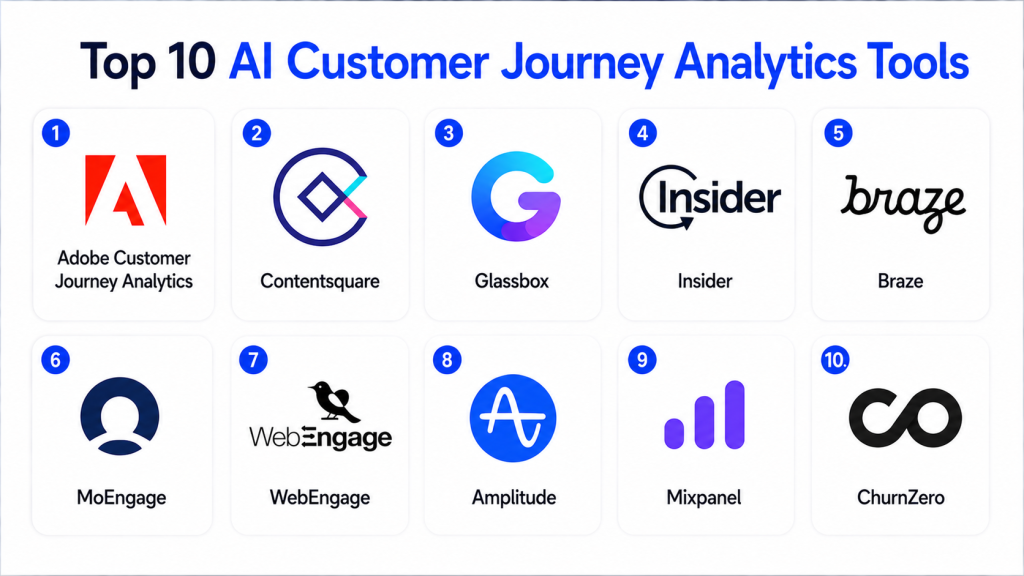
Top 10 AI Customer Journey Analytics Tools
1 — Adobe Customer Journey Analytics
One-line verdict: Best for large enterprises needing sophisticated cross-channel journey analysis across marketing, digital, customer, and business data.
Adobe Customer Journey Analytics is designed to help organizations analyze customer behavior across multiple channels and datasets. It can bring together customer interactions to provide a more complete view of journeys beyond traditional web analytics.
Standout Capabilities
- Cross-channel journey analysis.
- Customer behavior exploration.
- Journey visualization.
- Advanced segmentation.
- Customer-event analysis.
- Marketing analytics.
- Digital experience analysis.
- Enterprise reporting.
AI-Specific Depth
- Model support: Adobe-managed AI capabilities.
- RAG / knowledge integration: Customer and experience data context varies.
- Evaluation: Analytics validation and business-outcome comparison.
- Guardrails: Enterprise identity, permissions, and governance.
- Observability: Journey, customer, channel, and experience analytics.
Pros
- Strong enterprise analytics capabilities.
- Useful for complex omnichannel journeys.
- Broad Adobe ecosystem integration.
Cons
- Significant implementation complexity.
- Requires strong data governance.
- May be excessive for smaller businesses.
Security & Compliance
Verify SSO, RBAC, audit logs, encryption, retention, residency, consent controls, and required certifications according to deployment.
Deployment & Platforms
- Cloud: Available.
- Web: Available.
- Enterprise analytics environment: Available.
- Self-hosted: Varies / N/A.
Integrations & Ecosystem
- Adobe Experience Platform
- Marketing systems
- Customer data
- Digital analytics
- Data warehouses
- Campaign workflows
- Enterprise applications
Pricing Model
Enterprise commercial pricing.
Best-Fit Scenarios
- Enterprise omnichannel analytics.
- Complex digital customer journeys.
- Organizations using the broader Adobe ecosystem.
2 — Amplitude
One-line verdict: Best for product-led businesses wanting behavioral journey analytics, funnels, retention, experimentation, and product intelligence.
Amplitude helps product, growth, and business teams understand how customers interact with digital products. It provides behavioral analytics that can reveal which actions lead users toward conversion, retention, adoption, or disengagement.
Standout Capabilities
- Behavioral analytics.
- Journey analysis.
- Funnel analysis.
- Retention analytics.
- User cohorts.
- Feature-adoption analysis.
- Experimentation.
- Product intelligence.
AI-Specific Depth
- Model support: Platform-managed analytics and AI capabilities.
- RAG / knowledge integration: Product and behavioral context.
- Evaluation: Historical behavioral outcomes and experiments.
- Guardrails: Workspace and data-access controls.
- Observability: Product, journey, retention, and conversion analytics.
Pros
- Strong product analytics.
- Excellent for product-led growth.
- Useful for discovering behavioral journey patterns.
Cons
- Less focused on offline customer journeys.
- CRM and service context may require integrations.
- Enterprise omnichannel use cases require broader data architecture.
Security & Compliance
Verify SSO, RBAC, auditability, encryption, retention, residency, and certifications according to organizational requirements.
Deployment & Platforms
- Cloud: Available.
- Web: Available.
- Product SDKs: Available.
- Mobile and web analytics: Available.
Integrations & Ecosystem
- Applications
- Data warehouses
- Customer-data platforms
- Experimentation
- Marketing systems
- Product workflows
- Analytics tools
Pricing Model
Tiered and usage-oriented SaaS.
Best-Fit Scenarios
- SaaS product journeys.
- Product onboarding.
- Conversion and retention analysis.
3 — Mixpanel
One-line verdict: Best for teams wanting flexible behavioral journey, funnel, cohort, retention, and product engagement analysis.
Mixpanel helps organizations understand how users move through websites and applications. Teams can analyze events, funnels, retention, user segments, and behavioral patterns to identify where customers succeed or struggle.
Standout Capabilities
- Event analytics.
- Funnels.
- Retention.
- User journeys.
- Cohorts.
- Behavioral segmentation.
- Product analytics.
- Engagement analysis.
AI-Specific Depth
- Model support: Platform-managed analytics and AI-assisted capabilities.
- RAG / knowledge integration: Product-data context.
- Evaluation: Historical journey and conversion outcomes.
- Guardrails: Workspace and data permissions.
- Observability: Product, funnel, retention, and engagement analytics.
Pros
- Flexible event analytics.
- Easy behavioral segmentation.
- Strong for digital products.
Cons
- Not a complete enterprise CX platform.
- Offline journey data requires additional integration.
- Identity design requires careful implementation.
Security & Compliance
Verify SSO, RBAC, audit logs, encryption, retention, residency, and certifications.
Deployment & Platforms
- Cloud: Available.
- Web: Available.
- Product analytics integrations: Available.
Integrations & Ecosystem
- Web applications
- Mobile applications
- Data warehouses
- Customer-data platforms
- APIs
- Product workflows
- Business intelligence
Pricing Model
Tiered and usage-oriented SaaS.
Best-Fit Scenarios
- Digital product journeys.
- Funnel optimization.
- User retention analysis.
4 — Qualtrics Customer Experience
One-line verdict: Best for enterprises combining journey analytics with customer feedback, sentiment, surveys, and experience management.
Qualtrics focuses strongly on experience management and Voice of Customer programs. Journey-related customer information can be combined with surveys, feedback, sentiment, and operational signals to help organizations understand not only what customers do but also how they feel.
Standout Capabilities
- Customer-experience analytics.
- Voice of Customer.
- Journey insights.
- Survey analytics.
- Sentiment analysis.
- Experience drivers.
- Customer segmentation.
- Feedback intelligence.
AI-Specific Depth
- Model support: Qualtrics-managed AI.
- RAG / knowledge integration: Customer-experience context varies.
- Evaluation: Survey and business-outcome validation.
- Guardrails: Enterprise governance and permissions.
- Observability: Customer-experience, feedback, and journey analytics.
Pros
- Strong Voice of Customer capabilities.
- Combines behavioral and experiential signals.
- Suitable for enterprise CX programs.
Cons
- More complex than basic product analytics.
- Requires substantial customer data.
- Smaller teams may not need its full capabilities.
Security & Compliance
Verify SSO, RBAC, auditing, encryption, retention, residency, privacy controls, and required certifications.
Deployment & Platforms
- Cloud: Available.
- Web: Available.
- Enterprise CX environment: Available.
Integrations & Ecosystem
- Surveys
- CRM
- Customer feedback
- Contact centers
- Experience data
- Analytics
- Enterprise applications
Pricing Model
Enterprise commercial pricing.
Best-Fit Scenarios
- Voice of Customer programs.
- Journey plus sentiment analysis.
- Enterprise customer-experience management.
5 — Medallia
One-line verdict: Best for large organizations connecting customer journeys with experience signals, feedback, digital behavior, and operational data.
Medallia provides customer-experience management and analytics capabilities across digital, contact-center, survey, and operational environments.
It is particularly useful when organizations want to connect journey behavior with customer feedback and broader experience outcomes.
Standout Capabilities
- Customer-experience analytics.
- Journey insights.
- Digital experience.
- Customer feedback.
- Text analytics.
- Experience signals.
- Customer segmentation.
- Operational analytics.
AI-Specific Depth
- Model support: Medallia-managed AI.
- RAG / knowledge integration: Experience and customer context varies.
- Evaluation: Customer outcomes and human analytical review.
- Guardrails: Enterprise access and governance.
- Observability: Journey and experience analytics.
Pros
- Broad enterprise CX capabilities.
- Useful for omnichannel organizations.
- Combines behavioral and feedback signals.
Cons
- Enterprise-focused.
- Implementation can be substantial.
- Requires strong data integration.
Security & Compliance
Verify SSO, RBAC, auditability, retention, encryption, residency, privacy controls, and certifications.
Deployment & Platforms
- Cloud: Available.
- Web: Available.
- Enterprise CX environments: Available.
Integrations & Ecosystem
- Customer feedback
- Contact centers
- Digital experiences
- CRM
- Surveys
- Enterprise data
- Analytics systems
Pricing Model
Enterprise commercial model.
Best-Fit Scenarios
- Enterprise journey analytics.
- Customer-experience optimization.
- Multi-channel experience analysis.
6 — Contentsquare
One-line verdict: Best for digital-experience teams identifying friction, behavior patterns, and journey problems across websites and applications.
Contentsquare focuses on digital experience analytics. It helps organizations understand how users interact with digital interfaces and where frustration, abandonment, or usability problems occur.
Standout Capabilities
- Digital journey analysis.
- Experience analytics.
- Behavioral insights.
- Friction detection.
- Session analysis.
- Journey visualization.
- Conversion analysis.
- Digital performance insights.
AI-Specific Depth
- Model support: Platform-managed AI capabilities.
- RAG / knowledge integration: Digital experience context.
- Evaluation: Behavioral outcomes and conversion analysis.
- Guardrails: Workspace and data-access controls.
- Observability: Digital experience and journey analytics.
Pros
- Strong digital experience specialization.
- Useful for identifying website and application friction.
- Helps connect behavior with conversion outcomes.
Cons
- Primarily digital-focused.
- Offline customer journeys require other data sources.
- Broader CRM journey analysis may require integrations.
Security & Compliance
Verify SSO, RBAC, auditability, data masking, retention, encryption, residency, and applicable certifications.
Deployment & Platforms
- Cloud: Available.
- Web: Available.
- Web and application analysis: Available.
Integrations & Ecosystem
- Websites
- Applications
- Digital analytics
- Experimentation
- Product analytics
- Customer-data systems
- Business intelligence
Pricing Model
Commercial enterprise SaaS.
Best-Fit Scenarios
- Website optimization.
- Ecommerce journeys.
- Digital friction analysis.
7 — Glassbox
One-line verdict: Best for organizations needing detailed digital journey analytics, session intelligence, and customer-friction investigation.
Glassbox focuses on digital experience intelligence and customer journey analysis. It can help teams investigate how users navigate digital products and identify technical or experience problems affecting conversion.
Standout Capabilities
- Journey analytics.
- Session intelligence.
- Digital experience analysis.
- Customer-friction detection.
- Funnel analysis.
- Behavioral insights.
- Digital performance analysis.
- Experience monitoring.
AI-Specific Depth
- Model support: Platform-managed AI capabilities.
- RAG / knowledge integration: Digital-session context.
- Evaluation: Journey outcomes and human investigation.
- Guardrails: Enterprise access controls.
- Observability: Session, experience, and journey analytics.
Pros
- Detailed digital behavior visibility.
- Strong troubleshooting capabilities.
- Useful for complex customer journeys.
Cons
- Primarily focused on digital experiences.
- Can require significant data volume.
- Broader customer lifecycle analysis may require additional systems.
Security & Compliance
Verify SSO, RBAC, auditing, data masking, retention, encryption, residency, and required certifications.
Deployment & Platforms
- Cloud: Available.
- Web: Available.
- Digital experience analysis: Available.
Integrations & Ecosystem
- Websites
- Mobile applications
- Analytics
- Customer-experience systems
- Product tools
- Enterprise data
Pricing Model
Commercial enterprise pricing.
Best-Fit Scenarios
- Digital journey troubleshooting.
- Customer-friction investigation.
- Conversion optimization.
8 — Salesforce Customer 360 and Data Cloud
One-line verdict: Best for Salesforce-centered enterprises building customer journeys from CRM, service, marketing, commerce, and unified customer data.
Salesforce provides customer-data and analytics capabilities that can bring together information from multiple business functions.
Organizations can use unified customer profiles to understand how sales, marketing, service, commerce, and other interactions contribute to the customer lifecycle.
Standout Capabilities
- Unified customer profiles.
- CRM journey context.
- Customer segmentation.
- Marketing interactions.
- Service history.
- Customer-data activation.
- Workflow automation.
- Enterprise analytics.
AI-Specific Depth
- Model support: Salesforce-managed and supported AI capabilities.
- RAG / knowledge integration: CRM and connected customer data.
- Evaluation: Business-outcome and campaign evaluation.
- Guardrails: Salesforce identity and data permissions.
- Observability: CRM, customer, and journey analytics.
Pros
- Deep CRM integration.
- Strong customer identity context.
- Broad enterprise ecosystem.
Cons
- Significant implementation complexity.
- Best value requires broader Salesforce adoption.
- Licensing and architecture can become complex.
Security & Compliance
Verify SSO, RBAC, audit logs, encryption, retention, residency, consent management, and certifications according to selected products.
Deployment & Platforms
- Cloud: Available.
- Web: Available.
- Salesforce ecosystem: Available.
Integrations & Ecosystem
- CRM
- Marketing
- Customer service
- Commerce
- Customer data
- Enterprise applications
- Analytics
Pricing Model
Enterprise commercial pricing varying by selected products.
Best-Fit Scenarios
- CRM-driven customer journeys.
- Enterprise customer lifecycle analysis.
- Salesforce-centered organizations.
9 — Heap
One-line verdict: Best for digital teams wanting behavioral journey discovery with broad event capture and product-experience analysis.
Heap is a digital insights and product analytics platform designed to help teams understand user behavior across digital products.
It can reduce dependence on manually defining every event before teams begin investigating customer behavior.
Standout Capabilities
- Digital behavior analytics.
- Journey analysis.
- Event capture.
- Funnel analysis.
- Retention.
- User segmentation.
- Product analytics.
- Experience insights.
AI-Specific Depth
- Model support: Platform-managed analytics capabilities.
- RAG / knowledge integration: Product and behavioral context.
- Evaluation: Historical behavior and conversion outcomes.
- Guardrails: Workspace and data permissions.
- Observability: Product, journey, funnel, and behavioral analytics.
Pros
- Useful behavioral discovery.
- Strong digital analytics.
- Reduces some manual instrumentation requirements.
Cons
- Primarily focused on digital journeys.
- Offline customer context requires integrations.
- Complex data environments still need governance.
Security & Compliance
Verify SSO, RBAC, auditing, retention, encryption, data controls, residency, and certifications.
Deployment & Platforms
- Cloud: Available.
- Web: Available.
- Digital product analytics: Available.
Integrations & Ecosystem
- Websites
- Applications
- Data warehouses
- Customer-data systems
- Analytics
- Product workflows
- APIs
Pricing Model
Tiered commercial SaaS.
Best-Fit Scenarios
- Digital product analytics.
- Journey discovery.
- Conversion optimization.
10 — Custom AI Customer Journey Analytics Platform
One-line verdict: Best for mature organizations needing complete control over identity, journey data, models, predictions, and business logic.
Organizations can build custom customer journey analytics environments using data warehouses, event streams, CRM information, product telemetry, support interactions, marketing data, transaction history, machine learning, and business intelligence.
This approach provides maximum flexibility but also creates significant engineering and governance responsibilities.
Standout Capabilities
- Custom customer identity.
- Cross-channel event models.
- Custom journey definitions.
- Journey discovery.
- Predictive analytics.
- Custom segmentation.
- Private deployment.
- Custom business metrics.
AI-Specific Depth
- Model support: Open-source / proprietary / BYO / multi-model.
- RAG / knowledge integration: Fully customizable.
- Evaluation: Historical journeys, experiments, holdout datasets, and business outcomes.
- Guardrails: Custom privacy, access, and model controls.
- Observability: Data quality, models, journey metrics, cost, latency, and drift.
Pros
- Maximum flexibility.
- Complete data ownership options.
- Can model highly specialized journeys.
Cons
- High engineering effort.
- Identity resolution can be difficult.
- Continuous maintenance is required.
Security & Compliance
Entirely architecture-dependent. Organizations must design identity, consent, access controls, retention, encryption, auditing, privacy, residency, and model governance.
Deployment & Platforms
- Cloud: Possible.
- Self-hosted: Possible.
- Hybrid: Possible.
- Private infrastructure: Possible.
Integrations & Ecosystem
- CRM
- Product analytics
- Marketing
- Customer support
- Billing
- Data warehouses
- Business intelligence
Pricing Model
Costs include engineering, data infrastructure, storage, model usage, analytics, integrations, and ongoing maintenance.
Best-Fit Scenarios
- Complex enterprise journeys.
- Regulated organizations.
- Businesses with highly specialized customer-data environments.
Comparison Table
| Tool Name | Best For | Deployment | Model Flexibility | Strength | Watch-Out | Public Rating |
|---|---|---|---|---|---|---|
| Adobe Customer Journey Analytics | Large enterprises | Cloud | Hosted | Omnichannel journey analytics | Complex implementation | N/A |
| Amplitude | Product-led businesses | Cloud | Hosted | Behavioral journeys | Digital-first focus | N/A |
| Mixpanel | Product teams | Cloud | Hosted | Flexible event analytics | Limited offline context | N/A |
| Qualtrics | Enterprise CX | Cloud | Hosted | Journey + customer feedback | Enterprise complexity | N/A |
| Medallia | Large CX programs | Cloud | Hosted | Experience intelligence | Integration effort | N/A |
| Contentsquare | Digital experience teams | Cloud | Hosted | Friction detection | Digital-focused | N/A |
| Glassbox | Digital enterprises | Cloud | Hosted | Session-level journey analysis | Broader CX needs integrations | N/A |
| Salesforce | CRM-centered enterprises | Cloud | Hosted / Varies | Unified customer context | Ecosystem complexity | N/A |
| Heap | Digital product teams | Cloud | Hosted | Behavioral discovery | Primarily digital | N/A |
| Custom Platform | Mature enterprises | Cloud / Self-hosted / Hybrid | BYO / Multi-model | Maximum control | Engineering overhead | N/A |
Scoring & Evaluation
The following scores are comparative editorial assessments rather than official ratings. Customer journey analytics platforms serve different purposes, so a product analytics platform should not be evaluated exactly like an enterprise Voice of Customer environment.
The evaluation considers journey-analysis depth, reliability, integrations, usability, performance, security, governance, and the ability to convert journey data into practical business decisions.
- Core features – 20%
- AI reliability and evaluation – 15%
- Guardrails and safety – 10%
- Integrations and ecosystem – 15%
- Ease of use – 10%
- Performance and cost controls – 15%
- Security and administration – 10%
- Support and community – 5%
| Tool | Core | Reliability/Eval | Guardrails | Integrations | Ease | Perf/Cost | Security/Admin | Support | Weighted Total |
|---|---|---|---|---|---|---|---|---|---|
| Adobe CJA | 10 | 9 | 10 | 10 | 7 | 7 | 10 | 10 | 9.00 |
| Amplitude | 10 | 9 | 9 | 10 | 9 | 9 | 9 | 9 | 9.25 |
| Mixpanel | 9 | 9 | 9 | 9 | 10 | 9 | 9 | 9 | 9.10 |
| Qualtrics | 10 | 9 | 10 | 10 | 8 | 7 | 10 | 10 | 9.10 |
| Medallia | 10 | 9 | 10 | 10 | 8 | 7 | 10 | 10 | 9.10 |
| Contentsquare | 10 | 9 | 9 | 9 | 9 | 8 | 9 | 9 | 9.00 |
| Glassbox | 9 | 9 | 9 | 9 | 8 | 8 | 9 | 9 | 8.70 |
| Salesforce | 10 | 9 | 10 | 10 | 7 | 7 | 10 | 10 | 9.00 |
| Heap | 9 | 9 | 9 | 9 | 9 | 9 | 9 | 9 | 9.00 |
| Custom Platform | 10 | 10 | 10 | 10 | 5 | 7 | 10 | 6 | 8.85 |
Which AI Customer Journey Analytics Tool Is Right for You?
Solo / Freelancer
Solo businesses rarely need a complex enterprise journey analytics platform.
Basic web and product analytics may be enough to understand acquisition, conversion, purchase, and repeat usage.
SMB
Small and growing businesses should prioritize simple journey visualization, funnels, retention, cohorts, and behavioral segmentation.
Amplitude, Mixpanel, or Heap may be appropriate when most customer interactions happen digitally.
Avoid collecting large amounts of customer data without a clear business question.
Mid-Market
Mid-market businesses should connect product behavior with:
- CRM.
- Marketing.
- Customer support.
- Customer success.
- Billing.
- Surveys.
This provides a broader understanding of the complete customer journey.
Enterprise
Enterprises should evaluate:
- Customer identity resolution.
- Cross-channel analytics.
- SSO.
- RBAC.
- Auditability.
- Consent management.
- Data residency.
- Data retention.
- Journey visualization.
- Predictive analytics.
- Segmentation.
- Data-warehouse integration.
- Customer feedback.
- Real-time processing.
- AI governance.
The platform should preserve appropriate permissions as customer data moves between systems.
Regulated Industries
Finance, healthcare, insurance, government, and other regulated organizations need strong control over customer data.
Journey platforms may process:
- Personal information.
- Account information.
- Transaction history.
- Support conversations.
- Behavioral data.
- Device information.
Only collect information necessary for legitimate business purposes and maintain appropriate access, retention, and privacy controls.
Budget vs Premium
Lower-cost product analytics can be sufficient for digital-first customer journeys.
Premium enterprise platforms become more valuable when organizations require:
- Cross-channel identity.
- Offline interactions.
- Customer feedback.
- Contact-center data.
- CRM context.
- Predictive analytics.
- Enterprise governance.
- Complex segmentation.
Evaluate whether the additional journey data actually improves business decisions.
Build vs Buy
Building a custom platform can make sense when an organization already operates a mature data warehouse and has unusual customer journeys.
Buying is usually faster when standard product, marketing, CRM, service, and experience analytics cover most requirements.
Implementation Playbook: 30 / 60 / 90 Days
First 30 Days — Define Important Journeys
Start with three to five high-value journeys.
Examples:
- Visitor to signup.
- Signup to activation.
- Trial to paid subscription.
- Purchase to repeat purchase.
- Support request to resolution.
- New customer to renewal.
Define the success event for each journey.
Identify the data required to measure each step.
Days 31–60 — Connect Data and Validate Identity
Connect important sources such as:
- Website.
- Mobile application.
- CRM.
- Marketing.
- Customer support.
- Billing.
- Surveys.
Validate customer identity across systems.
Check for:
- Duplicate profiles.
- Missing events.
- Incorrect timestamps.
- Inconsistent customer IDs.
- Tracking gaps.
Do not trust AI-generated journey insights until the underlying data is reliable.
Days 61–90 — Optimize and Automate
Identify major friction points.
Examples include:
- Signup abandonment.
- Onboarding failure.
- Checkout abandonment.
- Repeated support contacts.
- Feature-adoption problems.
- Renewal friction.
Run controlled experiments where appropriate.
Use automation carefully for low-risk personalization and customer communication.
Track whether journey improvements increase conversion, satisfaction, retention, or revenue.
Common Mistakes and How to Avoid Them
- Tracking everything without clear objectives.
- Building dashboards before defining important journeys.
- Ignoring customer identity problems.
- Treating devices as customers.
- Ignoring offline interactions.
- Looking only at marketing journeys.
- Ignoring support experiences.
- Ignoring product usage.
- Focusing only on the average customer.
- Creating too many customer segments.
- Assuming correlation proves causation.
- Ignoring customer sentiment.
- Automating personalization without sufficient context.
- Failing to validate AI-generated insights.
- Collecting unnecessary personal data.
- Ignoring consent requirements.
- Allowing inconsistent event definitions.
- Failing to monitor tracking quality.
- Optimizing individual touchpoints while damaging the overall journey.
- Measuring activity instead of meaningful customer outcomes.
Frequently Asked Questions
1. What is AI customer journey analytics?
AI customer journey analytics uses behavioral data, customer information, and intelligent analysis to understand how people move through different interactions with a business and what influences their outcomes.
2. How is customer journey analytics different from web analytics?
Web analytics primarily measures website behavior. Customer journey analytics can connect websites with applications, CRM, marketing, support, purchases, surveys, and other customer interactions.
3. Can AI automatically discover customer journeys?
Some platforms can help identify common behavioral paths and patterns without requiring every journey to be manually predefined. Human interpretation is still important for understanding business meaning.
4. What data is needed for customer journey analytics?
Common sources include web events, mobile activity, CRM records, marketing interactions, support tickets, purchases, product usage, surveys, billing information, and customer-success activity.
5. Can customer journey analytics help reduce churn?
Yes. Teams can identify behavioral changes, poor onboarding, repeated support problems, low product adoption, and other journey patterns associated with customer disengagement.
6. Can customer journey analytics improve conversion rates?
Yes. Journey analysis can identify where customers abandon signup, onboarding, checkout, purchasing, or other important processes so teams can investigate and improve those experiences.
7. What is customer identity resolution?
Identity resolution attempts to connect interactions from different devices, channels, or systems with the correct customer profile while respecting privacy and consent requirements.
8. Can customer sentiment be included in journey analytics?
Yes. Survey responses, reviews, calls, support conversations, and other feedback can add emotional and experience context to behavioral journey data.
9. Are customer journey analytics platforms suitable for small businesses?
Yes, but small businesses usually benefit more from simpler product or digital analytics tools rather than complex enterprise customer-experience platforms.
10. How do I choose the best AI customer journey analytics platform?
Compare journey visualization, behavioral analytics, identity resolution, segmentation, data integrations, predictive capabilities, experimentation, privacy controls, security, usability, cost, and how effectively the platform turns journey insights into measurable business improvements.
Conclusion
AI customer journey analytics tools help organizations understand the complete sequence of interactions that shape customer behavior. Instead of evaluating marketing, product usage, sales, support, purchases, and retention separately, these platforms can connect signals across the customer lifecycle and reveal where experiences succeed or fail.Different tools fit different requirements. Adobe Customer Journey Analytics is well suited to complex enterprise environments. Amplitude, Mixpanel, and Heap are strong choices for digital product and behavioral analysis. Qualtrics and Medallia are particularly useful when customer feedback and experience signals are important. Contentsquare and Glassbox provide deeper visibility into digital experience and friction, while Salesforce is attractive for organizations that need CRM-centered customer context. Custom platforms provide maximum flexibility for businesses with sophisticated data teams and specialized journeys.