Introduction
DevOps has moved from a “nice to have” to a boardroom priority for enterprises under pressure to deliver software faster, safer, and more reliably. At the same time, cloud, Kubernetes, and AI‑driven operations have dramatically increased complexity for technology leaders. Working with an experienced DevOps consulting company and investing in targeted DevOps corporate training helps organizations turn this complexity into a competitive advantage instead of a liability. This guide explains how to approach DevOps, SRE, DevSecOps, and platform engineering with an enterprise mindset, and how a partner like Cotocus can support you end‑to‑end with consulting and corporate enablement.
What a Modern DevOps Consulting Company Really Does
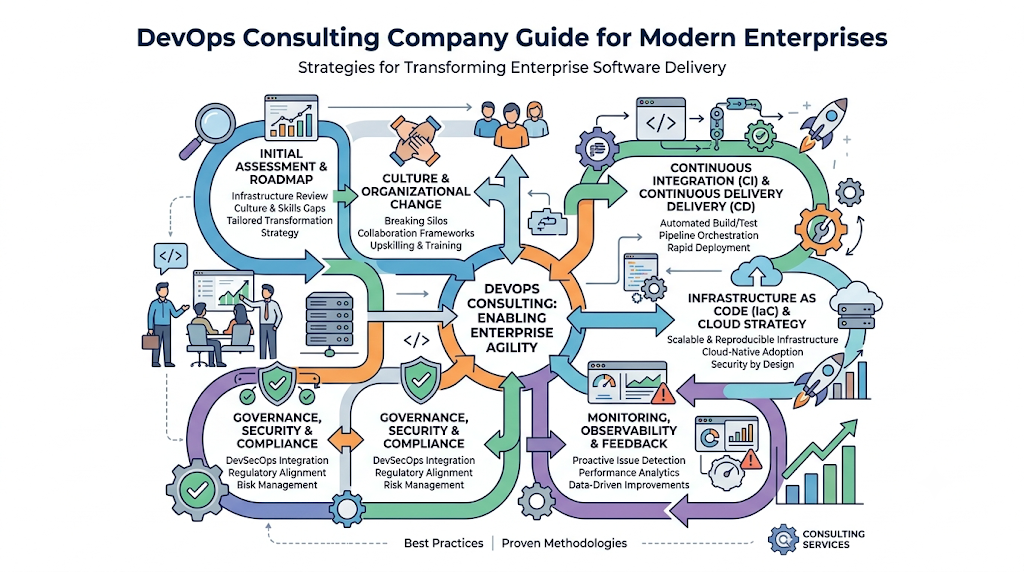
A modern DevOps consulting company goes far beyond “tool implementation” and focuses on end‑to‑end process improvement, culture change, and platform design. Consultants assess how software flows from idea to production, identify constraints, and design integrated delivery pipelines, observability, and feedback loops. They typically work across DevOps, SRE, DevSecOps, DataOps, AIOps, MLOps, GitOps, and cloud platforms, aligning engineering practices with business goals.
Cotocus operates in this space as a B2B technology and digital transformation consulting company, combining advisory, implementation, and corporate training. Their teams help organizations implement CI/CD pipeline consulting, infrastructure automation consulting, platform engineering consulting, and Kubernetes consulting services, typically backed by structured enablement programs for engineering teams. For CTOs and IT leaders, this means a single partner that can design the blueprint, implement it, and upskill your people so the change is sustainable.
Why Enterprises Need DevOps, SRE, and DevSecOps Consulting
Enterprise IT landscapes are a mix of legacy systems, microservices, multiple clouds, and third‑party platforms, making consistent delivery and reliability difficult. Poorly integrated tools, manual handoffs, and siloed teams often create long lead times, frequent incidents, and security gaps. DevOps consulting services and SRE consulting services provide an outside‑in perspective to streamline these delivery pipelines and reliability practices.
Site Reliability Engineering consulting focuses on availability, performance, and error budgets, bringing production‑first thinking into engineering teams. DevSecOps consulting services embed security early in the SDLC, combining automated security checks, compliance‑as‑code, and secure infrastructure patterns. For organizations that also deal with heavy data and AI workloads, AIOps consulting services, MLOps consulting services, and DataOps consulting services ensure that analytics and ML pipelines are treated with the same rigor as application delivery.
Traditional IT vs Modern DevOps and SRE
Table 1 – Traditional IT vs DevOps/SRE Delivery
| Aspect | Traditional IT Operations | DevOps & SRE Approach | Benefits (Modern) | Typical Use Cases | Best Choice |
|---|---|---|---|---|---|
| Release cycle | Quarterly or yearly releases | Weekly, daily, or on‑demand releases | Faster time‑to‑market and quicker feedback | Customer‑facing digital products | DevOps/SRE |
| Change process | Heavy CAB, manual approvals | Automated CI/CD with policy controls | Reduced lead time, fewer human errors | Mature engineering teams | DevOps/SRE |
| Reliability | Reactive incident response | Proactive SLOs, error budgets, automation | Predictable availability, fewer outages | Mission‑critical services | DevOps/SRE |
| Security | Late security reviews, manual checks | Embedded DevSecOps, security as code | Continuous risk reduction, better compliance | Regulated industries | DevOps/SRE |
| Tooling | Fragmented scripts and manual tasks | Integrated platforms, IaC, GitOps | Consistency, repeatability, easier audits | Medium to large enterprises | DevOps/SRE |
A DevOps consulting company helps organizations move from the traditional column to the modern column with a structured roadmap, avoiding disruption while increasing delivery speed and reliability.
Core Pillars: Consulting, Implementation, and DevOps Corporate Training
For DevOps transformation to stick, consulting, implementation, and DevOps corporate training must reinforce each other. Advisory defines the strategy, implementation brings in the tooling and automation, and training ensures teams can run and evolve the platform.
Cotocus provides DevOps consulting services, cloud consulting services, and Kubernetes consulting services alongside DevOps corporate training and Kubernetes corporate training. This mix allows enterprises to conduct executive workshops, design target operating models, then roll out CI/CD, infrastructure automation, and observability, while simultaneously upskilling developers, SREs, and security engineers. HR and L&D teams benefit from structured programs with certifications, labs, and assessments to measure progress.
Cloud, Kubernetes, and Platform Engineering for Enterprises
Cloud migration services and cloud consulting services are often the first step in modernizing legacy applications and data platforms. A mature partner will guide decisions on what to rehost, replatform, or refactor, and design landing zones, identity, and cost‑management patterns (including FinOps practices). Once workloads are in the cloud, platform engineering consulting helps create internal platforms that standardize how teams build, deploy, and operate services.
Kubernetes consulting services focus on production‑grade cluster design, multi‑cluster management, security, and observability for containerized workloads. GitOps consulting services then layer on declarative configuration and continuous delivery using Git as the source of truth. Cotocus typically combines these with CI/CD pipeline consulting and infrastructure automation consulting (e.g., Terraform, Ansible) to deliver repeatable, policy‑driven environments across clouds.
Consulting vs Building an Internal DevOps Team
Table 2 – DevOps Consulting vs In‑House Only
| Dimension | DevOps Consulting Services | In‑House Team Only | Benefits (Consulting) | Limitations (Consulting) | Best Use Case |
|---|---|---|---|---|---|
| Time to value | Rapid frameworks, expert accelerators | Slower, learn‑as‑you‑go | Faster implementation and reduced trial‑and‑error | Needs alignment with internal culture | Strategic transformations |
| Expertise breadth | Multi‑domain (DevOps, SRE, cloud, security) | Focused on current stack | Access to proven patterns across many clients | May depend on external availability | Complex, multi‑cloud estates |
| Cost model | Project‑based or retainer | Ongoing payroll and hiring costs | Predictable for transformation phases | Not a permanent replacement | Kickstarting initiatives |
| Knowledge transfer | Formal training and documentation | Implicit, depends on individuals | Structured upskilling via DevOps training for companies | Needs active internal participation | Building internal capability |
| Risk | Shared with experienced partner | Fully internal | Reduced risk of failed rollouts | Need clear success criteria | High‑impact changes |
In practice, most successful enterprises use both: they partner with a DevOps consulting company like Cotocus to design and bootstrap the transformation, while simultaneously building and training an internal platform and SRE team.
Best Practices for Successful DevOps and Cloud Transformation
Successful DevOps and cloud transformations follow consistent patterns, regardless of industry. Technology leaders should treat DevOps as an operating model change, not just a tooling upgrade.
Actionable best practices:
- Start with a value‑stream assessment to map how work flows from idea to production and where delays occur.
- Define a small but impactful pilot scope (one product or business unit) to validate new ways of working before scaling.
- Standardize on CI/CD pipeline patterns with automated testing, security checks, and quality gates.
- Implement infrastructure automation consulting outcomes such as infrastructure‑as‑code, configuration management, and immutable deployments.
- Use Kubernetes consulting services to introduce progressive rollouts, autoscaling, and self‑healing infrastructure.
- Build cross‑functional product teams that own services from development through operations, supported by SRE and platform engineering consulting.
- Invest in DevOps corporate training and DevSecOps corporate training to align skills with the new toolchain.
Common Challenges and How to Solve Them
Organizations often underestimate cultural resistance and overestimate the maturity of their existing processes. Teams may feel threatened by automation, or leadership might expect instant results without allowing time for experimentation. A DevOps consulting company can help facilitate workshops, clarify roles, and create a realistic roadmap tied to measurable outcomes.
Another common challenge is fragmented tooling: multiple CI servers, different deployment scripts, and inconsistent observability stacks. CI/CD pipeline consulting and platform engineering consulting address this by rationalizing tools and standardizing pipelines. Security is another hotspot, especially in regulated industries; DevSecOps consulting services align security controls with automated workflows, reducing friction between developers and security teams. Continuous corporate training ensures that as tools evolve, teams stay confident and productive.
Tool‑Centric Automation vs Platform Engineering
Table 3 – Tool‑Driven Automation vs Platform Engineering
| Aspect | Ad‑Hoc Tool Automation | Platform Engineering Consulting Approach | Benefits (Platform) | Limitations (Platform) | Best Choice |
|---|---|---|---|---|---|
| Focus | Individual scripts, local optimizations | Shared internal platforms and golden paths | Consistency and easier onboarding | Higher initial design effort | Platform engineering |
| Ownership | Individual teams or engineers | Dedicated platform team with product mindset | Clear ownership and roadmap | Needs investment | Medium/large orgs |
| User experience | DIY, varying developer experience | Self‑service portals, templates, and APIs | Faster delivery and reduced cognitive load | Requires UX focus | Growing engineering teams |
| Governance | Hard to enforce, manual reviews | Policy‑as‑code and guardrails | Better compliance and audit trails | Needs tooling integration | Regulated industries |
| Scalability | Difficult to scale across many teams | Designed to scale across products and business units | Reusable patterns and lower long‑term cost | Needs continuous improvement | Enterprise scale |
Cotocus supports platform engineering consulting that turns DevOps practices into internal products with clear SLAs, roadmaps, and feedback loops, combining CI/CD, GitOps, and observability into a cohesive developer platform.
Expert Tips from the Field
- Align DevOps metrics with business outcomes. Move beyond deployment counts and track lead time, change failure rate, and customer‑impacting incidents that leadership cares about.
- Treat training as part of the project, not an afterthought. Embed DevOps training for companies and Kubernetes corporate training into every major platform rollout, with labs that mirror your real environment.
- Design for multi‑cloud pragmatically. Use cloud consulting services to standardize security, networking, and identity, but avoid over‑abstracting away cloud‑native capabilities.
- Start SRE practices early. Even if you cannot dedicate full‑time SREs initially, introduce SLOs, incident reviews, and error budgets as soon as possible.
- Use AIOps and observability wisely. AIOps consulting services can help cut noise by correlating logs, metrics, and traces, but it works best when foundational instrumentation is already in place.
Industry Trends and Future Outlook
DevOps, SRE, and platform engineering are converging into a unified operating model focused on developer experience, reliability, and security by default. More organizations are investing in platform teams that offer self‑service capabilities, backed by GitOps and policy‑as‑code, instead of each team assembling its own toolchain. At the same time, AI and data‑driven operations are pushing AIOps, MLOps, and DataOps practices into mainstream adoption, blurring the lines between application and data platforms.
Corporate training is also evolving, moving from one‑off workshops to continuous learning ecosystems that blend instructor‑led sessions, labs, and certifications. Companies like Cotocus and its training unit DevOpsSchool focus on hands‑on, scenario‑based programs that align with real enterprise challenges rather than generic slide‑based courses. For technology decision makers, this means that the right DevOps consulting company can serve as both strategic advisor and long‑term upskilling partner as the landscape continues to change.
Why Choose Cotocus as Your DevOps Consulting Partner
Cotocus is a digital transformation consulting company headquartered in India, operating globally with a strong focus on DevOps, cloud, AI, and modern software engineering practices. It offers process improvement, advisory and consulting, recruitment, research and analytics, and a dedicated corporate training arm that covers DevOps, SRE, DevSecOps, DataOps, AIOps, MLOps, GitOps, CloudOps, and platform engineering. This breadth allows Cotocus to address strategy, execution, and capability building under one roof.
Enterprise clients and startup founders benefit from customized DevOps consulting services and DevOps corporate training designed around their technology stack, regulatory environment, and growth plans. The company emphasizes hands‑on labs, real‑world case studies, and measurable outcomes such as reduced deployment lead times, improved reliability, and stronger security posture. With presence across India and the USA, Cotocus supports organizations with both remote and on‑site engagements.
Frequently Asked Questions
- What does a DevOps consulting company actually deliver?
A DevOps consulting company assesses your current delivery and operations practices, then designs a roadmap for automation, culture change, and platform modernization. It typically delivers reference architectures, CI/CD patterns, infrastructure‑as‑code, observability setups, and governance models, often paired with DevOps corporate training so your teams can own the new way of working. - When should we engage DevOps consulting services?
You should consider DevOps consulting services when you face slow releases, frequent outages, or fragmented toolchains that are difficult to manage. Many enterprises also bring in consultants before or during major cloud migration services or large product modernizations, to avoid “lifting and shifting” existing problems into the cloud. - How do DevOps corporate training programs work for enterprises?
DevOps corporate training typically combines assessments, tailored curricula, instructor‑led sessions, and hands‑on labs aligned with your technology stack. Providers like Cotocus and DevOpsSchool offer multiple delivery modes—on‑site, online live, and self‑paced—plus certifications and post‑training support so HR and L&D teams can measure outcomes. - What is the difference between SRE consulting services and DevOps consulting?
DevOps consulting focuses on end‑to‑end software delivery, collaboration, and automation across development and operations. Site Reliability Engineering consulting zooms in on reliability, performance, and incident management, using practices like SLOs, error budgets, and blameless postmortems to drive improvements. In practice, both approaches complement each other in modern enterprises. - Why do companies need DevSecOps consulting services?
DevSecOps consulting services help integrate security into CI/CD pipelines and infrastructure, reducing the risk of vulnerabilities and compliance issues. Consultants work with security, development, and operations teams to automate scanning, policy enforcement, and secure configurations, supported by DevSecOps corporate training that builds shared understanding. - How does Kubernetes consulting services support enterprise teams?
Kubernetes consulting services assist with cluster architecture, security, multi‑environment strategies, and workload migration to containers. They also help teams adopt GitOps, progressive delivery, and observability best practices, often paired with Kubernetes corporate training so developers and SREs can manage the platform confidently. - What is the role of cloud consulting services in digital transformation?
Cloud consulting services guide decisions on cloud providers, landing zone design, migration strategies, and cost optimization. They help align infrastructure with application and data needs, often as part of a broader digital transformation consulting company engagement that includes DevOps, DataOps, and security. - How do AIOps, MLOps, and DataOps consulting services fit into DevOps?
AIOps consulting services use machine learning to analyze operational data and reduce alert noise. MLOps and DataOps consulting services extend DevOps principles to machine learning models and data pipelines, enabling consistent deployment, monitoring, and governance of analytics workloads. Together, they support AI‑driven operations in complex environments. - Can DevOps training for companies be customized to our stack?
Yes, serious providers design DevOps training for companies around your tools, platforms, and regulatory context. Cotocus, for example, offers customized programs spanning CI/CD, cloud, Kubernetes, security, and observability, with labs and examples drawn from real enterprise scenarios. - What KPIs should we track for DevOps and SRE success?
Common KPIs include deployment frequency, change failure rate, mean time to recovery, and lead time for changes. SRE practices add service‑level objectives and error budgets, while business stakeholders often track impact metrics like time‑to‑market, customer satisfaction, and incident‑related downtime costs. - How long does a typical DevOps transformation take?
Timelines vary by organization size and complexity, but many enterprises see meaningful improvements within 3–6 months for a pilot area. Full adoption across multiple business units can take 12–24 months, especially when paired with cloud migration services, platform engineering, and comprehensive corporate training. - Is DevOps consulting relevant for smaller startups?
Yes, startups benefit from DevOps consulting services that help avoid early technical debt and design scalable pipelines. Instead of building complex processes, consultants help founders adopt lightweight but robust patterns, so teams can move fast without sacrificing reliability or security. - How does DevOps corporate training support HR and L&D goals?
DevOps corporate training programs provide structured learning paths, assessments, and certifications that HR and L&D teams can align with career frameworks. They also make it easier to standardize skills across teams and support internal mobility into roles like SRE, platform engineer, or DevSecOps specialist. - What distinguishes Cotocus from other DevOps consulting companies?
Cotocus combines DevOps consulting, cloud and AI services, recruitment, and a strong corporate training portfolio under one brand. Its training unit DevOpsSchool delivers hands‑on, lab‑driven programs and certifications, while consulting teams focus on process improvement and digital product engineering across industries. - How can we get started with Cotocus for consulting or training?
You can contact Cotocus through their website to discuss DevOps consulting services, cloud migration services, or DevOps corporate training needs. They operate in India and the USA, offering remote and on‑site engagements, and typically begin with a discovery call to understand your context and propose a tailored roadmap.
Conclusion
DevOps, SRE, DevSecOps, and platform engineering are now foundational capabilities for any enterprise that relies on software to compete and grow. The challenge is not just adopting new tools, but aligning people, processes, and platforms around a modern operating model. Partnering with a DevOps consulting company that also provides robust DevOps corporate training helps organizations execute transformation with less risk and faster time‑to‑value. Cotocus brings advisory, implementation, and enablement together so CTOs, CIOs, and engineering leaders can focus on delivering secure, reliable digital experiences at scale.
A common challenge in DevOps transformations is ensuring that knowledge remains within the organization after the consulting engagement ends. The most successful initiatives focus not only on implementing tools and processes but also on building internal capabilities, documentation, and ownership models that teams can sustain independently over time.