Introduction
In modern digital enterprises, IT infrastructure has grown exceptionally complex. The widespread adoption of microservices, distributed containers, and cloud-native architectures means that even standard applications generate vast floods of operational data every single second. When something goes wrong in these intricate environments, IT teams often find themselves reacting after the fact—scrambling to diagnose issues while end users are already experiencing service disruptions. To explore more about how modern frameworks leverage artificial intelligence for system reliability, you can check industry guides like Splunk’s AIOps Explained Guide. This reactive loop can drain team resources, elevate stress levels, and lead to costly downtime. As a result, modern organizations increasingly want to catch warning signals before minor anomalies escalate into major outages. Artificial Intelligence for IT Operations, commonly known as AIOps, provides a powerful approach to analyzing complex operational telemetry, helping teams shift their strategy from firefighting current fires to anticipating and preventing potential problems.
What Is IT Incident Prediction?
IT incident prediction is the practice of identifying warning signals, trends, or abnormal patterns that indicate a potential system failure or performance degradation may happen in the future.
To understand prediction clearly, it helps to look at the progression of an operational event:
- Detection: Identifying an issue that is currently occurring right now.
- Diagnosis: Investigating why the current issue happened.
- Prediction: Recognizing patterns that suggest an issue is likely to occur soon.
- Prevention: Taking early action to neutralize the predicted risk.
Consider a simple everyday example: A database server’s memory utilization has been gradually increasing by two percent every single day due to a slow memory leak. Instead of waiting for the database to crash when memory hits 100%, an analytics system identifies this trajectory and warns the operations team days in advance, allowing them to schedule a safe restart or patch deployment.
What Is AIOps?
AIOps stands for Artificial Intelligence for IT Operations. It refers to the application of big data, machine learning, advanced analytics, and automation algorithms to solve traditional IT management challenges.
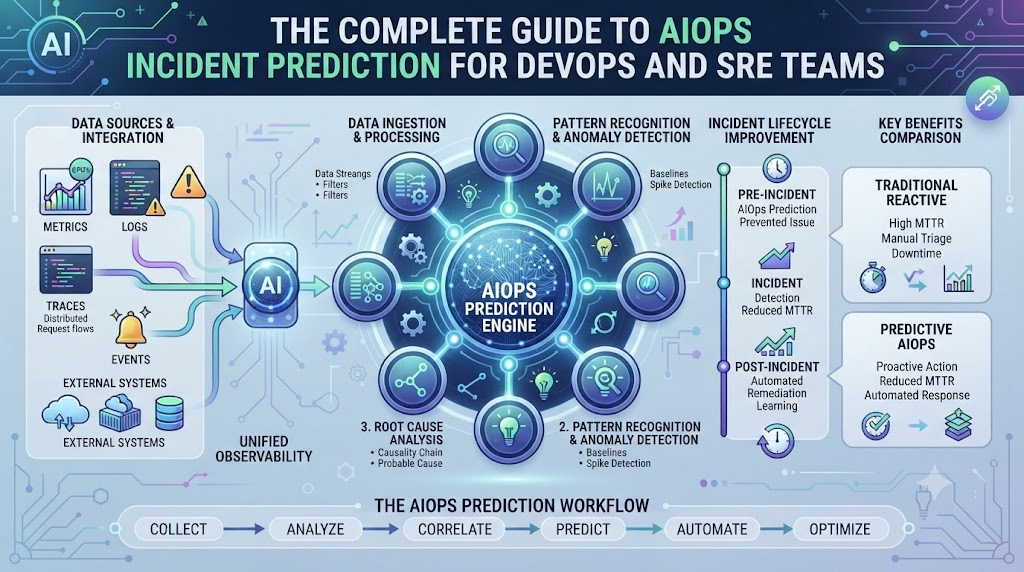
AIOps platforms do not operate in a vacuum. Instead, they ingest data from multiple telemetry channels simultaneously, including:
- System and application metrics
- Structured and unstructured logs
- Distributed application traces
- Raw event streams and alerts
- Configuration management records
- Historical incident archives
By combining these disparate signals, AIOps provides a unified view of system health, giving machine learning models the necessary context to recognize subtle shifts in behavior.
Reactive Monitoring vs. Predictive AIOps
Traditional monitoring tools have served IT teams well for decades, but they are fundamentally built to alert engineers after a threshold has been breached. Predictive AIOps introduces a different operational paradigm.
| Reactive IT Operations | Predictive AIOps |
| Responds after an issue appears | Looks for early warning signals and trends |
| Relies heavily on static alerts | Analyzes broad multi-source data patterns |
| Frequently uses fixed, rigid thresholds | Utilizes dynamic baselines adapted to context |
| Engineers investigate isolated alerts | Correlates related events to find root causes |
| Focuses entirely on current problems | Identifies potential future operational risks |
While traditional monitoring remains vital for validating live system states, AIOps complements these tools by adding a layer of intelligent foresight and correlation.
How AIOps Collects Data for Prediction
Reliable prediction depends entirely on the quality and breadth of the underlying telemetry. Without visibility, machine learning models cannot accurately forecast future states.
Metrics
Numerical time-series data—such as CPU utilization, memory pressure, disk I/O, network throughput, request latency, and error rates—provides the foundational pulse of infrastructure and applications.
Logs
System, application, and security logs capture discrete events and error strings that offer deep contextual clues about internal application states, hidden exceptions, and software warnings.
Traces
Distributed traces track requests as they hop across microservices, helping teams understand latency bottlenecks and structural dependencies across complex distributed pipelines.
Events and Alerts
Continuous event streams show state changes, configuration updates, and trigger warnings generated by individual monitoring utilities.
Incident History
Historical records of past failures, resolution steps, and post-mortem notes give machine learning models a reference library of what failure patterns looked like previously.
Role of Dynamic Baselines
In traditional monitoring, engineers configure static thresholds—such as triggering an alert if CPU usage exceeds 90% for five minutes. However, modern workloads fluctuate constantly based on business hours, marketing campaigns, and user habits. A static threshold often creates a flood of false alarms or misses real issues entirely during low-usage windows.
A dynamic baseline, by contrast, learns what “normal” behavior looks like across different hours, days of the week, or seasonal cycles.
By understanding these evolving patterns, a dynamic baseline can flag abnormal deviations instantly, even if the absolute metric value remains well below a traditional static cutoff point.
Anomaly Detection and Incident Prediction
Anomaly detection serves as a vital stepping stone toward AIOps incident prediction. The general operational flow follows a logical sequence:
$$\text{Normal Behavior} \longrightarrow \text{Data Ingestion} \longrightarrow \text{Pattern Analysis} \longrightarrow \text{Anomaly Identified} \longrightarrow \text{Risk Assessment} \longrightarrow \text{Early Warning}$$
However, it is vital to remember that an anomaly is not automatically an incident. For example, a sudden spike in database queries might look anomalous compared to midnight averages, but it could be entirely normal if a scheduled batch job runs every night.
AIOps uses contextual clues to separate harmless operational variations from genuine warning signals that demand engineering attention.
Event Correlation
When a single component fails in a distributed environment, it often triggers a cascade of secondary alerts across downstream services. A minor network glitch can easily generate hundreds of individual warning notifications.
Event correlation algorithms group these related alerts together into a single, cohesive incident ticket. By condensing thousands of noisy alerts into one root cause cluster, event correlation cuts through alert fatigue and helps engineers focus on the underlying issue rather than chasing symptoms.
Machine Learning in IT Incident Prediction
Machine learning algorithms power the analytical engine behind modern predictive operations. Rather than requiring manual scripting for every possible failure scenario, machine learning models learn directly from incoming data streams and historical records.
Key machine learning techniques include:
- Pattern Recognition: Identifying recurring sequences of events that consistently precede system failures.
- Time-Series Forecasting: Projecting metric trajectories forward in time to estimate when a resource might run out.
- Classification: Categorizing incoming anomalies based on similarity to known past incidents.
- Risk Scoring: Assigning dynamic risk scores to servers, clusters, or applications based on current health indicators.
Different models suit different datasets, meaning platforms often combine multiple machine learning approaches to maximize prediction accuracy.
Predictive Analytics and Early Warning Signals
Predictive analytics looks at historical trends alongside real-time telemetry to project future states. When applied to IT operations, these tools generate early warning signals for common failure modes.
Common examples include predicting:
- Storage volume exhaustion based on current growth velocity.
- Gradual API latency increases before timeouts trigger user complaints.
- Memory leak progression across containerized workloads.
- Network interface degradation preceding packet loss spikes.
These early warnings give SREs and platform engineers valuable time to intervene calmly during regular working hours rather than responding to sudden outages in the middle of the night.
Root Cause Analysis and Prediction
While prediction and root cause analysis work hand in hand, they address two distinct questions:
- Prediction asks: What might happen next?
- Root cause analysis asks: Why is this happening or why did this happen?
AIOps platforms often combine both capabilities, using predictive anomaly detection to spot an impending issue while simultaneously running automated root-cause analysis to pinpoint the exact dependency or code path responsible for the trend.
Practical Example: Predicting a Service Incident
Consider an online retail platform running on a containerized microservices architecture.
- Telemetry Collection: Metrics show that response latency on the checkout service is creeping upward by a few milliseconds every hour, while application logs show a slow accumulation of database connection pool wait messages.
- Signal Correlation: The AIOps platform ingests these metrics and logs, correlating the subtle latency shift with similar telemetry footprints recorded during a partial database slowdown three weeks prior.
- Early Warning Generation: Recognizing the matching pattern, the platform generates an early warning notification for the SRE team, assigning a high risk score to the checkout cluster.
- Proactive Intervention: An engineer reviews the alert, identifies an unoptimized database query introduced in a recent deployment, and applies a patch before connection limits are exhausted and user checkouts fail.
Benefits of AIOps for IT Incident Prediction
Implementing predictive operational capabilities can deliver substantial organizational advantages:
- Earlier Warnings: Catching developing problems before users notice service degradation.
- Reduced Alert Noise: Correlating related events to minimize distracting duplicate alerts.
- Faster Investigations: Providing contextual data that accelerates troubleshooting.
- Proactive Capacity Planning: Forecasting resource needs accurately based on actual usage trends.
- Lower Downtime Risk: Preventing severe outages through early, planned interventions.
The magnitude of these benefits depends heavily on data hygiene, team workflows, and the overall maturity of an organization’s observability practices.
Limitations and Challenges
While predictive analytics offers powerful advantages, it is not a silver bullet. Organizations should approach implementation with a realistic understanding of common hurdles:
- Data Quality Issues: Incomplete logs, missing metrics, or messy telemetry can severely degrade model accuracy.
- False Positives: Models may occasionally flag harmless variations as potential incidents, causing unnecessary alarm.
- Concept Drift: As applications change and deploy new code, old baseline models can become outdated if they do not adapt continuously.
- Lack of Explainability: Some complex machine learning models act as “black boxes,” making it difficult for engineers to understand why a prediction was made.
For these reasons, AIOps predictions should always support human engineering judgment rather than entirely replacing professional oversight.
Best Practices for Implementing Predictive AIOps
To maximize the value of predictive operations, organizations should follow structured implementation practices:
- Strengthen Observability First: Ensure comprehensive collection of metrics, logs, and traces across all critical services.
- Maintain Clean Incident History: Keep organized records of past outages and resolutions to train models effectively.
- Establish Dynamic Baselines: Replace rigid static thresholds with context-aware baselines that adapt to workload shifts.
- Filter Alert Noise: Tune correlation rules to minimize duplicate notifications and reduce operator fatigue.
- Retain Human Review: Keep experienced engineers in the loop for high-impact operational decisions and automated remediations.
- Continuously Evaluate Models: Regularly review false positive rates and update prediction models as system architectures evolve.
Future of IT Incident Prediction
The landscape of IT operations continues to evolve rapidly. Emerging trends in predictive operations include more advanced time-series forecasting models, tighter integration with AI assistants for guided troubleshooting, and predictive capacity management that automatically scales infrastructure before demand spikes occur.
Modern platforms increasingly combine anomaly detection with automated investigation workflows, helping teams move closer to self-healing environments while maintaining necessary safety controls and human governance.
FAQs
1. What is IT incident prediction?
IT incident prediction is the process of identifying warning signals, data trends, and abnormal behavior that indicate a potential system outage or performance drop may occur in the future.
2. How does AIOps predict IT incidents?
AIOps analyzes large volumes of historical and real-time operational data using machine learning, anomaly detection, and event correlation to recognize patterns that typically precede failures.
3. What data does AIOps use for incident prediction?
AIOps typically ingests metrics, structured logs, distributed traces, raw events, alerts, configuration data, and historical incident records.
4. What is the role of anomaly detection in AIOps?
Anomaly detection identifies unusual deviations from normal system behavior, serving as an early indicator that operational conditions are shifting away from healthy baselines.
5. How does machine learning help predict IT incidents?
Machine learning models recognize complex patterns in time-series data, forecast future metric trajectories, and assign risk scores based on how closely current telemetry matches historical failure signatures.
6. What is the difference between incident detection and prediction?
Incident detection identifies an operational issue that is already happening right now, whereas incident prediction forecasts a potential issue before it impacts service availability.
7. Can AIOps predict every IT incident?
No. Prediction quality depends heavily on data quality, system complexity, and workload predictability. AIOps flags risks and warning signals rather than guaranteeing absolute foresight.
8. How does AIOps reduce false alerts?
AIOps uses event correlation and context-aware dynamic baselines to group related alerts together and filter out normal operational variations that do not require intervention.
9. What are the challenges of AIOps incident prediction?
Key challenges include poor data quality, missing telemetry, false positives, changing application behavior, and the black-box nature of some machine learning models.
10. How can organizations implement predictive AIOps successfully?
Organizations should start by improving observability, maintaining clean incident histories, establishing dynamic baselines, tuning correlation rules, and keeping human engineers involved in decision-making.
Conclusion
Managing modern IT infrastructure requires moving beyond simple reactive firefighting. By harnessing operational data, AIOps provides teams with the tools to detect hidden anomalies, correlate noisy event streams, and recognize early warning signals before minor issues become major service outages. While predictive analytics and machine learning do not eliminate the unpredictable nature of complex systems, they empower IT operations, DevOps, and SRE professionals to transition toward a more proactive, resilient, and confident operational posture.