Introduction
AI Web Personalization & CRO Tools help businesses create more relevant website experiences and improve conversion rates using artificial intelligence, behavioral analytics, experimentation, and personalization. Instead of presenting identical website experiences to every visitor, these platforms can use visitor behavior, demographics, traffic sources, browsing patterns, and engagement signals to deliver more relevant content and experiences.Conversion Rate Optimization, commonly known as CRO, focuses on improving the percentage of website visitors who complete valuable actions such as purchasing a product, submitting a form, booking a demo, signing up for a service, or subscribing to a newsletter.
What Are AI Web Personalization & CRO Tools?
AI Web Personalization & CRO Tools combine website personalization with experimentation, analytics, behavioral intelligence, and machine learning.
Traditional CRO often involves manually creating hypotheses, building experiments, reviewing results, and deciding which variation performs best.
AI-powered platforms can accelerate parts of this process by analyzing visitor behavior and recommending or automatically delivering experiences based on observed patterns.
For example, an e-commerce website could display different product recommendations to visitors depending on their browsing behavior, while a B2B website could personalize content based on company characteristics or previous interactions.
Why AI Web Personalization & CRO Matters
Not every website visitor has the same needs.
A first-time visitor may need educational content, while a returning visitor may be ready to purchase. A visitor arriving through a specific campaign may also respond better to messaging related to that campaign.
AI can help identify these differences and support more relevant experiences.
Effective personalization can help businesses improve:
- Engagement
- Conversion rates
- Customer experience
- Average order value
- Lead generation
- Retention
- Revenue per visitor
Key Features of AI Web Personalization & CRO Tools
Website Personalization
Platforms can customize website content based on visitor characteristics and behavior.
Behavioral Analytics
AI can analyze clicks, sessions, navigation paths, scroll behavior, and other interactions.
A/B Testing
Teams can compare different website experiences to determine which performs better.
Multivariate Testing
Businesses can test combinations of multiple website elements.
AI Recommendations
Machine learning can recommend content, products, offers, or experiences.
Audience Segmentation
Visitors can be grouped according to behavior, demographics, interests, or other characteristics.
Predictive Analytics
AI can estimate conversion likelihood or identify visitors who may be more likely to engage.
Landing Page Optimization
Platforms can help teams test and optimize landing pages.
Conversion Funnels
Businesses can identify where visitors leave the conversion journey.
Session Analysis
Organizations can analyze how users interact with websites.
Heatmaps
Visual analytics can reveal areas of strong and weak visitor interaction.
Personalization Rules
Marketing teams can create rules that determine which experiences different audiences receive.
Experimentation Automation
Some platforms use AI to help identify winning experiences or allocate traffic between variations.
Common Use Cases
E-Commerce Personalization
Retailers can personalize products, offers, recommendations, and website experiences.
Lead Generation
B2B companies can personalize landing pages, forms, calls to action, and content.
SaaS Websites
Software companies can optimize signup flows, product pages, pricing pages, and demo requests.
Content Websites
Publishers can personalize article recommendations and content journeys.
Landing Page Optimization
Marketing teams can test messaging, layouts, forms, headlines, and calls to action.
Product Recommendations
AI can recommend products based on browsing and purchasing behavior.
Customer Journey Optimization
Businesses can analyze visitor journeys and identify conversion barriers.
Benefits of AI Web Personalization & CRO Tools
Higher Conversion Potential
Personalized experiences can make websites more relevant to different visitors.
Faster Experimentation
AI can help marketing teams analyze experiments and identify useful patterns more efficiently.
Better Customer Experiences
Visitors can receive content that better matches their interests and intent.
Reduced Manual Analysis
AI can process behavioral data without requiring teams to manually review every session.
Better Segmentation
Machine learning can uncover behavioral segments that may not be obvious through traditional analysis.
Improved Product Discovery
Personalized recommendations can help visitors find relevant products or content.
Scalable Personalization
AI makes it easier to personalize experiences across large visitor populations.
Better Decision-Making
CRO teams can use behavioral and experimental data to make more informed optimization decisions.
Challenges
Data Quality
Poor visitor data can lead to ineffective personalization.
Privacy
Organizations must handle visitor information responsibly and follow applicable privacy requirements.
Personalization Complexity
Creating too many audience segments can make website management difficult.
Experimentation Errors
Poorly designed experiments can produce misleading results.
Over-Personalization
Excessive personalization can make websites feel intrusive or inconsistent.
Integration Requirements
CRO platforms may need to connect with analytics, CRM, CDP, CMS, e-commerce, and marketing systems.
AI Interpretability
Marketing teams may need to understand why a platform recommends a particular experience.
Evaluation Criteria
AI Web Personalization & CRO Tools can be evaluated using:
- AI capabilities
- Website personalization
- A/B testing
- Experimentation
- Behavioral analytics
- Audience segmentation
- Recommendations
- Conversion analytics
- Reporting
- Integrations
- Ease of use
- Scalability
Key Trends
AI-Generated Personalization
AI is increasingly being used to automatically select content, offers, and experiences for different audiences.
Predictive Personalization
Machine learning can predict visitor intent and potential conversion behavior.
Automated Experimentation
AI can help teams identify promising website variations and optimize traffic allocation.
Real-Time Personalization
Websites can increasingly respond to visitor behavior during an active session.
AI-Powered Recommendations
Recommendation engines are becoming more sophisticated by analyzing behavioral and contextual signals.
Natural-Language CRO Analytics
Marketing teams can increasingly ask analytics platforms questions in natural language and receive insights.
Behavioral Intelligence
AI is increasingly combining session behavior, conversion data, and audience characteristics to understand customer journeys.
Privacy-Aware Personalization
Businesses are placing greater emphasis on consent, data minimization, transparency, and responsible personalization.
Methodology
The platforms below were selected based on their relevance to website personalization, conversion optimization, experimentation, behavioral analytics, AI recommendations, and customer journey optimization.
The comparison considers:
- AI capabilities
- Personalization
- Experimentation
- CRO analytics
- Behavioral insights
- Recommendations
- Segmentation
- Integrations
- Ease of use
- Scalability
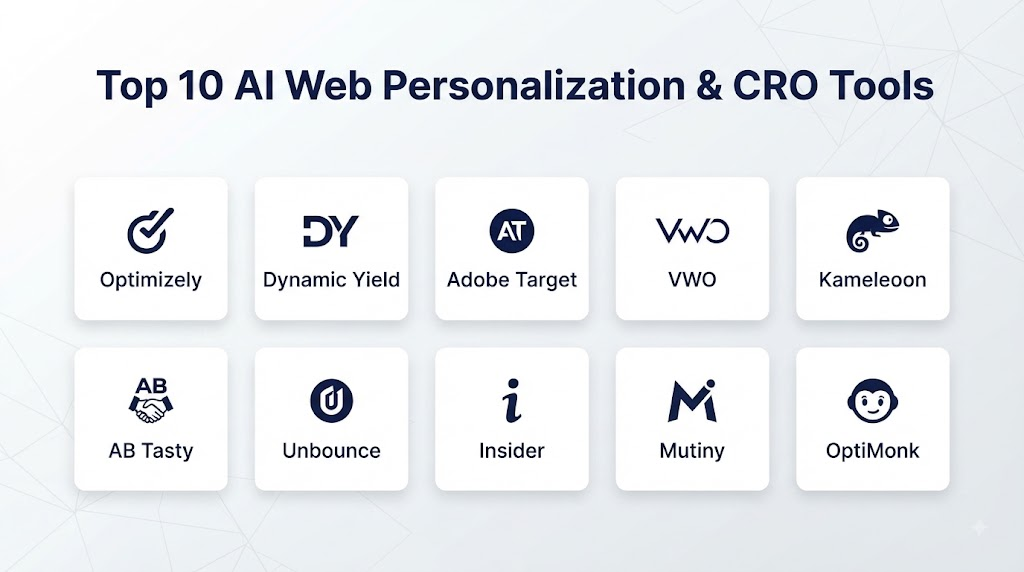
Top 10 AI Web Personalization & CRO Tools
1. Optimizely
Optimizely provides experimentation, personalization, content optimization, and digital experience capabilities for organizations seeking to improve website performance.
Key Features
- A/B testing
- Web experimentation
- Personalization
- Feature experimentation
- Behavioral analytics
- AI-powered optimization
Pros
- Strong experimentation capabilities
- Broad digital experience functionality
- Enterprise scalability
- Comprehensive testing options
Cons
- Advanced functionality can be complex
- Enterprise implementations may require specialized expertise
2. Adobe Target
Adobe Target provides personalization and experimentation capabilities as part of the broader Adobe Experience ecosystem.
Key Features
- Personalization
- A/B testing
- Automated recommendations
- Audience targeting
- Experience optimization
- AI-powered decisioning
Pros
- Strong personalization capabilities
- Extensive enterprise functionality
- Good integration with Adobe products
- Advanced targeting
Cons
- Can be complex
- Best suited to organizations with mature digital marketing operations
3. VWO
VWO provides experimentation, conversion optimization, behavioral analytics, and personalization capabilities.
Key Features
- A/B testing
- Heatmaps
- Session recordings
- Personalization
- Funnel analysis
- Conversion optimization
Pros
- Strong CRO functionality
- Broad experimentation capabilities
- Useful behavioral analytics
- Accessible interface
Cons
- Advanced use cases require configuration
- Larger experimentation programs may need dedicated expertise
4. Dynamic Yield
Dynamic Yield provides personalization, product recommendations, experimentation, and optimization capabilities.
Key Features
- AI personalization
- Product recommendations
- A/B testing
- Audience segmentation
- Behavioral targeting
- Experience optimization
Pros
- Strong personalization
- Good recommendation capabilities
- Useful e-commerce applications
- Advanced targeting
Cons
- Primarily suited to organizations with significant personalization needs
- Implementation can require technical resources
5. AB Tasty
AB Tasty provides experimentation, personalization, feature management, and digital experience optimization.
Key Features
- A/B testing
- Personalization
- Feature experimentation
- Behavioral targeting
- AI optimization
- Conversion analytics
Pros
- Good experimentation capabilities
- Strong personalization
- User-friendly platform
- Suitable for marketing teams
Cons
- Advanced implementations may require technical support
- Feature breadth can require configuration
6. Kameleoon
Kameleoon provides experimentation and personalization capabilities designed to help organizations optimize digital experiences.
Key Features
- A/B testing
- AI personalization
- Audience targeting
- Predictive analytics
- Experimentation
- Conversion optimization
Pros
- Strong personalization
- Good experimentation capabilities
- Predictive functionality
- Flexible targeting
Cons
- Advanced capabilities may require expertise
- Larger deployments can require planning
7. Mutiny
Mutiny focuses on website personalization for B2B organizations, helping marketing teams create experiences tailored to different audiences.
Key Features
- B2B website personalization
- Audience targeting
- Personalization campaigns
- Conversion optimization
- Account-based personalization
- Analytics
Pros
- Strong B2B focus
- Useful account-based personalization
- Marketing-friendly workflows
- Good website targeting
Cons
- Primarily focused on B2B use cases
- More complex personalization strategies require planning
8. Intellimize
Intellimize focuses on AI-powered website personalization and experimentation to help businesses optimize visitor experiences.
Key Features
- AI personalization
- Automated experimentation
- Conversion optimization
- Audience targeting
- Website optimization
- Performance analytics
Pros
- Strong AI focus
- Automated experimentation
- Useful personalization
- Conversion-oriented approach
Cons
- Advanced personalization requires good data
- Best suited to organizations with measurable website traffic
9. Insider
Insider provides personalization, customer journey orchestration, experimentation, and AI-powered marketing capabilities.
Key Features
- Web personalization
- AI recommendations
- Customer journey orchestration
- Audience segmentation
- Experimentation
- Predictive analytics
Pros
- Broad personalization capabilities
- Strong customer journey functionality
- Useful AI features
- Omnichannel applications
Cons
- Broad platform can require configuration
- Enterprise implementations may be complex
10. Algolia
Algolia provides AI-powered search and discovery capabilities that can contribute to website personalization and conversion optimization, particularly for e-commerce and content-heavy websites.
Key Features
- AI search
- Product discovery
- Recommendations
- Personalization
- Search analytics
- Merchandising
Pros
- Strong search capabilities
- Excellent product discovery
- Useful e-commerce applications
- Fast user experience
Cons
- Primarily focused on search and discovery
- Full CRO programs may require additional tools
Comparison Table: AI Web Personalization & CRO Tools
| No. | Platform | Best For | Personalization | A/B Testing | AI Optimization | Behavioral Analytics | Recommendations |
|---|---|---|---|---|---|---|---|
| 1 | Optimizely | Enterprise experimentation | Strong | Strong | Strong | Strong | Strong |
| 2 | Adobe Target | Enterprise personalization | Strong | Strong | Strong | Strong | Strong |
| 3 | VWO | CRO and experimentation | Strong | Strong | Strong | Strong | Strong |
| 4 | Dynamic Yield | E-commerce personalization | Strong | Strong | Strong | Strong | Strong |
| 5 | AB Tasty | Digital experimentation | Strong | Strong | Strong | Strong | Strong |
| 6 | Kameleoon | AI personalization | Strong | Strong | Strong | Strong | Strong |
| 7 | Mutiny | B2B personalization | Strong | Strong | Strong | Strong | Moderate |
| 8 | Intellimize | AI experimentation | Strong | Strong | Strong | Strong | Strong |
| 9 | Insider | Customer journey personalization | Strong | Strong | Strong | Strong | Strong |
| 10 | Algolia | Search and discovery | Strong | Moderate | Strong | Strong | Strong |
Weighted Evaluation Table
| No. | Platform | AI Capabilities 20% | Personalization 20% | Experimentation 15% | CRO Analytics 15% | Integrations 10% | Ease of Use 10% | Scalability 10% | Total Score |
|---|---|---|---|---|---|---|---|---|---|
| 1 | Optimizely | 20 | 20 | 15 | 15 | 10 | 9 | 10 | 99 |
| 2 | Adobe Target | 20 | 20 | 15 | 15 | 10 | 8 | 10 | 98 |
| 3 | VWO | 19 | 19 | 15 | 15 | 9 | 10 | 10 | 97 |
| 4 | Dynamic Yield | 20 | 20 | 15 | 14 | 9 | 9 | 10 | 97 |
| 5 | AB Tasty | 19 | 19 | 15 | 14 | 9 | 9 | 10 | 95 |
| 6 | Kameleoon | 19 | 19 | 15 | 14 | 9 | 9 | 9 | 94 |
| 7 | Mutiny | 18 | 19 | 14 | 13 | 9 | 10 | 9 | 92 |
| 8 | Intellimize | 20 | 19 | 15 | 14 | 8 | 9 | 9 | 94 |
| 9 | Insider | 20 | 20 | 15 | 15 | 9 | 8 | 10 | 97 |
| 10 | Algolia | 19 | 17 | 12 | 14 | 10 | 9 | 10 | 91 |
Which AI Web Personalization & CRO Tool Is Right for You?
Choose Optimizely if experimentation and enterprise-level digital experience optimization are your primary priorities.
Choose Adobe Target if your organization already operates within the Adobe ecosystem and needs advanced personalization.
Choose VWO if conversion optimization, A/B testing, heatmaps, and behavioral analytics are central requirements.
Choose Dynamic Yield if product recommendations and e-commerce personalization are major priorities.
Choose AB Tasty if you want experimentation and personalization in a marketing-friendly environment.
Choose Kameleoon if AI-powered personalization and experimentation are important to your optimization strategy.
Choose Mutiny if you operate a B2B website and need account-based website personalization.
Choose Intellimize if automated AI experimentation and website personalization are your main priorities.
Choose Insider if you need web personalization connected with broader customer journey orchestration.
Choose Algolia if search, product discovery, and recommendation experiences are central to your conversion strategy.
Common Mistakes
- Personalizing without a clear business objective
- Creating too many audience segments
- Running poorly designed A/B tests
- Making decisions from insufficient sample sizes
- Ignoring mobile visitors
- Optimizing only for clicks instead of meaningful conversions
- Failing to consider the complete customer journey
- Using outdated visitor data
- Over-personalizing website experiences
- Ignoring privacy and consent requirements
- Treating AI recommendations as guaranteed improvements
- Failing to continuously evaluate personalization results
FAQs
1. What are AI Web Personalization & CRO Tools?
They are platforms that use artificial intelligence, machine learning, experimentation, and behavioral analytics to personalize websites and improve conversion performance.
2. How does AI improve website personalization?
AI can analyze visitor behavior, interests, context, and other signals to determine which content, recommendations, or experiences may be most relevant.
3. Can AI improve conversion rates?
AI can help identify optimization opportunities and personalize experiences, but actual conversion improvements depend on website quality, audience, offer, traffic, implementation, and other factors.
4. Can these platforms perform A/B testing?
Yes. Many platforms provide A/B testing and experimentation capabilities for comparing different website experiences.
5. What types of websites benefit from personalization?
E-commerce stores, SaaS websites, B2B websites, media sites, marketplaces, travel websites, and other businesses with significant digital traffic can benefit from personalization.
6. Can AI personalize websites in real time?
Some platforms can adjust website experiences during a visitor session based on behavioral and contextual signals.
7. What data is needed for AI website personalization?
Typical data can include browsing behavior, referral source, location, device information, previous interactions, purchase history, audience attributes, and conversion activity, subject to applicable privacy requirements.
8. Can AI replace CRO teams?
No. AI can automate analysis and experimentation tasks, but CRO professionals remain important for defining hypotheses, interpreting results, designing experiences, and understanding business context.
9. What should businesses consider when selecting a CRO platform?
Businesses should evaluate experimentation capabilities, personalization, analytics, integrations, AI functionality, ease of implementation, scalability, privacy controls, and compatibility with existing technology.
10. What is the future of AI Web Personalization & CRO Tools?
The category is moving toward real-time personalization, automated experimentation, predictive visitor intent, AI-generated experiences, intelligent recommendations, natural-language analytics, and increasingly automated conversion optimization.
Conclusion
AI Web Personalization & CRO Tools are becoming valuable components of modern digital marketing and customer experience strategies. They allow businesses to move beyond one-size-fits-all websites and create experiences that better reflect visitor behavior and intent.Optimizely, Adobe Target, VWO, Dynamic Yield, AB Tasty, Kameleoon, Mutiny, Intellimize, Insider, and Algolia provide different approaches to experimentation, personalization, behavioral analytics, and conversion optimization.The right platform depends on website traffic, business model, personalization requirements, technical capabilities, experimentation maturity, and existing marketing technology.