Introduction
AI Engagement & Pulse Survey Analytics Tools help organizations collect employee feedback, analyze workforce sentiment, identify engagement trends, and understand factors affecting employee experience. These platforms use AI, natural language processing, sentiment analysis, and people analytics to turn employee survey responses into actionable workforce insights.
Organizations can use these tools to:
- Measure employee engagement
- Run recurring pulse surveys
- Analyze employee sentiment
- Identify engagement trends
- Detect recurring workforce concerns
- Segment survey results
- Analyze open-text feedback
- Identify potential engagement drivers
- Monitor organizational changes
- Support data-driven employee experience strategies
What Are AI Engagement & Pulse Survey Analytics Tools?
AI Engagement & Pulse Survey Analytics Tools combine employee listening capabilities with automated analytics to help HR teams understand workforce sentiment.
Traditional employee surveys often produce large volumes of qualitative and quantitative data that can take considerable time to analyze manually. AI can help classify responses, identify themes, summarize feedback, and surface trends across survey cycles.
A typical platform may analyze:
- Employee engagement scores
- Survey responses
- Open-text comments
- Sentiment
- Survey participation
- Manager effectiveness
- Organizational trends
- Department-level feedback
- Employee experience indicators
Pulse surveys are generally shorter and more frequent than traditional annual engagement surveys, allowing organizations to monitor changes in workforce sentiment over time.
Why AI Engagement Analytics Matters
Employee engagement can change because of organizational restructuring, management changes, workload, compensation, career opportunities, workplace policies, or other factors.
Frequent employee listening can provide organizations with more timely information than annual surveys alone.
AI analytics can help organizations:
- Detect emerging themes
- Compare engagement trends
- Analyze large volumes of comments
- Identify areas requiring investigation
- Prioritize employee experience initiatives
- Monitor the impact of organizational changes
Key Features
Pulse Survey Creation
Organizations can create short, recurring employee surveys.
Employee Engagement Measurement
Platforms can measure engagement using configurable questions and standardized metrics.
Sentiment Analysis
AI can analyze the sentiment expressed in employee comments.
Text Analytics
Natural language processing can identify themes and recurring topics in open-text responses.
Automated Summarization
AI can summarize large volumes of employee feedback.
Engagement Drivers
Some platforms can identify factors associated with stronger or weaker engagement.
Survey Segmentation
HR teams can analyze results across departments, teams, locations, roles, and other groups.
Trend Analysis
Organizations can compare engagement results across different survey periods.
Manager Analytics
Some platforms provide manager-level insights to help leaders understand team engagement.
Action Planning
Platforms can help organizations convert survey insights into follow-up actions.
Benchmarking
Some solutions provide internal or external comparison capabilities.
Anonymous Feedback
Employee listening platforms can provide privacy-focused survey mechanisms to encourage honest responses.
HR Integrations
Platforms can integrate with HRIS and other employee-management systems.
Common Use Cases
Employee Engagement Measurement
HR teams can regularly measure how employees perceive their workplace experience.
Organizational Change Monitoring
Pulse surveys can help organizations understand employee sentiment during restructuring, mergers, policy changes, or other major initiatives.
Manager Effectiveness
Feedback can help identify differences in employee experience across teams.
Employee Experience Programs
Organizations can use survey data to prioritize improvements to workplace processes and culture.
Sentiment Monitoring
AI can analyze open-text feedback to identify recurring positive and negative themes.
Workforce Retention
Engagement data can provide context for broader workforce retention and turnover analysis.
Leadership Feedback
Leaders can use aggregated survey insights to understand employee concerns.
Remote and Hybrid Workforce Monitoring
Pulse surveys can help organizations understand employee experiences across different working arrangements.
Benefits
Faster Feedback Analysis
AI can process large volumes of employee comments more quickly than manual review.
More Frequent Listening
Pulse surveys allow organizations to collect feedback regularly.
Better Theme Identification
AI can identify recurring topics across thousands of responses.
Improved Employee Experience
Insights can help HR teams prioritize workplace improvements.
Data-Driven Decision Making
Leaders can combine engagement metrics with qualitative employee feedback.
Trend Visibility
Organizations can monitor whether engagement is improving, declining, or remaining stable.
Actionable Insights
AI-generated summaries can help leaders focus on major workforce themes.
Challenges
Employee Privacy
Survey responses can contain sensitive personal or workplace information.
Anonymity Concerns
Employees may hesitate to provide honest feedback if they do not trust the survey’s privacy protections.
AI Interpretation Errors
Sentiment and text classification models can misunderstand sarcasm, context, or nuanced feedback.
Survey Fatigue
Excessive pulse surveys can reduce participation and engagement.
Response Bias
Employees who respond may not represent the entire workforce.
Poor Follow-Up
Collecting feedback without acting on it can reduce employee trust.
Data Segmentation Risks
Very small groups may create privacy concerns when survey results are segmented too deeply.
Cultural Differences
Language and cultural context can affect how employee feedback is interpreted.
Evaluation Criteria
AI Engagement & Pulse Survey Analytics Tools can be evaluated using:
- Pulse survey capabilities
- Engagement measurement
- Sentiment analysis
- Text analytics
- AI summarization
- Engagement drivers
- Trend analysis
- Survey segmentation
- Benchmarking
- Action planning
- Privacy controls
- HR integrations
- Reporting
- Ease of use
- Scalability
Key Trends
Continuous Employee Listening
Organizations are moving from annual engagement surveys toward shorter and more frequent listening programs.
Generative AI Survey Analysis
AI can summarize employee comments and identify recurring themes across large response volumes.
Real-Time Sentiment Intelligence
Organizations increasingly want faster visibility into workforce sentiment.
Personalized Follow-Up
AI can help recommend relevant actions based on engagement patterns and employee feedback.
Manager-Level Insights
Employee listening is increasingly connected with manager effectiveness and team development.
Multilingual Feedback Analysis
Modern AI systems can process employee comments across multiple languages.
Integrated People Analytics
Engagement information is increasingly combined with workforce, performance, retention, and organizational data.
Responsible Employee Listening
Privacy, anonymity, access controls, transparency, and responsible use are becoming increasingly important.
Methodology
The platforms below were selected based on their relevance to employee engagement measurement, pulse surveys, employee listening, sentiment analysis, text analytics, workforce insights, and AI-assisted survey analysis.
The comparison considers:
- Engagement analytics
- Pulse surveys
- AI text analysis
- Sentiment intelligence
- Trend analysis
- Employee listening
- Integrations
- Reporting
- Ease of use
- Scalability
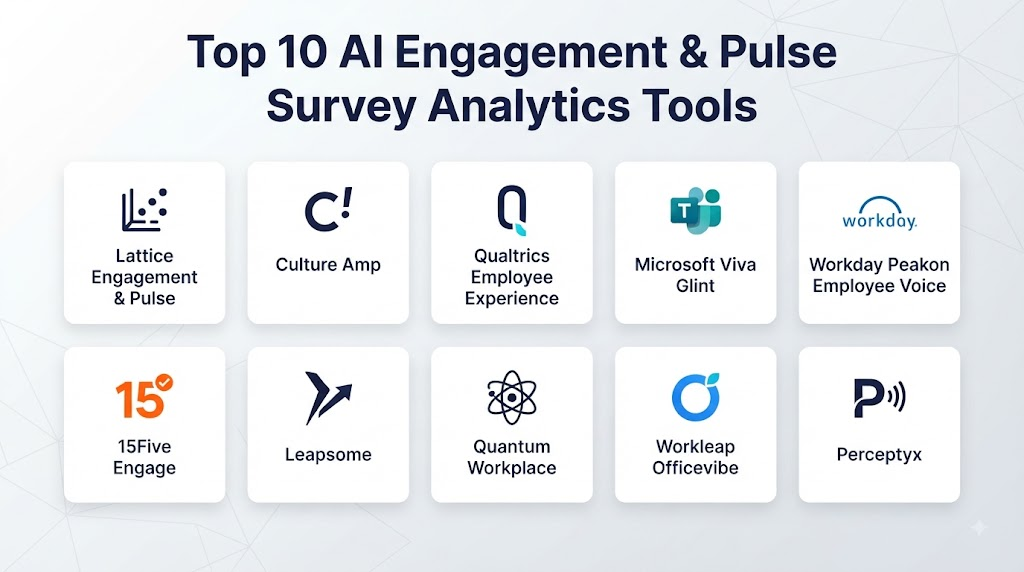
Top 10 AI Engagement & Pulse Survey Analytics Tools
1. Culture Amp
Culture Amp provides employee engagement, experience, performance, and people analytics capabilities for organizations looking to understand and improve employee experience.
Key Features
- Engagement surveys
- Pulse surveys
- Sentiment analysis
- Employee feedback
- People analytics
- Engagement drivers
Pros
- Strong employee engagement capabilities
- Good survey functionality
- Useful analytics
- Strong employee experience focus
Cons
- Advanced analytics can require configuration
- Organizations need strong follow-up processes to act on insights
2. Qualtrics EmployeeXM
Qualtrics EmployeeXM provides employee experience measurement and analytics capabilities covering engagement, listening, feedback, and organizational insights.
Key Features
- Employee surveys
- Pulse surveys
- Sentiment analysis
- Text analytics
- Employee experience analytics
- Action planning
Pros
- Highly configurable
- Strong survey capabilities
- Advanced analytics
- Broad employee experience functionality
Cons
- Extensive functionality can create implementation complexity
- Advanced configurations may require specialist expertise
3. Workday Peakon Employee Voice
Workday Peakon Employee Voice provides continuous employee listening and engagement analytics designed to help organizations understand employee sentiment and engagement drivers.
Key Features
- Continuous listening
- Pulse surveys
- Engagement analytics
- Employee sentiment
- Driver analysis
- Workforce insights
Pros
- Strong continuous listening capabilities
- Useful engagement-driver analysis
- Good enterprise HR integration
- Strong analytics
Cons
- Works particularly well within broader enterprise HR environments
- Implementation may require planning
4. Microsoft Viva Glint
Microsoft Viva Glint provides employee engagement and feedback capabilities within the Microsoft Viva ecosystem.
Key Features
- Employee surveys
- Pulse surveys
- Engagement analytics
- Sentiment insights
- AI-assisted analysis
- Action planning
Pros
- Strong employee engagement focus
- Integrates with Microsoft workplace environments
- Useful survey analytics
- Good manager insights
Cons
- Microsoft ecosystem alignment may be important
- Advanced functionality may require configuration
5. Perceptyx
Perceptyx provides employee listening, organizational research, workforce analytics, and employee experience capabilities.
Key Features
- Employee listening
- Engagement surveys
- Pulse surveys
- Sentiment analysis
- Workforce analytics
- Organizational insights
Pros
- Strong employee listening capabilities
- Broad workforce analytics
- Useful organizational research
- Supports enterprise engagement programs
Cons
- Enterprise-oriented platform
- Implementation can require organizational planning
6. Lattice
Lattice provides performance management, employee engagement, feedback, goal management, and people analytics capabilities.
Key Features
- Employee engagement surveys
- Pulse surveys
- Feedback
- Performance analytics
- Employee development
- People insights
Pros
- Strong connection between engagement and performance
- User-friendly employee experience
- Good people-management capabilities
- Useful feedback functionality
Cons
- Broader people-management platform rather than a dedicated survey analytics system
- Advanced survey analytics may require complementary capabilities
7. 15Five
15Five provides employee engagement, performance management, manager effectiveness, and employee feedback capabilities.
Key Features
- Pulse surveys
- Engagement surveys
- Employee feedback
- Manager insights
- Performance management
- Engagement analytics
Pros
- Strong manager-focused functionality
- Easy-to-use employee feedback tools
- Good pulse survey capabilities
- Supports continuous employee conversations
Cons
- More focused on employee management than advanced enterprise survey analytics
- Complex analytics requirements may need additional tools
8. Leapsome
Leapsome provides employee engagement, performance management, learning, goals, and people analytics capabilities.
Key Features
- Engagement surveys
- Pulse surveys
- Sentiment analysis
- Performance management
- Employee feedback
- People analytics
Pros
- Broad employee experience platform
- Good engagement functionality
- Strong connection between feedback and development
- Useful analytics
Cons
- Broad platform can require configuration
- Advanced enterprise analytics may require implementation support
9. Medallia
Medallia provides experience management and feedback analytics capabilities covering employees, customers, and other stakeholders.
Key Features
- Employee feedback
- Engagement analytics
- Sentiment analysis
- Text analytics
- Experience management
- AI-powered insights
Pros
- Strong experience analytics
- Advanced text analysis
- Broad feedback capabilities
- Useful enterprise analytics
Cons
- Broad platform can be complex
- Best suited to organizations with mature experience-management programs
10. Workleap Officevibe
Workleap Officevibe focuses on employee engagement, pulse surveys, feedback, and manager insights.
Key Features
- Pulse surveys
- Engagement measurement
- Employee feedback
- Team analytics
- Manager insights
- Engagement trends
Pros
- Simple employee listening experience
- Strong pulse survey functionality
- Useful manager insights
- Suitable for continuous feedback
Cons
- More focused on engagement than complex enterprise workforce analytics
- Advanced data modeling may require complementary systems
Comparison Table: AI Engagement & Pulse Survey Analytics Tools
| No. | Platform | Best For | Pulse Surveys | Sentiment Analysis | Text Analytics | Engagement Drivers | Action Planning |
|---|---|---|---|---|---|---|---|
| 1 | Culture Amp | Employee engagement | Strong | Strong | Strong | Strong | Strong |
| 2 | Qualtrics EmployeeXM | Enterprise experience management | Strong | Strong | Strong | Strong | Strong |
| 3 | Workday Peakon Employee Voice | Continuous listening | Strong | Strong | Strong | Strong | Strong |
| 4 | Microsoft Viva Glint | Enterprise engagement | Strong | Strong | Strong | Strong | Strong |
| 5 | Perceptyx | Employee listening | Strong | Strong | Strong | Strong | Strong |
| 6 | Lattice | Engagement + performance | Strong | Moderate | Strong | Strong | Strong |
| 7 | 15Five | Manager engagement | Strong | Moderate | Moderate | Strong | Strong |
| 8 | Leapsome | Engagement + development | Strong | Strong | Strong | Strong | Strong |
| 9 | Medallia | Experience analytics | Strong | Strong | Strong | Strong | Strong |
| 10 | Workleap Officevibe | Pulse surveys | Strong | Moderate | Moderate | Strong | Strong |
Weighted Evaluation Table
| No. | Platform | Engagement Analytics 20% | Pulse Surveys 20% | AI Text Analysis 15% | Sentiment Intelligence 15% | Integrations 10% | Ease of Use 10% | Scalability 10% | Total Score |
|---|---|---|---|---|---|---|---|---|---|
| 1 | Culture Amp | 20 | 20 | 15 | 15 | 10 | 9 | 10 | 99 |
| 2 | Qualtrics EmployeeXM | 20 | 20 | 15 | 15 | 10 | 8 | 10 | 98 |
| 3 | Workday Peakon Employee Voice | 20 | 20 | 15 | 15 | 10 | 9 | 10 | 99 |
| 4 | Microsoft Viva Glint | 19 | 20 | 15 | 15 | 10 | 9 | 10 | 98 |
| 5 | Perceptyx | 20 | 19 | 15 | 15 | 10 | 8 | 10 | 97 |
| 6 | Lattice | 18 | 19 | 14 | 13 | 10 | 10 | 9 | 93 |
| 7 | 15Five | 17 | 19 | 13 | 13 | 9 | 10 | 9 | 90 |
| 8 | Leapsome | 18 | 19 | 14 | 14 | 10 | 9 | 9 | 93 |
| 9 | Medallia | 20 | 19 | 15 | 15 | 10 | 8 | 10 | 97 |
| 10 | Workleap Officevibe | 17 | 19 | 13 | 13 | 9 | 10 | 9 | 90 |
Which AI Engagement & Pulse Survey Analytics Tool Is Right for You?
Choose Culture Amp if employee engagement, experience measurement, and actionable people analytics are your primary priorities.
Choose Qualtrics EmployeeXM if you need highly configurable enterprise employee experience surveys and advanced analytics.
Choose Workday Peakon Employee Voice if continuous listening and engagement-driver analysis are important to your workforce strategy.
Choose Microsoft Viva Glint if your organization already operates heavily within the Microsoft ecosystem.
Choose Perceptyx if you need enterprise-scale employee listening and organizational research capabilities.
Choose Lattice if engagement needs to work closely with performance management, feedback, and employee development.
Choose 15Five if manager effectiveness, employee feedback, and regular pulse surveys are key priorities.
Choose Leapsome if you want engagement analytics connected with performance, learning, and employee development.
Choose Medallia if your organization needs advanced experience analytics and large-scale text and sentiment analysis.
Choose Workleap Officevibe if you want a straightforward employee pulse survey and engagement platform.
Common Mistakes
- Sending surveys too frequently
- Creating excessively long pulse surveys
- Ignoring employee anonymity
- Collecting feedback without taking action
- Treating sentiment scores as definitive facts
- Ignoring cultural and language differences
- Over-segmenting survey results
- Sharing sensitive comments without appropriate safeguards
- Focusing only on engagement scores
- Ignoring qualitative employee feedback
- Failing to communicate survey outcomes
- Using AI summaries without human review
- Measuring engagement without tracking improvements over time
FAQs
1. What are AI Engagement & Pulse Survey Analytics Tools?
These platforms use employee surveys, AI, sentiment analysis, text analytics, and people analytics to help organizations understand workforce engagement and employee feedback.
2. What is a pulse survey?
A pulse survey is a short employee survey conducted regularly to measure changes in workforce sentiment, engagement, or employee experience.
3. How does AI analyze employee survey responses?
AI can classify responses, identify recurring themes, analyze sentiment, summarize open-text feedback, and highlight changes across survey periods.
4. Can AI identify employee engagement drivers?
Yes. Some platforms analyze relationships between survey questions and engagement outcomes to identify factors that may be associated with stronger or weaker engagement.
5. Are employee pulse surveys anonymous?
Many platforms provide anonymity or confidentiality features, but organizations should clearly communicate how responses are collected, processed, and reported.
6. How frequently should companies conduct pulse surveys?
There is no universal schedule. Organizations should balance the need for timely feedback with the risk of survey fatigue and declining participation.
7. Can AI analyze open-ended employee comments?
Yes. Natural language processing can categorize comments, identify themes, summarize feedback, and analyze sentiment.
8. Can engagement analytics help reduce employee turnover?
Engagement analytics can help organizations identify workforce concerns that may contribute to poor employee experience and retention challenges. However, engagement data should be combined with other workforce information and employee feedback.
9. What are the biggest risks of AI employee survey analytics?
Key risks include privacy issues, weak anonymity protections, biased responses, incorrect sentiment interpretation, excessive survey frequency, and failure to act on employee feedback.
10. What is the future of AI engagement analytics?
The market is moving toward continuous employee listening, generative AI summaries, real-time sentiment analysis, personalized action recommendations, multilingual feedback analysis, and integrated people analytics.
Conclusion
AI Engagement & Pulse Survey Analytics Tools help organizations transform employee feedback into more timely workforce intelligence. By combining pulse surveys, engagement measurement, sentiment analysis, text analytics, and AI-assisted insights, organizations can better understand how employees experience the workplace.Culture Amp, Qualtrics EmployeeXM, Workday Peakon Employee Voice, Microsoft Viva Glint, Perceptyx, Lattice, 15Five, Leapsome, Medallia, and Workleap Officevibe provide different approaches to employee listening and engagement analytics.The best platform depends on organizational size, survey complexity, employee experience goals, analytics requirements, HR integrations, and desired level of AI automation.