Introduction
AI Dependency Upgrade Assistants are software development tools that use artificial intelligence to help developers identify outdated dependencies, recommend upgrades, analyze compatibility risks, and automate dependency maintenance workflows.
Modern software applications rely heavily on open-source libraries, frameworks, and external packages. Keeping these dependencies updated is essential for maintaining security, performance, compatibility, and software reliability.
Manual dependency management can become difficult because developers need to evaluate:
- New package versions
- Security vulnerabilities
- Breaking changes
- Compatibility issues
- Upgrade impact
AI Dependency Upgrade Assistants help development teams automate these activities by providing:
- Dependency discovery
- Version upgrade recommendations
- Security vulnerability detection
- Compatibility analysis
- Automated pull requests
- Upgrade explanations
- Change impact analysis
These tools are used by:
- Software developers
- DevOps engineers
- DevSecOps teams
- Platform engineers
- Security teams
- Enterprise engineering organizations
They integrate with:
- Git repositories
- Package managers
- CI/CD pipelines
- IDEs
- Security platforms
The goal of AI Dependency Upgrade Assistants is to help organizations maintain secure, modern, and reliable software by simplifying dependency lifecycle management.
Why AI Dependency Upgrade Assistants Matter
Software dependencies change frequently because of:
- Security vulnerabilities
- New features
- Performance improvements
- Framework updates
- Compliance requirements
Outdated dependencies can create:
- Security risks
- Compatibility problems
- Maintenance challenges
- Technical debt
AI Dependency Upgrade Assistants help teams:
- Keep software updated
- Reduce manual effort
- Improve security
- Manage technical debt
- Accelerate development
How AI Dependency Upgrade Assistants Work
Step 1: Dependency Discovery
Tools identify:
- Libraries
- Packages
- Frameworks
- Versions
Step 2: Security Analysis
AI checks:
- Known vulnerabilities
- Risk levels
- Security impact
Step 3: Upgrade Recommendation
The system suggests:
- Safe versions
- Required changes
- Upgrade priority
Step 4: Automated Changes
Tools can create:
- Pull requests
- Upgrade patches
- Change summaries
Step 5: Validation
The system verifies:
- Build compatibility
- Test results
- Deployment impact
Key Features of AI Dependency Upgrade Assistants
Automated Dependency Discovery
Tracks:
- Direct dependencies
- Transitive dependencies
Vulnerability Detection
Identifies:
- Security issues
- Risky packages
Version Recommendations
Suggests:
- Stable versions
- Security fixes
Compatibility Analysis
Evaluates:
- Breaking changes
- Application impact
Automated Pull Requests
Creates:
- Upgrade branches
- Change descriptions
Dependency Monitoring
Tracks:
- New releases
- Security alerts
Common Use Cases
Enterprise Applications
Maintaining:
- Large software systems
- Multiple projects
Open Source Projects
Managing:
- Community dependencies
- Package updates
DevSecOps Workflows
Supporting:
- Secure software delivery
Cloud-Native Applications
Updating:
- Containers
- Kubernetes packages
- Cloud libraries
Legacy Modernization
Helping teams:
- Reduce technical debt
- Upgrade old libraries
CI/CD Pipelines
Automating:
- Dependency checks
- Upgrade validation
Benefits of AI Dependency Upgrade Assistants
Improved Security
Helps identify vulnerable dependencies.
Reduced Maintenance Effort
Automates repetitive upgrade tasks.
Faster Updates
Accelerates dependency management.
Better Reliability
Improves software stability.
Reduced Technical Debt
Keeps applications modern.
Challenges of AI Dependency Upgrade Assistants
Breaking Changes
Updates may introduce compatibility problems.
Limited Application Context
AI may not fully understand business logic.
False Recommendations
Suggested upgrades require review.
Testing Requirements
Changes must be validated.
Complex Enterprise Environments
Large systems need careful migration planning.
Evaluation Criteria
Upgrade Accuracy
Evaluate:
- Recommendation quality
- Compatibility analysis
Security Intelligence
Consider:
- Vulnerability detection
- Risk prioritization
Automation
Evaluate:
- Pull requests
- Workflow automation
Language Support
Check:
- Package ecosystem coverage
Integration
Consider:
- Git platforms
- CI/CD support
Developer Experience
Evaluate:
- Usability
- Explanation quality
Key Trends
AI-Powered Software Maintenance
Organizations are adopting AI for continuous dependency management.
Automated Security Remediation
AI tools are improving:
- Vulnerability fixing workflows
Intelligent Pull Requests
Future tools will provide:
- Better upgrade explanations
- Risk predictions
Autonomous Maintenance Agents
AI agents will increasingly manage:
- Dependency updates
- Compatibility checks
Continuous Software Health Monitoring
Dependency management is becoming part of:
- Application reliability practices
Methodology
The following AI Dependency Upgrade Assistants were evaluated based on:
- Upgrade automation
- Security analysis
- Compatibility detection
- Integration
- Developer experience
- Scalability
- Enterprise readiness
- Reporting
- AI capabilities
- Value
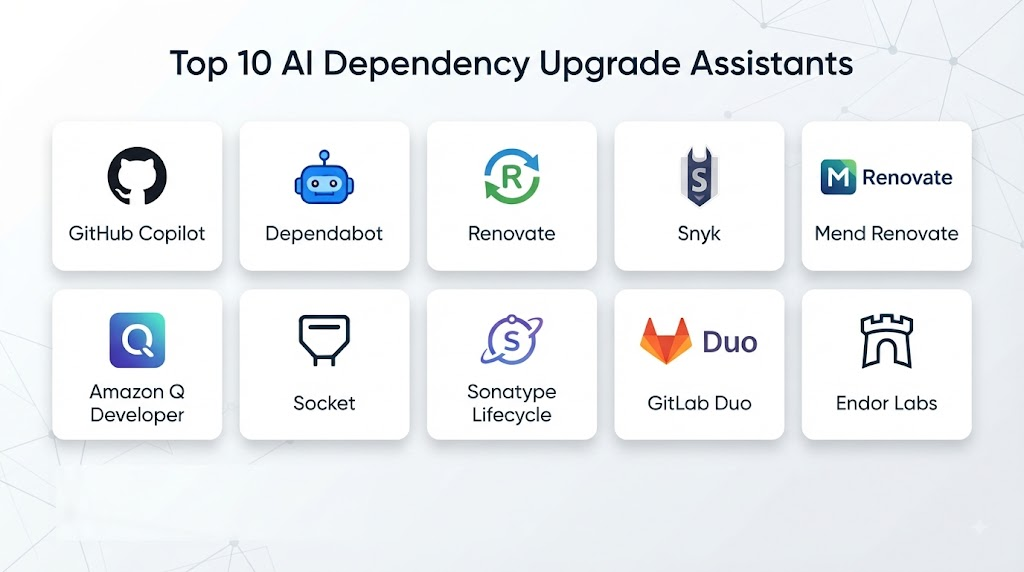
Top 10 AI Dependency Upgrade Assistants
1. Snyk Open Source
Snyk Open Source helps developers identify and fix vulnerable dependencies.
Key Features
- Dependency scanning
- Vulnerability detection
- Upgrade recommendations
- Automated fixes
- Developer integration
Pros
- Strong security capabilities
- Developer-friendly workflows
Cons
- Advanced features require paid plans
2. GitHub Dependabot
GitHub Dependabot automatically monitors and updates dependencies.
Key Features
- Security updates
- Version updates
- Pull request creation
- GitHub integration
Pros
- Native GitHub integration
- Easy setup
Cons
- Limited advanced AI analysis
3. Renovate Bot
Renovate automates dependency updates across repositories.
Key Features
- Automated upgrade PRs
- Dependency monitoring
- Custom rules
- Multi-platform support
Pros
- Highly configurable
- Broad ecosystem support
Cons
- Requires configuration
4. Mend Renovate
Mend provides automated dependency management and security analysis.
Key Features
- Dependency tracking
- Vulnerability detection
- Upgrade automation
- Compliance reporting
Pros
- Enterprise security support
- Strong automation
Cons
- Enterprise-focused pricing
5. Dependabot AI Features
Dependabot provides intelligent dependency update workflows.
Key Features
- Automated updates
- Security alerts
- Upgrade suggestions
- Repository integration
Pros
- Simple adoption
- GitHub ecosystem support
Cons
- Requires GitHub environment
6. Amazon Inspector
Amazon Inspector analyzes software dependencies and vulnerabilities.
Key Features
- Package vulnerability scanning
- Security assessment
- Cloud integration
- Risk analysis
Pros
- Strong AWS integration
- Security-focused
Cons
- Best for AWS workloads
7. Sonatype Lifecycle
Sonatype Lifecycle manages open-source component security.
Key Features
- Dependency analysis
- Policy enforcement
- Risk assessment
- Upgrade guidance
Pros
- Strong enterprise governance
- Security intelligence
Cons
- Requires setup
8. Socket AI Dependency Analysis
Socket provides advanced dependency security analysis.
Key Features
- Package behavior analysis
- Supply chain protection
- Dependency monitoring
- Risk detection
Pros
- Strong supply chain security
- Modern approach
Cons
- Focused mainly on security
9. JFrog Xray
JFrog Xray provides software composition analysis.
Key Features
- Dependency scanning
- Vulnerability detection
- Artifact analysis
- Repository integration
Pros
- Strong DevOps integration
- Enterprise scalability
Cons
- Best with JFrog ecosystem
10. FOSSA
FOSSA provides open-source dependency management.
Key Features
- License analysis
- Security scanning
- Dependency tracking
- Compliance reporting
Pros
- Strong open-source governance
- Easy integration
Cons
- Less focused on automated upgrades
Comparison Table: Top 10 AI Dependency Upgrade Assistants
| No. | Tool Name | Best For | Platform(s) Supported | Deployment | Standout Feature | Public Rating |
|---|---|---|---|---|---|---|
| 1 | Snyk Open Source | Security upgrades | Cloud/IDE | Managed | Vulnerability fixes | 4.7/5 |
| 2 | GitHub Dependabot | GitHub projects | GitHub | Cloud | Automated PRs | 4.6/5 |
| 3 | Renovate Bot | Custom upgrades | Git platforms | Cloud | Configuration flexibility | 4.7/5 |
| 4 | Mend Renovate | Enterprise teams | Cloud | Managed | Automation | 4.6/5 |
| 5 | Dependabot AI | Repository updates | GitHub | Cloud | Native integration | 4.6/5 |
| 6 | Amazon Inspector | AWS workloads | AWS | Cloud | Security scanning | 4.5/5 |
| 7 | Sonatype Lifecycle | Enterprise governance | Cloud | Managed | Component intelligence | 4.7/5 |
| 8 | Socket | Supply chain security | Cloud | Managed | Package analysis | 4.6/5 |
| 9 | JFrog Xray | DevOps environments | Cloud/Local | Enterprise | Artifact security | 4.6/5 |
| 10 | FOSSA | Open-source management | Cloud | Managed | Compliance analysis | 4.5/5 |
Weighted Evaluation Table
| No. | Tool Name | Upgrade Automation 25% | Ease of Use 15% | Security 15% | Compatibility 10% | Scalability 10% | Integration 10% | Value 15% | Total Score |
|---|---|---|---|---|---|---|---|---|---|
| 1 | Snyk Open Source | 24 | 15 | 15 | 10 | 10 | 10 | 14 | 98 |
| 2 | GitHub Dependabot | 23 | 15 | 14 | 10 | 10 | 10 | 14 | 96 |
| 3 | Renovate Bot | 25 | 13 | 14 | 10 | 10 | 10 | 14 | 96 |
| 4 | Mend Renovate | 24 | 14 | 15 | 10 | 10 | 10 | 13 | 96 |
| 5 | Dependabot AI | 23 | 15 | 14 | 10 | 10 | 10 | 14 | 96 |
| 6 | Amazon Inspector | 23 | 14 | 15 | 10 | 10 | 10 | 13 | 95 |
| 7 | Sonatype Lifecycle | 24 | 13 | 15 | 10 | 10 | 10 | 13 | 95 |
| 8 | Socket | 23 | 14 | 15 | 10 | 10 | 10 | 14 | 96 |
| 9 | JFrog Xray | 24 | 13 | 15 | 10 | 10 | 10 | 13 | 95 |
| 10 | FOSSA | 22 | 15 | 14 | 10 | 10 | 10 | 13 | 94 |
Which AI Dependency Upgrade Assistant Is Right for You?
Choose Snyk Open Source for security-focused dependency upgrades.
Choose GitHub Dependabot for GitHub-based projects.
Choose Renovate Bot for flexible automation.
Choose Mend Renovate for enterprise dependency management.
Choose Amazon Inspector for AWS workloads.
Choose Sonatype Lifecycle for open-source governance.
Choose Socket for software supply chain protection.
Choose JFrog Xray for DevOps environments.
Choose FOSSA for open-source compliance.
Implementation Playbook
Phase 1: Inventory Dependencies
- Identify packages
- Map versions
- Understand risks
Phase 2: Configure AI Assistant
- Connect repositories
- Set upgrade policies
- Define rules
Phase 3: Review Recommendations
- Validate upgrades
- Check compatibility
- Run tests
Phase 4: Automate Updates
- Enable pull requests
- Add CI/CD checks
- Monitor results
Phase 5: Continuous Maintenance
- Track dependencies
- Update policies
- Reduce technical debt
Common Mistakes
- Updating dependencies without testing
- Ignoring security alerts
- Accepting upgrades blindly
- Poor dependency visibility
- No rollback strategy
- Lack of ownership
FAQs
1. What are AI Dependency Upgrade Assistants?
They are tools that use AI to help identify, recommend, and automate software dependency updates.
2. Why are dependency upgrades important?
They improve security, compatibility, and application reliability.
3. Can AI tools automatically update dependencies?
Yes, many tools create automated upgrade pull requests.
4. Do dependency assistants detect vulnerabilities?
Yes, many identify security issues in packages.
5. Can these tools prevent breaking changes?
They can analyze risks but require testing before deployment.
6. Which ecosystems do these tools support?
Support varies across JavaScript, Python, Java, .NET, Go, and other ecosystems.
7. Are AI dependency tools useful for DevSecOps?
Yes, they support secure software delivery workflows.
8. Can enterprises use AI dependency assistants?
Yes, many provide governance and reporting features.
9. Do these tools replace developers?
No, developers review and approve changes.
10. What is the future of dependency management?
AI will enable more autonomous software maintenance and security updates.
Conclusion
AI Dependency Upgrade Assistants are becoming essential for modern software teams by simplifying dependency management, improving security, and reducing maintenance effort.Tools such as Snyk Open Source, GitHub Dependabot, Renovate, Mend, Sonatype Lifecycle, Socket, and JFrog Xray help organizations keep applications secure and up to date.As software supply chains continue growing in complexity, AI-powered dependency management will play an important role in improving software reliability, security, and developer productivity.