Introduction
AI Candidate Matching Platforms help recruiters connect job requirements with candidates who have relevant skills, experience, qualifications, and career backgrounds. Instead of depending entirely on manual resume reviews or exact keyword searches, these platforms use artificial intelligence and semantic matching to identify potentially suitable candidates.AI matching can analyze information from resumes, professional profiles, applicant databases, job descriptions, skills taxonomies, and recruiting systems. This allows hiring teams to evaluate larger talent pools while reducing repetitive screening work.
What Are AI Candidate Matching Platforms?
AI Candidate Matching Platforms use machine learning, natural-language processing, semantic search, skills intelligence, and other AI technologies to compare candidates with open positions.
Traditional matching may depend heavily on exact keywords. AI-based matching can evaluate the broader meaning of a candidate’s experience.
For example, a candidate whose resume says “managed distributed cloud infrastructure” may be considered relevant for a position requiring cloud operations experience even if the exact phrase used in the job description is different.
AI matching can consider:
- Skills
- Work experience
- Job responsibilities
- Education
- Certifications
- Industry background
- Career progression
- Location
- Job preferences
- Related skills
- Transferable capabilities
Why AI Candidate Matching Matters
Recruiters often have to evaluate large candidate pools while dealing with changing skill requirements. Manual comparison can be slow and may cause qualified candidates to be overlooked.
AI matching can help recruiters quickly identify candidates who deserve closer human review.
It can support:
- Faster candidate discovery
- More efficient screening
- Skills-based recruitment
- Candidate rediscovery
- Internal mobility
- High-volume hiring
- Talent pipeline development
Key Features of AI Candidate Matching Platforms
Semantic Candidate Matching
AI evaluates the meaning of candidate experience rather than relying only on exact keyword matches.
Skills Intelligence
Platforms can identify explicit and related skills from candidate profiles.
Job-to-Candidate Matching
Systems compare candidate profiles against specific job requirements.
Candidate Ranking
Candidates can be prioritized according to skills, experience, qualifications, and other criteria.
Transferable Skills Recognition
AI can identify related capabilities that may be useful even when candidates lack an exact job-title match.
Resume Parsing
Systems extract structured information from resumes and candidate documents.
Candidate Recommendations
Recruiters can receive AI-generated suggestions for open positions.
Talent Rediscovery
Organizations can search historical applicant databases for candidates who may fit current openings.
Internal Talent Matching
Employees can be matched with internal opportunities based on skills and career interests.
Candidate Search
Recruiters can search candidate pools using natural-language queries and structured filters.
Applicant Tracking Integration
Candidate matching capabilities can be connected to broader recruiting workflows.
Matching Analytics
Recruiting teams can evaluate candidate pipelines, matching outcomes, and recruitment performance.
Common Use Cases
High-Volume Hiring
Organizations can quickly identify candidates from large applicant pools.
Technical Recruiting
Recruiters can match candidates based on programming languages, frameworks, cloud technologies, engineering skills, and certifications.
Executive Recruitment
AI can help identify candidates with relevant leadership experience and industry backgrounds.
Internal Mobility
Companies can identify employees who may be suitable for open positions.
Graduate Recruitment
Organizations can identify candidates based on education, projects, internships, and transferable skills.
Global Recruiting
Recruiters can compare candidates across different markets and professional backgrounds.
Talent Rediscovery
Previously considered candidates can be matched with new roles without requiring recruiters to start sourcing from scratch.
Benefits of AI Candidate Matching
Faster Candidate Identification
AI can process candidate information much faster than manual comparison.
Better Skills-Based Matching
Recruiters can focus on actual capabilities instead of relying only on job titles.
Larger Talent Pools
Semantic matching can help uncover candidates who might be missed by traditional searches.
Improved Recruiter Productivity
Recruiters can spend less time manually comparing resumes.
Better Candidate Rediscovery
Existing recruitment databases can become more useful when AI can identify relevant historical candidates.
Support for Internal Mobility
Organizations can identify employees with skills that align with new opportunities.
Scalable Recruitment
AI matching can support organizations that need to process large numbers of candidates.
Challenges
Matching Accuracy
AI recommendations may not always reflect a candidate’s actual ability or suitability.
Algorithmic Bias
Models trained on historical recruitment data may reproduce existing biases.
Incomplete Candidate Profiles
Missing or outdated candidate information can affect matching results.
False Positives
AI may identify candidates as strong matches even when important qualifications are missing.
False Negatives
Qualified candidates may be overlooked if their experience is difficult for the system to interpret.
Explainability
Recruiters may need visibility into why a particular candidate was recommended.
Privacy
Candidate data must be collected, processed, stored, and shared responsibly.
Over-Reliance on Scores
A matching score should support recruiter judgment rather than replace it.
Evaluation Criteria
AI Candidate Matching Platforms can be evaluated using:
- AI matching capabilities
- Semantic search
- Skills intelligence
- Resume parsing
- Candidate ranking
- Transferable skills recognition
- Talent rediscovery
- Internal mobility
- Integrations
- Explainability
- Bias controls
- Ease of use
- Scalability
Key Trends
Skills-Based Matching
Recruiting is increasingly moving from job-title-based matching toward skills and capabilities.
Natural-Language Search
Recruiters can increasingly describe desired candidates in natural language rather than constructing complex Boolean queries.
Transferable Skills Discovery
AI can identify candidates whose previous experience may translate into a new role.
Internal Talent Matching
Organizations are using AI to connect employees with career opportunities and open positions.
Talent Rediscovery
Recruiters can reuse historical candidate data instead of repeatedly searching for new applicants.
Explainable Matching
Recruitment teams increasingly expect systems to provide understandable reasons behind candidate recommendations.
Responsible AI
Organizations are placing greater emphasis on fairness, privacy, human oversight, and monitoring.
Integrated Talent Intelligence
Candidate matching is becoming part of broader talent intelligence ecosystems covering sourcing, screening, recruiting, workforce planning, and internal mobility.
Methodology
The platforms below were selected based on their relevance to AI-powered candidate matching, skills intelligence, talent discovery, applicant screening, internal mobility, and recruitment workflow management.
The comparison considers:
- AI capabilities
- Candidate matching
- Skills intelligence
- Semantic search
- Candidate ranking
- Talent rediscovery
- Internal mobility
- Integrations
- Ease of use
- Scalability
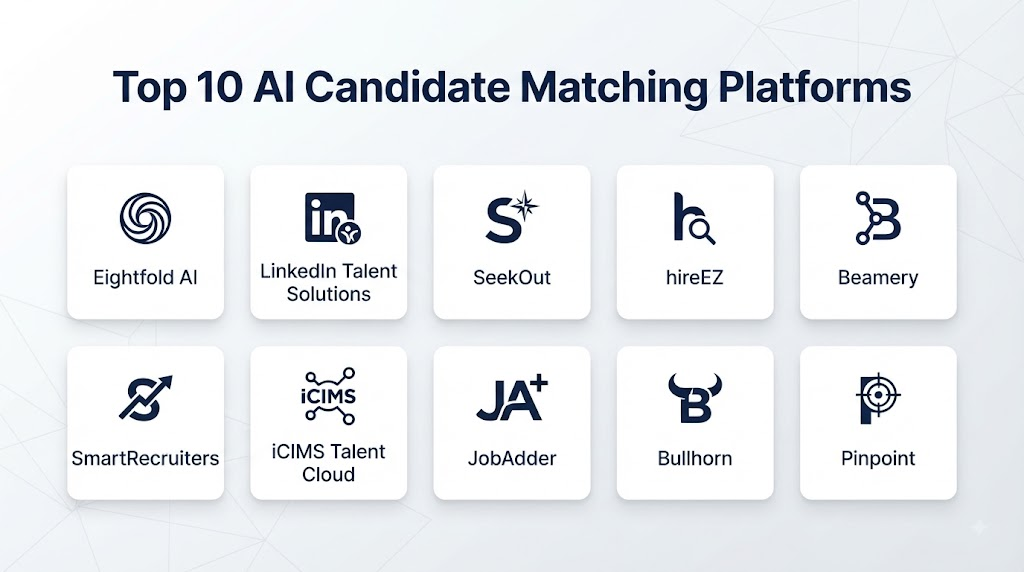
Top 10 AI Candidate Matching Platforms
1. Eightfold AI
Eightfold AI provides talent intelligence capabilities focused on skills, candidate matching, talent discovery, internal mobility, and workforce intelligence.
Key Features
- AI candidate matching
- Skills intelligence
- Talent discovery
- Candidate recommendations
- Internal mobility
- Talent rediscovery
Pros
- Strong skills-based matching
- Broad talent intelligence capabilities
- Useful internal and external talent applications
- Enterprise-focused functionality
Cons
- Enterprise implementations can be complex
- Advanced capabilities require quality talent data
2. Workday Recruiting
Workday Recruiting provides recruiting and talent-management capabilities within the broader Workday ecosystem.
Key Features
- Candidate matching
- Resume management
- Recruiting workflows
- Applicant tracking
- Talent management
- Recruiting analytics
Pros
- Strong enterprise HR integration
- Broad recruiting functionality
- Comprehensive talent ecosystem
- Useful analytics
Cons
- Implementation can be complex
- Advanced configurations may require specialist support
3. LinkedIn Recruiter
LinkedIn Recruiter provides professional talent search, candidate discovery, recommendations, and recruiter engagement capabilities.
Key Features
- Candidate search
- Talent recommendations
- Advanced filters
- Candidate messaging
- Professional profiles
- Hiring insights
Pros
- Extensive professional talent network
- Strong candidate discovery
- Detailed professional profiles
- Useful recruiter workflows
Cons
- Cost can be significant for some organizations
- Candidate information depends on profile completeness
4. iCIMS
iCIMS provides talent acquisition and applicant tracking capabilities with AI-assisted candidate matching and recruitment workflows.
Key Features
- Candidate matching
- Resume parsing
- Applicant tracking
- Talent search
- Candidate management
- Recruitment automation
Pros
- Strong enterprise capabilities
- Broad integrations
- Flexible recruiting workflows
- Useful candidate management
Cons
- Large deployments can require extensive configuration
- Implementation may require specialist resources
5. SmartRecruiters
SmartRecruiters provides talent acquisition capabilities including applicant tracking, candidate management, recruitment marketing, and AI-supported matching.
Key Features
- Candidate matching
- Resume screening
- Applicant tracking
- Candidate search
- Recruitment workflows
- Hiring analytics
Pros
- Broad recruitment functionality
- Strong enterprise workflows
- Extensive integrations
- Suitable for larger organizations
Cons
- Large feature set can require training
- Enterprise implementation may require planning
6. SeekOut
SeekOut provides AI-assisted talent search and candidate discovery for recruiters.
Key Features
- AI candidate search
- Candidate matching
- Talent discovery
- Skills search
- Talent insights
- Candidate engagement
Pros
- Strong sourcing capabilities
- Useful skills-based search
- Good passive candidate discovery
- Recruiter-focused workflows
Cons
- Advanced functionality can require training
- Results depend on available candidate data
7. hireEZ
hireEZ provides AI-powered sourcing, candidate discovery, matching, engagement, and talent pipeline capabilities.
Key Features
- AI sourcing
- Candidate matching
- Talent discovery
- Passive candidate sourcing
- Outreach
- Recruiting analytics
Pros
- Strong sourcing automation
- Useful AI matching
- Good passive candidate discovery
- Broad candidate engagement capabilities
Cons
- Advanced workflows require configuration
- Larger deployments may require structured implementation
8. Paradox
Paradox provides conversational AI and recruitment automation capabilities that can support candidate screening, matching, scheduling, and engagement.
Key Features
- Conversational screening
- Candidate engagement
- Applicant screening
- Automated scheduling
- Recruiting automation
- Candidate workflows
Pros
- Strong conversational capabilities
- Useful high-volume recruiting support
- Good candidate engagement
- Workflow automation
Cons
- More focused on conversational recruiting than pure matching
- Advanced workflows require configuration
9. Greenhouse
Greenhouse provides applicant tracking and structured hiring capabilities that can support candidate evaluation and recruitment workflows.
Key Features
- Applicant tracking
- Candidate management
- Resume screening
- Candidate search
- Structured interviews
- Recruiting analytics
Pros
- Strong structured hiring approach
- Good recruiting workflows
- Extensive integrations
- Useful hiring analytics
Cons
- Candidate matching is part of a broader recruitment platform
- Advanced workflows may require configuration
10. Phenom
Phenom provides AI-powered talent intelligence across recruiting, candidate engagement, career sites, talent matching, and workforce management.
Key Features
- AI candidate matching
- Talent intelligence
- Candidate recommendations
- Career-site personalization
- Internal mobility
- Talent analytics
Pros
- Broad talent intelligence
- Strong AI-driven matching
- Useful candidate and employee experiences
- Enterprise capabilities
Cons
- Enterprise implementation can be complex
- Advanced capabilities may require significant configuration
Comparison Table: AI Candidate Matching Platforms
| No. | Platform | Best For | AI Matching | Skills Intelligence | Semantic Search | Talent Rediscovery | Internal Mobility |
|---|---|---|---|---|---|---|---|
| 1 | Eightfold AI | Talent intelligence | Strong | Strong | Strong | Strong | Strong |
| 2 | Workday Recruiting | Enterprise recruiting | Strong | Strong | Strong | Strong | Strong |
| 3 | LinkedIn Recruiter | Professional talent discovery | Strong | Strong | Strong | Moderate | Moderate |
| 4 | iCIMS | Enterprise talent acquisition | Strong | Strong | Strong | Strong | Strong |
| 5 | SmartRecruiters | Enterprise hiring | Strong | Strong | Strong | Strong | Strong |
| 6 | SeekOut | Advanced talent search | Strong | Strong | Strong | Strong | Moderate |
| 7 | hireEZ | AI sourcing | Strong | Strong | Strong | Strong | Moderate |
| 8 | Paradox | Conversational recruiting | Strong | Moderate | Strong | Moderate | Moderate |
| 9 | Greenhouse | Structured hiring | Strong | Strong | Moderate | Strong | Moderate |
| 10 | Phenom | Talent intelligence | Strong | Strong | Strong | Strong | Strong |
Weighted Evaluation Table
| No. | Platform | AI Capabilities 20% | Candidate Matching 20% | Skills Intelligence 15% | Semantic Search 15% | Integrations 10% | Ease of Use 10% | Scalability 10% | Total Score |
|---|---|---|---|---|---|---|---|---|---|
| 1 | Eightfold AI | 20 | 20 | 15 | 15 | 10 | 8 | 10 | 98 |
| 2 | Workday Recruiting | 20 | 19 | 15 | 14 | 10 | 8 | 10 | 96 |
| 3 | LinkedIn Recruiter | 19 | 20 | 14 | 15 | 10 | 9 | 10 | 97 |
| 4 | iCIMS | 19 | 19 | 15 | 14 | 10 | 9 | 10 | 96 |
| 5 | SmartRecruiters | 19 | 19 | 15 | 14 | 10 | 8 | 10 | 95 |
| 6 | SeekOut | 19 | 20 | 15 | 15 | 9 | 9 | 9 | 96 |
| 7 | hireEZ | 19 | 19 | 15 | 15 | 10 | 9 | 10 | 97 |
| 8 | Paradox | 18 | 18 | 13 | 14 | 10 | 9 | 9 | 91 |
| 9 | Greenhouse | 18 | 18 | 14 | 13 | 10 | 9 | 10 | 92 |
| 10 | Phenom | 20 | 20 | 15 | 15 | 10 | 8 | 10 | 98 |
Which AI Candidate Matching Platform Is Right for You?
Choose Eightfold AI if skills-based talent intelligence, candidate matching, and internal mobility are major priorities.
Choose Workday Recruiting if candidate matching needs to operate within a broader enterprise HR ecosystem.
Choose LinkedIn Recruiter if access to a large professional talent network is central to your sourcing strategy.
Choose iCIMS if you need enterprise applicant tracking combined with candidate matching and talent acquisition workflows.
Choose SmartRecruiters if you want a broad talent acquisition platform with AI-supported candidate matching.
Choose SeekOut if advanced candidate search, skills discovery, and passive talent sourcing are important.
Choose hireEZ if AI-powered sourcing, matching, and candidate engagement are key requirements.
Choose Paradox if conversational recruiting and automated candidate interactions are important.
Choose Greenhouse if structured hiring and recruitment workflow management are your primary priorities.
Choose Phenom if you need broader AI-powered talent intelligence covering candidates, employees, and workforce experiences.
Common Mistakes
- Treating AI matching scores as final hiring decisions
- Relying exclusively on exact job-title matching
- Ignoring transferable skills
- Using incomplete candidate data
- Failing to validate AI recommendations
- Ignoring algorithmic bias
- Using outdated job requirements
- Failing to monitor false positives
- Failing to monitor false negatives
- Ignoring candidate privacy
- Over-automating candidate communication
- Providing insufficient human oversight
FAQs
1. What are AI Candidate Matching Platforms?
AI Candidate Matching Platforms use artificial intelligence to compare candidate profiles with job requirements and identify potentially suitable applicants.
2. How does AI candidate matching work?
AI can analyze skills, work history, education, job responsibilities, experience, and other candidate information before comparing it with the requirements of an open position.
3. Can AI identify transferable skills?
Yes. Advanced matching systems can identify related capabilities that may be relevant even when candidates do not have the exact job title or terminology specified in a vacancy.
4. Can AI matching replace recruiters?
No. AI matching should support recruiters by prioritizing candidates, while human professionals remain responsible for evaluating suitability and making hiring decisions.
5. Is AI candidate matching useful for internal mobility?
Yes. Organizations can compare employee skills and experience with available internal positions to identify potential career opportunities.
6. Can AI matching reduce hiring time?
It can reduce the time required for initial candidate discovery and comparison, particularly when recruiters are handling large applicant pools.
7. What is semantic candidate matching?
Semantic matching evaluates the meaning and context of candidate information instead of relying exclusively on exact keyword matches.
8. What are the risks of AI candidate matching?
Major risks include inaccurate recommendations, algorithmic bias, incomplete candidate data, privacy concerns, false positives, false negatives, and excessive reliance on automated scores.
9. How should companies evaluate candidate matching software?
Companies should evaluate matching accuracy, skills intelligence, semantic search, explainability, integrations, privacy, bias controls, scalability, and human-review capabilities.
10. What is the future of AI candidate matching?
The category is moving toward skills-based matching, natural-language search, transferable-skills discovery, predictive recommendations, internal talent matching, explainable AI, and broader talent intelligence.
Conclusion
AI Candidate Matching Platforms can help organizations make recruitment workflows faster, more scalable, and more skills-focused. By analyzing candidate profiles and comparing them with job requirements, these systems can help recruiters discover relevant talent that may otherwise be overlooked.Eightfold AI, Workday Recruiting, LinkedIn Recruiter, iCIMS, SmartRecruiters, SeekOut, hireEZ, Paradox, Greenhouse, and Phenom offer different approaches to AI-powered candidate matching and talent intelligence.The right platform depends on hiring volume, workforce size, recruiting requirements, existing HR systems, sourcing strategy, and the level of AI assistance required.