Introduction
Exploring China by road offers an unforgettable sense of freedom. China builds some of the smoothest, most scenic highways in the world. Paved ribbons run through misty limestone mountains, vast deserts, and deep river gorges. Traveling by road lets you see ancient villages far beyond high-speed train stops.
You can stop whenever you spot a roadside tea farm or a hilltop pagoda. Exploring remote regions on your own schedule reveals the true heart of the country. Modern expressways make cross-country road trips comfortable and accessible for foreign travelers.
Finding reliable rental vehicles across China used to require local contacts and complex paperwork. Today, modern booking tools simplify your journey. MotoShare serves as a trusted vehicle discovery and rental platform in China. The platform helps independent riders and drivers locate inspected vehicles across major transport hubs.
Why Rent a Motorcycle in China?
Renting a motorcycle lets you experience China with total sensory immersion. You smell cedar forests along high mountain passes and hear monks chanting in rural monasteries. Two wheels give you the agility to explore narrow village lanes with ease.
City outskirts often face heavy car traffic during peak commuting hours. A motorcycle allows you to bypass congestion around suburban ring roads and transit corridors. Once outside major urban centers, riding along quiet national highways feels completely open and stress-free.
Mountain curves demand your full attention and deliver unmatched riding joy. Winding switchbacks in western provinces reward riders with dramatic panoramic views at every turn. You can pause at scenic pullouts where large tour buses cannot fit.
Choosing the right machine is vital for your safety on varied terrain. A lightweight bike handles crowded suburban streets without exhausting the rider. In contrast, heavier adventure bikes provide the stable power needed for steep mountain climbs.
Always match engine displacement to your physical comfort and road experience. Beginners should choose lightweight commuter models under 250cc for easy handling. Experienced riders tackling high elevations will appreciate torque-rich 500cc or 750cc twin-cylinder engines.
Choosing Your Ride: Scooters, Touring Bikes, and Cars
Selecting the correct vehicle shapes your entire Chinese travel experience. Different provinces feature radically different road surfaces, weather patterns, and local traffic speeds.
City commuting requires small dimensions and easy parking access. Long-distance provincial highway cruising requires wind protection, soft seating, and reliable luggage capacity. Study your planned route carefully before picking a vehicle category.
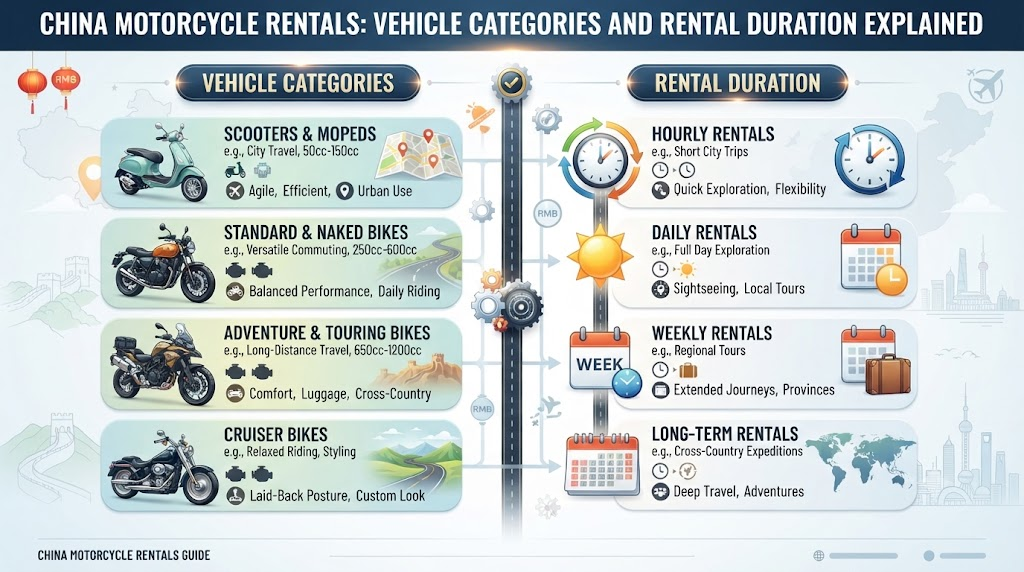
| Vehicle Type | Best Use | Rider Skill Needed | Luggage Space | Road Comfort |
| City Scooter / E-Bike | Daily city errands, sightseeing, and flat suburban roads | Beginner (Easy balance, twist-and-go throttle) | Minimal (Under-seat tub and front hook) | Moderate for short 20-minute rides |
| Commuter Motorcycle | Secondary provincial roads, scenic lakes, and country towns | Intermediate (Manual clutch and gear control) | Low to Medium (Optional rear tail box) | Good for two-hour country day rides |
| Adventure Touring Bike | Mountain switchbacks, rough valleys, and long multi-day loops | Advanced (Taller seat height and off-road balance) | High (Lockable aluminum panniers and top case) | Excellent for eight-hour touring days |
| Rental Car / SUV | Cross-province family travel, stormy weather, and desert routes | Basic (Standard driver license, automatic gearbox) | Maximum (Enclosed trunk and rear passenger seats) | Superior all-weather climate control |
Luggage capacity dictates how far you can travel without fatigue. Hard aluminum side boxes on touring motorcycles keep your gear dry during heavy downpours. They also lock securely when you step away to visit mountain temples.
Cars offer deep trunks that swallow heavy family bags and photography gear. Long fuel range keeps you moving through remote areas without anxiety. Touring bikes and modern SUVs travel 350 to 500 kilometers between fuel stops.
Motorcycle Rental Beijing and Motorcycle Rental Shanghai
Motorcycle touring in Beijing provides instant access to ancient history and jagged peaks. The northern districts of Huairou, Yanqing, and Miyun feature world-class mountain roads. Riders carve through twisting mountain roads leading straight to unrestored watchtowers of the Great Wall.
Beijing strictly enforces motorcycle access on its concentric Ring Roads. Bikes with local Beijing A plates enjoy wider access across outer zones. In contrast, B-plate motorcycles cannot enter inside the busy Fourth Ring Road.
Always plan your path to clear suburban rings before morning traffic builds. Reserving a motorcycle rental Beijing through reputable shops ensures your bike carries legitimate registration plates. You can start your mountain ride directly outside the inner traffic control areas.
Shanghai presents a dynamic, ultra-modern backdrop dominated by futuristic city skylines. The city features wide riverfront boulevards, coastal sea walls, and peaceful delta highways. You can cruise along flat canal roads connecting water towns across Jiangsu and Zhejiang.
Urban Shanghai enforces complex license plate rules across central districts. Yellow A plates allow wide access, while blue plates face strict suburban zone boundaries. Motorcycles cannot enter cross-river tunnels or elevated urban expressways.
Arranging your motorcycle rental Shanghai gives you an ideal base for exploring scenic regional lake loops. Head southwest toward Qiandao Lake to enjoy smooth lakeside tarmac and fresh air.
Scooter Rental China and Urban City Travel
Lightweight scooters offer the easiest way to navigate busy Chinese urban centers. Small machines glide through lively neighborhood alleys and narrow shopping streets. You avoid expensive city parking garages and slow taxi lines during rush hour.
Electric scooters dominate local transit in nearly every Chinese city. These whisper-quiet bikes let you explore historic hutongs and riverfront promenades without disturbing residents. They travel at manageable speeds, making them ideal for casual urban explorers.
City centers provide dedicated motorcycle and scooter parking bays painted on sidewalks. Never park your bike outside marked white or yellow street boxes. Traffic wardens quickly ticket or impound two-wheelers left on unmarked sidewalks.
Public battery-charging stations stand near convenience stores and shopping plazas. Standard neighborhood charging points accept payment through popular digital smartphone apps. Most neighborhood e-scooters offer 40 to 60 kilometers of travel per charge.
Pedestrian zones and shopping walking streets strictly prohibit motorized two-wheelers. Always dismount and push your scooter when entering historic walking streets. Finding a verified bike rental China or scooter rental China lets you experience bustling downtown neighborhoods like a local resident.
Adventure Motorcycle Rental China
An adventure motorcycle is a heavy-duty touring bike built for harsh environments. It features long-travel suspension to soak up potholes and uneven gravel tracks. Spoked wheels and dual-sport tires provide firm traction on both wet asphalt and loose dirt.
These bikes offer upright handlebars and wide seats designed for long days in the saddle. Tall windscreens deflect highway wind blast away from your chest, which prevents rider fatigue. High ground clearance lets you ride over fallen mountain rocks without damaging engine cases.
Western Sichuan features incredible high-altitude routes with dramatic views of snowcapped peaks. Riders tackle the famous G318 highway, climbing through steep switchbacks above 4,000 meters. The road winds past Tibetan prayer flags and deep river canyons.
Shangri-La and northern Yunnan deliver sweeping mountain tarmac through alpine evergreen forests. The route hugs the deep ravines of Tiger Leaping Gorge alongside the Jinsha River. High mountain passes lead riders into vast valleys dotted with grazing yaks.
Gansu offers stark desert roads cutting through the barren Hexi Corridor. Strong crosswinds sweep across dry plateaus near ancient Silk Road outpost towers. Booking an adventure motorcycle rental China ensures your machine has the power and durability needed for these remote wild lands.
Pre-Ride Vehicle Inspection Checklist
A complete mechanical inspection protects your life before leaving the rental garage. Even well-maintained rental fleets suffer wear from rough mountain roads and changing temperatures.
Never rush through your initial bike handover inspection. Spend ten quiet minutes checking structural components, brake hardware, and vital engine fluid levels. Identifying small issues early prevents dangerous breakdowns in isolated mountain valleys.
| Check Point | What to Look For | Why It Matters |
| Tires & Tread Depth | Deep tread patterns, no sidewall cracking, correct cold air pressure | Prevents sudden blowouts and skidding on wet roads |
| Front & Rear Brakes | Thick brake pad material, firm lever feel, clean brake fluid sight glass | Guarantees rapid emergency stopping power down steep grades |
| Headlight & Indicators | Bright high and low beams, functioning brake light, working turn signals | Ensures visual clarity inside unlit mountain highway tunnels |
| Chain & Fluid Levels | Proper chain tension, fresh chain lubricant, clear oil level in engine window | Prevents snapping drive chains and catastrophic engine seizures |
| Registration & Insurance | Laminated green registration card, current insurance sticker or paper policy | Proves vehicle legality during routine provincial police checkpoints |
| Mirrors & Throttle Cable | Clear mirror glass, tight mirror stems, smooth and snappy throttle return | Eliminates dangerous blind spots and stuck throttles |
Take time to complete a formal vehicle condition check with your rental agent. Walk slowly around the bike and record a high-definition video of all body panels. Zoom in on existing scratches, scuffed crash bars, or bent footpegs.
Keep your digital inspection video saved on your phone until you return the keys. This photographic record eliminates awkward disputes over pre-existing cosmetic flaws. Verify that the agent signs the paper handover form before you ride away.
Motorcycle Road Trip China and Scenic Route Planning
Planning a successful motorcycle road trip China requires balancing distance with physical endurance. Mountain riding takes far more concentration and energy than cruising on flat motorways. Limit daily riding targets to 200 or 250 kilometers in high mountain corridors.
Road construction, slow trucks, and unexpected rockfalls can quickly double your travel time. Give yourself ample daytime hours to solve flat tires or fuel delays. Never ride through unfamiliar mountain terrain after the sun drops below the peaks.
Expressway regulations for motorcycles vary dramatically across different Chinese administrative provinces. Some provinces allow motorcycles on toll expressways, while others enforce strict bans. Always watch the overhead lane signage as you approach highway toll booths.
If a toll station displays a red motorcycle prohibition icon, take the exit immediately. Shift your route onto the parallel National Highway, designated with a “G” prefix. G-roads run through scenic countryside and do not charge tolls to motorcycles.
Summer brings sudden monsoon downpours across southern and southwestern provinces. Heavy rain triggers landslides and mud deposits across winding valley roads. Pack professional waterproof riding gear and monitor local weather alerts before crossing mountain passes.
Car Rental China for Foreigners and Self Drive Options
Renting a car provides unmatched comfort, security, and climate control for many travelers. Families traveling with small children or elderly relatives need enclosed cabin space. Large passenger vehicles protect everyone from freezing mountain winds and summer dust storms.
Cars keep your expensive luggage, cameras, and camping gear dry and safe. Winter expeditions across northern plateaus require powerful vehicle heaters to stay comfortable. Modern SUVs handle washed-out gravel detours without throwing passengers off balance.
Mainland China did not sign the United Nations conventions on road traffic. Consequently, authorities do not accept the International Driving Permit (IDP). Driving on mainland roads with only an IDP is illegal and leads to heavy fines or detention.
Foreign travelers must obtain a Chinese Temporary Driving Permit (临时驾驶许可). You apply for this official document at local Vehicle Management Offices (车辆管理所). Many major airport branches in cities like Beijing and Shanghai process these permits quickly.
The temporary permit matches the vehicle class listed on your home country license. A standard car license grants you a Class C1 or C2 permit for passenger cars. Booking a car rental China, self drive car rental China, or car rental China for foreigners unlocks unmatched freedom across the mainland.
Finding Verified Rentals Through MotoShare
Booking road transport in a foreign country can feel intimidating and confusing. Different rental shops use varying security terms, deposit rules, and vehicle conditions. MotoShare solves this problem by offering a unified vehicle discovery platform.
The platform connects international travelers with verified, high-quality rental partners across China. Every host on the marketplace undergoes thorough credential checks before listing vehicles. This screening ensures all listed bikes and cars carry legal registration and valid insurance.
Using MotoShare allows you to search easily by city, pickup date, and vehicle class. You can compare clear, upfront prices listed directly in Chinese Yuan (RMB). The platform eliminates hidden service charges, unexpected handover fees, and inflated tourist markups.
Browse trusted modern motorcycle brands popular on Chinese highways today. Explore capable models from CFMOTO, Benelli, Voge, and QJMotor. You can read transparent customer reviews from other international riders before booking your ride.
Real-Life Travel Scenarios
- The Urban Expat in Shanghai: Marcus, an architect living in Jing’an, rents a compact 150cc scooter through MotoShare. He glides past morning traffic along the Suzhou Creek corridor. The nimble bike allows him to park right outside his studio door every morning.
- The Mountain Adventurer in Yunnan: Elena books a CFMOTO 800MT adventure motorcycle in Kunming. She spends ten glorious days carving through the high passes above Shangri-La. The long-travel suspension soaks up rough mountain gravel near the borders of Tibet.
- The Business Traveler in Beijing: David arrives at Beijing Capital Airport and visits the Vehicle Management counter. He shows his translated license to get a temporary Class C2 permit. He picks up an electric sedan to attend meetings across the Haidian technology hub.
- The Silk Road Road-Trip Duo: Sarah and Liam rent a rugged four-wheel-drive SUV in Lanzhou. They drive northwest past the rainbow hills of Zhangye toward the desert oasis of Dunhuang. The enclosed vehicle keeps their cameras dust-free during afternoon desert windstorms.
Common Mistakes to Avoid When Renting in China
- Trusting an International Driving Permit: Many travelers assume an IDP works on Chinese roads. Police will cite you for driving without a valid license. Always obtain an official Chinese Temporary Driving Permit before your trip.
- Riding on Forbidden Elevated Expressways: Entering central city ring roads or elevated highways on a motorcycle invites heavy camera fines. Always watch entrance signs for motorcycle bans. Stick to surface-level city streets or designated regional roads.
- Skipping Official License Translations: Showing an English-language license at rental desks causes immediate booking rejection. Government agencies require a certified Chinese translation. Arrange an authorized translation through an official notary before visiting the permit office.
- Rushing the Pre-Ride Inspection: Leaving the rental shop without inspecting tire tread and brake pads invites mechanical trouble. Take ten minutes to test every switch and examine the chain. Photograph all body panels to document any pre-existing scratches.
- Relying Exclusively on Cash: Highway toll gates, fuel pumps, and repair shops rarely handle foreign payment networks. Remote merchants often lack physical cash change. Set up Chinese digital payment accounts linked to your international bank cards before departure.
- Ignoring Extreme Mountain Weather: High-altitude mountain passes experience sudden temperature drops, hail, and thick fog. Riding in light summer jackets can cause dangerous hypothermia. Pack thermal base layers and heavy waterproof outer shells for all western routes.
- Using Online Navigation Maps Without Offline Downloads: Cellular data signals vanish inside deep river canyons and remote mountain forests. Losing your navigation map causes stressful wrong turns. Always download comprehensive offline map regions on your smartphone before departing each morning.
- Choosing a Motorcycle Beyond Your Skill: Booking a heavy, tall adventure motorcycle without off-road riding experience leads to low-speed drops. High seat heights make balancing difficult on steep gravel switchbacks. Rent a lighter, lower bike that allows you to plant both feet firmly on the ground.
Simple Rental Booking Checklist
- Valid Passport: Ensure your passport has at least six months of remaining validity, along with an entry visa and stamp.
- Chinese Driving Permit: Carry your original Chinese Temporary Driving Permit or full Chinese Driver’s License.
- Payment Method for Security Deposit: Bring an accepted international credit card or digital wallet funded with sufficient RMB.
- Certified License Translation: Carry an official, notarized Chinese translation of your home country driver’s license.
- Certified Riding Helmet: Pack a quality helmet meeting DOT, ECE, or Chinese CCC safety standards.
- Fuel and Battery Policy: Confirm whether the vehicle follows a strict full-to-full return policy before signing the contract.
Frequently Asked Questions
1. Can foreigners rent a car or motorcycle in China with an International Driving Permit (IDP)?
No, mainland China does not recognize the International Driving Permit. The country has not signed the United Nations road traffic conventions that authorize IDP documents.
Foreign travelers must hold a Chinese driving credential to operate motor vehicles legally. You must apply for a Chinese Temporary Driving Permit upon arrival. Driving with an IDP alone is treated as driving without a license.
2. How does a foreign visitor get a Chinese Temporary Driving Permit?
You apply at a local Vehicle Management Office or designated airport police service desk. Present your passport, valid Chinese visa, original driver’s license, and an official certified Chinese translation.
You must provide two passport-sized color photos with a white background. You also attend a short road safety class explaining local traffic signs. Most airport offices issue the temporary permit on the same day.
3. Are motorcycle helmets required by law across China?
Yes, Chinese national traffic law strictly mandates helmets for all motorcycle operators and passengers. Traffic cameras actively photograph riders and automatically issue fines for non-compliance.
Your helmet should carry recognized certification marks such as Chinese CCC, DOT, or ECE standards. Premium rental providers through MotoShare can provide certified riding helmets with your bike booking. Always keep your helmet strap securely fastened while moving.
4. Are motorcycles allowed on Chinese highways and expressways?
Expressway rules for motorcycles depend on the specific province you visit. National traffic law technically permits motorcycles over 125cc on expressways under strict speed caps.
However, many provincial governments enforce complete bans on two-wheelers using expressway networks. Watch the signs at every toll entrance before entering. When prohibited, ride on national G-highways that run parallel to the toll route.
5. What is the mandatory vehicle insurance policy in China?
Every motorized road vehicle in China must carry Compulsory Traffic Accident Liability Insurance. Locals refer to this mandatory coverage as Jiaoqiangxian (交强险).
This basic policy covers third-party bodily injury and property damage resulting from an accident. Rental agencies generally include this required coverage in their standard base rental rate. You should also purchase optional commercial insurance to cover vehicle damage and theft.
6. Can tourists rent lightweight electric scooters without a driver’s license?
Standard national-standard electric bicycles with functional pedals and speed caps under 25 km/h do not require a driving license. These lightweight urban runabouts are classified as non-motorized transport.
However, fast electric scooters with heavier frames and higher top speeds are classified as electric light motorcycles. Those models require an official Class F or E driver’s license. Always verify the vehicle classification with your rental shop before riding.
7. What documents are needed to pick up a rental car in China?
You must present your physical passport showing a valid Chinese visa and entry immigration stamp. Bring your original home country driver’s license alongside its notarized Chinese translation.
Present your official paper Chinese Temporary Driving Permit matching the car category. Finally, provide an accepted digital payment method or credit card in your name to cover the security deposit.
8. Which motorcycle models, like CFMOTO, are most popular for road trips in China?
Domestic brands offer fantastic reliability and widespread parts support across China. The CFMOTO 450MT and 800MT adventure touring bikes are extremely popular for long-distance highway expeditions.
The Benelli TRK 502 remains a common sight along mountain passes due to its smooth engine and comfortable ergonomics. Commuters often choose versatile 250cc street bikes from Voge and QJMotor for light weekend touring. These domestic models perform reliably in high-altitude environments.
9. How do security deposits work for vehicle rentals in China?
Rental companies collect a refundable security deposit when you pick up your vehicle. The deposit protects the owner against vehicle damage, late returns, or unpaid fuel charges.
Shops also hold a small secondary traffic violation deposit for thirty days after return. This waiting period allows local police bureaus to process any automated camera tickets. Unused deposit funds return directly to your card or digital account once records clear.
10. Can I rent a car or motorcycle in Beijing and drop it off in another city?
One-way vehicle rentals are widely available for standard rental cars through major regional hubs. However, one-way returns for motorcycles depend on the specific fleet operator.
Moving a motorcycle back to its home city requires dedicated freight shipping or long return rides. Many MotoShare operators support one-way routes along popular touring corridors for an additional vehicle relocation fee. Always arrange one-way plans with your rental host before departure.
11. What should riders do if they experience a breakdown or flat tire in rural China?
Park your bike safely on the hard shoulder well away from passing traffic. Switch on your hazard lights and place an emergency warning triangle behind your vehicle.
Call your rental agency’s roadside assistance phone number listed on your rental agreement. Small town tire repair shops, known as Xiuche (修车), operate across all national highways. Local mechanics can plug standard tubeless tires quickly and affordably.
12. Why should travelers use a marketplace like MotoShare to discover local rentals?
Independent vehicle rental across China can involve confusing language barriers and uncertain insurance terms. MotoShare simplifies the entire process by curating verified commercial rental agencies onto a single clean platform.
You can compare vehicle specs, read authentic traveler reviews, and review clear pricing in RMB. Secure booking policies protect your deposit and guarantee you receive a road-legal, inspected vehicle.
Conclusion
Exploring China by motorcycle or car delivers an incredible travel adventure across historic landscapes. Success begins with matching your vehicle choice to your route, personal skill level, and expected seasonal weather. Securing a legal Chinese Temporary Driving Permit gives you complete peace of mind on every highway. MotoShare connects you directly with inspected bikes and cars so you can focus entirely on the open road ahead. Pack your protective riding gear, double-check your offline maps, and prepare to discover the ancient wonders of China on your own terms.