Introduction
Every time you open your banking app, buy shoes online, or stream your favorite TV show, hundreds of digital systems work behind the scenes. These systems include web servers, database engines, storage drives, and network routers. Every second of the day, each machine creates a small status update called an event. When everything works fine, these updates pass by quietly. But when something breaks, thousands of these updates turn into loud, flashing red alarms within seconds.
Modern businesses run on complex computer networks that talk to each other non-stop. A medium-sized company can easily see over fifty thousand system alerts every single hour. For human workers sitting in an IT support room, this flood of data creates complete chaos. Finding one broken cable inside a room full of shouting computer monitors is like trying to spot a whisper during an earthquake. Without a clear way to organize these warnings, engineers spend all day putting out small fires while the main problem keeps burning.
To make sense of this digital storm, modern technology teams turn to smart platforms and education hubs like AIOps School to learn how artificial intelligence can manage messy system data. The core secret behind keeping large computer networks stable is a concept known as event correlation. It acts like a skilled digital detective that listens to every cry for help, groups related warnings together, and points engineers straight to the real issue before normal users notice any trouble.
The Nightmare of Alert Fatigue
Imagine your smartphone buzzing with a new email every three seconds, day and night. At first, you open every single message because you fear missing something important. After two hours of constant vibrations, your head hurts and you stop looking closely. Eventually, you put your phone face down on the table and ignore it completely. When your best friend sends an urgent text asking for help, you do not see it because it is buried under hundreds of junk messages.
This exact problem happens to computer engineers every day, and it is known as alert fatigue. When a company’s main software platform experiences a hiccup, it does not send just one polite note to the team. Instead, every single piece of software that depends on that platform starts sending panicked emails, text messages, and dashboard pings. Within ten minutes, five engineers might receive three thousand notifications. Their computer screens turn into an unreadable waterfall of bright red text.
Human brains simply cannot read, process, and understand data at that speed. When engineers face endless alarms, their natural reaction is to get overwhelmed, tired, and numb. They start clicking the “acknowledge” button on warnings without reading the details just to make the sound stop. This creates massive danger for the entire business. A tiny warning that actually explains why the checkout cart is broken gets dismissed as harmless noise.
Alert fatigue damages both systems and people. Talented engineers burn out quickly when their entire work week feels like a never-ending fire drill. They spend hours chasing false alarms instead of building helpful software features. Because they are tired and flooded with noise, the time it takes to fix real outages stretches from minutes into hours. The business loses money, customers get angry, and the support team feels defeated by their own monitoring tools.
What is IT Event Correlation?
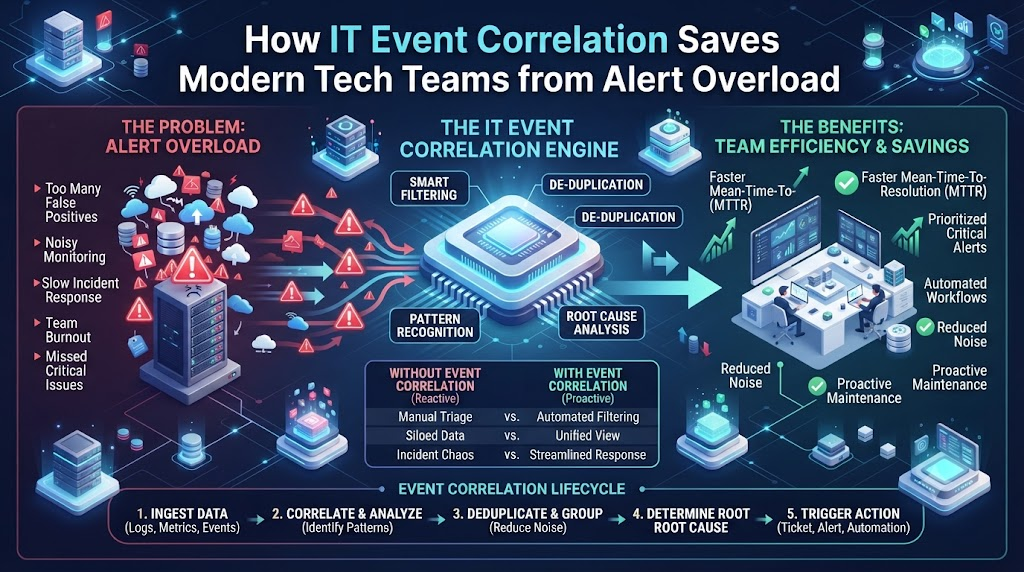
IT event correlation is a smart method that connects the dots between separate computer messages. Think of it like a medical doctor reviewing a sick patient. If a patient has a runny nose, a fever, red eyes, and a cough, the doctor does not treat each symptom as four different, unrelated diseases. The doctor connects these four clues together and realizes the patient simply has the flu. Event correlation does the exact same thing for computer networks. It looks at hundreds of scattered system alarms, figures out which ones are related, and bundles them into one clear story.
Silencing the Noise
The first job of event correlation is turning down the volume on duplicate and harmless alerts. When a network switch loses power, every server plugged into that switch shouts that it cannot reach the outside world. That single power loss can create five hundred identical messages that all say, “Connection failed.” Event correlation catches these repetitive messages instantly. It drops the duplicate copies into a quiet folder and keeps only the first relevant notice, wiping out up to eighty percent of the clutter before any human has to read it.
Connecting the Clues
Once the duplicate noise is gone, the correlation engine acts like a detective assembling a puzzle. It compares incoming alerts across different parts of the company. It checks when each alert happened, which machine sent it, and what other systems sit next to that machine in the data center. By looking at the relationships between different parts of the tech stack, the system realizes that a database error on server A and a slow loading screen on server B are actually part of the exact same incident.
Finding the Root Cause
The final step is pinpointing the true source of the trouble, which experts call the root cause. When twenty alarms ring at once, nineteen of them are usually just side effects of the first broken part. Correlation software traces the chain reaction backward. It skips past the angry warning messages sent by the user apps and points directly to the real culprit, such as an expired security certificate or an unplugged cable. Instead of handing the team twenty confusing tickets, it creates one single action plan that tells the on-call engineer exactly what to fix.
Comparing Traditional IT vs. Correlated IT
The difference between managing IT alerts by hand and using smart correlation is night and day. The following table highlights how team operations change when correlation tools take over the monitoring process:
| Comparison Metric | IT Department Without Correlation | IT Department With Event Correlation |
| Number of Alerts Received | Thousands of raw, unorganized notifications flood inboxes every day. | Only a few high-priority, grouped incident summaries appear. |
| Time to Find the Problem | Hours spent reading server logs, guessing origins, and running manual checks. | Minutes, because the software highlights the exact broken root component. |
| Team Stress Levels | Very high; constant alert fatigue leads to engineer panic and burnout. | Low and steady; engineers work quietly on clear, verified tasks. |
When an IT department works without correlation, their daily life is chaotic. Every time an alert sounds, engineers drop what they are doing and scramble to check system screens. Three different engineers might start working on the same outage from three different angles, not realizing they are investigating the same broken machine. This wasted effort costs companies huge sums of money every year because critical services stay down much longer than necessary.
In contrast, a department that uses event correlation operates with calm precision. The software handles the dirty work of sorting, organizing, and cleaning up system chatter behind the scenes. When an engineer gets paged, the alert contains useful context, a list of affected users, and a direct link to the failing part. Work becomes proactive instead of reactive, and team members can finally focus on making their products faster and more secure.
The Top Techniques Used to Correlate Events
Technology teams use a few distinct methods to connect digital events together. Some are basic and follow simple logic, while others rely on modern machine learning brains. Here is how the most popular techniques work in practice:
Time-Based Correlation
Time-based correlation is the simplest way to group clues. This method works on a very basic rule: if twenty different parts of your network scream for help within the exact same two-second window, those errors are almost certainly related. Imagine walking through an office where all the lights, the printers, and the coffee machine shut off at 2:03 PM. You do not need to test every printer individually to know that the main circuit breaker tripped at 2:03 PM. Time-based engines watch for sudden spikes in warnings and bundle everything that occurs within that tiny time frame into a single investigation package.
Rule-Based Correlation
Rule-based correlation takes things a step further by using predefined logic written by human experts. These rules follow a straightforward “If This Happens, Then Do That” path. For example, a senior engineer might write a rule that says: “If the main storage disk fills to ninety-nine percent, and the customer database stops answering queries thirty seconds later, group them together and blame the full disk.” Rule-based systems are extremely dependable for known issues that have happened before. However, they struggle when a brand new, unexpected bug appears that does not match any existing rule in the rulebook.
AI-Driven Correlation
AI-driven correlation uses modern machine learning algorithms to discover patterns on its own, without waiting for humans to write rules. The AI system studies months of historical data, learning what normal network behavior looks like at 9:00 AM on a Monday versus midnight on a Sunday. When strange behavior starts, the AI spots subtle connections across thousands of servers that a human would never notice. It learns which errors typically follow other errors, adapts whenever the company updates its software code, and gets smarter with every incident it resolves.
A Real-World Scenario: Stopping a Digital Avalanche
To see how event correlation works during a live crisis, let us look at a realistic story from an online retail store during a busy holiday shopping weekend.
At 2:15 PM, a cooling fan fails inside a server rack that hosts the store’s primary customer database. Because the fan stops spinning, the database processor overheats and shuts itself off to prevent physical melting. This sudden shutdown starts a massive digital avalanche across the entire company.
First, the product catalog cannot pull up prices, so it starts throwing error codes. Second, the shopping cart service cannot save customer orders, triggering dozens of error messages. Third, the mobile phone app cannot log shoppers into their accounts, sending thousands of failure alerts to the mobile team. Fourth, the payment gateway reports that checkouts have timed out. Within ninety seconds, the monitoring dashboard lights up with more than eight hundred distinct red alarms, and phones start buzzing in six different departments.
Without event correlation, chaos takes over. The mobile app team blames the network team, the payment team blames the banking provider, and the catalog team starts restarting their own servers. Everyone assumes their own specific piece of software is broken. Meanwhile, thirty minutes pass without anyone looking at the physical server rack in the basement where the cooling fan died.
With event correlation in place, the outcome is completely different. The correlation platform sees the eight hundred alarms coming in, notes that they all started after 2:15 PM, and traces the software connections back through the catalog, through the shopping cart, and straight to the unresponsive database machine. It instantly silences the seven hundred and ninety-nine secondary alarms about broken shopping carts and slow apps. Instead, it generates a single high-priority alert that says: “Primary database hardware down due to cooling failure; all user services temporarily impacted.” The on-call hardware technician swaps out the cooling unit, the database boots back up, and the entire incident gets resolved in eight minutes flat.
FAQs
What is an IT event in simple words?
An IT event is a small status update created by a computer, server, or application that records something that just happened, such as a user login or a file download.
Why do servers send so many error messages when only one thing breaks?
Computers connect like a chain of dominoes, so when one central machine stops working, every other application that relies on it fails immediately and sends its own separate warning.
What does the term alert fatigue mean?
Alert fatigue is the state of mental exhaustion engineers experience when they receive hundreds of constant, unimportant alarms until they begin ignoring or missing real warnings.
How does event correlation help reduce costs for a business?
It cuts down the time systems stay broken, prevents costly service downtime, and allows IT teams to solve problems faster without needing to hire dozens of extra log reviewers.
What is the main difference between an event and an alert?
An event is a neutral record of any normal action that occurred, while an alert is a specific warning notification sent to humans when an event indicates an actual problem.
Can a small company benefit from event correlation?
Yes, because even small businesses use cloud tools and websites that generate thousands of log entries, and small teams have fewer engineers available to search through raw data manually.
What happens if an event correlation system encounters an error it has never seen before?
A good correlation platform will use time matching and machine learning to group the strange error with other events that happened at the exact same moment across the network.
Is rule-based correlation better than AI-driven correlation?
Neither is strictly better because rule-based tools provide reliable results for known problems, while AI-driven tools are better at catching surprising, complex issues that do not have existing rules.
Does event correlation fix the broken computer systems automatically?
Correlation tools primarily identify, organize, and locate the root cause of an issue, but they can also trigger automated repair scripts to restart machines or fix minor bugs without human intervention.
How long does it take for a team to notice the benefits of event correlation?
Most teams see an immediate drop of sixty to eighty percent in total alert volume within the first few days of turning on correlation software.
Conclusion
Modern technology networks are growing larger and more complex every single day. As businesses move more of their daily operations to cloud servers and automated apps, the volume of data flying across digital wires will only increase. Expecting human engineers to read every raw alert, spot hidden patterns, and find broken parts by hand is no longer practical. It drains team morale, wastes valuable time, and leaves companies exposed to long, costly service outages.
IT event correlation provides the clarity that modern technical teams desperately need. By combining time checks, expert rules, and intelligent machine learning, correlation platforms strip away the overwhelming noise and bring the real story into plain view. They turn thousands of screaming alarms into simple, actionable steps that any engineer can follow with confidence. When organizations invest in event correlation, they protect their staff from burnout, keep their services running smoothly, and deliver a reliable experience to customers around the globe.