Introduction
AI Returns Fraud Detection tools use machine learning, behavioral analytics, transaction intelligence, computer vision, rules, and customer data to identify suspicious product returns and refund activity. Instead of relying only on fixed rules, these systems can analyze patterns across orders, customers, products, devices, payment methods, locations, return reasons, and historical behavior to estimate fraud or abuse risk.
Returns fraud can include behaviors such as returning different products, claiming that an item was never received, repeatedly requesting refunds, manipulating return reasons, exploiting refund policies, or abusing promotional and replacement programs. AI can help retailers identify these patterns while reducing unnecessary friction for legitimate customers.
Best for: E-commerce retailers, marketplaces, apparel brands, electronics sellers, omnichannel retailers, and enterprises processing large volumes of returns.
Not ideal for: Small retailers with very low return volumes, businesses without reliable transaction and return data, or organizations where basic rules and manual review are already sufficient.
What’s Changed in AI Returns Fraud Detection
- Real-time risk scoring is becoming more important: Retailers increasingly want suspicious returns evaluated during return authorization rather than weeks later.
- Behavioral patterns matter more than individual transactions: AI can identify repeated return behavior that may appear normal when each transaction is viewed independently.
- Customer and transaction signals are being combined: Return frequency, order history, product type, refund value, account behavior, and payment information can provide a broader risk picture.
- Computer vision can support physical-return verification: Images can potentially help identify damaged, incorrect, used, or materially different products.
- Multimodal workflows are expanding: Textual return reasons, product images, transaction data, and historical behavior can potentially be evaluated together.
- AI-assisted investigation is becoming practical: Systems can summarize suspicious cases and highlight the signals that caused elevated risk.
- Human-in-the-loop review remains important: High-risk cases may require manual investigation rather than automatic rejection.
- Explainability matters: Fraud teams need actionable reasons behind risk scores rather than unexplained AI decisions.
- False positives are receiving greater attention: Aggressive fraud controls can reject legitimate customers and damage retention.
- Adaptive fraud models are increasingly important: Fraud patterns change when policies, products, shipping processes, and promotions change.
- Privacy and governance are critical: Returns systems can process sensitive customer and transaction information.
- Model monitoring is essential: Fraud teams need to monitor drift, false positives, false negatives, and changing attack patterns.
- AI agents can support investigation workflows: Agents may help gather order information, summarize cases, and recommend next steps under controlled permissions.
- Cost-aware detection is becoming important: The objective is not simply detecting more suspicious activity but reducing losses while protecting legitimate customer relationships.
Quick Buyer Checklist
When evaluating AI Returns Fraud Detection tools, look for:
- Real-time return-risk scoring.
- Refund-risk scoring.
- Customer behavior analysis.
- Order history analysis.
- Return-frequency analysis.
- Product-level risk signals.
- Payment and transaction intelligence.
- Device intelligence.
- Account-linking capabilities.
- Identity signals.
- Geolocation signals where legally appropriate.
- Return-reason analysis.
- Product image analysis.
- Computer vision support.
- Anomaly detection.
- Machine-learning models.
- Rules engine.
- Custom risk thresholds.
- Case management.
- Manual review workflows.
- Explainable risk signals.
- Human approval workflows.
- Model evaluation.
- False-positive monitoring.
- Model drift monitoring.
- Audit trails.
- Role-based access.
- SSO.
- Data retention controls.
- Encryption.
- Data residency options.
- API access.
- Webhooks.
- E-commerce integrations.
- CRM integrations.
- OMS integrations.
- WMS integrations.
- Payment integrations.
- Customer-service integrations.
- Data warehouse support.
- Real-time decisioning.
- Latency monitoring.
- Cost controls.
- Data portability.
- Vendor lock-in protection.
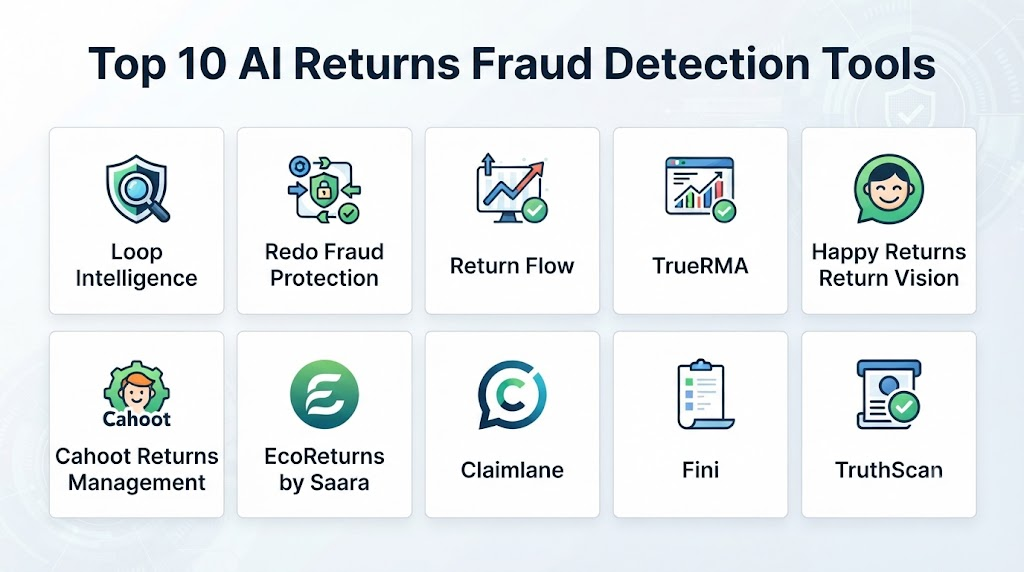
Top 10 AI Returns Fraud Detection Tools
1. Riskified
One-line verdict: Best for large e-commerce businesses seeking automated decisions around returns, refunds, and transaction-related customer risk.
Short description:
Riskified provides e-commerce risk-management and fraud-prevention technology. Its broader platform is designed to help merchants manage fraud and customer risk across digital commerce journeys, including post-purchase scenarios.
Standout Capabilities
- E-commerce fraud prevention.
- Customer risk assessment.
- Transaction analysis.
- Returns and refund risk management.
- Automated decisioning.
- Behavioral analysis.
- Merchant risk controls.
- Fraud investigation support.
AI-Specific Depth
- Model support: Vendor-managed machine-learning models.
- RAG / knowledge integration: N/A for core fraud decisioning.
- Evaluation: Model performance and decision outcomes are central to the platform; exact evaluation methodology is not publicly stated.
- Guardrails: Risk policies, decision controls, and merchant-configurable workflows vary.
- Observability: Risk and decision analytics; exact tracing and AI telemetry capabilities vary.
Pros
- Strong e-commerce fraud specialization.
- Suitable for high-volume merchants.
- Can support automated risk decisions.
Cons
- Enterprise-oriented implementation may be more than small retailers need.
- Exact model architecture is proprietary.
- Pricing is not publicly stated.
Security & Compliance
Security controls, certifications, data retention, encryption, and residency options should be verified for the specific agreement and deployment.
Deployment & Platforms
- Cloud.
- API-based.
- E-commerce integrations.
- Enterprise environments.
Integrations & Ecosystem
The platform is designed to connect with commerce transaction and post-purchase workflows.
- E-commerce platforms.
- Payment ecosystems.
- Order systems.
- Customer data.
- APIs.
- Risk workflows.
- Analytics.
Pricing Model
Enterprise pricing is not publicly stated.
Best-Fit Scenarios
- Large online retailers.
- High-volume e-commerce.
- Complex fraud and return environments.
2. Forter
One-line verdict: Best for enterprises needing identity-based fraud intelligence across commerce transactions, accounts, and post-purchase activity.
Short description:
Forter provides fraud prevention and digital identity solutions for commerce businesses. Its approach uses behavioral and identity signals to help organizations distinguish legitimate customers from potentially fraudulent activity.
Standout Capabilities
- Identity intelligence.
- Fraud detection.
- Transaction risk assessment.
- Account protection.
- Behavioral analytics.
- E-commerce risk management.
- Automated decisioning.
- Post-purchase risk capabilities.
AI-Specific Depth
- Model support: Vendor-managed AI and machine-learning models.
- RAG / knowledge integration: N/A.
- Evaluation: Risk decision performance is evaluated through fraud outcomes; exact internal methodology is proprietary.
- Guardrails: Risk policies and configurable decision controls.
- Observability: Fraud and decision analytics.
Pros
- Strong identity-centric approach.
- Broad fraud coverage.
- Useful for large digital commerce operations.
Cons
- Broad platform may be excessive for smaller retailers.
- Proprietary models limit direct model control.
- Pricing is not publicly stated.
Security & Compliance
Specific security controls and certifications should be verified with the provider for the relevant service.
Deployment & Platforms
- Cloud.
- APIs.
- E-commerce environments.
- Enterprise infrastructure.
Integrations & Ecosystem
- E-commerce platforms.
- Payment systems.
- Account systems.
- Customer data.
- APIs.
- Fraud operations.
- Analytics.
Pricing Model
Enterprise pricing varies and is not publicly stated.
Best-Fit Scenarios
- Enterprise retailers.
- Marketplaces.
- High-volume digital commerce.
3. Signifyd
One-line verdict: Best for merchants combining fraud protection, commerce risk intelligence, and post-purchase protection workflows.
Short description:
Signifyd provides e-commerce fraud prevention and commerce protection capabilities. Its platform can help merchants evaluate transactions and customer behavior while reducing fraud-related losses.
Standout Capabilities
- Fraud detection.
- Transaction risk analysis.
- Behavioral intelligence.
- Automated decisioning.
- Commerce protection.
- Customer experience optimization.
- Fraud operations.
- Post-purchase risk management.
AI-Specific Depth
- Model support: Vendor-managed machine-learning and risk models.
- RAG / knowledge integration: N/A.
- Evaluation: Fraud outcomes and decision performance.
- Guardrails: Configurable business and risk controls.
- Observability: Risk and commerce performance reporting.
Pros
- E-commerce-focused.
- Supports automated risk decisions.
- Can reduce manual fraud-review workload.
Cons
- Exact AI methodology is proprietary.
- Advanced capabilities may require enterprise implementation.
- Pricing varies.
Security & Compliance
Specific security and compliance details should be verified for the selected service.
Deployment & Platforms
- Cloud.
- API-based.
- E-commerce integrations.
Integrations & Ecosystem
- Commerce platforms.
- Payment systems.
- Order management.
- Customer data.
- APIs.
- Fraud workflows.
Pricing Model
Pricing varies according to merchant requirements and transaction volume.
Best-Fit Scenarios
- E-commerce merchants.
- High-volume transactions.
- Automated fraud prevention.
4. Riskified Policy Protect
One-line verdict: Best for merchants looking specifically at post-purchase policy abuse and return-related financial risk.
Short description:
Riskified’s post-purchase capabilities focus on protecting merchants from abuse associated with returns, refunds, and other customer-service policies. These workflows are particularly relevant to retailers dealing with high return rates.
Standout Capabilities
- Returns abuse detection.
- Refund-risk assessment.
- Policy abuse analysis.
- Customer behavior intelligence.
- Automated decisioning.
- Risk scoring.
- Post-purchase analytics.
- Merchant policy controls.
AI-Specific Depth
- Model support: Vendor-managed machine learning.
- RAG / knowledge integration: N/A.
- Evaluation: Risk and outcome-based evaluation; detailed methodology is proprietary.
- Guardrails: Merchant policies and decision controls.
- Observability: Post-purchase risk and decision analytics.
Pros
- Directly relevant to return and refund abuse.
- Designed for commerce environments.
- Can automate parts of post-purchase decisioning.
Cons
- Proprietary models.
- Enterprise-focused.
- Pricing is not publicly stated.
Security & Compliance
Verify applicable security controls, certifications, retention policies, and data-residency options with the provider.
Deployment & Platforms
- Cloud.
- API.
- E-commerce environments.
Integrations & Ecosystem
- Order systems.
- Returns platforms.
- Commerce platforms.
- Customer data.
- APIs.
- Fraud operations.
Pricing Model
Enterprise pricing is not publicly stated.
Best-Fit Scenarios
- Apparel retailers.
- High-return categories.
- Large e-commerce operations.
5. ReturnLogic
One-line verdict: Best for retailers seeking returns-management infrastructure with data that can support fraud and abuse analysis.
Short description:
ReturnLogic focuses on returns management and reverse-logistics workflows. Its value for fraud detection comes from structuring return information and enabling merchants to analyze return behavior and operational patterns.
Standout Capabilities
- Returns management.
- Return authorization.
- Return tracking.
- Reverse logistics.
- Return analytics.
- Customer return workflows.
- Inventory visibility.
- Operational reporting.
AI-Specific Depth
- Model support: AI-specific fraud model availability varies / N/A.
- RAG / knowledge integration: N/A.
- Evaluation: Analytics and operational reporting; dedicated AI evaluation varies.
- Guardrails: Workflow and policy controls.
- Observability: Returns analytics and operational reporting.
Pros
- Strong returns-management focus.
- Useful source of structured return data.
- Can improve return-process visibility.
Cons
- Not primarily a dedicated AI fraud-detection engine.
- Advanced fraud detection may require additional technology.
- AI-specific capabilities vary.
Security & Compliance
Specific security and compliance capabilities should be verified for the applicable plan.
Deployment & Platforms
- Cloud.
- Web.
- E-commerce integrations.
Integrations & Ecosystem
- E-commerce platforms.
- Returns workflows.
- Order management.
- Customer service.
- Inventory systems.
- APIs.
Pricing Model
Pricing varies by implementation and is not stated here.
Best-Fit Scenarios
- Retailers modernizing returns.
- Brands with high return volumes.
- Businesses needing better returns data.
6. Loop Returns
One-line verdict: Best for brands seeking modern returns infrastructure that can provide behavioral data for identifying suspicious return patterns.
Short description:
Loop Returns provides returns-management technology for e-commerce brands. Its primary focus is improving the return experience and operational process, while structured return data can support broader fraud and abuse analysis.
Standout Capabilities
- Returns management.
- Return exchanges.
- Return portals.
- Customer experience.
- Return analytics.
- Exchange optimization.
- Returns workflows.
- E-commerce integration.
AI-Specific Depth
- Model support: AI-specific fraud model capabilities vary / N/A.
- RAG / knowledge integration: N/A.
- Evaluation: Returns and operational analytics.
- Guardrails: Return-policy and workflow controls.
- Observability: Returns performance metrics.
Pros
- Strong returns specialization.
- Useful for improving return workflows.
- Generates structured return behavior data.
Cons
- Not primarily a fraud-detection platform.
- Dedicated fraud intelligence may require another solution.
- AI capabilities vary by product.
Security & Compliance
Verify security and compliance details for the selected service.
Deployment & Platforms
- Cloud.
- Web.
- E-commerce integrations.
Integrations & Ecosystem
- E-commerce.
- Order management.
- Customer experience.
- Inventory.
- APIs.
- Analytics.
Pricing Model
Pricing varies.
Best-Fit Scenarios
- D2C brands.
- Apparel retailers.
- High-return e-commerce businesses.
7. Stripe Radar
One-line verdict: Best for merchants wanting machine-learning transaction risk signals connected directly to their payment infrastructure.
Short description:
Stripe Radar uses machine learning and payment-related signals to detect potentially fraudulent transactions. Although its core purpose is payment fraud rather than returns fraud, transaction-risk data can form part of a broader return-abuse strategy.
Standout Capabilities
- Payment fraud detection.
- Machine-learning risk assessment.
- Transaction monitoring.
- Rules.
- Risk signals.
- Payment intelligence.
- Automated blocking.
- Payment ecosystem integration.
AI-Specific Depth
- Model support: Stripe-managed machine-learning models.
- RAG / knowledge integration: N/A.
- Evaluation: Transaction outcomes and fraud signals.
- Guardrails: Rules and risk controls.
- Observability: Payment and fraud analytics.
Pros
- Strong payment-data context.
- Useful for transaction-level fraud.
- Integrates with payment workflows.
Cons
- Not specifically designed for return abuse.
- Requires additional return-behavior data.
- Payment fraud and returns fraud are different problems.
Security & Compliance
Stripe provides security controls for its payment infrastructure; exact certifications and applicable controls should be verified for the services used.
Deployment & Platforms
- Cloud.
- APIs.
- Web.
- Mobile applications.
Integrations & Ecosystem
- Payment systems.
- E-commerce.
- APIs.
- Billing.
- Customer data.
- Fraud workflows.
Pricing Model
Pricing varies by payment and selected services.
Best-Fit Scenarios
- Online merchants using integrated payment infrastructure.
- Payment fraud prevention.
- Combined payment and returns-risk architectures.
8. Sift
One-line verdict: Best for organizations seeking behavioral intelligence across payment, account, and digital-commerce fraud signals.
Short description:
Sift provides digital trust and fraud-prevention technology focused on identifying suspicious behavior across accounts and transactions. Its behavioral approach can complement return-abuse detection when integrated with return events.
Standout Capabilities
- Behavioral analysis.
- Fraud detection.
- Account protection.
- Payment risk.
- Device intelligence.
- Risk scoring.
- Automated decisioning.
- Fraud operations.
AI-Specific Depth
- Model support: Vendor-managed machine-learning models.
- RAG / knowledge integration: N/A.
- Evaluation: Fraud outcomes and risk performance.
- Guardrails: Policies and decision controls.
- Observability: Risk analytics and fraud reporting.
Pros
- Strong behavioral fraud capabilities.
- Broad digital-risk coverage.
- Useful for complex customer journeys.
Cons
- Return-specific capabilities may require integration.
- Proprietary models.
- Pricing is not publicly stated.
Security & Compliance
Verify applicable security, compliance, retention, and residency requirements directly for the selected service.
Deployment & Platforms
- Cloud.
- APIs.
- Digital commerce environments.
Integrations & Ecosystem
- E-commerce.
- Payment systems.
- Customer accounts.
- APIs.
- Data platforms.
- Fraud operations.
Pricing Model
Enterprise pricing varies.
Best-Fit Scenarios
- Digital marketplaces.
- Large e-commerce businesses.
- Behavioral fraud detection.
9. DataVisor
One-line verdict: Best for enterprises wanting customizable AI-driven anomaly detection across large-scale fraud and abuse datasets.
Short description:
DataVisor focuses on fraud and risk detection using machine learning and anomaly detection. Its broader capabilities can be adapted to detect unusual behavioral patterns across commerce and customer activity.
Standout Capabilities
- Anomaly detection.
- Fraud detection.
- Machine learning.
- Behavioral analytics.
- Risk scoring.
- Unsupervised detection.
- Fraud investigation.
- Enterprise risk management.
AI-Specific Depth
- Model support: Vendor-managed machine-learning models; specific deployment flexibility varies.
- RAG / knowledge integration: N/A.
- Evaluation: Fraud detection performance and investigation outcomes.
- Guardrails: Rules and risk-management controls.
- Observability: Fraud analytics and risk monitoring.
Pros
- Strong anomaly-detection orientation.
- Useful for complex fraud patterns.
- Suitable for large-scale risk operations.
Cons
- May require substantial integration work.
- Not exclusively focused on returns.
- Pricing is not publicly stated.
Security & Compliance
Specific security and compliance claims should be verified for the selected deployment.
Deployment & Platforms
- Cloud.
- Enterprise APIs.
- Data-intensive environments.
Integrations & Ecosystem
- Customer data.
- Transaction systems.
- E-commerce.
- APIs.
- Analytics.
- Fraud operations.
Pricing Model
Enterprise pricing is not publicly stated.
Best-Fit Scenarios
- Large fraud teams.
- Complex behavioral patterns.
- Enterprise anomaly detection.
10. Sardine
One-line verdict: Best for organizations wanting behavioral risk intelligence and identity signals that can complement returns-abuse detection.
Short description:
Sardine provides fraud prevention and risk infrastructure focused on identity, device, behavior, and transaction signals. Its capabilities can contribute to broader commerce abuse detection when return activity is included in the risk architecture.
Standout Capabilities
- Fraud prevention.
- Device intelligence.
- Identity intelligence.
- Behavioral analysis.
- Transaction monitoring.
- Risk scoring.
- Rules.
- Case investigation.
AI-Specific Depth
- Model support: Vendor-managed AI and machine-learning capabilities.
- RAG / knowledge integration: N/A.
- Evaluation: Fraud and risk outcomes.
- Guardrails: Rules and risk controls.
- Observability: Risk and fraud analytics.
Pros
- Strong behavioral and identity signals.
- Flexible risk infrastructure.
- Useful for broader fraud programs.
Cons
- Not a dedicated returns-management product.
- Requires return-event integration for return-specific detection.
- Pricing is not publicly stated.
Security & Compliance
Verify security, privacy, certifications, retention, and residency requirements for the selected services.
Deployment & Platforms
- Cloud.
- APIs.
- Enterprise applications.
Integrations & Ecosystem
- E-commerce.
- Payments.
- Identity.
- Customer data.
- APIs.
- Fraud platforms.
Pricing Model
Enterprise pricing varies.
Best-Fit Scenarios
- Digital commerce.
- Identity-risk programs.
- Complex fraud environments.
Comparison Table
| Tool Name | Best For | Deployment | Model Flexibility | Strength | Watch-Out | Public Rating |
|---|---|---|---|---|---|---|
| Riskified | E-commerce risk and returns abuse | Cloud | Managed | Commerce-specific risk intelligence | Proprietary models | |
| Forter | Identity-based fraud prevention | Cloud | Managed | Identity intelligence | Enterprise complexity | |
| Signifyd | Commerce fraud protection | Cloud | Managed | Automated risk decisions | Return-specific depth varies | |
| Riskified Policy Protect | Returns and refund abuse | Cloud | Managed | Post-purchase protection | Enterprise-oriented | |
| ReturnLogic | Returns management | Cloud | Varies | Structured returns workflows | Not dedicated fraud AI | |
| Loop Returns | Modern returns operations | Cloud | Varies | Returns experience | Requires fraud layer | |
| Stripe Radar | Payment fraud signals | Cloud | Managed | Payment intelligence | Not returns-specific | |
| Sift | Behavioral fraud detection | Cloud | Managed | Behavioral signals | Requires returns integration | |
| DataVisor | Enterprise anomaly detection | Cloud | Managed/Configurable | Complex fraud patterns | Implementation effort | |
| Sardine | Identity and behavioral risk | Cloud | Managed | Identity and device intelligence | Requires returns data |
Scoring & Evaluation
The scores below are comparative editorial assessments based on suitability for returns-fraud programs, rather than official vendor ratings. A dedicated returns-risk product can score highly on direct relevance, while broader fraud platforms may score higher for extensibility and behavioral intelligence.
| Tool | Core | Reliability/Eval | Guardrails | Integrations | Ease | Perf/Cost | Security/Admin | Support | Weighted Total |
|---|---|---|---|---|---|---|---|---|---|
| Riskified | 10 | 9 | 9 | 10 | 8 | 8 | 9 | 9 | 9.05 |
| Forter | 9 | 9 | 9 | 10 | 8 | 8 | 9 | 9 | 8.90 |
| Signifyd | 9 | 9 | 9 | 10 | 9 | 8 | 9 | 9 | 9.00 |
| Riskified Policy Protect | 10 | 9 | 9 | 10 | 8 | 8 | 9 | 9 | 9.05 |
| ReturnLogic | 7 | 7 | 8 | 8 | 9 | 8 | 8 | 8 | 7.75 |
| Loop Returns | 7 | 7 | 8 | 9 | 9 | 8 | 8 | 8 | 7.90 |
| Stripe Radar | 8 | 9 | 9 | 10 | 9 | 9 | 10 | 10 | 9.05 |
| Sift | 9 | 9 | 9 | 9 | 8 | 8 | 9 | 9 | 8.85 |
| DataVisor | 9 | 9 | 9 | 9 | 7 | 8 | 9 | 9 | 8.65 |
| Sardine | 9 | 8 | 9 | 9 | 8 | 8 | 9 | 9 | 8.65 |
Top 3 for Enterprise
- Riskified — Strong fit for large e-commerce return and post-purchase risk programs.
- Forter — Strong identity and behavioral fraud intelligence.
- Signifyd — Strong commerce-focused automated risk decisioning.
Top 3 for SMB
- Stripe Radar — Particularly useful when payment and fraud infrastructure are already built around Stripe.
- Loop Returns — Useful for improving structured returns operations.
- ReturnLogic — Useful for businesses needing better return management and data.
Top 3 for Developers
- Sardine — Useful for integrating behavioral and identity risk signals.
- DataVisor — Strong for customizable enterprise fraud analytics.
- Sift — Strong behavioral risk infrastructure.
Which AI Returns Fraud Detection Tool Is Right for You?
Solo / Freelancer
Small businesses should avoid implementing a complex fraud machine-learning stack unless return losses justify the investment.
Start with:
- Return-frequency rules.
- Order-value thresholds.
- Manual review.
- Customer-service verification.
- Return-reason monitoring.
- Basic anomaly reporting.
As transaction volume grows, introduce predictive risk scoring.
SMB
SMBs should prioritize solutions that are simple to integrate and can protect customer experience.
Look for:
- E-commerce integrations.
- Automated risk scoring.
- Return-risk rules.
- Customer history.
- Basic case management.
- Payment intelligence.
- Return analytics.
Avoid implementing several overlapping fraud systems unless the incremental protection can be demonstrated.
Mid-Market
Mid-market retailers should combine:
- Transaction risk.
- Return history.
- Customer behavior.
- Product information.
- Account signals.
- Device intelligence.
- Return reasons.
- Refund history.
This provides a more complete picture than evaluating individual return requests independently.
Enterprise
Enterprise retailers should consider a centralized returns-risk architecture.
Important components include:
- Real-time event streams.
- Customer identity resolution.
- Fraud scoring.
- Returns management.
- Payment risk.
- Computer vision.
- Case management.
- Data warehouse.
- Model monitoring.
- Human review.
- Governance.
- Privacy controls.
Enterprises should also distinguish between fraud, policy abuse, and legitimate high-return behavior.
A customer who returns many products is not necessarily fraudulent.
Regulated Industries
Organizations handling sensitive customer information should evaluate:
- Data minimization.
- Access control.
- Encryption.
- Data retention.
- Audit logs.
- Data residency.
- Model governance.
- Explainability.
- Human oversight.
- Fairness.
- Automated-decision requirements.
Risk models should avoid unnecessary sensitive attributes and should be regularly reviewed for unintended discriminatory effects.
Budget vs Premium
Budget Approach
Start with:
- Rule-based return thresholds.
- Customer return history.
- Refund frequency.
- Manual review.
- Basic anomaly detection.
Premium Approach
A sophisticated architecture can combine:
- Real-time AI scoring.
- Behavioral intelligence.
- Device signals.
- Identity intelligence.
- Computer vision.
- Return-reason analysis.
- Graph-based relationships.
- Automated case prioritization.
- AI investigation assistance.
Build vs Buy
Build when:
- Your return volume is very large.
- You have strong data-science capabilities.
- Your return policies are highly specialized.
- You need complete model control.
- Your existing data platform is mature.
Buy when:
- You need fast deployment.
- Fraud prevention is not your core engineering competency.
- You need proven commerce integrations.
- You want vendor-managed model maintenance.
Hybrid Approach
A hybrid architecture can combine:
- Third-party risk signals.
- Internal return data.
- Custom business rules.
- Internal machine-learning models.
- Human fraud investigators.
- Centralized analytics.
Implementation Playbook: 30 / 60 / 90 Days
First 30 Days: Pilot + Success Metrics
Start by mapping the complete return journey:
- Order placement.
- Shipment.
- Delivery.
- Return request.
- Return authorization.
- Return shipment.
- Warehouse receipt.
- Product inspection.
- Refund.
- Replacement.
Build a baseline dataset containing:
- Customer ID.
- Order history.
- Product information.
- Return frequency.
- Return value.
- Return reasons.
- Refund history.
- Payment information.
- Device information where appropriate.
- Shipping information.
- Account activity.
Define success metrics:
- Fraud detection rate.
- False-positive rate.
- False-negative rate.
- Prevented loss.
- Manual-review rate.
- Legitimate return approval rate.
- Customer complaints.
- Refund processing time.
Days 31–60: Security + Evaluation + Rollout
Build an evaluation framework using confirmed fraud and legitimate-return cases.
Test:
- High-frequency returners.
- High-value returns.
- First-time customers.
- Long-term customers.
- Multiple-account behavior.
- Different product categories.
- Different return reasons.
- Different geographic markets.
- Seasonal patterns.
Evaluate:
- Precision.
- Recall.
- False-positive rate.
- False-negative rate.
- Calibration.
- Model stability.
- Detection latency.
For AI-assisted workflows, red-team:
- Prompt injection.
- Unauthorized data access.
- Incorrect case summaries.
- Unsupported fraud accusations.
- Sensitive-data exposure.
- Unapproved automated decisions.
Introduce:
- Model versioning.
- Rule versioning.
- Prompt versioning where applicable.
- Audit logs.
- Human approval.
- Incident-response procedures.
Days 61–90: Optimize + Scale
Move from simple detection to decision optimization.
Possible actions include:
- Approve low-risk returns automatically.
- Send medium-risk cases to review.
- Request additional evidence where appropriate.
- Escalate high-risk cases.
- Flag suspicious accounts.
- Monitor repeated patterns.
- Prioritize warehouse inspection.
Track:
- Fraud losses.
- Legitimate-return approval.
- Customer satisfaction.
- Manual workload.
- Model performance.
- Latency.
- Infrastructure cost.
- Drift.
- Appeal outcomes.
Common Mistakes & How to Avoid Them
- Treating every frequent returner as fraudulent: High return frequency can be legitimate.
- Using rigid rules alone: Fraudsters can adapt to predictable thresholds.
- Ignoring false positives: Incorrectly blocking legitimate returns can damage customer trust.
- Analyzing only individual transactions: Fraud patterns often appear across multiple orders.
- Ignoring product differences: Return behavior varies substantially by category.
- Ignoring return reasons: Repeated unusual reasons can be valuable risk signals.
- Ignoring physical-product verification: The returned item may not match the original order.
- Ignoring computer vision opportunities: Images can provide useful supporting evidence in appropriate workflows.
- Automating high-impact decisions: High-risk cases may require human review.
- No evaluation dataset: Fraud models need reliable historical outcomes.
- No model monitoring: Fraud tactics change continuously.
- Ignoring policy changes: A new return policy can make historical models less reliable.
- Using excessive customer data: More data does not automatically mean better or fairer detection.
- No explanation layer: Fraud investigators need actionable signals.
- Ignoring model drift: Changing customer behavior can reduce prediction quality.
- No audit trail: Organizations should be able to understand important decisions.
- No appeal process: Legitimate customers need a way to challenge incorrect decisions.
- Optimizing only fraud prevention: The system should also protect customer experience and retention.
- Ignoring operational costs: Manual reviews can become expensive at scale.
- Creating vendor lock-in: Keep important return and risk data portable where practical.
FAQs
1. What Is AI Returns Fraud Detection?
AI Returns Fraud Detection uses machine learning and behavioral analytics to identify potentially fraudulent or abusive return and refund activity.
2. What Is Returns Fraud?
Returns fraud occurs when a customer intentionally manipulates the return or refund process to obtain an improper financial benefit.
3. What Is Return Abuse?
Return abuse involves exploiting legitimate return policies in ways that create excessive or unintended costs for a retailer.
4. Is Frequent Returning Automatically Fraud?
No. Some customers legitimately return many products, particularly in categories where fit, size, or product selection creates higher return rates.
5. What Signals Can AI Analyze?
Potential signals include return frequency, order value, product category, customer history, return reasons, refund patterns, account behavior, device information, and transaction activity.
6. Can AI Detect Product-Switching Fraud?
It can help identify suspicious patterns, especially when return records, product identifiers, warehouse inspection data, and images are available.
7. Can Computer Vision Help With Returns Fraud?
Yes. Computer vision can potentially compare returned-product images with expected product characteristics and identify visible discrepancies or damage.
8. Can AI Detect Refund Abuse?
Yes. AI can analyze refund behavior and identify unusual patterns that may indicate potential abuse.
9. Can AI Detect Wardrobing?
AI can help identify behavioral patterns associated with repeated purchase-and-return activity, although determining intent requires careful interpretation.
10. Does Returns Fraud Detection Require Generative AI?
No. Traditional machine-learning models are often appropriate for risk scoring. Generative AI is more useful for investigation summaries, analyst assistance, and controlled workflow automation.
11. Can AI Agents Investigate Suspicious Returns?
AI agents can potentially gather approved information, summarize cases, identify relevant signals, and recommend next steps. High-impact decisions should remain governed by policies and human oversight.
12. Can Returns Fraud Detection Work in Real Time?
Yes. Real-time systems can score return requests during authorization and route cases according to their risk level.
13. Should High-Risk Returns Always Be Rejected?
No. A high-risk score should generally indicate that additional review or verification may be appropriate rather than automatically proving fraud.
14. How Can Retailers Reduce False Positives?
Use multiple signals, calibrated thresholds, customer context, human review, appeals, and continuous evaluation against confirmed legitimate cases.
15. What Is the Difference Between Fraud and Policy Abuse?
Fraud generally involves intentional deception or unauthorized financial benefit. Policy abuse can involve exploiting a legitimate policy in ways that may not meet a strict fraud definition.
16. Can AI Detect Multiple Accounts?
Potentially. Device, identity, behavioral, payment, and transaction relationships can sometimes reveal connections between accounts, subject to privacy and legal requirements.
17. Can AI Detect Return Fraud Without Customer History?
Yes, but prediction quality may be lower for new customers. Transaction and return-session signals can still provide useful information.
18. What Data Is Needed?
Useful data includes orders, returns, refunds, products, customer history, return reasons, shipping events, and relevant transaction information.
19. Is Customer Data Safe With AI Fraud Platforms?
It depends on the provider and configuration. Buyers should verify encryption, retention, access controls, data usage, residency, and applicable compliance requirements.
20. Can Returns Fraud Detection Integrate With an E-Commerce Platform?
Yes. Most modern fraud architectures connect commerce, order, payment, returns, customer, and warehouse data through APIs or event-based integrations.
21. Can AI Detect Fraud Across Multiple Orders?
Yes. Cross-order analysis is one of the major advantages of behavioral fraud detection because suspicious patterns may not be visible in an individual return.
22. How Accurate Should a Returns Fraud Model Be?
There is no universal accuracy target. Precision, recall, false-positive rate, false-negative rate, calibration, and financial impact should all be considered.
23. How Often Should a Fraud Model Be Retrained?
It depends on fraud volume and behavioral change. Organizations should monitor model performance and retrain or recalibrate when performance deteriorates.
24. What Is Model Drift in Returns Fraud?
Model drift occurs when patterns in customer behavior or fraudulent activity change enough that previous model relationships become less reliable.
25. Should Retailers Build Their Own Returns Fraud Model?
Large retailers with strong data-science teams may benefit from custom models. Smaller businesses often gain more value from managed fraud solutions and structured rules.
26. Can AI Reduce Manual Fraud Investigations?
Yes. AI can prioritize cases, summarize evidence, identify patterns, and route cases to investigators, reducing unnecessary manual work.
27. Can AI Prevent Fraud Without Hurting Customer Experience?
It can help, but only when risk thresholds and intervention strategies are carefully designed. Overly aggressive fraud controls can frustrate legitimate customers.
28. What Is the Best AI Returns Fraud Detection Tool?
There is no universal winner. Riskified is particularly relevant to e-commerce and post-purchase risk, Forter is strong in identity intelligence, Signifyd focuses on commerce risk, while Sift, DataVisor, and Sardine can support broader behavioral fraud architectures.
29. What Should I Measure After Implementing AI Returns Fraud Detection?
Track prevented losses, fraud detection, false positives, legitimate-return approval, manual-review volume, customer complaints, refund speed, and overall profitability.
30. What Is the Biggest Challenge With AI Returns Fraud Detection?
The biggest challenge is balancing fraud prevention with customer experience. A system that detects more suspicious activity but incorrectly blocks legitimate customers can create significant long-term costs.
Conclusion
AI Returns Fraud Detection is becoming an important component of modern e-commerce risk management as retailers deal with increasing return volumes, sophisticated abuse patterns, and pressure to maintain convenient customer experiences.The most effective systems do not simply ask whether a return looks suspicious. They evaluate the broader context:The best approach is rarely to maximize the number of rejected returns. Instead, retailers should optimize for lower fraud losses, fewer false positives, faster investigations, better customer experiences, and measurable financial impact.