Introduction
AI Security Posture Management (AI-SPM) Platforms are security solutions designed to discover, assess, monitor, and protect artificial intelligence systems across an organization’s technology environment.
As enterprises rapidly adopt AI models, generative AI applications, machine learning pipelines, and AI agents, maintaining a strong security posture has become a critical requirement.
AI systems introduce new security challenges, including:
- AI model vulnerabilities
- Data exposure risks
- Unauthorized model access
- Prompt injection attacks
- Model theft
- Shadow AI usage
- Weak AI governance controls
- Third-party AI risks
AI Security Posture Management Platforms help organizations continuously identify and manage security risks across the entire AI lifecycle.
These platforms provide capabilities such as:
- AI asset discovery
- Risk assessment
- Security monitoring
- Vulnerability management
- Compliance tracking
- Model protection
- Access control analysis
- Threat detection
AI-SPM platforms are used by:
- Security teams
- AI engineers
- MLOps teams
- Cloud security teams
- CISOs
- Governance professionals
- Enterprise AI architects
The goal of AI Security Posture Management Platforms is to help organizations build secure, compliant, and resilient AI environments.
Why AI Security Posture Management Matters
AI systems are becoming valuable business assets and are increasingly connected with sensitive enterprise data.
Without proper AI security management, organizations may experience:
- Data leakage
- Model compromise
- Unauthorized AI usage
- Compliance failures
- Security incidents
AI-SPM platforms help organizations:
- Discover hidden AI assets
- Identify security weaknesses
- Protect AI workloads
- Improve governance
- Reduce AI-related risks
Common AI Security Risks
Shadow AI
Employees may use unauthorized AI tools without security approval.
Risks include:
- Data exposure
- Compliance problems
- Lack of visibility
Model Security Risks
Includes:
- Model theft
- Model manipulation
- Unauthorized access
Data Security Risks
Includes:
- Sensitive data leakage
- Poor access controls
- Unsafe training data
Application Security Risks
Includes:
- Vulnerable AI applications
- Unsafe integrations
- API attacks
AI Supply Chain Risks
Includes:
- Untrusted models
- Vulnerable dependencies
- Third-party AI risks
How AI Security Posture Management Platforms Work
Step 1: AI Asset Discovery
Platforms identify:
- AI models
- AI applications
- APIs
- Data sources
Step 2: Security Assessment
Tools evaluate:
- Vulnerabilities
- Misconfigurations
- Access risks
Step 3: Risk Prioritization
Systems classify:
- Critical risks
- Security gaps
- Compliance issues
Step 4: Security Enforcement
Organizations apply:
- Policies
- Controls
- Protection measures
Step 5: Continuous Monitoring
Platforms track:
- New threats
- AI changes
- Security posture
Key Components of AI Security Posture Management Platforms
AI Asset Inventory
Tracks:
- Models
- Applications
- AI services
- Owners
Vulnerability Assessment Engine
Identifies:
- Security weaknesses
- AI risks
Threat Monitoring
Detects:
- Suspicious activities
- Attacks
- Misuse
Policy Management
Controls:
- AI security rules
- Access requirements
Compliance Dashboard
Provides:
- Security reports
- Governance status
Risk Management System
Helps:
- Prioritize issues
- Reduce exposure
Key Features of AI Security Posture Management Platforms
AI Discovery
Finds:
- Unknown AI applications
- Shadow AI usage
Security Risk Scoring
Measures:
- Risk levels
- Vulnerability impact
Model Protection
Secures:
- AI models
- Model endpoints
Data Protection
Monitors:
- Sensitive information
- Data access
Access Management
Controls:
- User permissions
- AI resources
Continuous Monitoring
Tracks:
- Security changes
- New threats
Common Use Cases
Enterprise AI Security
Protecting:
- Internal AI systems
- Business applications
Generative AI Security
Managing:
- LLM applications
- AI assistants
- Copilots
Cloud AI Protection
Securing:
- AI workloads
- Cloud models
AI Agent Security
Monitoring:
- Autonomous agents
- Tool permissions
Financial Services
Protecting:
- AI decision systems
- Customer data
Healthcare AI
Securing:
- Medical AI applications
- Sensitive information
Benefits of AI Security Posture Management Platforms
Better AI Visibility
Organizations discover all AI assets.
Reduced Security Risks
Helps identify vulnerabilities early.
Stronger Governance
Supports AI security policies.
Improved Compliance
Helps meet security requirements.
Continuous Protection
Provides ongoing AI monitoring.
Evaluation Criteria
AI Discovery
Evaluate:
- Asset visibility
- Shadow AI detection
Security Coverage
Consider:
- Vulnerability detection
- Threat protection
AI Integration
Check:
- Cloud platforms
- ML environments
Automation
Evaluate:
- Continuous monitoring
- Risk analysis
Compliance Support
Consider:
- Reporting
- Governance frameworks
Scalability
Evaluate:
- Enterprise deployment
Key Trends
AI Security Posture Management Growth
Organizations are adopting dedicated AI security layers.
Generative AI Security
Platforms are focusing on:
- LLM risks
- Prompt attacks
- Data protection
AI Supply Chain Security
Companies are securing:
- Models
- Datasets
- Dependencies
AI Governance Integration
Security posture management is becoming part of AI governance.
Continuous AI Risk Monitoring
Organizations are moving toward:
- Real-time AI security visibility
Methodology
The following AI Security Posture Management Platforms were evaluated based on:
- AI asset discovery
- Security capabilities
- Risk management
- Monitoring
- Compliance support
- Integration
- Scalability
- Enterprise readiness
- Automation
- Value
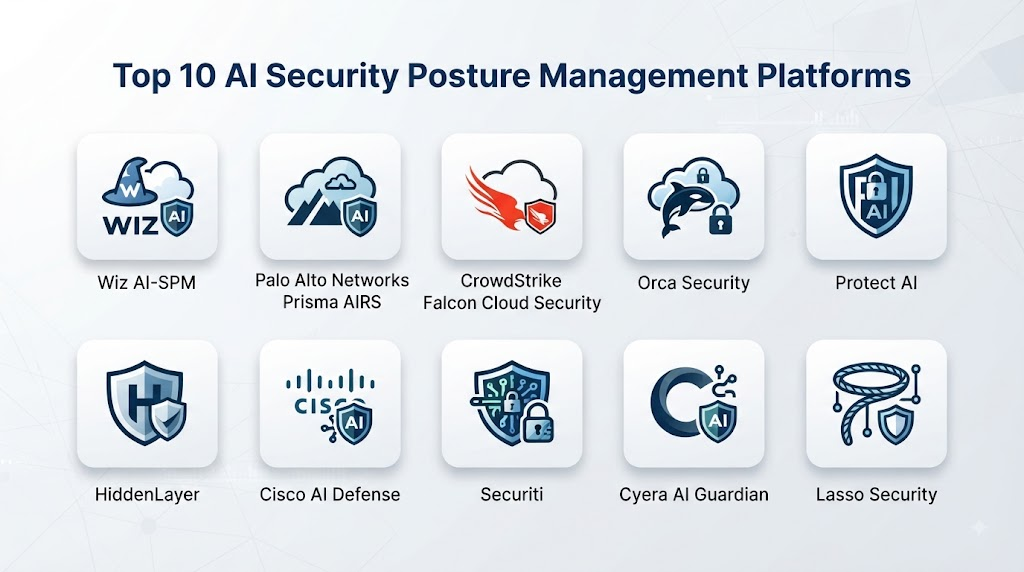
Top 10 AI Security Posture Management Platforms
1. Protect AI
Protect AI provides cybersecurity solutions specifically designed for machine learning and AI environments.
Key Features
- AI asset discovery
- Model vulnerability scanning
- AI supply chain security
- Model protection
- Security monitoring
- Risk assessment
Pros
- AI-focused security platform
- Strong ML security capabilities
- Enterprise ready
Cons
- Requires security expertise
2. Wiz AI Security
Wiz provides cloud security and AI workload protection capabilities.
Key Features
- AI asset discovery
- Cloud risk analysis
- Exposure management
- Security visualization
- Risk prioritization
Pros
- Strong cloud security
- Easy risk visibility
Cons
- Cloud-focused approach
3. Palo Alto Networks AI Security
Palo Alto Networks provides enterprise AI security solutions.
Key Features
- AI threat protection
- Data security
- AI application monitoring
- Risk analysis
- Security controls
Pros
- Strong cybersecurity ecosystem
- Enterprise adoption
Cons
- Complex deployment
4. Microsoft Defender for Cloud AI Security
Microsoft provides AI security capabilities through its security ecosystem.
Key Features
- AI workload protection
- Threat detection
- Compliance monitoring
- Identity security
- Cloud integration
Pros
- Strong Microsoft integration
- Enterprise security
Cons
- Best for Microsoft environments
5. CrowdStrike AI Security
CrowdStrike provides AI-powered cybersecurity protection.
Key Features
- Threat intelligence
- Endpoint protection
- AI risk monitoring
- Security analytics
- Incident response
Pros
- Strong security platform
- Threat intelligence capabilities
Cons
- Less focused only on AI models
6. HiddenLayer AI Security Platform
HiddenLayer specializes in protecting AI systems.
Key Features
- AI threat detection
- Model protection
- Attack detection
- AI monitoring
- Security intelligence
Pros
- AI security specialization
- Strong protection capabilities
Cons
- Specialized platform
7. Robust Intelligence AI Security Platform
Robust Intelligence provides AI testing and security management.
Key Features
- AI risk assessment
- Model testing
- Vulnerability detection
- Monitoring
- Security validation
Pros
- Enterprise AI security
- Comprehensive testing
Cons
- Enterprise pricing
8. Lakera Guard
Lakera Guard focuses on protecting generative AI applications.
Key Features
- Prompt injection detection
- AI threat detection
- Data protection
- Runtime security
- LLM monitoring
Pros
- Strong LLM security
- Real-time protection
Cons
- Primarily focused on generative AI
9. Cisco AI Defense
Cisco provides AI security capabilities for enterprise environments.
Key Features
- AI application security
- Threat detection
- Data protection
- Network security integration
- Governance support
Pros
- Enterprise security ecosystem
- Strong infrastructure support
Cons
- Requires Cisco environment knowledge
10. Check Point AI Security
Check Point provides AI security and threat prevention solutions.
Key Features
- AI threat protection
- Security monitoring
- Data protection
- Risk management
- Enterprise controls
Pros
- Strong cybersecurity experience
- Enterprise features
Cons
- Broad security focus
Comparison Table: Top 10 AI Security Posture Management Platforms
| No. | Tool Name | Best For | Platform(s) Supported | Deployment | Standout Feature | Public Rating |
|---|---|---|---|---|---|---|
| 1 | Protect AI | AI security | Cloud / Enterprise | Managed | AI asset protection | 4.8/5 |
| 2 | Wiz AI Security | Cloud AI security | Cloud | Managed | Risk visibility | 4.7/5 |
| 3 | Palo Alto AI Security | Enterprise security | Cloud | Managed | Threat protection | 4.7/5 |
| 4 | Microsoft Defender AI Security | Microsoft environments | Azure | Managed | Security integration | 4.7/5 |
| 5 | CrowdStrike AI Security | Threat protection | Cloud | Managed | Security intelligence | 4.6/5 |
| 6 | HiddenLayer | AI model security | Cloud | Enterprise | AI threat detection | 4.6/5 |
| 7 | Robust Intelligence | AI security testing | Cloud | Enterprise | AI risk testing | 4.6/5 |
| 8 | Lakera Guard | LLM security | Cloud | Managed | Prompt defense | 4.7/5 |
| 9 | Cisco AI Defense | Enterprise AI security | Cloud | Managed | Network integration | 4.5/5 |
| 10 | Check Point AI Security | Cybersecurity | Cloud | Managed | Threat prevention | 4.5/5 |
Weighted Evaluation Table
| No. | Tool Name | Security 25% | Ease of Use 15% | AI Integration 15% | Risk Detection 10% | Scalability 10% | Monitoring 10% | Value 15% | Total Score |
|---|---|---|---|---|---|---|---|---|---|
| 1 | Protect AI | 25 | 14 | 15 | 10 | 10 | 10 | 14 | 98 |
| 2 | Wiz AI Security | 24 | 15 | 14 | 10 | 10 | 10 | 14 | 97 |
| 3 | Palo Alto AI Security | 25 | 13 | 15 | 10 | 10 | 10 | 13 | 96 |
| 4 | Microsoft Defender AI Security | 24 | 15 | 15 | 10 | 10 | 10 | 13 | 97 |
| 5 | CrowdStrike AI Security | 24 | 14 | 14 | 10 | 10 | 10 | 13 | 95 |
| 6 | HiddenLayer | 24 | 13 | 15 | 10 | 10 | 10 | 13 | 95 |
| 7 | Robust Intelligence | 24 | 13 | 15 | 10 | 10 | 10 | 13 | 95 |
| 8 | Lakera Guard | 24 | 15 | 15 | 10 | 10 | 10 | 14 | 98 |
| 9 | Cisco AI Defense | 23 | 13 | 14 | 10 | 10 | 10 | 13 | 93 |
| 10 | Check Point AI Security | 23 | 14 | 14 | 10 | 10 | 10 | 13 | 94 |
Which AI Security Posture Management Platform Is Right for You?
Choose Protect AI for dedicated AI security management.
Choose Wiz AI Security for cloud AI visibility.
Choose Palo Alto AI Security for enterprise cybersecurity.
Choose Microsoft Defender AI Security for Azure environments.
Choose CrowdStrike AI Security for threat intelligence.
Choose HiddenLayer for AI model protection.
Choose Robust Intelligence for AI security testing.
Choose Lakera Guard for LLM application security.
Choose Cisco AI Defense for enterprise infrastructure.
Choose Check Point AI Security for broad cybersecurity protection.
Implementation Playbook
Phase 1: Discover AI Assets
- Identify AI models
- Find AI applications
- Map ownership
Phase 2: Assess Security Risks
- Scan vulnerabilities
- Evaluate exposure
- Prioritize risks
Phase 3: Apply Security Controls
- Configure policies
- Protect models
- Secure access
Phase 4: Monitor AI Environment
- Track threats
- Detect changes
- Review incidents
Phase 5: Continuous Improvement
- Update controls
- Improve governance
- Maintain security posture
Common Mistakes
- Using AI without security visibility
- Ignoring shadow AI usage
- No model protection
- Poor access management
- Missing AI monitoring
- Treating AI security as traditional security only
FAQs
1. What are AI Security Posture Management Platforms?
They are tools that help organizations discover, assess, and protect AI systems from security risks.
2. Why is AI-SPM important?
It provides visibility and security controls for modern AI environments.
3. What risks do AI-SPM platforms detect?
They detect model vulnerabilities, data risks, access issues, and AI security threats.
4. Can AI-SPM protect generative AI applications?
Yes, many platforms support LLM and AI application security.
5. Who uses AI Security Posture Management tools?
Security teams, AI engineers, MLOps teams, and enterprises.
6. How is AI-SPM different from traditional security tools?
AI-SPM focuses specifically on AI models, data, and AI workflows.
7. Can AI-SPM detect shadow AI?
Yes, many platforms provide AI discovery capabilities.
8. Are AI-SPM platforms part of AI governance?
Yes, security posture management supports responsible AI governance.
9. How often should AI security posture be checked?
Continuous monitoring is recommended.
10. What is the future of AI-SPM?
AI security posture management will become a standard requirement for enterprise AI adoption.
Conclusion
AI Security Posture Management Platforms are becoming essential as organizations deploy more artificial intelligence systems across business operations. These platforms provide visibility, risk assessment, monitoring, and protection for AI environments.Solutions such as Protect AI, Wiz AI Security, Palo Alto AI Security, Microsoft Defender, HiddenLayer, Robust Intelligence, and Lakera Guard help organizations secure AI applications and reduce emerging AI-related risks.As AI adoption continues expanding, maintaining a strong AI security posture will be critical for building safe, reliable, and enterprise-ready artificial intelligence systems.