Introduction
Synthetic Data Generation Platforms are AI-powered tools that create artificial datasets that replicate the characteristics, patterns, and relationships of real-world data without exposing sensitive information.
Organizations use synthetic data when real data is limited, expensive, unavailable, or restricted because of privacy regulations. These platforms help teams generate realistic datasets for machine learning training, software testing, analytics, and AI model development.
Synthetic data can be generated for different formats, including:
- Structured data
- Images
- Video
- Text
- Audio
- Healthcare records
- Financial transactions
- Customer behavior data
Synthetic Data Generation Platforms are used by:
- Data scientists
- AI engineers
- Machine learning teams
- MLOps professionals
- Data privacy teams
- Software developers
- Enterprise organizations
Modern synthetic data platforms provide capabilities such as:
- AI-based data generation
- Privacy protection
- Data augmentation
- Statistical modeling
- Machine learning integration
- Dataset customization
- Quality evaluation
- Bias reduction
- Data simulation
- Enterprise security
The goal of Synthetic Data Generation Platforms is to create high-quality artificial datasets that improve AI development while protecting sensitive information.
What Is Synthetic Data?
Synthetic data is artificially generated information created by algorithms that imitate real-world data patterns.
Instead of using actual customer or operational data, organizations can generate similar datasets for development and testing.
Example:
Real customer dataset:
Customer ID | Age | Purchase History | Location
Synthetic dataset:
Generated Customer ID | Similar Age Pattern | Similar Purchase Behavior
The synthetic dataset does not represent real individuals but maintains useful statistical patterns.
Why Synthetic Data Matters for AI
AI systems require large amounts of high-quality training data.
Organizations often face challenges such as:
- Limited real-world data
- Privacy restrictions
- Expensive data collection
- Data imbalance
- Lack of rare scenarios
Synthetic data helps organizations:
- Train AI models faster
- Protect sensitive information
- Increase dataset size
- Create rare examples
- Improve model testing
How Synthetic Data Generation Works
Data Analysis
The system studies:
- Data patterns
- Relationships
- Distributions
- Behaviors
Model Training
AI models learn:
- Statistical structures
- Data relationships
- Feature dependencies
Data Generation
The platform creates:
- New artificial records
- Similar patterns
- Controlled variations
Quality Validation
Generated data is tested for:
- Accuracy
- Diversity
- Privacy
- Similarity
Model Integration
Synthetic datasets are used for:
- Training
- Testing
- Simulation
Types of Synthetic Data
Structured Synthetic Data
Used for:
- Databases
- Business analytics
- Financial systems
Examples:
- Customer records
- Transactions
- Sales data
Synthetic Image Data
Used for:
- Computer vision
- Robotics
- Healthcare imaging
Examples:
- Object images
- Medical scans
Synthetic Text Data
Used for:
- NLP systems
- Chatbots
- LLM training
Examples:
- Conversations
- Documents
Synthetic Video Data
Used for:
- Autonomous systems
- Surveillance AI
Examples:
- Traffic scenarios
- Simulated environments
Synthetic Audio Data
Used for:
- Speech AI
- Voice assistants
Examples:
- Generated voices
- Speech samples
Key Components of Synthetic Data Platforms
Data Generation Engine
Creates:
- Artificial datasets
- Simulated examples
Privacy Protection Layer
Ensures:
- Data anonymity
- Privacy compliance
Data Modeling System
Learns:
- Patterns
- Relationships
Quality Evaluation Engine
Measures:
- Data usefulness
- Similarity
- Accuracy
Simulation Environment
Supports:
- Scenario creation
- Testing workflows
Integration Layer
Connects with:
- ML pipelines
- Cloud platforms
- Data systems
Key Features of Synthetic Data Generation Platforms
AI-Based Data Creation
Uses:
- Machine learning
- Generative models
Privacy Preservation
Supports:
- Anonymization
- Differential privacy
Data Customization
Allows:
- Specific scenarios
- Controlled generation
Data Augmentation
Creates:
- More training examples
- Diverse datasets
Quality Monitoring
Evaluates:
- Data accuracy
- Distribution similarity
Enterprise Integration
Supports:
- APIs
- Cloud platforms
- ML workflows
Common Use Cases
Machine Learning Training
Creating:
- AI training datasets
- Model development data
Healthcare AI
Generating:
- Patient-like datasets
- Medical simulations
Financial Services
Creating:
- Transaction simulations
- Fraud scenarios
Autonomous Vehicles
Generating:
- Driving scenarios
- Edge cases
Software Testing
Creating:
- Test databases
- User scenarios
Generative AI Development
Producing:
- Training examples
- Evaluation datasets
Benefits of Synthetic Data Platforms
Privacy Protection
Sensitive information can be protected.
Faster Data Availability
Teams can generate data quickly.
Reduced Data Collection Costs
Less dependency on real-world data.
Better AI Training
Models receive more diverse examples.
Improved Testing
Rare scenarios can be simulated.
Evaluation Criteria
Data Quality
Evaluate:
- Realism
- Accuracy
- Diversity
Privacy Protection
Consider:
- Anonymization
- Compliance support
Generation Capabilities
Evaluate:
- Data types
- Customization options
AI Integration
Check support for:
- ML frameworks
- Data pipelines
Scalability
Consider:
- Large dataset generation
- Enterprise workloads
Security
Evaluate:
- Data governance
- Access controls
Key Trends
Generative AI-Based Synthetic Data
Modern platforms use:
- Foundation models
- Generative AI
Privacy-Preserving AI
Synthetic data supports:
- Data sharing
- Secure collaboration
Synthetic Data for LLM Training
Organizations are generating:
- Instruction datasets
- Conversation data
Digital Twin Development
Synthetic data supports:
- Simulation
- Industrial modeling
Automated Data Generation
AI is reducing manual dataset creation.
Methodology
The following Synthetic Data Generation Platforms were evaluated based on:
- Data generation capabilities
- AI integration
- Privacy features
- Data quality
- Scalability
- Enterprise readiness
- Security
- Ease of use
- Integration support
- Value
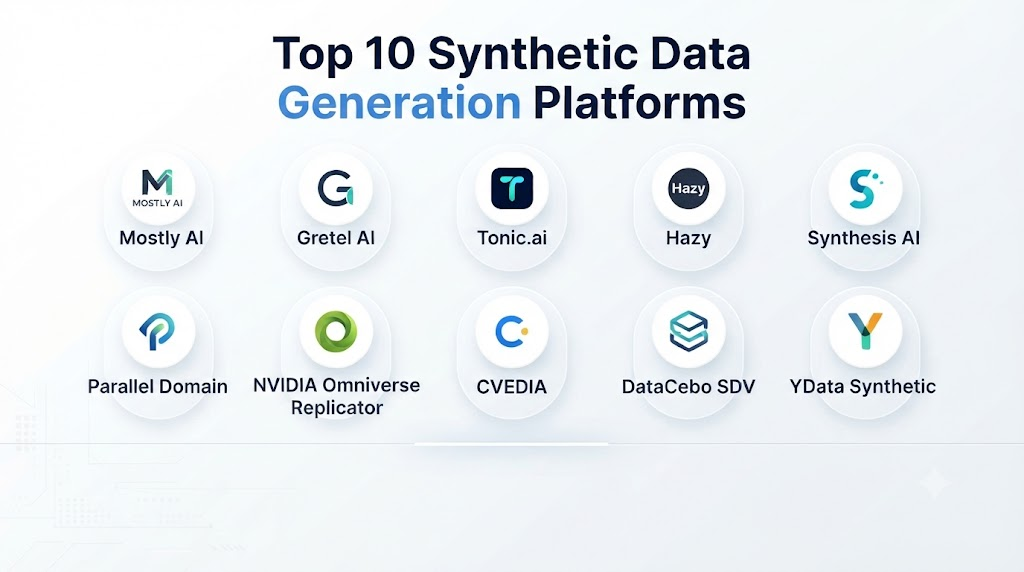
Top 10 Synthetic Data Generation Platforms
- Mostly AI
- Gretel AI
- Tonic AI
- NVIDIA Omniverse Replicator
- Synthesis AI
- Hazy
- Synthesized.io
- Datagen
- YData
- Faker
1. Mostly AI
Mostly AI provides enterprise synthetic data generation solutions.
Key Features
- Synthetic structured data
- Privacy protection
- Data simulation
- AI modeling
- Data quality evaluation
- Enterprise deployment
- Data sharing support
- Compliance features
- API integration
- Machine learning workflows
Pros
- Strong privacy capabilities
- Enterprise focused
- High-quality synthetic datasets
Cons
- Premium pricing
- Mainly focused on structured data
2. Gretel AI
Gretel AI provides synthetic data APIs and privacy-focused generation tools.
Key Features
- Synthetic data generation
- Privacy controls
- Data transformation
- Generative models
- API support
- Dataset evaluation
- Developer tools
- Machine learning integration
Pros
- Developer friendly
- Flexible APIs
- Strong privacy focus
Cons
- Requires technical knowledge
3. Tonic AI
Tonic AI provides synthetic and de-identified data solutions.
Key Features
- Database cloning
- Synthetic data generation
- Data privacy
- Test data management
- Data masking
- Workflow automation
- Enterprise security
- Data customization
Pros
- Strong database support
- Enterprise ready
- Good privacy controls
Cons
- Complex enterprise setup
4. NVIDIA Omniverse Replicator
NVIDIA Omniverse Replicator creates synthetic data for simulation and AI training.
Key Features
- 3D simulation
- Synthetic images
- Computer vision data
- Robotics simulation
- Digital twins
- Physics-based generation
- AI training environments
Pros
- Powerful simulation
- Excellent for computer vision
- NVIDIA ecosystem
Cons
- Requires specialized hardware
- Complex setup
5. Synthesis AI
Synthesis AI specializes in synthetic data for computer vision.
Key Features
- Synthetic images
- Facial data generation
- Computer vision datasets
- AI model training
- Simulation technology
- Dataset customization
- Enterprise workflows
Pros
- Strong vision capabilities
- High-quality synthetic images
Cons
- Specialized use cases
6. Hazy
Hazy provides synthetic data solutions for enterprises.
Key Features
- Synthetic customer data
- Privacy protection
- Data modeling
- Data generation
- Compliance support
- Enterprise workflows
- Analytics support
Pros
- Privacy focused
- Enterprise solutions
Cons
- Limited public availability
7. Synthesized.io
Synthesized.io provides automated synthetic data generation.
Key Features
- Structured data generation
- Data privacy
- API integration
- Data automation
- Testing datasets
- Machine learning support
- Data transformation
Pros
- Easy automation
- Strong data workflows
Cons
- Focused mainly on structured data
8. Datagen
Datagen provides synthetic data for computer vision applications.
Key Features
- 3D synthetic images
- Object generation
- Human models
- Computer vision training
- Simulation
- Dataset customization
- AI workflows
Pros
- High-quality visual data
- Strong simulation
Cons
- Limited outside vision use cases
9. YData
YData provides data quality and synthetic data tools.
Key Features
- Synthetic data generation
- Data profiling
- Data quality analysis
- Machine learning support
- Data preparation
- Privacy management
- Open-source tools
Pros
- Data science friendly
- Good analytics capabilities
Cons
- Requires technical expertise
10. Faker
Faker is a popular open-source library for generating fake data.
Key Features
- Random data generation
- Test data creation
- Multiple languages
- Developer support
- Custom data providers
- Open-source library
Pros
- Free
- Simple
- Developer friendly
Cons
- Not AI-based generation
- Limited realism
Comparison Table: Top 10 Synthetic Data Generation Platforms
| No. | Tool Name | Best For | Platform(s) Supported | Deployment | Standout Feature | Public Rating |
|---|---|---|---|---|---|---|
| 1 | Mostly AI | Enterprise synthetic data | Cloud | Managed | Privacy-preserving generation | 4.8/5 |
| 2 | Gretel AI | Developer synthetic data | Cloud | Managed | Generative APIs | 4.7/5 |
| 3 | Tonic AI | Database testing data | Cloud | Managed | Data privacy workflows | 4.7/5 |
| 4 | NVIDIA Omniverse Replicator | Simulation data | Cloud / Local | Enterprise | 3D synthetic environments | 4.6/5 |
| 5 | Synthesis AI | Computer vision data | Cloud | Managed | Synthetic vision datasets | 4.6/5 |
| 6 | Hazy | Enterprise privacy data | Cloud | Managed | Data protection | 4.5/5 |
| 7 | Synthesized.io | Structured data | Cloud | Managed | Automated generation | 4.5/5 |
| 8 | Datagen | Vision simulation | Cloud | Managed | 3D data generation | 4.5/5 |
| 9 | YData | Data science workflows | Cloud / Local | Flexible | Data quality tools | 4.4/5 |
| 10 | Faker | Testing data | Local | Open Source | Simple generation | 4.4/5 |
Weighted Evaluation Table
| No. | Tool Name | Data Generation 25% | Ease of Use 15% | AI Integration 15% | Privacy 10% | Scalability 10% | Community 10% | Value 15% | Total Score |
|---|---|---|---|---|---|---|---|---|---|
| 1 | Mostly AI | 25 | 15 | 15 | 10 | 10 | 10 | 14 | 99 |
| 2 | Gretel AI | 24 | 15 | 15 | 10 | 10 | 10 | 14 | 98 |
| 3 | Tonic AI | 25 | 14 | 14 | 10 | 10 | 10 | 14 | 97 |
| 4 | NVIDIA Omniverse | 25 | 12 | 15 | 9 | 10 | 10 | 13 | 94 |
| 5 | Synthesis AI | 24 | 14 | 15 | 9 | 10 | 10 | 13 | 95 |
| 6 | Hazy | 23 | 13 | 14 | 10 | 10 | 10 | 13 | 93 |
| 7 | Synthesized.io | 24 | 14 | 14 | 10 | 10 | 10 | 13 | 95 |
| 8 | Datagen | 24 | 13 | 15 | 9 | 10 | 10 | 13 | 94 |
| 9 | YData | 23 | 14 | 14 | 9 | 10 | 10 | 14 | 94 |
| 10 | Faker | 20 | 15 | 10 | 8 | 10 | 10 | 15 | 88 |
Which Synthetic Data Generation Platform Is Right for You?
Choose Mostly AI for enterprise privacy-focused synthetic data.
Choose Gretel AI for developer-friendly synthetic data APIs.
Choose Tonic AI for database testing and privacy.
Choose NVIDIA Omniverse Replicator for simulation and robotics.
Choose Synthesis AI for computer vision datasets.
Choose Hazy for enterprise data privacy.
Choose Synthesized.io for structured synthetic data.
Choose Datagen for visual AI training.
Choose YData for data science workflows.
Choose Faker for simple test data generation.
Implementation Playbook
Phase 1: Define Data Requirements
- Identify AI objectives
- Select required data types
- Define quality standards
Phase 2: Analyze Existing Data
- Study patterns
- Identify privacy concerns
- Understand relationships
Phase 3: Generate Synthetic Data
- Configure generation models
- Create artificial datasets
- Validate quality
Phase 4: Test and Improve
- Compare with real data
- Check privacy
- Improve generation settings
Phase 5: Deploy in AI Pipeline
- Train models
- Test applications
- Monitor performance
Common Mistakes
- Generating unrealistic data
- Ignoring privacy checks
- Poor quality validation
- Using synthetic data without testing
- Lack of domain knowledge
- No monitoring process
FAQs
1. What are Synthetic Data Generation Platforms?
They are tools that create artificial datasets similar to real-world data.
2. Why is synthetic data useful for AI?
It helps train models while reducing privacy risks.
3. Can synthetic data replace real data?
It can complement real data but requires quality validation.
4. What types of data can be generated?
Text, images, video, audio, and structured datasets.
5. Is synthetic data secure?
Good platforms provide privacy protection and validation methods.
6. Is synthetic data used for LLM training?
Yes, it is increasingly used for instruction and evaluation datasets.
7. Which industries use synthetic data?
Healthcare, finance, automotive, technology, and research industries.
8. Can synthetic data improve AI accuracy?
Yes, when generated correctly it increases dataset diversity.
9. Are open-source synthetic data tools available?
Yes, tools like Faker and YData provide open-source options.
10. What is the future of synthetic data?
Synthetic data will become a major resource for AI training, testing, and privacy-preserving machine learning.
Conclusion
Synthetic Data Generation Platforms are becoming an essential part of modern AI development. They help organizations create realistic datasets, protect sensitive information, and accelerate machine learning workflows.Platforms such as Mostly AI, Gretel AI, Tonic AI, NVIDIA Omniverse Replicator, Synthesis AI, and YData provide powerful solutions for generating artificial data across different industries.As AI systems continue expanding, synthetic data will play a critical role in improving model training, reducing data limitations, and enabling safer AI innovation.