Introduction
AI Incident Response Playbook Tools are security and governance solutions designed to help organizations detect, investigate, respond to, and recover from artificial intelligence-related security incidents.
As organizations increasingly deploy AI systems, including large language models (LLMs), AI agents, machine learning models, and automated decision systems, new security challenges are emerging.
AI incidents can include:
- Data leakage
- Prompt injection attacks
- Model manipulation
- AI system misuse
- Unauthorized AI access
- Model failures
- Harmful AI outputs
- AI compliance violations
AI Incident Response Playbook Tools help security teams create structured response processes for handling these incidents efficiently.
These platforms provide capabilities such as:
- Incident detection
- Security investigation
- Response automation
- AI risk tracking
- Incident documentation
- Root cause analysis
- Recovery workflows
- Compliance reporting
AI Incident Response Playbook Tools are used by:
- Security operations teams
- AI security engineers
- MLOps teams
- Incident responders
- Compliance teams
- Enterprise security leaders
The goal of AI Incident Response Playbook Tools is to help organizations quickly identify AI-related incidents, minimize damage, and improve the security and reliability of AI systems.
Why AI Incident Response Matters
AI systems operate with:
- Large datasets
- Complex models
- External integrations
- Automated decision-making
A security failure can impact:
- Customer information
- Business operations
- AI reliability
- Regulatory compliance
AI Incident Response Tools help organizations:
- Reduce response time
- Improve investigation accuracy
- Standardize security processes
- Protect AI assets
- Maintain trust
Types of AI Security Incidents
Prompt Injection Incidents
Attackers attempt to manipulate AI instructions.
Examples:
- Hidden malicious prompts
- Instruction bypass attempts
Data Leakage Incidents
Sensitive information is exposed through:
- AI responses
- Logs
- Training data
Model Security Incidents
Includes:
- Model theft
- Model manipulation
- Unauthorized changes
AI Agent Incidents
Involves:
- Unsafe autonomous actions
- Unauthorized tool usage
AI Compliance Incidents
Includes:
- Policy violations
- Missing documentation
- Governance failures
How AI Incident Response Playbook Tools Work
Step 1: Incident Detection
Platforms identify:
- Security alerts
- AI anomalies
- Policy violations
Step 2: Incident Classification
Systems categorize:
- Severity
- Impact
- Risk level
Step 3: Investigation
Teams analyze:
- Logs
- AI behavior
- Model activity
Step 4: Response Automation
Tools execute:
- Blocking actions
- Access restrictions
- Recovery workflows
Step 5: Post-Incident Review
Organizations document:
- Root causes
- Improvements
- Security lessons
Key Components of AI Incident Response Platforms
Incident Management System
Tracks:
- Security events
- Response activities
AI Monitoring Integration
Collects:
- Model behavior
- Application activity
Investigation Dashboard
Provides:
- Incident visibility
- Analysis tools
Automation Engine
Supports:
- Automated response workflows
Knowledge Base
Stores:
- Playbooks
- Response procedures
Reporting System
Generates:
- Incident reports
- Compliance documentation
Key Features of AI Incident Response Playbook Tools
Automated Incident Detection
Identifies:
- AI security threats
- Abnormal behavior
Playbook Automation
Creates:
- Standard response workflows
Threat Intelligence Integration
Provides:
- Attack information
- Security context
Root Cause Analysis
Helps identify:
- Source of incidents
- System weaknesses
Alert Management
Controls:
- Security notifications
- Incident prioritization
Compliance Reporting
Maintains:
- Audit records
- Incident documentation
Common Use Cases
Enterprise AI Applications
Managing:
- AI assistant incidents
- Internal AI risks
LLM Security Operations
Handling:
- Prompt attacks
- AI misuse
AI Agent Protection
Responding to:
- Unauthorized agent actions
Healthcare AI
Protecting:
- Medical AI systems
- Patient information
Financial AI
Managing:
- Fraud detection incidents
- Automated decisions
Cloud AI Operations
Monitoring:
- AI infrastructure security
Benefits of AI Incident Response Playbook Tools
Faster Response
Reduces incident handling time.
Better Investigation
Provides structured analysis.
Improved AI Security
Helps prevent repeated failures.
Stronger Governance
Maintains AI incident records.
Reduced Business Impact
Limits security damage.
Evaluation Criteria
Incident Management
Evaluate:
- Tracking capabilities
- Workflow support
Automation
Consider:
- Automated response actions
- Playbook execution
AI Integration
Check:
- AI monitoring support
- Security integrations
Reporting
Evaluate:
- Incident documentation
- Compliance reports
Scalability
Consider:
- Enterprise environments
Security Intelligence
Evaluate:
- Threat analysis
- Detection capabilities
Key Trends
AI Security Operations
Organizations are creating dedicated AI security teams.
Automated AI Response
Security platforms are adding:
- Automated remediation
- AI-driven investigations
AI Agent Incident Management
New playbooks focus on:
- Autonomous AI failures
- Agent misuse
Continuous AI Monitoring
Organizations are moving toward:
- Real-time AI security operations
Responsible AI Governance
Incident response is becoming part of:
- AI governance frameworks
Methodology
The following AI Incident Response Playbook Tools were evaluated based on:
- Incident management
- Automation
- AI security integration
- Investigation capabilities
- Reporting
- Scalability
- Governance support
- Enterprise readiness
- Threat intelligence
- Value
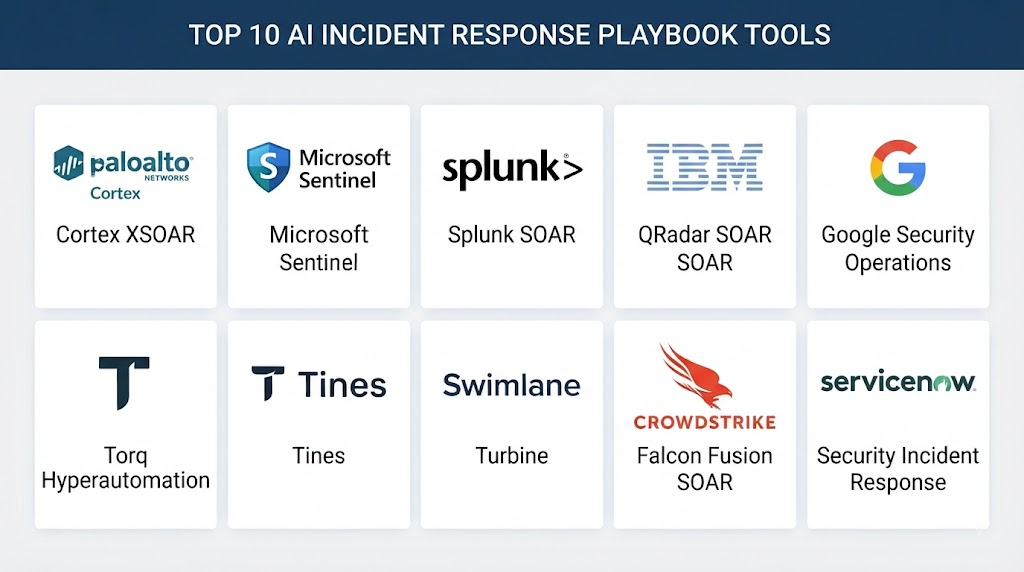
Top 10 AI Incident Response Playbook Tools
1. ServiceNow Security Incident Response
ServiceNow provides enterprise incident management workflows.
Key Features
- Incident tracking
- Security workflows
- Automation
- Case management
- Reporting
- Compliance documentation
Pros
- Strong enterprise workflow support
- Excellent integration capabilities
Cons
- Complex implementation
2. Palo Alto Cortex XSOAR
Cortex XSOAR provides security orchestration and automated response.
Key Features
- Incident automation
- Threat intelligence
- Investigation workflows
- Playbook management
- Security integrations
Pros
- Powerful automation
- Strong security ecosystem
Cons
- Requires expertise
3. Splunk SOAR
Splunk SOAR provides security orchestration capabilities.
Key Features
- Automated playbooks
- Incident investigation
- Threat analysis
- Workflow automation
- Security integrations
Pros
- Strong analytics
- Enterprise adoption
Cons
- Expensive for smaller teams
4. Microsoft Sentinel
Microsoft Sentinel provides cloud-native security operations.
Key Features
- Threat detection
- Incident investigation
- Automation rules
- Security analytics
- AI-powered monitoring
Pros
- Strong Microsoft integration
- Cloud scalability
Cons
- Best with Microsoft ecosystem
5. IBM QRadar SOAR
IBM QRadar SOAR supports security incident management.
Key Features
- Incident response workflows
- Automation
- Investigation tools
- Threat intelligence
- Reporting
Pros
- Enterprise security capabilities
- Strong compliance support
Cons
- Complex deployment
6. CrowdStrike Falcon Fusion
CrowdStrike provides automated security workflows.
Key Features
- Threat response
- Automated actions
- Security investigations
- Incident management
- Endpoint integration
Pros
- Strong threat intelligence
- Fast response capabilities
Cons
- Focused on CrowdStrike ecosystem
7. Tines
Tines provides automation workflows for security operations.
Key Features
- No-code automation
- Playbook creation
- Incident workflows
- Security integrations
Pros
- Easy automation
- Flexible workflows
Cons
- Requires workflow design
8. Swimlane Turbine
Swimlane provides security automation and orchestration.
Key Features
- Security playbooks
- Automation
- Case management
- Threat response
- Integrations
Pros
- Strong SOAR capabilities
- Custom workflows
Cons
- Enterprise-focused
9. Google Security Operations
Google Security Operations provides security monitoring and response capabilities.
Key Features
- Threat detection
- Investigation
- Security analytics
- Incident workflows
- Cloud integration
Pros
- Strong analytics
- Cloud-native security
Cons
- Requires Google ecosystem knowledge
10. Rapid7 InsightConnect
Rapid7 provides security automation workflows.
Key Features
- Incident automation
- Security integrations
- Investigation workflows
- Response playbooks
- Threat management
Pros
- Easy integration
- Good security automation
Cons
- Limited AI-specific features
Comparison Table: Top 10 AI Incident Response Playbook Tools
| No. | Tool Name | Best For | Platform(s) Supported | Deployment | Standout Feature | Public Rating |
|---|---|---|---|---|---|---|
| 1 | ServiceNow Security Incident Response | Enterprise workflows | Cloud | Managed | Incident management | 4.8/5 |
| 2 | Cortex XSOAR | Security automation | Cloud | Enterprise | Automated playbooks | 4.8/5 |
| 3 | Splunk SOAR | SOC teams | Cloud | Managed | Security orchestration | 4.7/5 |
| 4 | Microsoft Sentinel | Cloud security | Azure | Managed | AI detection | 4.7/5 |
| 5 | IBM QRadar SOAR | Enterprise security | Cloud | Enterprise | Incident workflows | 4.6/5 |
| 6 | CrowdStrike Falcon Fusion | Threat response | Cloud | Managed | Automated response | 4.7/5 |
| 7 | Tines | Security automation | Cloud | Managed | No-code workflows | 4.6/5 |
| 8 | Swimlane Turbine | SOAR automation | Cloud | Enterprise | Custom playbooks | 4.6/5 |
| 9 | Google Security Operations | Security analytics | Cloud | Managed | Threat investigation | 4.6/5 |
| 10 | Rapid7 InsightConnect | Automation | Cloud | Managed | Security workflows | 4.5/5 |
Weighted Evaluation Table
| No. | Tool Name | Incident Response 25% | Ease of Use 15% | Automation 15% | AI Integration 10% | Scalability 10% | Reporting 10% | Value 15% | Total Score |
|---|---|---|---|---|---|---|---|---|---|
| 1 | ServiceNow SIR | 25 | 14 | 15 | 10 | 10 | 10 | 14 | 98 |
| 2 | Cortex XSOAR | 25 | 13 | 15 | 10 | 10 | 10 | 14 | 97 |
| 3 | Splunk SOAR | 24 | 14 | 15 | 10 | 10 | 10 | 13 | 96 |
| 4 | Microsoft Sentinel | 24 | 15 | 15 | 10 | 10 | 10 | 14 | 98 |
| 5 | IBM QRadar SOAR | 24 | 13 | 14 | 10 | 10 | 10 | 13 | 94 |
| 6 | CrowdStrike Fusion | 24 | 14 | 15 | 10 | 10 | 10 | 14 | 97 |
| 7 | Tines | 23 | 15 | 14 | 10 | 10 | 10 | 14 | 96 |
| 8 | Swimlane Turbine | 24 | 13 | 15 | 10 | 10 | 10 | 13 | 95 |
| 9 | Google Security Operations | 23 | 14 | 14 | 10 | 10 | 10 | 13 | 94 |
| 10 | Rapid7 InsightConnect | 23 | 14 | 14 | 10 | 10 | 10 | 13 | 94 |
Which AI Incident Response Playbook Tool Is Right for You?
Choose ServiceNow Security Incident Response for enterprise workflows.
Choose Cortex XSOAR for advanced security automation.
Choose Splunk SOAR for SOC operations.
Choose Microsoft Sentinel for cloud-native security.
Choose IBM QRadar SOAR for enterprise incident management.
Choose CrowdStrike Falcon Fusion for threat response.
Choose Tines for no-code automation.
Choose Swimlane Turbine for customizable playbooks.
Choose Google Security Operations for cloud security analytics.
Choose Rapid7 InsightConnect for security automation.
Implementation Playbook
Phase 1: Identify AI Incident Types
- Define AI risks
- Create response categories
- Assign responsibilities
Phase 2: Build AI Security Playbooks
- Define workflows
- Configure alerts
- Create response actions
Phase 3: Integrate Security Tools
- Connect monitoring systems
- Add threat intelligence
- Enable automation
Phase 4: Test Response Process
- Run simulations
- Improve workflows
- Train teams
Phase 5: Continuous Improvement
- Review incidents
- Update playbooks
- Improve AI security
Common Mistakes
- No AI-specific incident process
- Manual response only
- Poor incident documentation
- No monitoring integration
- Missing root cause analysis
- No continuous improvement
FAQs
1. What are AI Incident Response Playbook Tools?
They are platforms that help organizations manage and respond to AI-related security incidents.
2. Why are AI incident response tools important?
They help reduce response time and minimize AI security risks.
3. What AI incidents can these tools handle?
They can manage data leaks, model attacks, prompt attacks, and AI failures.
4. Can SOAR platforms support AI security incidents?
Yes, many SOAR platforms can automate AI-related response workflows.
5. Who uses AI incident response tools?
Security teams, AI teams, and enterprise IT organizations.
6. What is an AI incident playbook?
It is a predefined process for detecting and responding to AI security events.
7. Can AI incident response be automated?
Yes, automation can handle alerts, investigations, and response actions.
8. How do AI incident tools improve governance?
They maintain records and provide accountability.
9. Should AI incidents be monitored continuously?
Yes, continuous monitoring helps detect threats quickly.
10. What is the future of AI incident response?
AI security operations will increasingly use automation and intelligent response systems.
Conclusion
AI Incident Response Playbook Tools are becoming essential as organizations depend more on artificial intelligence systems. These platforms help security teams detect incidents, automate responses, investigate causes, and improve AI reliability.Solutions such as ServiceNow Security Incident Response, Palo Alto Cortex XSOAR, Microsoft Sentinel, Splunk SOAR, CrowdStrike Falcon Fusion, and IBM QRadar SOAR provide strong capabilities for managing modern AI security incidents.As AI adoption grows, organizations will need structured incident response processes to maintain secure, reliable, and trustworthy AI environments.