Introduction
Agent Policy & Permission Systems are security frameworks designed to control, manage, and govern the actions of AI agents across applications, tools, data sources, and enterprise environments.
As AI agents become more autonomous, they are gaining the ability to perform tasks such as accessing databases, executing workflows, calling APIs, managing documents, and making operational decisions. However, increased autonomy creates the need for strong permission controls to ensure agents only perform approved actions.
Agent Policy & Permission Systems provide a governance layer that defines:
- What an AI agent can access
- Which actions an agent can perform
- What data an agent can use
- When approval is required
- How agent activities are monitored
These systems help organizations:
- Secure AI agent operations
- Prevent unauthorized actions
- Protect sensitive information
- Apply business rules
- Maintain compliance
- Improve AI governance
- Manage agent identities
Agent Policy & Permission Systems are used by:
- Enterprise security teams
- AI engineering teams
- Cloud architects
- Compliance teams
- Software developers
- Platform engineering teams
- Risk management teams
Modern agent permission systems provide capabilities such as:
- Agent identity management
- Role-based access control
- Policy enforcement
- Permission workflows
- Audit logging
- Access monitoring
- Tool restrictions
- Data governance
- Human approval controls
The goal of Agent Policy & Permission Systems is to ensure AI agents operate safely, securely, and according to organizational policies.
What Are Agent Policy & Permission Systems?
Agent Policy & Permission Systems are security mechanisms that define and enforce rules for AI agent behavior.
They control:
- Agent access
- Tool usage
- Data permissions
- Workflow execution
- Decision authority
Similar to how users have permissions in enterprise software, AI agents require controlled identities and access rights.
Why AI Agents Need Permission Systems
Traditional applications usually operate with fixed permissions. AI agents are different because they can:
- Make decisions
- Select tools
- Execute actions
- Interact with multiple systems
Without proper controls, agents may:
- Access unnecessary data
- Execute unauthorized actions
- Expose confidential information
- Create operational risks
Permission systems provide safety and governance.
Key Components of Agent Policy Systems
Agent Identity Management
Creates unique identities for AI agents.
Controls:
- Agent authentication
- Agent ownership
- Agent lifecycle
Role-Based Access Control (RBAC)
Assigns permissions based on agent roles.
Examples:
- Customer support agent
- Finance agent
- Developer agent
Attribute-Based Access Control (ABAC)
Uses conditions to determine access.
Examples:
- User department
- Data sensitivity
- Time restrictions
- Location
Policy Enforcement
Ensures agents follow defined rules.
Examples:
- Allowed tools
- Restricted actions
- Approval requirements
Audit and Monitoring
Tracks:
- Agent activities
- Tool usage
- Data access
- Decisions
Human Approval Controls
Requires human review for sensitive actions.
Examples:
- Financial transactions
- Data deletion
- External communication
How Agent Policy & Permission Systems Work
Agent Request
An AI agent requests access to perform an action.
Example:
“Update customer information.”
Identity Verification
The system checks:
- Agent identity
- Permissions
- Role
Policy Evaluation
Rules determine whether the action is allowed.
Example:
Customer service agents can update contact details but cannot delete accounts.
Access Decision
The system:
- Allows action
- Blocks action
- Requests approval
Logging
The activity is recorded for auditing.
Types of Agent Permission Models
Role-Based Access Control (RBAC)
Permissions are assigned according to roles.
Advantages:
- Easy management
- Common enterprise model
Attribute-Based Access Control (ABAC)
Permissions depend on conditions.
Advantages:
- Flexible
- Dynamic security
Policy-Based Access Control (PBAC)
Uses rules and policies.
Advantages:
- Fine-grained control
- Better governance
Zero Trust Access
Every action is verified.
Advantages:
- Strong security
- Reduced risks
Key Capabilities of Agent Policy & Permission Systems
Fine-Grained Permissions
Controls specific actions.
Examples:
- Read data
- Modify records
- Execute commands
Tool Access Management
Controls which tools agents can use.
Examples:
- APIs
- Databases
- Cloud services
Data Access Governance
Protects:
- Personal information
- Business data
- Confidential documents
Policy Automation
Automatically applies security rules.
Benefits:
- Faster management
- Reduced manual effort
Compliance Management
Supports:
- Audit requirements
- Security standards
- Governance policies
Real-Time Monitoring
Tracks agent actions continuously.
Common Use Cases
Enterprise AI Assistants
Controls access to:
- Internal documents
- Business applications
- Employee data
Financial AI Agents
Manages:
- Transaction permissions
- Risk controls
- Compliance requirements
Healthcare AI Systems
Protects:
- Patient information
- Medical records
- Sensitive workflows
Software Development Agents
Controls:
- Code repositories
- Deployment systems
- Infrastructure access
Customer Support Agents
Manages:
- Customer data
- Ticket systems
- Communication tools
Autonomous Business Agents
Controls:
- Workflow execution
- External integrations
- Decision authority
Why Agent Policy & Permission Systems Matter
Prevent Unauthorized Actions
Agents only perform approved tasks.
Improve Security
Sensitive data remains protected.
Enable Enterprise Adoption
Organizations can safely deploy AI agents.
Support Compliance
Helps meet regulatory requirements.
Improve Accountability
Agent actions become traceable.
Evaluation Criteria for Buyers
Identity Management
Evaluate:
- Agent authentication
- Identity lifecycle
- Credential management
Policy Flexibility
Look for:
- Custom policies
- Dynamic rules
- Fine-grained permissions
Integration Support
Platforms should connect with:
- Cloud systems
- Enterprise applications
- APIs
Monitoring Features
Important capabilities:
- Audit logs
- Alerts
- Activity tracking
Security Standards
Consider support for:
- Zero Trust
- Encryption
- Access governance
Scalability
Evaluate:
- Number of agents
- Enterprise workloads
- Distributed systems
Key Trends
Rise of AI Governance Platforms
Organizations are creating dedicated AI control systems.
Zero Trust for AI Agents
Every agent action is increasingly verified.
Identity Management for AI
AI agents are receiving unique identities.
Enterprise Agent Security
Companies are investing in secure AI deployment.
Automated Policy Enforcement
AI governance is becoming more automated.
Regulatory Compliance
Organizations need better AI accountability.
Methodology
The following Agent Policy & Permission Systems were evaluated based on:
- Identity management
- Access control
- Policy enforcement
- Security capabilities
- Integration support
- Monitoring
- Enterprise readiness
- Scalability
- Compliance features
- Value
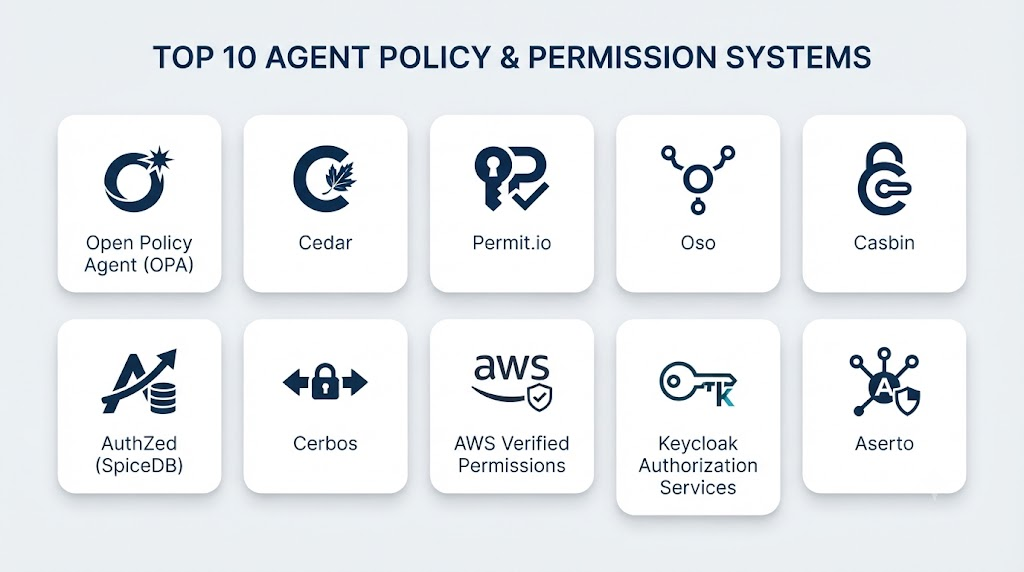
Top 10 Agent Policy & Permission Systems
1. Open Policy Agent (OPA)
Open Policy Agent is an open-source policy engine used for enforcing authorization decisions across applications and infrastructure.
Key Features
- Policy-based access control
- Fine-grained authorization
- Policy language
- Real-time decisions
- Cloud-native security
- API authorization
- Compliance support
- Policy testing
- Integration support
- Open-source framework
Pros
- Flexible policies
- Open-source
- Cloud-native
- Strong community
- Widely adopted
Cons
- Requires policy expertise
- Configuration complexity
- Security design required
Platforms
Cloud and self-hosted environments.
Deployment or Support
Enterprise security deployment.
Security & Compliance
Strong policy enforcement capabilities.
Integrations & Ecosystem
Cloud platforms, Kubernetes, APIs, applications.
Support & Community
Large open-source community.
2. Microsoft Entra ID
Microsoft Entra ID provides identity and access management capabilities for enterprise applications.
Key Features
- Identity management
- Access policies
- Authentication
- Conditional access
- Role management
- Security monitoring
- Enterprise integration
- Identity governance
- Application access
- Compliance support
Pros
- Enterprise-ready
- Strong Microsoft ecosystem
- Advanced identity controls
- Good security features
- Scalable
Cons
- Microsoft ecosystem dependency
- Complex configuration
- Licensing considerations
Platforms
Cloud environments.
Deployment or Support
Enterprise deployment.
Security & Compliance
Enterprise identity security.
Integrations & Ecosystem
Microsoft services and enterprise applications.
Support & Community
Enterprise support.
3. AWS IAM
AWS Identity and Access Management controls access to AWS resources and services.
Key Features
- Identity management
- Permission policies
- Role-based access
- Access keys
- Resource control
- Security monitoring
- Cloud governance
- Fine-grained permissions
- Enterprise security
- API access control
Pros
- Powerful permissions
- Deep AWS integration
- Mature platform
- Strong security
- Scalable
Cons
- AWS-specific
- Complex policies
- Requires cloud expertise
Platforms
AWS cloud.
Deployment or Support
Enterprise cloud environments.
Security & Compliance
AWS security framework.
Integrations & Ecosystem
AWS services.
Support & Community
Large cloud community.
4. Google Cloud IAM
Google Cloud IAM provides access control and identity management for Google Cloud resources.
Key Features
- Permission management
- Roles
- Identity control
- Policy management
- Security monitoring
- Cloud governance
- Resource access control
- Enterprise integration
- Compliance support
- API security
Pros
- Strong cloud security
- Flexible permissions
- Google ecosystem
- Scalable
- Enterprise-ready
Cons
- Google Cloud dependency
- Complex setup
- Requires expertise
Platforms
Google Cloud.
Deployment or Support
Enterprise deployment.
Security & Compliance
Google Cloud security.
Integrations & Ecosystem
Google Cloud services.
Support & Community
Enterprise support.
5. HashiCorp Vault
HashiCorp Vault manages secrets and secure access credentials.
Key Features
- Secret management
- Identity-based access
- Credential rotation
- Encryption
- Access policies
- Audit logging
- Secure authentication
- API security
- Enterprise governance
- Cloud integration
Pros
- Strong security
- Excellent secret management
- Flexible deployment
- Enterprise adoption
- Open-source option
Cons
- Requires expertise
- Infrastructure management
- Complex configuration
Platforms
Cloud and self-hosted.
Deployment or Support
Enterprise security deployment.
Security & Compliance
Strong encryption and access controls.
Integrations & Ecosystem
Cloud platforms, applications, APIs.
Support & Community
Large developer community.
6. CyberArk Identity Security
CyberArk provides identity security and privileged access management.
Key Features
- Privileged access control
- Identity protection
- Credential security
- Policy management
- Risk monitoring
- Access governance
- Enterprise security
- Compliance support
- Threat protection
- Audit capabilities
Pros
- Strong security focus
- Enterprise-grade
- Good governance
- Compliance support
- Identity protection
Cons
- Higher complexity
- Enterprise pricing
- Requires security expertise
Platforms
Enterprise environments.
Deployment or Support
Enterprise deployment.
Security & Compliance
Strong identity security.
Integrations & Ecosystem
Enterprise systems.
Support & Community
Enterprise support.
7. Okta Identity Governance
Okta provides identity and access governance solutions.
Key Features
- Identity management
- Access governance
- Authentication
- Lifecycle management
- Policy controls
- Security monitoring
- Application access
- Compliance workflows
- User management
- Enterprise integration
Pros
- Strong identity platform
- Easy integration
- Enterprise adoption
- Good user experience
- Scalable
Cons
- Cloud dependency
- Licensing costs
- Configuration complexity
Platforms
Cloud environments.
Deployment or Support
Enterprise deployment.
Security & Compliance
Identity security controls.
Integrations & Ecosystem
Business applications and SaaS tools.
Support & Community
Enterprise support.
8. Keycloak
Keycloak is an open-source identity and access management platform.
Key Features
- Authentication
- Authorization
- Identity federation
- Role management
- Access policies
- Single sign-on
- User management
- API security
- Open-source deployment
- Custom extensions
Pros
- Open-source
- Flexible
- Self-hosted
- Customizable
- Large community
Cons
- Requires management
- Technical setup needed
- Enterprise support requires planning
Platforms
Cloud and self-hosted environments.
Deployment or Support
Flexible deployment.
Security & Compliance
Depends on configuration.
Integrations & Ecosystem
Applications, APIs, and enterprise systems.
Support & Community
Open-source community.
9. Auth0 Fine-Grained Authorization
Auth0 provides identity and authorization services for applications.
Key Features
- Authorization policies
- Identity management
- Access control
- API security
- User authentication
- Permission management
- Developer tools
- Security monitoring
- Application integration
- Cloud deployment
Pros
- Developer-friendly
- Easy integration
- Strong identity features
- Good documentation
- Flexible
Cons
- SaaS dependency
- Pricing considerations
- Advanced features require planning
Platforms
Cloud environments.
Deployment or Support
Application deployment.
Security & Compliance
Identity security features.
Integrations & Ecosystem
Applications and APIs.
Support & Community
Developer community.
10. Styra Enterprise OPA
Styra provides enterprise policy management built around Open Policy Agent.
Key Features
- Policy management
- Authorization control
- Compliance monitoring
- Policy lifecycle
- Security governance
- Cloud-native controls
- Audit capabilities
- Enterprise dashboards
- Policy automation
- OPA integration
Pros
- Enterprise OPA management
- Strong governance
- Policy visibility
- Security-focused
- Scalable
Cons
- Requires policy expertise
- Enterprise complexity
- Additional platform layer
Platforms
Cloud and enterprise environments.
Deployment or Support
Enterprise deployment.
Security & Compliance
Strong governance capabilities.
Integrations & Ecosystem
Cloud platforms, Kubernetes, APIs.
Support & Community
Enterprise support.
Comparison Table
| Tool Name | Best For | Platform(s) Supported | Deployment | Standout Feature | Public Rating |
|---|---|---|---|---|---|
| OPA | Policy enforcement | Cloud/Local | Enterprise | Flexible policies | |
| Entra ID | Enterprise identity | Cloud | Enterprise | Identity governance | |
| AWS IAM | Cloud permissions | AWS | Enterprise | Resource access | |
| Google Cloud IAM | Cloud security | Google Cloud | Enterprise | Permission control | |
| Vault | Secrets management | Cloud/Local | Enterprise | Credential security | |
| CyberArk | Privileged access | Enterprise | Enterprise | Identity protection | |
| Okta | Identity governance | Cloud | Enterprise | Access management | |
| Keycloak | Open-source IAM | Cloud/Local | Flexible | Custom identity | |
| Auth0 | Application security | Cloud | Flexible | Developer identity | |
| Styra OPA | Enterprise policies | Cloud/Local | Enterprise | Policy governance |
Weighted Evaluation
| Tool Name | Core Features 25% | Ease of Use 15% | Integrations & Ecosystem 15% | Security & Compliance 10% | Performance & Reliability 10% | Support & Community 10% | Price/Value 15% | Total |
|---|---|---|---|---|---|---|---|---|
| OPA | 25 | 13 | 15 | 10 | 10 | 10 | 15 | 98 |
| Entra ID | 24 | 13 | 15 | 10 | 10 | 10 | 13 | 95 |
| AWS IAM | 25 | 12 | 15 | 10 | 10 | 10 | 14 | 96 |
| Google IAM | 24 | 12 | 15 | 10 | 10 | 10 | 14 | 95 |
| Vault | 24 | 12 | 15 | 10 | 10 | 10 | 14 | 95 |
| CyberArk | 24 | 11 | 14 | 10 | 10 | 10 | 12 | 91 |
| Okta | 24 | 14 | 15 | 10 | 10 | 10 | 13 | 96 |
| Keycloak | 23 | 13 | 14 | 10 | 10 | 10 | 15 | 95 |
| Auth0 | 23 | 15 | 15 | 10 | 10 | 10 | 13 | 96 |
| Styra OPA | 24 | 12 | 14 | 10 | 10 | 10 | 13 | 93 |
Which Agent Policy & Permission System Is Right for You?
Choose Open Policy Agent for flexible AI policy enforcement.
Choose Microsoft Entra ID for enterprise identity management.
Choose AWS IAM for AWS-based AI agents.
Choose Google Cloud IAM for Google Cloud environments.
Choose HashiCorp Vault for secrets and credentials.
Choose CyberArk for privileged access security.
Choose Okta for identity governance.
Choose Keycloak for open-source identity management.
Choose Auth0 for application authorization.
Choose Styra Enterprise OPA for enterprise policy governance.
Implementation Playbook
Phase 1: Identify Agent Permissions
- List AI agents
- Define required actions
- Classify sensitive resources
Phase 2: Create Identity Framework
- Assign agent identities
- Define roles
- Configure authentication
Phase 3: Build Policies
- Create access rules
- Configure approval workflows
- Apply restrictions
Phase 4: Monitor Agent Activity
- Track actions
- Review logs
- Detect unusual behavior
Phase 5: Improve Governance
- Update policies
- Review permissions
- Optimize security
Common Mistakes
- Giving agents excessive permissions
- No agent identity management
- Poor policy documentation
- Lack of monitoring
- Ignoring data sensitivity
- Missing approval workflows
- Weak access controls
- No regular permission reviews
FAQs
1. What are Agent Policy & Permission Systems?
They are security systems that control what AI agents can access and do.
2. Why do AI agents need permissions?
Permissions prevent unauthorized actions and protect sensitive resources.
3. What is AI agent identity management?
It assigns unique identities to AI agents for secure access control.
4. Can AI agents have different permission levels?
Yes. Organizations can assign different roles and access levels.
5. What is policy-based access control?
It uses rules to decide whether an action should be allowed.
6. Are AI agent permissions similar to user permissions?
Yes. Agents require controlled access like human users.
7. How are agent actions monitored?
Through logs, audits, and security monitoring systems.
8. Can permissions change dynamically?
Yes. Many systems support dynamic policies.
9. Who manages AI agent permissions?
Security teams, IT teams, and AI governance teams.
10. What is the future of AI agent governance?
AI agents will increasingly require identity, policy, and permission management frameworks.
Conclusion
Agent Policy & Permission Systems are becoming a fundamental security layer for autonomous AI applications. They ensure AI agents can perform useful tasks while maintaining control, compliance, and protection.Solutions such as Open Policy Agent, Microsoft Entra ID, AWS IAM, HashiCorp Vault, Okta, Auth0, and Styra help organizations build secure AI agent environments.As AI agents become more powerful and widely adopted, policy and permission management will become essential for creating trustworthy, secure, and enterprise-ready AI systems.