Introduction
AI Static Analysis Augmentation Tools are software security and development solutions that use artificial intelligence to enhance traditional static code analysis by providing deeper code understanding, improved vulnerability detection, smarter recommendations, and automated remediation support.
Static analysis has long been used by development teams to identify coding issues, security vulnerabilities, and quality problems without executing applications. However, modern applications have become more complex with cloud services, microservices, open-source dependencies, and large codebases.
AI augmentation improves static analysis by adding capabilities such as:
- Intelligent code understanding
- Advanced vulnerability detection
- False-positive reduction
- Automated fix suggestions
- Code quality recommendations
- Security risk prioritization
- Developer-focused explanations
AI Static Analysis Augmentation Tools are used by:
- Software developers
- Application security teams
- DevSecOps teams
- Security engineers
- Code quality teams
- Enterprise engineering organizations
These tools integrate with:
- IDEs
- Git repositories
- CI/CD pipelines
- Security platforms
- Software development workflows
The goal of AI Static Analysis Augmentation Tools is to help organizations build more secure, reliable, and maintainable software while reducing manual code review effort.
Why AI Static Analysis Augmentation Matters
Modern software systems contain:
- Millions of lines of code
- Multiple programming languages
- Third-party libraries
- Complex architectures
Traditional analysis may produce:
- Too many alerts
- False positives
- Limited explanations
AI augmentation helps teams:
- Prioritize important issues
- Understand vulnerabilities
- Reduce investigation time
- Improve developer productivity
- Fix problems faster
How AI Static Analysis Augmentation Tools Work
Step 1: Code Collection
Tools analyze:
- Source files
- Pull requests
- Repository history
- Dependencies
Step 2: Static Analysis Execution
The system checks:
- Code patterns
- Security rules
- Quality issues
Step 3: AI-Based Understanding
AI evaluates:
- Context
- Risk level
- Developer intent
Step 4: Issue Prioritization
The platform identifies:
- Critical vulnerabilities
- Important code problems
- Recommended actions
Step 5: Remediation Support
AI provides:
- Fix suggestions
- Code improvements
- Explanations
Key Features of AI Static Analysis Augmentation Tools
Intelligent Vulnerability Detection
Identifies:
- Security flaws
- Unsafe coding patterns
- Weak configurations
False Positive Reduction
Uses AI to:
- Understand context
- Reduce unnecessary alerts
Automated Fix Suggestions
Provides:
- Code patches
- Improvement recommendations
Code Quality Analysis
Detects:
- Code smells
- Maintainability issues
- Complexity problems
Security Risk Prioritization
Ranks:
- Vulnerability severity
- Business impact
Developer Integration
Supports:
- IDE workflows
- Pull requests
- CI/CD pipelines
Common Use Cases
Application Security
Finding:
- Vulnerabilities
- Security weaknesses
DevSecOps
Supporting:
- Secure development pipelines
Enterprise Software Development
Improving:
- Code quality
- Security posture
Open Source Security
Analyzing:
- Public repositories
- Dependencies
Cloud-Native Applications
Securing:
- APIs
- Microservices
Legacy Code Modernization
Helping teams:
- Understand old code
- Improve quality
Benefits of AI Static Analysis Augmentation Tools
Faster Security Reviews
Automates code inspection.
Better Vulnerability Detection
Finds complex issues.
Reduced Alert Fatigue
Prioritizes meaningful findings.
Improved Developer Productivity
Provides actionable guidance.
Stronger Software Security
Supports secure coding practices.
Challenges of AI Static Analysis Augmentation Tools
AI Accuracy
Recommendations require validation.
Limited Business Context
AI may not fully understand application goals.
Integration Complexity
Enterprise environments may require setup.
Code Privacy Concerns
Source code security must be maintained.
Human Review Required
Developers must verify fixes.
Evaluation Criteria
Security Detection
Evaluate:
- Vulnerability identification
- Accuracy
AI Capabilities
Consider:
- Context understanding
- Recommendations
Language Support
Check:
- Programming languages
- Framework coverage
Integration
Evaluate:
- IDEs
- CI/CD
- Repository support
Developer Experience
Consider:
- Usability
- Feedback quality
Enterprise Readiness
Evaluate:
- Governance
- Reporting
Key Trends
AI-Powered Application Security
Organizations are combining AI with traditional security testing.
Automated Secure Coding
AI tools are helping developers fix issues during development.
DevSecOps Intelligence
Security analysis is moving closer to developers.
AI Code Agents
Future tools will automatically:
- Detect
- Explain
- Fix security issues
Context-Aware Security Analysis
AI systems are improving:
- Repository understanding
- Risk analysis
Methodology
The following AI Static Analysis Augmentation Tools were evaluated based on:
- Security analysis
- AI capabilities
- Code understanding
- Language support
- Integration
- Automation
- Developer experience
- Scalability
- Enterprise readiness
- Value
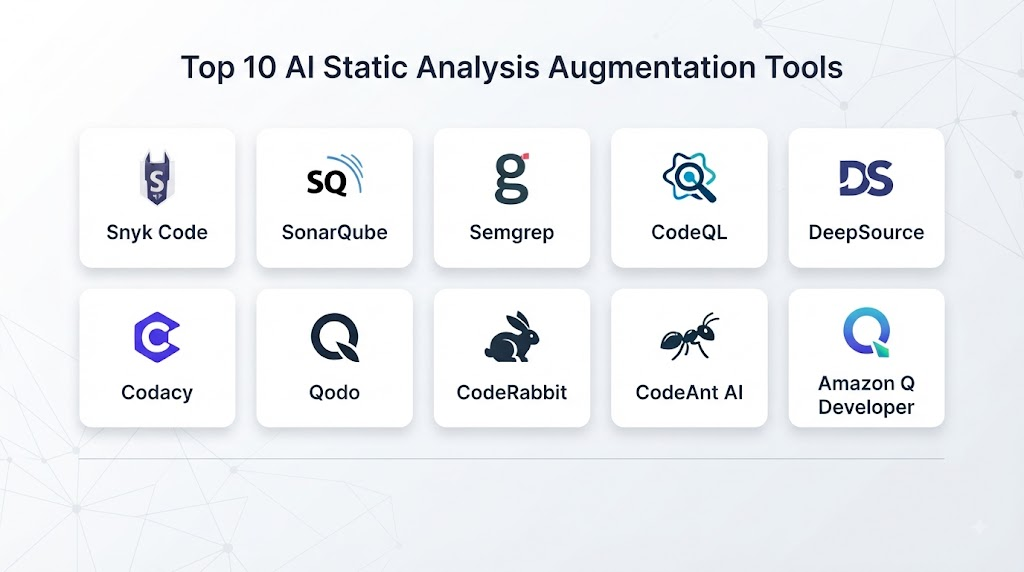
Top 10 AI Static Analysis Augmentation Tools
1. SonarQube AI Code Quality
SonarQube provides continuous code quality and security analysis.
Key Features
- Static code analysis
- Security issue detection
- Code quality rules
- Quality gates
- Developer feedback
Pros
- Strong enterprise adoption
- Broad language support
Cons
- Requires configuration and tuning
2. Snyk Code
Snyk Code provides AI-powered application security analysis.
Key Features
- Vulnerability detection
- Developer security feedback
- Real-time scanning
- IDE integration
Pros
- Developer-friendly
- Strong security focus
Cons
- Mainly security-focused
3. GitHub Advanced Security CodeQL
CodeQL provides semantic code analysis for security vulnerabilities.
Key Features
- Code scanning
- Security queries
- Repository analysis
- Developer workflows
Pros
- Strong GitHub integration
- Powerful security analysis
Cons
- Best with GitHub ecosystem
4. Semgrep AI
Semgrep provides code analysis and security scanning.
Key Features
- Static analysis
- Security rules
- AI assistance
- Developer integrations
Pros
- Flexible rules
- Fast scanning
Cons
- Requires rule management
5. Checkmarx One
Checkmarx provides enterprise application security testing.
Key Features
- Static application security testing
- Vulnerability detection
- Risk analysis
- Developer workflows
Pros
- Enterprise security capabilities
- Broad coverage
Cons
- Complex deployment
6. Veracode AI-Powered SAST
Veracode provides cloud-based application security testing.
Key Features
- Static analysis
- Vulnerability identification
- Security guidance
- Compliance support
Pros
- Strong security reputation
- Enterprise features
Cons
- Higher cost
7. Fortify Static Code Analyzer
Fortify provides enterprise static application security testing.
Key Features
- Code scanning
- Security analysis
- Vulnerability detection
- Reporting
Pros
- Mature security platform
- Enterprise support
Cons
- Requires expertise
8. Qodana by JetBrains
Qodana provides intelligent code quality analysis.
Key Features
- Static analysis
- Code inspections
- CI/CD integration
- Developer feedback
Pros
- Strong IDE integration
- Developer experience
Cons
- Best for JetBrains users
9. Amazon CodeGuru Reviewer
Amazon CodeGuru Reviewer uses machine learning for code reviews.
Key Features
- Automated analysis
- Code recommendations
- Security checks
- AWS integration
Pros
- AWS ecosystem support
- Automated insights
Cons
- AWS-focused
10. DeepSource
DeepSource provides automated code quality analysis.
Key Features
- Static analysis
- Bug detection
- Security checks
- Automated fixes
Pros
- Developer friendly
- Good automation
Cons
- Language coverage varies
Comparison Table: Top 10 AI Static Analysis Augmentation Tools
| No. | Tool Name | Best For | Platform(s) Supported | Deployment | Standout Feature | Public Rating |
|---|---|---|---|---|---|---|
| 1 | SonarQube | Code quality | Cloud/Local | Enterprise | Quality analysis | 4.7/5 |
| 2 | Snyk Code | Security scanning | Cloud | Managed | Vulnerability detection | 4.7/5 |
| 3 | CodeQL | Secure development | GitHub | Cloud | Semantic analysis | 4.8/5 |
| 4 | Semgrep AI | Flexible scanning | Cloud/Local | Managed | Custom rules | 4.6/5 |
| 5 | Checkmarx One | Enterprise security | Cloud | Managed | App security | 4.6/5 |
| 6 | Veracode SAST | Security testing | Cloud | Managed | Compliance support | 4.6/5 |
| 7 | Fortify SCA | Enterprise SAST | Cloud/Local | Enterprise | Security analysis | 4.5/5 |
| 8 | Qodana | Code quality | IDE/CI | Managed | IDE integration | 4.5/5 |
| 9 | CodeGuru Reviewer | AWS applications | AWS | Cloud | ML analysis | 4.5/5 |
| 10 | DeepSource | Automated fixes | Cloud | Managed | Code improvement | 4.6/5 |
Weighted Evaluation Table
| No. | Tool Name | Analysis Accuracy 25% | Ease of Use 15% | Security 15% | AI Capability 10% | Scalability 10% | Integration 10% | Value 15% | Total Score |
|---|---|---|---|---|---|---|---|---|---|
| 1 | SonarQube | 25 | 14 | 15 | 10 | 10 | 10 | 14 | 98 |
| 2 | Snyk Code | 24 | 15 | 15 | 10 | 10 | 10 | 14 | 98 |
| 3 | CodeQL | 25 | 13 | 15 | 10 | 10 | 10 | 14 | 97 |
| 4 | Semgrep AI | 24 | 14 | 14 | 10 | 10 | 10 | 14 | 96 |
| 5 | Checkmarx One | 24 | 13 | 15 | 10 | 10 | 10 | 13 | 95 |
| 6 | Veracode SAST | 24 | 14 | 15 | 10 | 10 | 10 | 13 | 96 |
| 7 | Fortify SCA | 24 | 12 | 15 | 10 | 10 | 10 | 13 | 94 |
| 8 | Qodana | 23 | 15 | 14 | 10 | 10 | 10 | 13 | 95 |
| 9 | CodeGuru Reviewer | 23 | 14 | 14 | 10 | 10 | 10 | 13 | 94 |
| 10 | DeepSource | 23 | 15 | 14 | 10 | 10 | 10 | 14 | 96 |
Which AI Static Analysis Augmentation Tool Is Right for You?
Choose SonarQube for comprehensive code quality management.
Choose Snyk Code for developer-focused security.
Choose GitHub CodeQL for GitHub security workflows.
Choose Semgrep AI for flexible code analysis.
Choose Checkmarx One for enterprise application security.
Choose Veracode SAST for compliance-focused security.
Choose Fortify SCA for mature enterprise SAST.
Choose Qodana for JetBrains development environments.
Choose Amazon CodeGuru Reviewer for AWS applications.
Choose DeepSource for automated code improvements.
Implementation Playbook
Phase 1: Define Analysis Goals
- Identify security requirements
- Select coding standards
- Define quality goals
Phase 2: Integrate Tool
- Connect repositories
- Configure rules
- Enable scanning
Phase 3: Review AI Findings
- Validate issues
- Apply recommendations
- Improve code
Phase 4: Add Automation
- Integrate CI/CD
- Enable continuous scanning
- Track improvements
Phase 5: Continuous Improvement
- Update rules
- Improve security practices
- Maintain code quality
Common Mistakes
- Ignoring AI recommendations
- Not tuning security rules
- Failing to protect source code
- Treating all alerts equally
- Skipping developer training
- No continuous monitoring
FAQs
1. What are AI Static Analysis Augmentation Tools?
They are tools that enhance traditional static analysis using artificial intelligence.
2. Why use AI in static analysis?
AI improves code understanding and helps identify important issues faster.
3. Can AI static analysis find security vulnerabilities?
Yes, many tools detect security flaws and risky coding patterns.
4. Do these tools replace developers?
No, they assist developers and security teams.
5. Which programming languages are supported?
Support varies, but many tools support popular enterprise languages.
6. Can AI reduce false positives?
Yes, AI helps improve issue prioritization and context understanding.
7. Are these tools useful for DevSecOps?
Yes, they integrate into secure development workflows.
8. Can AI suggest fixes?
Many tools provide remediation guidance and code suggestions.
9. Are AI static analysis tools suitable for enterprises?
Yes, many provide governance and reporting features.
10. What is the future of AI static analysis?
AI will provide deeper code understanding and more automated remediation.
Conclusion
AI Static Analysis Augmentation Tools are improving software security and code quality by combining traditional static analysis with advanced artificial intelligence capabilities.Platforms such as SonarQube, Snyk Code, GitHub CodeQL, Semgrep AI, Checkmarx One, Veracode, and DeepSource help organizations detect vulnerabilities, improve development practices, and build more secure applications.As software complexity continues increasing, AI-powered static analysis will become an essential capability for modern DevSecOps and secure software engineering.