Introduction
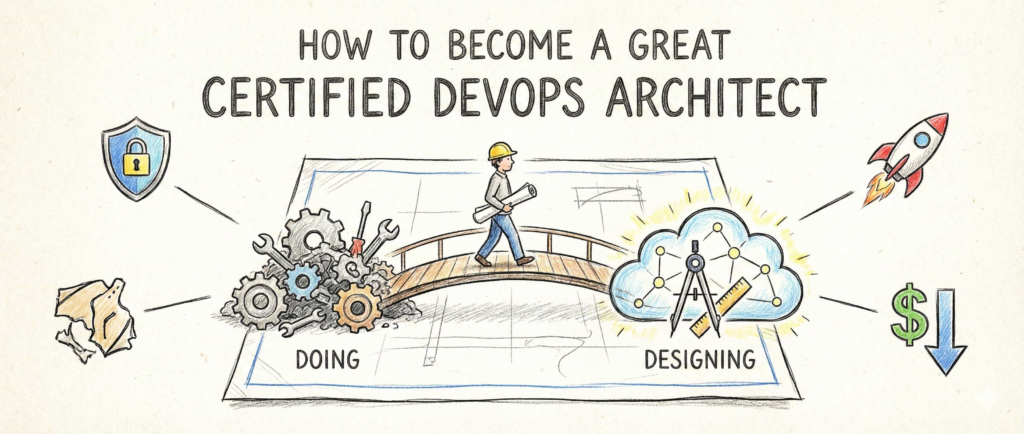
Every engineer eventually hits a point where they want to stop just building tools and start designing the whole system. This transition from “doing” to “designing” marks a major milestone in your career. True leadership in technology requires a shift in how you think. You must stop reacting to daily bugs and start creating plans that prevent those bugs from ever happening.
The Certified DevOps Architect (CDA) program gives you the skills to make this shift. It teaches you how to build fast, safe, and reliable environments for large teams. In this guide, I will walk you through why this path matters and how it can help you reach the next level of leadership.
What is Certified DevOps Architect (CDA)?
The Certified DevOps Architect (CDA) is an expert-level track for people who want to own the technical vision of a company. While a developer writes code and a DevOps engineer builds the pipeline, the architect designs the entire ecosystem. You learn to connect development, operations, and security into one strong, automated system.
Why it matters in today’s software, cloud, and automation ecosystem
We live in a world where software must move fast. Companies use many clouds and thousands of small services. Without a clear design, these systems become a mess of high costs and frequent crashes. A Certified DevOps Architect (CDA) brings order. You create the standards that allow developers to work faster without breaking the site. You ensure the company stays stable and profitable as it grows.
Why certifications are important for engineers and managers
A certification acts as a clear map for your learning. It forces you to master areas you might skip in your daily tasks. For engineers, it fills knowledge gaps. For managers, it acts as a badge of trust. When a manager hires a Certified DevOps Architect (CDA), they know they get an expert who understands global standards and can lead a team through big changes.
Certification Overview Table
| Track | Level | Who it’s for | Prerequisites | Skills Covered | Recommended Order |
| Strategy & Design | Expert | Senior Leads & Managers | Professional Knowledge | Scaling, Governance, IaC | After Professional |
Provider: DevOpsSchool
Certification Deep-Dive: Certified DevOps Architect (CDA)
What is this certification?
The Certified DevOps Architect (CDA) is a masterclass in high-level system design. It teaches you how to look at a business problem and solve it using automation. You move away from just “using tools” and start “designing solutions.”
Who should take this certification?
- Senior Software Engineers who want to lead.
- DevOps Specialists who want to design global systems.
- Cloud Professionals who need to see the whole lifecycle.
- Engineering Managers who want to lead with technical authority.
Skills you will gain
- Platform Design: You will build foundations that support hundreds of developers.
- Governance at Scale: You will set rules that keep code safe and legal.
- Infrastructure as Code (IaC): You will manage thousands of servers as easily as one.
- System Resilience: You will design systems that fix themselves when they break.
- Cost Control: You will keep cloud bills low while keeping performance high.
Real-world projects you should be able to do
- Global Infrastructure Launch: Design a system that serves millions of users across continents with zero delay.
- Automated Compliance: Build a pipeline that checks for security and legal rules every time a developer saves work.
- Developer Self-Service: Create a portal where a new developer gets everything they need in minutes.
- Disaster Recovery: Design a system that moves to another cloud provider instantly if a major outage happens.
Preparation Plan
7–14 Days Plan
Focus on the core pillars of the CDA curriculum. Review major design patterns and study how tools connect. Use practice exams to find your weak spots.
30 Days Plan
- Weeks 1-2: Deep dive into architecture theory. Focus on high availability.
- Week 3: Practice with advanced tools like Kubernetes and Terraform in a design context.
- Week 4: Take mock tests and practice explaining your choices simply.
60 Days Plan
- Month 1: Read whitepapers on modern automation. Master the logic of scaling and cost.
- Month 2: Complete three “mock” architecture projects. Practice presenting your designs to a lead team.
Common mistakes to avoid
- Chasing Shiny Tools: Do not pick a tool because it is famous. Pick it because it solves the problem.
- Ignoring the Team: A system only works if people use it. Always design for the human side.
- Over-complicating: If your design is too complex to explain, it is too complex to run.
Best next certification after this
- Same track: Master in DevOps for ultimate technical depth.
- Cross-track: DevSecOps Professional to master security.
- Leadership: Certified DevOps Manager for those moving into executive roles.
Choose Your Learning Path
1. The DevOps Path
This path suits the person who loves the big picture. You learn every step from the first line of code to the final delivery.
2. The DevSecOps Path
This path focuses on protection. You learn how to make security a natural part of the flow. You ensure the company stays safe.
3. The Site Reliability Engineering (SRE) Path
This path is for those who value stability. You treat operations like a software problem. Your goal keeps the site up 99.99% of the time.
4. The AIOps / MLOps Path
This path leads to the future. You learn to manage AI models and use AI to help run your servers. It is perfect for those who want to work with data science.
5. The DataOps Path
Data is the lifeblood of business. This path teaches you how to apply DevOps logic to data pipelines, ensuring information stays fast and accurate.
6. The FinOps Path
This path connects engineering to the bank account. You learn how to save money by optimizing how the company uses the cloud.
Role → Recommended Certifications Mapping
| Your Current Role | Step 1 | Step 2 (The Goal) |
| DevOps Engineer | Professional Cert | Certified DevOps Architect (CDA) |
| SRE | SRE Practitioner | Certified DevOps Architect (CDA) |
| Platform Engineer | Certified DevOps Architect (CDA) | Cloud Native Expert |
| Cloud Engineer | Cloud Solutions | Certified DevOps Architect (CDA) |
| Security Engineer | DevSecOps Professional | Certified DevOps Architect (CDA) |
| Data Engineer | DataOps Specialist | Certified DevOps Architect (CDA) |
| FinOps Practitioner | FinOps Professional | Certified DevOps Architect (CDA) |
| Engineering Manager | Management Cert | Certified DevOps Architect (CDA) |
Next Certifications to Take
Once you achieve your Certified DevOps Architect (CDA), you have several options for growth:
- Specialist: Pursue a Master in Site Reliability Engineering. This helps you manage massive systems that never sleep.
- Innovator: Look into MLOps Certified Professional. As AI grows, companies need architects who can handle smart systems.
- Leader: Consider the Certified DevOps Manager track. This prepares you for senior leadership roles.
Training & Certification Support Institutions
DevOpsSchool
This institution leads the way in technical education. They focus on hands-on labs and real-world projects. They provide deep support for the Certified DevOps Architect (CDA) program.
Cotocus
Cotocus specializes in professional consulting and training. They help individuals and companies adopt modern engineering practices through expert-led sessions and practical exercises.
ScmGalaxy
This is a massive community hub. It offers thousands of tutorials and forums where you can get help with any automation problem from experienced pros.
BestDevOps
They provide high-quality training for modern cloud roles. They make complex topics easy to understand, which is perfect for busy working professionals.
devsecopsschool.com
This school focuses entirely on security within the DevOps world. They teach you how to protect the software world from code to cloud.
sreschool.com
Everything here is about uptime and reliability. They teach you how to keep systems running smoothly even under extreme pressure.
aiopsschool.com
This school bridges the gap between AI and IT operations. You learn how to use machine learning to predict and fix server issues automatically.
dataopsschool.com
They apply DevOps ideas to data management. This school helps you deliver high-quality data at high speed for business decisions.
finopsschool.com
Go here to learn cloud financial management. They teach you how to optimize your cloud budget without losing performance or speed.
FAQs Section
General FAQs
- Is this program hard?
Yes. It is an expert-level certification. It requires solid experience. - How much time do I need?
Most professionals spend 4 to 8 weeks of study. - Do I need a college degree?
No. Your skills and experience matter most in this field. - What order should I take certifications in?
Start with a Professional cert, then move to the Architect (CDA). - Does this increase my salary?
Yes. Architects earn high pay because they handle the most responsibility. - Will it help me get a job?
Yes. It proves to recruiters that you can handle senior-level design and leadership tasks. - Is it valid globally?
Yes. The principles you learn stay the same around the world. - Can a manager benefit from this?
Yes. It helps managers understand the technical choices their teams make. - Do I need to be a coder?
You should understand how code works, but you do not need to be a full-time programmer. - Does the certificate expire?
Most experts recommend a refresher or an advanced course every few years. - Is there a hands-on part?
Yes. You must prove you can design a system, not just talk about it. - Should I study alone?
A class or a mentor usually makes the learning process much faster.
Certified DevOps Architect (CDA) Specific FAQs
- Does CDA cover multiple clouds?
Yes. You learn to design for AWS, Azure, and Google Cloud. - Is it about tools or strategy?
It focuses 70% on strategy and 30% on tools. - Does it include Kubernetes?
Yes. Kubernetes is a core part of modern architecture design. - Will I learn CI/CD?
Yes. You will learn to design large-scale delivery systems. - Is security a big part?
Yes. You cannot be a good architect without knowing how to keep the system safe. - How is it different from a Cloud Architect?
A Cloud Architect focuses on cloud services. A DevOps Architect focuses on the delivery process. - Is it good for SREs?
Yes. It gives SREs the design skills they need for better reliability. - Does it help with cloud costs?
Yes. Efficient design naturally leads to lower cloud bills.
Testimonials, Conclusion & Call to Action
⭐ Testimonials
DevOps Engineer:
“The Certified DevOps Architect (CDA) program changed my mindset. I stopped ‘fixing’ things and started ‘designing’ them. My company now views me as a leader.”
SRE:
“I finally understood how to build for reliability from day one. The study plan was easy to follow and fit perfectly with my job.”
Cloud Engineer:
“I knew the cloud, but I did not have a plan. This certification gave me the roadmap I needed to reach the architect level.”
Security Engineer:
“I now know how to talk to developers about security without slowing them down. It has made me much more effective in my role.”
Engineering Manager:
“I took this to support my team better. Now I can help them make smarter technical choices that save the company money.”
Conclusion
Achieving the Certified DevOps Architect (CDA) certification moves you from being a person who follows orders to being a person who defines the future. In an industry that moves this fast, the ability to design stable and scalable systems is the ultimate career insurance. Plan your journey, stay consistent, and take the next step in your career today.
I really appreciate how this post distinguishes the ‘Architect’ role from the ‘Engineer’ role, specifically regarding the shift from execution to strategy. Many professionals get stuck in the ‘tool trap’ thinking that mastering Kubernetes alone makes them an architect, but as this guide points out, the real value is in governance, cost control, and designing for resilience. The 60-day preparation plan is also a very realistic timeline for someone already at a senior level looking to make that jump.