Introduction
The modern technology landscape is changing faster than ever before. For many years, we relied on manual efforts to manage servers and applications, but that is no longer enough. This guide focuses on the Certified AIOps Professional program, which is designed for engineers who want to stay ahead of the curve. This certification is essential for those working in DevOps, cloud-native environments, and platform engineering. By moving toward artificial intelligence for operations, professionals can automate complex tasks and predict issues before they happen. This guide is built to help you understand how this path fits into your career. We will look at the different levels of learning and how they apply to real-world work. Aiopsschool provides the framework for this journey, ensuring that you make informed decisions about your professional growth.
What is the Certified AIOps Professional?
The Certified AIOps Professional is a specialized designation that proves an engineer can apply machine learning and data science to IT operations. It is not just about understanding theory; it is about knowing how to handle production environments. This program exists because the amount of data generated by modern systems has become too large for humans to monitor alone. This certification aligns with modern enterprise practices by teaching engineers how to build self-healing systems. It focuses on the practical application of algorithms to log files, metrics, and traces. Instead of just reacting to alerts, you learn how to create systems that find the root cause of a problem automatically. This shift is vital for companies that need to maintain high availability and performance at scale.
Who Should Pursue Certified AIOps Professional?
This path is ideal for professionals already working in technical roles like DevOps engineers, Site Reliability Engineers (SREs), and Cloud Architects. It is also very beneficial for security professionals who want to use AI for threat detection and for data engineers who manage large pipelines. Even engineering managers should consider it to better understand the future of technical team workflows. In India and across the globe, there is a massive demand for people who understand both operations and automation. Beginners with a strong interest in automation can use this as a roadmap, while experienced veterans can use it to modernize their existing skill sets. It bridges the gap between traditional infrastructure management and the future of intelligent automation, making it relevant for almost anyone in the IT sector.
Why Certified AIOps Professional is Valuable and Beyond
The demand for AIOps is growing because enterprises are moving away from manual to-do lists and toward automated intelligence. As systems become more complex with microservices and hybrid clouds, the human brain needs help. This certification ensures that you have the skills to remain relevant even when specific tools change. It teaches you the logic and the strategy behind intelligent operations. The return on your time and investment is high because these skills are not tied to a single vendor. You learn concepts that apply to any cloud or on-premise environment. Companies are actively looking for experts who can reduce the noise of too many alerts and focus on what really matters. By mastering these techniques, you become a high-value asset who can save a company time, money, and reputation.
Certified AIOps Professional Certification Overview
The program is delivered via the official training path and hosted on the Aiopsschool platform. It is designed to be a practical journey rather than a simple test of memory. The certification levels are split into clear tiers that allow you to progress at your own pace. Each level focuses on different aspects of the AIOps lifecycle, from data collection to model deployment. The assessment approach is focused on how you handle actual engineering problems. It looks at your ability to configure tools, analyze data patterns, and implement automated responses. The ownership of the program lies with industry experts who update the content regularly to match current enterprise standards. This ensures that what you learn on the platform is exactly what is being used in the industry right now.
Certified AIOps Professional Certification Tracks & Levels
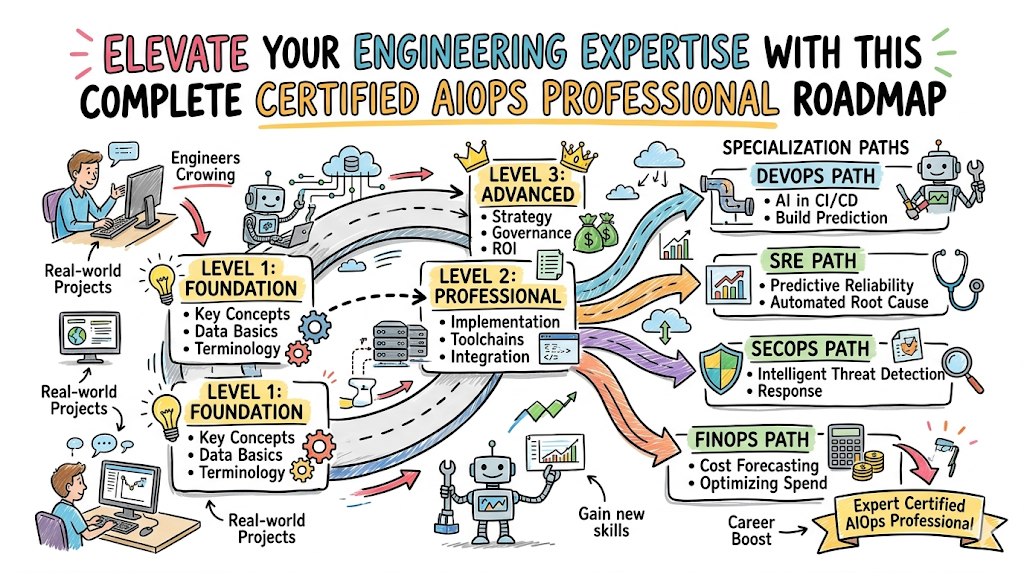
The certification is organized into three main levels: Foundation, Professional, and Advanced. The Foundation level introduces the core concepts of data science for operations. It is perfect for those who are just starting to explore how AI can help with monitoring and logging. It sets the stage for more complex automation tasks. The Professional and Advanced levels go much deeper into specialized tracks like SRE, FinOps, and DevSecOps. These levels show how to integrate AI into specific workflows to achieve better results. As you move up the levels, the focus shifts from understanding tools to designing complete architectures. This alignment ensures that your career progression is backed by a solid technical foundation at every step.
Complete Certified AIOps Professional Certification Table
| Track | Level | Who it’s for | Prerequisites | Skills Covered | Recommended Order |
| Core AIOps | Foundation | Beginners, Junior Devs | Basic Linux & Cloud | Data Collection, Monitoring | First |
| Operations | Professional | SREs, DevOps Engineers | Foundation Level | Pattern Recognition, Automation | Second |
| Strategy | Advanced | Architects, Managers | Professional Level | Predictive Analytics, Strategy | Third |
| Security | Specialist | Security Engineers | Basic Security Knowledge | Threat Detection, AI-Sec | Optional |
| Financial | Specialist | FinOps Practitioners | Cloud Billing Knowledge | Cost Prediction, Optimization | Optional |
Detailed Guide for Each Certified AIOps Professional Certification
Certified AIOps Professional – Foundation Level
What it is
This level validates your understanding of the basic pillars of AIOps. It proves you know how to collect operational data and understand the difference between traditional monitoring and AI-driven observability.
Who should take it
This is for junior engineers, system administrators, or anyone new to the field of automated operations. It is the starting point for those who want a long-term career in intelligent infrastructure.
Skills you’ll gain
- Understanding of telemetry data including logs, metrics, and traces.
- Ability to set up basic data pipelines for operations.
- Knowledge of the AIOps lifecycle and its core benefits.
Real-world projects you should be able to do
- Set up a centralized logging system that feeds into an AI tool.
- Create basic dashboards that highlight anomalies in system performance.
Preparation plan
- Explain 7–14 days: Focus on learning the vocabulary and core concepts of observability.
- 30 days: Practice setting up open-source monitoring tools.
- 60 days: Complete the official coursework and take practice assessments.
Common mistakes
- Skipping the basics of data collection before trying to learn machine learning models.
- Focusing only on tools and ignoring the underlying operational logic.
Best next certification after this
- Same-track option: Professional AIOps Level.
- Cross-track option: SRE Foundation.
- Leadership option: IT Strategy Basics.
Certified AIOps Professional – Professional Level
What it is
This level confirms that you can implement and manage AIOps solutions in a real production environment. It focuses on using algorithms to solve actual uptime and performance problems.
Who should take it
Mid-level engineers, DevOps professionals, and SREs who are responsible for maintaining system health. You should have some experience with automation scripts and cloud platforms.
Skills you’ll gain
- Implementing automated incident response workflows.
- Configuring machine learning models for alert deduplication.
- Using AI to perform root cause analysis across distributed systems.
Real-world projects you should be able to do
- Build an automated system that suppresses flapping alerts.
- Deploy a predictive scaling model that adjusts cloud resources based on traffic patterns.
Preparation plan
- Explain 7–14 days: Review advanced monitoring configurations and API integrations.
- 30 days: Work through lab scenarios involving real-world system failures.
- 60 days: Finalize knowledge on model tuning and data cleaning for operations.
Common mistakes
- Trying to automate everything at once without testing the logic.
- Neglecting the quality of the data being fed into the AI models.
Best next certification after this
- Same-track option: Advanced AIOps Architect.
- Cross-track option: DevSecOps Professional.
- Leadership option: Technical Lead Certification.
Choose Your Learning Path
DevOps Path
In this path, the focus is on integrating AI into the Continuous Integration and Continuous Deployment pipeline. You learn how to use AI to predict if a code change will cause a failure before it reaches production. It is about making the software delivery process smarter and more reliable. This helps developers get faster feedback and reduces the risk of major outages during releases. It bridges the gap between coding and stable deployments.
DevSecOps Path
This path combines security with intelligent operations. You will learn how to use AI to scan for vulnerabilities in real-time and detect unusual user behavior that might indicate a breach. The goal is to make security a proactive part of the operational workflow. By using AI, you can identify threats that traditional signature-based security tools might miss. It ensures that security scales alongside your infrastructure automatically.
SRE Path
The Site Reliability Engineering path is all about maintaining service levels and availability. Here, AIOps is used to manage error budgets and perform automated incident response. You will learn how to build systems that can heal themselves without human intervention. This path is perfect for those who want to focus on high-scale system stability and performance. It emphasizes the reduction of manual toil through intelligent automation.
AIOps Path
This is the core path for those who want to become specialists in intelligent operations. You will dive deep into data science, neural networks, and how they apply specifically to infrastructure. The focus is on building the platform that other teams use to gain insights into their applications. It is a highly technical role that requires a balance of engineering and data skills. This path prepares you to be the primary architect of AI systems.
MLOps Path
This path is specifically for managing the lifecycle of machine learning models in a production setting. You learn how to treat models like software, including versioning, testing, and deployment. The goal is to ensure that models remain accurate and performant over time as new data comes in. It bridges the gap between data science teams and operations teams to ensure smooth transitions. This path is essential for scaling AI initiatives across an enterprise.
DataOps Path
This path focuses on the flow of data within an organization and its operational health. You learn how to use AI to monitor data quality and ensure that data pipelines are always running efficiently. It is about treating data as a product that needs high availability and reliability. This is essential for companies that rely on real-time data for making business decisions. It ensures that the foundation of your AI is always solid and trustworthy.
FinOps Path
The FinOps path is designed to help organizations manage their cloud spending using AI tools. You will learn how to use predictive models to forecast future costs and identify areas where money is being wasted. It combines financial management with technical automation to ensure the best return on cloud investments. This is a high-demand skill as cloud budgets continue to grow globally. It provides the visibility needed to keep cloud scaling sustainable.
Role → Recommended Certified AIOps Professional Certifications
| Role | Recommended Certifications |
| DevOps Engineer | AIOps Professional, DevSecOps Specialist |
| SRE | AIOps Professional, SRE Advanced |
| Platform Engineer | AIOps Advanced, MLOps Specialist |
| Cloud Engineer | AIOps Foundation, FinOps Specialist |
| Security Engineer | DevSecOps Specialist, AIOps Professional |
| Data Engineer | DataOps Specialist, AIOps Foundation |
| FinOps Practitioner | FinOps Specialist, AIOps Professional |
| Engineering Manager | AIOps Foundation, Leadership Track |
Next Certifications to Take After Certified AIOps Professional
Same Track Progression
Once you have mastered the professional level, you should look toward the Advanced Architect level. This is where you learn to design the entire strategy for an organization. You will focus on high-level architecture, choosing the right tools, and setting the standards for how AI is used across the company. It moves you from a doer to a designer of intelligent systems. Deep specialization ensures you remain at the top of the technical hierarchy.
Cross-Track Expansion
If you want to broaden your skills, moving into DevSecOps or FinOps is a great choice. These areas allow you to apply your AIOps knowledge to different business problems. For example, using AI for cost management or security threat hunting makes you a more versatile engineer. This cross-training is very attractive to employers looking for T-shaped professionals. Skill broadening prevents your career from becoming stagnant in one niche.
Leadership & Management Track
For those who want to lead teams, the next step is moving into technical management. You can use your deep understanding of AIOps to guide how a department operates. You will learn how to communicate the value of AI to business leaders and how to build teams that can support these complex systems. This path is about strategy, people, and long-term organizational growth. It is the natural transition for those looking to impact the business at a higher level.
Training & Certification Support Providers for Certified AIOps Professional
DevOpsSchool
DevOpsSchool provides a massive ecosystem for learning modern engineering practices. They offer detailed training that covers the entire software development lifecycle with a focus on automation. Their AIOps courses are built to help professionals transition from traditional operations to AI-driven workflows. They use a blend of theoretical knowledge and hands-on labs to ensure that students can handle real production issues. The support provided by their mentors helps students clear doubts quickly and stay on track with their learning goals. They are a reliable partner for those looking to build a long-term career in DevOps and AIOps.
Cotocus
Cotocus is known for its high-quality technical consulting and expert-led training programs. They focus on providing specialized knowledge that is directly applicable to the modern workforce. Their training for AIOps is designed for professionals who need to understand how to implement machine learning in infrastructure. They provide deep dives into toolsets and strategies that help organizations reduce downtime. The instructors at Cotocus are practitioners who bring real-world examples into every session. This ensures that the learning experience is practical and results-oriented. They are a great choice for engineers who want to learn from the best in the industry.
Scmgalaxy
Scmgalaxy has been a pillar of the DevOps and SCM community for many years. They offer a wide range of resources, from free tutorials and blogs to structured certification training. Their approach to AIOps is grounded in their long history of infrastructure management and automation. They provide students with a clear understanding of how AIOps integrates with existing CI/CD pipelines. The community aspect of Scmgalaxy allows students to learn from their peers as well as their instructors. This collaborative environment is perfect for engineers who want to stay connected with the latest industry trends. They offer a practical and community-focused learning path.
BestDevOps
BestDevOps focuses on delivering the most relevant and up-to-date content for today’s engineering roles. Their courses are streamlined to ensure that professionals can gain new skills without wasting time on outdated information. Their AIOps training covers the most important aspects of the certification, focusing on anomaly detection and automated remediation. They provide a clear and simple learning path that is easy for busy professionals to follow. The quality of their training is reflected in the high success rate of their students. They are an excellent option for those who want a direct and efficient way to achieve their certification goals.
devsecopsschool.com
This platform is specifically designed for the intersection of security and operations. They provide comprehensive training on how to secure modern infrastructure using automated tools. Their AIOps training highlights how artificial intelligence can be used to identify and respond to security threats in real-time. This specialized focus is invaluable for engineers who want to excel in DevSecOps roles. They offer hands-on experience with security-focused AI tools and workflows. By learning here, professionals can ensure that they are building systems that are both intelligent and secure. They are the leading resource for security-conscious engineering professionals.
sreschool.com
Sreschool is dedicated to the principles of Site Reliability Engineering and system stability. They provide in-depth training on how to use AIOps to improve system reliability and reduce manual toil. Their curriculum is designed to help engineers master the art of maintaining high availability at scale. They focus on the practical use of AI for incident management and performance monitoring. The training at sreschool is highly technical and aimed at those who are responsible for mission-critical systems. They provide the skills needed to turn complex operational data into actionable insights. It is the perfect place for aspiring and current SREs.
As the official hosting platform for the Certified AIOps Professional program, this site is the primary source of information. They offer the complete curriculum and the most accurate assessment tools for the certification. The site is a hub for the latest AIOps research, whitepapers, and best practices. They provide a structured environment that guides students through every level of the certification journey. By learning directly from the source, professionals can be sure they are getting the most relevant and authoritative information available. It is the essential starting point for anyone serious about becoming a certified AIOps expert.
dataopsschool.com
Dataopsschool focuses on the critical field of data operations and pipeline management. They provide training that shows how to apply AIOps principles to ensure the health and reliability of data. This is essential for any organization that relies on data-driven decision-making. Their courses cover how to use AI to monitor data quality and automate data engineering tasks. This ensures that the data used by AI models is always accurate and up to date. They offer a unique perspective that bridges the gap between data engineering and intelligent operations. It is a vital resource for data professionals.
finopsschool.com
Finopsschool provides the specialized knowledge needed to manage cloud costs in a modern engineering environment. They teach professionals how to use AIOps tools to gain visibility into cloud spending and optimize resources. Their curriculum combines financial principles with technical automation to drive business value. They show how AI can predict future costs and prevent cloud budget overruns. This is an increasingly important skill as companies look to scale their cloud infrastructure efficiently. They offer a practical path for those who want to merge technical expertise with financial accountability. It is the leading platform for FinOps training.
Frequently Asked Questions (General)
- How difficult is the Certified AIOps Professional exam for a beginner?
The exam is designed to be challenging because it tests practical skills, but beginners can succeed by following the foundation training. It requires a commitment to understanding the logic behind the data rather than just memorizing tool names.
- How much time is needed to prepare for the certification while working?
Most working professionals can prepare within 30 to 60 days by dedicating a few hours each week. The key is to balance reading the theory with hands-on practice in a lab environment.
- Are there specific prerequisites for the foundation level?
There are no hard prerequisites, but a basic understanding of Linux and cloud concepts will help you learn faster. It is designed to be an entry point for those new to intelligent automation.
- What is the expected return on investment for this career path?
The ROI is typically seen through faster career progression and access to high-demand roles. Companies prioritize hiring certified professionals who can demonstrate a modern approach to managing infrastructure.
- What is the best order to take these certifications?
You should always start with the Foundation level to build a solid base. From there, you can move to the Professional level and then choose a specialization like SRE or FinOps.
- Is this certification recognized by global enterprises?
Yes, the skills taught in this program are based on global industry standards. The certification is recognized by companies looking for engineers who can manage complex, cloud-native environments.
- How long will the certification remain valid after passing?
The certification is usually valid for two years, after which you may need to recertify. This ensures that your skills remain current as the technology and tools in the field evolve.
- Does the program focus on specific vendor tools?
The program is designed to be vendor-neutral, focusing on concepts that apply to any tool. However, you will get hands-on experience with many popular open-source and industry-standard tools.
- Can a manager without a deep coding background benefit from this?
Yes, managers can gain a high-level understanding of how AIOps impacts team efficiency and business goals. It helps them lead technical teams more effectively and make better strategic decisions.
- Is there a community or network for certified professionals?
Yes, passing the exam grants you access to a global network of AIOps professionals. This community is a valuable resource for sharing knowledge and finding new career opportunities.
- Are lab environments provided for hands-on practice?
Most official training providers include access to cloud-based labs where you can practice real-world scenarios. This hands-on experience is a critical part of the learning and certification process.
- How does AIOps differ from standard monitoring?
Standard monitoring tells you that something is wrong, whereas AIOps uses data to tell you why it is wrong and how to fix it. It moves operations from a reactive state to a proactive and predictive state.
FAQs on Certified AIOps Professional
- What specific machine learning techniques are taught?
The program covers clustering, regression, and pattern matching as they apply to operational data. You will learn how these techniques help in finding the root cause of complex system failures.
- How does this certification help with managing large-scale alerts?
You will learn how to use AI to group thousands of related alerts into a single incident. This significantly reduces noise and helps engineers focus on the most important issues.
- Is it necessary to be a data scientist to pass?
No, the focus is on applying AI to operations rather than building new algorithms from scratch. You only need to understand how to use and tune the models for your specific environment.
- Does the curriculum cover hybrid and multi-cloud environments?
Yes, the principles of AIOps are designed to work across any infrastructure, including on-premise and multiple cloud providers. You will learn how to unify data from different sources.
- How are the practical exams structured?
Practical exams usually involve a series of tasks in a live lab environment. You will be asked to configure tools and solve specific operational problems to prove your competency.
- Can I take the certification exam from my home?
Yes, the certification offers online proctored exams that can be taken from any location. This makes it convenient for professionals all over the world to get certified.
- What kind of training support is available for students?
Students have access to expert mentors, detailed documentation, and community forums. This support system ensures that you can overcome any technical challenges during your study.
- Why is there a focus on open-source tools in the training?
Open-source tools are the foundation of modern infrastructure and are used by almost every major company. Learning these tools ensures that your skills are highly portable across different organizations.
Final Thoughts
As someone who has navigated the ups and downs of the tech industry, I believe that AIOps is the next logical step for every operations professional. We have reached a point where systems are too large and too fast for manual management to keep up. The ability to use artificial intelligence to maintain stability and performance is no longer a luxury; it is a requirement.
The Certified AIOps Professional program offers a structured and practical way to gain these essential skills. It moves you away from simple firefighting and toward a more strategic, intelligent way of working. If you are serious about your career and want to be at the forefront of the industry, this certification is a very wise investment. Focus on the practical labs, understand the data, and you will see the impact on your career immediately.