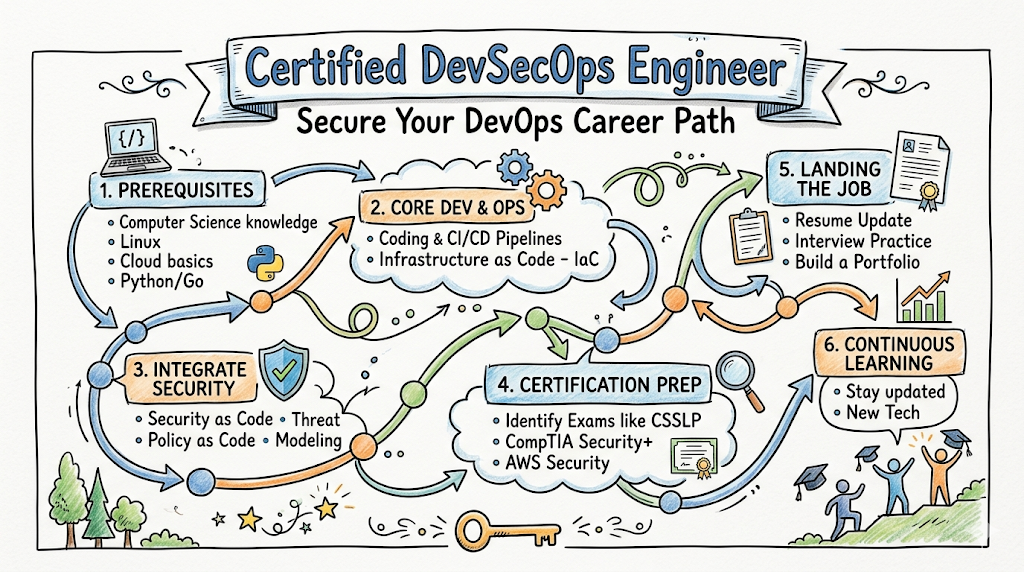
Security is now a daily responsibility for every technology team. Applications, APIs, and pipelines are under constant pressure from threats, compliance needs, and fast business change. In this environment, a Certified DevSecOps Engineer becomes a key role in any modern organization. This guide will help you understand what the Certified DevSecOps Engineer certification is, why it matters, who should take it, and how to build a clear career path around it. You will also see learning paths, role-based recommendations, FAQs, and trusted training institutions that can support your journey.
Why Certified DevSecOps Engineer matters
Many organizations still treat security as the last step before release. This creates friction, delays, and risk. A Certified DevSecOps Engineer changes this by bringing security into planning, coding, building, testing, and operations.
With this certification, you can:
- Design CI/CD pipelines where security checks are part of the normal flow.
- Work with developers, SREs, and security teams using a shared language.
- Reduce security incidents by finding problems earlier in the lifecycle.
- Show employers that you understand both DevOps and security, not just one side.
Certification overview
What it is
Certified DevSecOps Engineer is a professional certification focused on secure software delivery. It covers concepts, tools, and workflows that make security part of everyday DevOps work, not a separate gate.
You learn how to design secure pipelines, automate security checks, handle vulnerabilities, and manage secrets in a reliable way.
Who should take it
This certification is ideal for:
- DevOps engineers who want to add deep security skills to their profile
- Security engineers who want to work closer to CI/CD, cloud, and containers
- SREs and platform engineers who own production reliability and uptime
- Cloud engineers who design and implement deployment architectures
- Software engineers who want to understand security in the delivery pipeline
- Engineering managers who must drive secure delivery practices across teams
Skills you’ll gain
- DevSecOps principles and culture
- Secure software development lifecycle (secure SDLC) basics
- Designing secure CI/CD pipelines
- Integrating SAST, DAST, SCA, and container security tools
- Using secrets management correctly in pipelines and production
- Handling vulnerabilities and security findings in a repeatable process
- Working with compliance, audit, and governance requirements
- Collaborating with dev, ops, and security teams without blocking delivery
Real‑world projects you should be able to do
- Build a CI/CD pipeline with static, dynamic, and dependency security scans
- Configure container image scanning and enforce basic image policies
- Implement secure secrets management for builds, tests, and deployments
- Add security gates and quality thresholds into existing pipelines
- Write simple threat models for an application and align pipelines to them
- Design basic incident response playbooks from a DevSecOps point of view
Preparation plan (7–14 / 30 / 60 days)
7–14 days (fast track)
This plan works if you already have strong DevOps and some security experience.
- Day 1–3: Review DevOps and CI/CD concepts, refresh basic security ideas.
- Day 4–7: Focus on DevSecOps principles and core tools (SAST, DAST, SCA, container scanning, secrets).
- Day 8–12: Do hands-on labs and create a small secure pipeline for a sample app.
- Day 13–14: Revise notes, review practice questions, and refine your understanding of key patterns and anti-patterns.
30 days (balanced plan)
This plan is suitable for most working engineers.
- Week 1: Understand DevSecOps culture, secure SDLC, and high-level designs.
- Week 2: Learn tools and techniques for pipeline security and secrets management.
- Week 3: Focus on vulnerability management, collaboration, and real-world scenarios.
- Week 4: Build a complete small project, review sample questions, and revise all topics.
60 days (steady plan)
This plan works if you are newer to security or DevOps.
- Weeks 1–2: Strengthen DevOps basics, CI/CD, Git, containers, and cloud.
- Weeks 3–4: Learn basic application security concepts and secure SDLC.
- Weeks 5–6: Dive into DevSecOps tools, build a secure pipeline, and work through case studies.
- Final days: Revision, mock tests, and polishing your project examples.
Common mistakes
- Thinking DevSecOps is only about adding more tools
- Ignoring culture and collaboration between Dev, Ops, and Security
- Skipping hands-on practice and relying only on theory
- Overloading pipelines with too many checks without a clear plan
- Forgetting to maintain and improve security rules over time
- Not aligning security work with business priorities and risk levels
Best next certification after this
- Same track: An advanced DevSecOps or application security certification that goes deeper into threat modeling, secure design, or supply chain security.
- Cross-track: A Kubernetes security, cloud security, or SRE certification that adds breadth to your profile.
- Leadership: A security leadership, architecture, or governance-focused certification for people who want to design and lead secure delivery at scale.
Certification table
| Track | Level | Who it’s for | Prerequisites | Skills covered | Recommended order |
|---|---|---|---|---|---|
| DevSecOps | Intermediate | DevOps, SRE, Cloud, Security, and Platform engineers | Basic DevOps, CI/CD, Linux, cloud concepts, basic security | DevSecOps principles, secure SDLC, secure CI/CD, security tools integration, secrets and vulnerability management | After core DevOps or cloud foundations and basic security |
Choose your path: 6 learning paths
DevOps path
In this path, you start from automation and delivery speed, then add strong security. This is ideal if you already work with CI/CD and want to make your pipelines safer.
Typical sequence:
- DevOps foundations and CI/CD basics
- Cloud and container fundamentals
- Certified DevSecOps Engineer
- Optional: Kubernetes, GitOps, or observability certifications
DevSecOps path
This path is for people who want security to be their central focus within DevOps. It is suitable for DevOps engineers and security engineers who want to work closely together.
Typical sequence:
- DevOps fundamentals and basic application security
- Certified DevSecOps Engineer
- Advanced application security or DevSecOps specialization
- Optional: supply chain security or governance certifications
SRE path
In this path, you focus on reliability and security together. SREs deal with outages, incidents, and performance, and DevSecOps skills help them handle security-related issues as well.
Typical sequence:
- SRE foundations, monitoring, and incident management
- Observability and performance engineering
- Certified DevSecOps Engineer
- Optional: resilience engineering or reliability-focused security certifications
AIOps / MLOps path
This path is for teams handling AI and machine learning systems. DevSecOps skills help you secure pipelines that process data, train models, and deploy services.
Typical sequence:
- MLOps or AIOps basics and deployment pipelines
- Data and model management fundamentals
- Certified DevSecOps Engineer
- Optional: governance and security for ML and data systems
DataOps path
Here the focus is on secure and reliable data pipelines. Data engineers and DataOps professionals need to protect data as it moves across systems.
Typical sequence:
- DataOps and data pipeline tools
- Data platform and storage basics in the cloud
- Certified DevSecOps Engineer
- Optional: data governance, privacy, and compliance certifications
FinOps path
FinOps professionals work at the intersection of cloud cost and engineering. DevSecOps skills help them understand secure architectures and how misconfigurations can impact both risk and cost.
Typical sequence:
- Cloud fundamentals and FinOps basics
- Dashboards, tagging, and financial governance
- Certified DevSecOps Engineer
- Optional: cloud governance or architecture certifications with a security angle
Role → Recommended certifications
DevOps Engineer
- DevOps foundations or CI/CD certification
- Cloud platform certification
- Certified DevSecOps Engineer
- Optional: Kubernetes or container-focused certifications
SRE
- SRE foundations certification
- Monitoring and observability certification
- Certified DevSecOps Engineer
- Optional: reliability or incident response specialization
Platform Engineer
- Cloud and Kubernetes certifications
- Infrastructure-as-code and automation certifications
- Certified DevSecOps Engineer
- Optional: GitOps or internal developer platform certifications
Cloud Engineer
- Core cloud certifications (compute, network, storage)
- Container or Kubernetes certifications
- Certified DevSecOps Engineer
- Optional: cloud security or architecture certifications
Security Engineer
- Application, network, or cloud security certifications
- Offensive or defensive security specialization
- Certified DevSecOps Engineer
- Optional: governance, risk, and compliance certifications
Data Engineer
- Data engineering or big data certifications
- Cloud data platform certifications
- Certified DevSecOps Engineer
- Optional: DataOps, privacy, or governance certifications
FinOps Practitioner
- Cloud fundamentals certifications
- FinOps or cloud cost management certifications
- Certified DevSecOps Engineer
- Optional: cloud governance or architecture certifications
Engineering Manager
- Technology leadership or management certifications
- Cloud or architecture certifications
- Certified DevSecOps Engineer
- Optional: governance, risk, and compliance or security leadership certifications
Next certifications to take (3 options)
After achieving Certified DevSecOps Engineer, you can choose from three main directions.
Same track (DevSecOps specialization)
You can go deeper into DevSecOps with advanced application security, secure design, or supply chain security certifications. This is good if you want to stay hands-on with security in pipelines and applications.
Cross-track (broad skills)
You can expand into adjacent areas like Kubernetes security, cloud security, SRE, or observability. This makes you more flexible and useful across different teams and projects.
Leadership (strategy and governance)
You can move towards security leadership, architecture, or governance-focused certifications. This suits people who design and guide secure delivery practices at organization level.
Top institutions for Certified DevSecOps Engineer training
DevOpsSchool
DevOpsSchool offers structured programs that combine theory, demonstrations, and labs. Their Certified DevSecOps Engineer training focuses on real-world scenarios, such as securing existing pipelines and integrating security tools step by step. They design their sessions to fit the needs of working engineers and managers.
Cotocus
Cotocus provides training on DevOps, cloud, and security with flexible formats. Their DevSecOps-related courses help you connect concepts with practice through hands-on exercises. They also support customized learning paths for individuals and teams who want to grow from basic DevOps to DevSecOps roles.
Scmgalaxy
ScmGalaxy is known for deep, practical workshops on DevOps and automation tools. Their DevSecOps training focuses on integrating scanners, secrets management, and policies into everyday workflows. They use real examples so you can apply the same patterns in your own pipelines.
BestDevOps
BestDevOps curates focused learning content for busy professionals. Their DevSecOps offerings help you understand the most important parts first, such as secure CI/CD and vulnerability handling. This makes it easier to move from theory to practical implementation without feeling overloaded.
devsecopsschool.com
devsecopsschool.com specializes in DevSecOps training and certifications. They have courses aligned closely with the Certified DevSecOps Engineer program. With a strong focus on hands-on labs, they help you practice pipeline security, tool integration, and collaboration patterns that match real project needs.
sreschool.com
sreschool.com focuses on Site Reliability Engineering and related skills. Their programs often connect reliability, observability, and security. For SREs, their content helps show how DevSecOps practices protect production systems while keeping them reliable and performant.
aiopsschool.com
aiopsschool.com works on the intersection of operations, automation, and intelligent systems. Their content can help you see how DevSecOps fits into AIOps environments, where automation is used to detect and respond to issues, including security-related signals.
dataopsschool.com
dataopsschool.com focuses on secure and reliable data workflows. Their training helps DataOps and data engineering teams apply DevSecOps ideas to data pipelines. This includes topics like securing data tools, protecting sensitive data, and aligning with compliance requirements.
finopsschool.com
finopsschool.com helps organizations manage cloud costs more effectively. When combined with DevSecOps skills, you can design architectures that are secure, efficient, and financially responsible. Their training supports teams in balancing security, performance, and cost.
FAQs
1. What is a Certified DevSecOps Engineer?
A Certified DevSecOps Engineer is a professional who integrates security into DevOps practices. They design and manage secure pipelines, tools, and processes across the software lifecycle.
2. How difficult is this certification?
The certification is at an intermediate level. It is easier if you already know DevOps basics and have some exposure to security concepts or tools.
3. How much time should I plan for preparation?
Most working engineers need 30 to 60 days with consistent study and practice. Experienced DevOps or security professionals may prepare faster if they follow a focused 7–14 day plan.
4. Do I need a strong coding background?
You should be comfortable reading and writing simple scripts and configuration files. You do not need to be a full-time application developer, but you must understand how code flows through pipelines.
5. Do I need prior security experience?
Prior security experience helps, but it is not mandatory. With basic security knowledge and strong motivation, you can use this certification as a structured way to enter DevSecOps.
6. What are the main topics covered?
The certification covers DevSecOps principles, secure SDLC, secure CI/CD pipelines, security tools integration, secrets management, vulnerability management, and collaboration practices among teams.
7. How does this certification help my career?
It signals that you can bridge DevOps and security, which is highly valuable for modern organizations. It can help you reach DevSecOps Engineer, Security-focused DevOps Engineer, or Security-aware SRE roles.
8. Is this certification useful outside of security teams?
Yes. DevOps, SRE, platform, and cloud engineers all benefit from DevSecOps skills. It helps them build safer systems and communicate better with security teams.
9. Can fresh graduates attempt this certification?
They can, but they will need extra time to understand DevOps basics and core security concepts. It is more comfortable for people with some industry exposure.
10. How should I structure a daily study routine?
Divide your time into three parts: learning concepts, practicing with tools, and revising. Try to touch all three every week, even if in small blocks.
11. What kinds of tools should I practice with?
You should practice with at least one tool for static analysis, dynamic testing, dependency scanning, container scanning, and secrets management. The exact tools can vary by organization.
12. How can I show my DevSecOps skills to employers?
You can show your certificate, but also share small project examples, pipeline configurations, and documentation of how you built secure workflows. This proves that you can apply the concepts in practice.
FAQs
1. What exactly does the Certified DevSecOps Engineer exam test?
It tests your understanding of DevSecOps concepts, your ability to design secure pipelines, and your knowledge of security practices across the software lifecycle. It also checks if you can think through real-world scenarios.
2. What are the minimum prerequisites for attempting Certified DevSecOps Engineer?
You should know basic DevOps practices, CI/CD pipelines, Linux, and at least one cloud platform at a basic level. Basic awareness of security concepts is also recommended.
3. How should I use the official certification page?
Use the official certification page to check syllabus, exam format, and any updates. Treat it as the main source of truth for what will be tested and how the program is structured.
4. How can I combine my current role with this certification?
If you are already in DevOps, SRE, cloud, or security, start by adding small DevSecOps improvements to your current projects. Use what you learn for the certification directly in your job tasks.
5. What kind of questions can I expect in the exam?
You can expect scenario-based questions, best-practice questions, and concept questions about secure pipelines, tools, and workflows. The focus is on understanding and application, not only memorization.
6. How do I avoid over-focusing on tools for this certification?
Tools are important, but always connect them back to principles. Ask yourself why a tool is used, where it fits in the pipeline, and what risk it helps reduce.
7. What should I do in the last week before the exam?
In the last week, revise key topics, review your project or lab pipeline, and solve as many practice questions as you can. Focus on weak areas you identified earlier.
8. How soon should I plan the next certification after this one?
It is usually better to apply your new skills in real projects for some time. Once you feel confident, choose a same-track, cross-track, or leadership certification that aligns with your career direction.
Conclusion
Certified DevSecOps Engineer is more than a technical exam. It is a structured way to learn how security, development, and operations can move together. By understanding principles, practicing with tools, and applying them in real projects, you turn DevSecOps into a habit, not a one-time task. Whether you are a DevOps engineer, SRE, cloud engineer, security engineer, data engineer, FinOps practitioner, or an engineering manager, this certification helps you build safer systems without losing speed. With clear learning paths and role-based guidance, you can choose the direction that matches your career and grow step by step into a trusted DevSecOps professional.