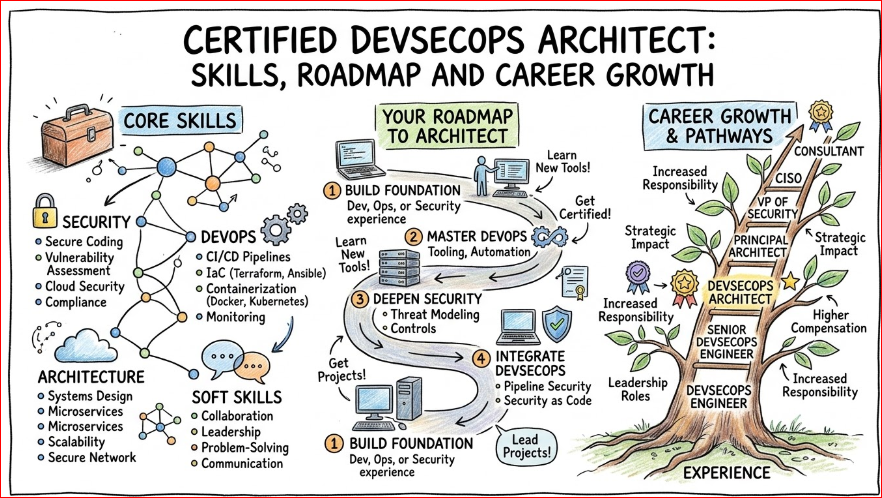
Modern software is fast, distributed, and always online. Security can no longer be a separate step at the end; it must be part of design, coding, testing, deployment, and operations.
Certified DevSecOps Architect is a program that helps you learn how to design and build secure, scalable, and compliant DevSecOps architectures for real-world enterprises. This guide explains what the certification is, who should take it, what skills you gain, how to prepare, and how it fits into your long-term DevOps, Security, and Cloud career path.
Why Certified DevSecOps Architect matters
- Security and compliance are now board-level topics; breaches hurt brand, revenue, and trust.
- Cloud-native systems, microservices, and Kubernetes have increased complexity; a strong security architecture is essential.
- Companies need people who can connect DevOps speed with security, governance, and risk management.
With this certification, you can move from “tool operator” to “security-focused architect” who shapes how teams build and ship software safely.
Certification Snapshot Table
| Track | Level | Who it’s for | Prerequisites | Skills covered | Recommended order | Link (keep empty or add later) |
|---|---|---|---|---|---|---|
| DevSecOps Architecture | Professional | DevOps, Cloud, Security, Platform, SRE, and Solution Architects; senior engineers and managers | Strong DevOps and cloud basics, CI/CD familiarity, basic application security and vulnerability scanning, containers, basic architecture exposure | Secure CI/CD design, shift-left security, container and Kubernetes security, cloud-native security, threat modeling, risk management, compliance as code, incident response | Foundation in DevOps/cloud/security → hands-on DevSecOps practice → Certified DevSecOps Architect |
About Certified DevSecOps Architect
What it is
Certified DevSecOps Architect is a specialized program that teaches you how to design security-first architectures across DevOps pipelines and modern cloud platforms. You learn to combine security, reliability, performance, and compliance in one consistent architecture. The focus is on patterns, frameworks, and decisions, not just tools.
Who should take it
This certification is ideal for:
- DevOps Engineers who are moving into architecture or security-heavy roles.
- Security Engineers who want to understand CI/CD, cloud, and container platforms deeply.
- SREs and Platform Engineers responsible for secure, reliable platforms.
- Cloud Engineers who design landing zones, environments, and shared services.
- Engineering Managers and Technical Leads who own security outcomes for teams.
Skills you’ll gain
- Designing secure CI/CD pipelines with gated controls and automated checks.
- Implementing shift-left security in code, build, and test phases.
- Securing containers, Kubernetes clusters, and microservices.
- Applying cloud-native security patterns in hybrid and multi-cloud setups.
- Threat modeling for services, APIs, data flows, and supply chains.
- Building security as code and compliance as code workflows.
- Designing alerting, incident response, and resilience from an architecture view.
- Communicating security trade-offs with engineers, security, and business stakeholders.
Real-world projects you should be able to do after it
After completing this certification, you should be able to:
- Design a secure CI/CD pipeline for microservices with SAST, DAST, SCA, and IaC scanning.
- Build a secure container and Kubernetes platform with secrets management, network policies, and runtime protections.
- Create security reference architectures for multi-cloud or hybrid environments.
- Define security and compliance guardrails as code, integrated into pipelines and platforms.
- Run threat modeling workshops and convert outputs into practical controls.
- Develop blueprints for logging, monitoring, and incident response for critical services.
Preparation plan (7–14 / 30 / 60 days)
You can choose a preparation plan based on your background and available time.
7–14 days (fast track)
Best suited for professionals already working in DevOps, cloud, or security architecture.
- Review the certification objectives and syllabus.
- Map each objective to your current or past projects.
- Revise CI/CD security, cloud security basics, Kubernetes, and container security patterns.
- Focus on architecture patterns, trade-offs, and design decisions rather than tool commands.
- Practice writing short architecture notes for sample scenarios.
30 days (standard track)
Best suited for working engineers with hands-on experience but limited formal architecture exposure.
- Week 1: DevSecOps principles, secure SDLC, shift-left concepts, security checkpoints in pipelines.
- Week 2: Container security, Kubernetes basics, secrets management, service-to-service security.
- Week 3: Cloud-native security, identity, policies, threat modeling frameworks.
- Week 4: Architecture scenarios, mock designs, incident response, and revision with sample questions.
60 days (career transition track)
Best suited for people moving from pure DevOps, pure security, or non-cloud roles.
- Month 1:
- Build fundamentals across DevOps, cloud basics, CI/CD, code security, and vulnerability management.
- Learn core Kubernetes, container, and secrets management concepts.
- Month 2:
- Study architecture patterns, reference architectures, and security frameworks.
- Practice designing end-to-end secure delivery flows for different types of applications.
- Do mock case studies and review your designs with peers or mentors where possible.
Common mistakes
Avoid these common mistakes when preparing or applying the certification in real work:
- Focusing only on tools and not on design patterns and principles.
- Ignoring non-functional requirements such as performance, reliability, and usability while adding security.
- Treating security as only “scanners in the pipeline” instead of thinking about architecture and culture.
- Not practicing architecture diagrams, threat models, and decision records.
- Overcomplicating solutions with too many tools and controls that teams cannot maintain.
Best next certification after this
After Certified DevSecOps Architect, good next steps include:
- A deeper DevSecOps or Cloud Security expert-level certification to build more specialized authority.
- An SRE or Reliability-focused certification to balance security with reliability and performance.
- A leadership or architecture governance program to grow into Head of DevSecOps or Platform Security roles.
Choose Your Path: 6 Learning Paths
You can position Certified DevSecOps Architect inside a larger learning journey. Below are six useful paths.
DevOps Path
Best for engineers focused on speed, automation, and delivery.
- Start: DevOps foundation (Linux, Git, CI/CD basics).
- Next: DevOps professional level (Kubernetes, Terraform, advanced CI/CD).
- Then: DevSecOps-focused certifications to add security into your DevOps skill set.
- Finally: Certified DevSecOps Architect to move into architecture and leadership responsibilities.
DevSecOps Path
Best for professionals in high-risk industries or security-focused teams.
- Start: DevSecOps foundation or professional-level certification covering tools and practices.
- Next: Hands-on DevSecOps engineer-level work across pipelines, code, containers, and cloud.
- Then: Certified DevSecOps Architect to design complete security platforms and reference architectures.
SRE Path
Best for people focused on reliability and uptime.
- Start: DevOps or SRE foundations.
- Next: SRE professional level (SLIs/SLOs, error budgets, incident management, observability).
- Then: Certified DevSecOps Architect to ensure that reliability and security are designed together.
AIOps/MLOps Path
Best for engineers working with data-driven systems and AI-powered operations.
- Start: AIOps or MLOps foundation and professional certifications.
- Next: Focus on monitoring, anomaly detection, and automated remediation.
- Then: Certified DevSecOps Architect to build secure, observable platforms for AI and ML workloads.
DataOps Path
Best for data engineers and analytics platform owners.
- Start: DataOps foundation and professional certifications.
- Next: Data quality, pipeline automation, governance, and observability.
- Then: Certified DevSecOps Architect to design secure data platforms and pipelines with strong access control and compliance.
FinOps Path
Best for people owning cloud cost, budgets, and financial governance.
- Start: FinOps foundation or practitioner-level programs.
- Next: Hands-on cloud cost optimization and governance work with engineering teams.
- Then: Certified DevSecOps Architect to combine cost, security, and reliability into your cloud architecture decisions.
Role → Recommended Certifications
| Role | Recommended certifications path (including Certified DevSecOps Architect) |
|---|---|
| DevOps Engineer | DevOps foundation → DevOps professional → DevSecOps professional → Certified DevSecOps Architect |
| SRE | DevOps or SRE foundation → SRE professional → Observability or monitoring certifications → Certified DevSecOps Architect |
| Platform Engineer | DevOps professional → Kubernetes or cloud platform certifications → DevSecOps professional → Certified DevSecOps Architect |
| Cloud Engineer | Cloud provider associate or professional → DevOps professional → Security-focused certification → Certified DevSecOps Architect |
| Security Engineer | Security or offensive/defensive certification → DevSecOps professional → Certified DevSecOps Architect |
| Data Engineer | DataOps professional → Cloud or data platform certifications → Certified DevSecOps Architect for secure data platforms |
| FinOps Practitioner | FinOps practitioner → Cloud governance programs → Certified DevSecOps Architect to design cost-aware and secure architectures |
| Engineering Manager | DevOps or agile leadership → Security or DevSecOps program → Certified DevSecOps Architect to lead secure delivery at scale |
Top Institutions for Certified DevSecOps Architect Training
DevOpsSchool
DevOpsSchool offers structured DevOps, SRE, and DevSecOps training with a strong focus on hands-on labs and real project scenarios. They provide complete learning paths that start from fundamentals and move towards advanced architecture and leadership skills. Their programs help you connect tools, processes, and culture in a practical way.
Cotocus
Cotocus is an implementation and training partner that supports enterprises in building DevOps and DevSecOps practices. They combine consulting, coaching, and project-based learning so you can apply concepts to real environments. This is useful if your goal is to build organization-wide DevSecOps architectures, not just pass an exam.
Scmgalaxy
Scmgalaxy provides training on DevOps, CI/CD, configuration management, and modern delivery practices. Their focus is on end-to-end lifecycle automation, which is a strong base before moving into DevSecOps architecture. With this foundation, you can better understand where and how to embed security.
BestDevOps
BestDevOps curates DevOps and cloud-centric courses that target working professionals. They emphasize industry relevance, updated syllabus, and practical guidance for career growth. This makes them helpful if you want your DevSecOps Architect journey aligned with current market needs.
devsecopsschool.com
DevSecOpsSchool is focused specifically on security-first DevOps and DevSecOps education. They cover topics like threat modeling, secure pipelines, compliance as code, and cloud-native security in depth. Their Certified DevSecOps Architect content and related tracks are designed to match real enterprise challenges.
sreschool.com
SRESchool specializes in Site Reliability Engineering, error budgets, SLIs/SLOs, and high-availability design. This is valuable for DevSecOps Architects because security and reliability must work together in the same architecture. Their programs help you design systems that are both secure and reliable at scale.
aiopsschool.com
AIOpsSchool focuses on applying AI and machine learning to IT operations, monitoring, and automation. As a DevSecOps Architect, understanding AIOps patterns can help you design self-healing and intelligent detection systems. This is especially useful for large, complex environments where manual monitoring is not enough.
dataopsschool.com
DataOpsSchool provides training in DataOps, data pipeline automation, and governance. Data security, privacy, and compliance are major concerns for modern architectures, so their content complements DevSecOps skills very well. With this combination, you can design secure data platforms and analytics pipelines.
finopsschool.com
FinOpsSchool focuses on cloud financial management, cost optimization, and cloud governance. For a DevSecOps Architect, FinOps knowledge helps you design solutions that are secure, reliable, and cost-efficient. This makes you more valuable to both technology and business stakeholders.
FAQs on Certified DevSecOps Architect
1. How difficult is Certified DevSecOps Architect?
It is a professional-level certification with a strong focus on architecture, design, and applied security. If you already have DevOps, cloud, and basic security experience, it is challenging but manageable with structured preparation.
2. How much time do I need to prepare?
Most working engineers can prepare in 30 to 60 days with focused study and practice. Very experienced professionals may be able to complete preparation in 7 to 14 days by mapping objectives to their real projects.
3. What are the prerequisites?
You should be comfortable with CI/CD basics, version control, cloud platforms, containers, and basic application security concepts. Prior DevOps or DevSecOps experience is highly recommended, even if informal.
4. Do I need to be a security expert before starting?
You do not need to be a full-time security specialist, but you need basic understanding of vulnerabilities, scanning, and secure coding ideas. The certification will deepen your skills and help you think like a security architect.
5. Is this more for engineers or managers?
It is suitable for both senior engineers and managers who are close to technical work. Architects, tech leads, platform leads, and engineering managers can all benefit.
6. What is the main difference between DevSecOps Engineer and DevSecOps Architect?
A DevSecOps Engineer focuses on implementation: configuring tools, pipelines, and integrations. A DevSecOps Architect focuses on overall design: patterns, reference architectures, guardrails, and alignment with risk and compliance goals.
7. How does this certification help my career?
It helps you move from individual contributor work to higher-impact architecture and leadership roles in security and DevOps. It also makes you more valuable in regulated industries such as finance, healthcare, and telecom.
8. Can this certification help if I want to move into cloud security?
Yes. It gives you a strong base in secure CI/CD, cloud-native security, and automation across platforms. After this, you can pursue deeper cloud security or vendor-specific certifications.
9. In what sequence should I take related certifications?
A common sequence is: DevOps foundation → DevOps professional → DevSecOps professional → Certified DevSecOps Architect. You can then add SRE, Cloud Security, or leadership certifications, depending on your role goals.
10. What kind of exam questions should I expect?
You should expect scenario-style questions, where you choose architectures, controls, or patterns that best solve a given security and delivery problem. The exam will test understanding and design thinking more than raw tool commands.
11. Is this certification useful for non-product companies like consulting or services?
Yes. Many consulting and services organizations design and implement DevSecOps solutions for multiple clients. Being a Certified DevSecOps Architect helps you lead these engagements and propose solid architectures.
12. How will this certification affect my salary and opportunities?
Salary depends on location and company, but security-focused architecture roles are often compensated higher than pure implementation roles. More importantly, it opens doors to roles like DevSecOps Architect, Platform Security Lead, and Head of DevSecOps.
FAQs focused on: difficulty, time, prerequisites, sequence, value, career outcomes
1. Is Certified DevSecOps Architect harder than typical DevOps certifications?
Yes, it is usually tougher than entry-level DevOps or cloud certifications because it expects you to design end‑to‑end secure architectures, not just configure tools. It tests your judgement across security, reliability, and delivery speed, so it feels more like an architect exam than a pure practitioner exam.
2. How much weekly study time should working professionals plan for?
Most working engineers should plan 7 to 10 focused study hours per week for 4 to 8 weeks. If your current role already involves CI/CD, cloud, and security reviews, you may need less extra time because your daily work becomes part of your preparation.
3. Can I start this certification without any DevSecOps background?
You can, but it is not ideal. You should at least understand basic DevOps concepts, common security risks, and how CI/CD pipelines work before you target an architect‑level certification, otherwise many scenarios will feel abstract and confusing.
4. What is a sensible long‑term sequence if I am starting from pure development?
A practical sequence is: core programming and version control → basic cloud and DevOps fundamentals → one hands‑on DevSecOps or security practitioner certification → Certified DevSecOps Architect as your architecture step. This way you bring both hands‑on experience and security awareness into the exam.
5. How does this certification add value if I already work as a DevOps Engineer?
It gives you a structured way to think about security architecture, risk, and governance, not only automation. You become the person who can design secure delivery patterns for multiple teams, which is more strategic than only owning one pipeline or cluster.
6. Does this certification really help with moving into leadership roles?
Yes, because it trains you to balance security, cost, and delivery speed when making design decisions. This ability to handle trade‑offs is exactly what is expected from leads, architects, and managers, so it supports promotions into platform, security, or DevOps leadership.
7. How does Certified DevSecOps Architect impact my chances in regulated industries?
In sectors like banking, insurance, healthcare, and telecom, secure delivery and compliance are mandatory, not optional. Showing this certification signals that you understand both technical controls and governance needs, which makes your profile stand out in these industries.
8. Is this certification worth it if I want to stay hands‑on and not move into management?
It is still very valuable, because many senior individual contributors now operate as “architect‑level” engineers. You can remain hands‑on while owning designs, patterns, and guardrails for multiple teams, which often comes with higher impact and better compensation.
Next Certifications to Take After Certified DevSecOps Architect
Same track (DevSecOps deepening)
- DevSecOps expert-level or advanced architecture programs.
- Specialized cloud security or container security certifications.
Cross-track (breadth across related domains)
- SRE or Observability certifications to combine security with reliability and performance.
- DataOps or AIOps programs to secure data and intelligent operations platforms.
- FinOps-focused certifications to design cost-aware secure architectures.
Leadership (strategy and governance)
- Engineering leadership, architecture governance, or transformation programs.
- Agile, product, or platform leadership tracks to lead large DevSecOps initiatives.
Conclusion
Certified DevSecOps Architect is a powerful step if you want to move from “running security tools” to “designing secure systems.” It connects DevOps, cloud, security, compliance, and reliability into one clear architectural view that you can apply in real companies.
With the right preparation plan, the support of focused institutions, and a clear role path, this certification can become the anchor of your security and DevOps career. If you are already working as a DevOps Engineer, SRE, Cloud Engineer, Security Engineer, or Engineering Manager, this is a natural and high-impact next step.