Introduction
Confidential Computing for AI Workloads refers to security technologies that protect sensitive data, AI models, and computations while artificial intelligence systems are running.
Traditional security methods protect data when it is stored or transferred, but confidential computing adds protection during active processing. This is especially important for organizations running AI workloads that involve sensitive information, proprietary models, and valuable intellectual property.
As enterprises adopt machine learning models, generative AI applications, and AI agents, protecting data during AI processing has become a major security requirement.
Confidential Computing helps organizations secure:
- AI model training
- Machine learning inference
- Sensitive datasets
- Enterprise AI applications
- Federated learning workflows
- AI research environments
These solutions use technologies such as:
- Trusted Execution Environments (TEEs)
- Secure enclaves
- Hardware-based isolation
- Memory encryption
- Attestation mechanisms
Confidential Computing for AI Workloads is used by:
- AI engineers
- Cloud architects
- Security teams
- MLOps professionals
- Healthcare organizations
- Financial institutions
- Government agencies
Modern confidential AI platforms provide capabilities such as:
- Secure AI execution
- Protected model inference
- Encrypted computation
- Secure data collaboration
- Privacy-preserving machine learning
- Hardware-backed security
The goal of Confidential Computing for AI Workloads is to enable organizations to use powerful AI systems while keeping sensitive data and models protected throughout the AI lifecycle.
Why Confidential Computing Matters for AI
AI workloads often process highly sensitive information, including:
- Customer records
- Medical data
- Financial information
- Proprietary algorithms
- Business intelligence
Without confidential computing, organizations may face:
- Data exposure
- Model theft
- Unauthorized access
- Compliance challenges
- Intellectual property risks
Confidential AI environments help organizations:
- Protect sensitive AI workloads
- Secure model execution
- Enable trusted collaboration
- Improve privacy
- Meet regulatory requirements
How Confidential Computing Works
Step 1: Secure Environment Creation
A protected execution area is created using hardware security features.
Step 2: Data Protection
Sensitive information is encrypted before processing.
Step 3: Secure AI Execution
AI models run inside:
- Trusted Execution Environments
- Secure enclaves
Step 4: Remote Attestation
The system verifies:
- Trusted hardware
- Approved software
- Secure configuration
Step 5: Protected Results
Only authorized users receive outputs.
Key Technologies Behind Confidential AI
Trusted Execution Environments (TEEs)
Provide isolated environments for secure computation.
Examples:
- Intel SGX
- AMD SEV
- ARM TrustZone
Secure Enclaves
Protected areas inside processors.
Benefits:
- Memory protection
- Isolation
- Secure execution
Hardware Memory Encryption
Protects:
- Active data
- Computation memory
Remote Attestation
Verifies:
- System integrity
- Trusted execution
Confidential Computing Use Cases in AI
Secure AI Model Training
Protecting:
- Training datasets
- Model parameters
Privacy-Preserving Inference
Running AI predictions without exposing sensitive data.
Healthcare AI
Protecting:
- Patient information
- Medical research data
Financial AI
Securing:
- Fraud detection models
- Financial analytics
Federated Learning
Allowing organizations to collaborate without sharing raw data.
Enterprise Generative AI
Protecting:
- Private documents
- Internal AI assistants
Benefits of Confidential Computing for AI
Strong Data Protection
Protects information during AI processing.
Better Privacy
Reduces exposure of sensitive data.
Secure Cloud AI Adoption
Enables safer use of cloud infrastructure.
Intellectual Property Protection
Protects proprietary AI models.
Regulatory Support
Helps organizations meet security requirements.
Key Features of Confidential AI Platforms
Secure Model Execution
Allows AI models to run inside protected environments.
Encrypted Processing
Protects data during computation.
Hardware-Based Isolation
Separates sensitive workloads from other systems.
Remote Attestation
Confirms trusted execution.
Secure Data Collaboration
Enables multiple organizations to work together safely.
AI Workload Protection
Protects:
- Training
- Inference
- Deployment
Evaluation Criteria
Security Capabilities
Evaluate:
- Hardware protection
- Isolation methods
AI Support
Consider:
- ML frameworks
- AI workload compatibility
Cloud Integration
Check:
- Cloud provider support
Performance
Evaluate:
- Computing efficiency
- AI workload impact
Compliance Support
Consider:
- Privacy requirements
- Industry regulations
Scalability
Evaluate:
- Enterprise deployment
Key Trends
Confidential Generative AI
Organizations are protecting:
- LLM inference
- Private AI assistants
Secure AI Cloud Adoption
Cloud providers are expanding:
- Confidential GPU computing
- Secure AI infrastructure
Privacy-Preserving Machine Learning
More organizations are adopting:
- Secure collaboration methods
AI Data Protection
Companies are protecting:
- Training data
- Model assets
Confidential AI Agents
Future AI agents will require:
- Secure execution environments
- Protected decision workflows
Methodology
The following Confidential Computing for AI Workloads Platforms were evaluated based on:
- Security architecture
- AI workload support
- Cloud integration
- Performance
- Privacy capabilities
- Scalability
- Enterprise readiness
- Hardware support
- Compliance
- Value
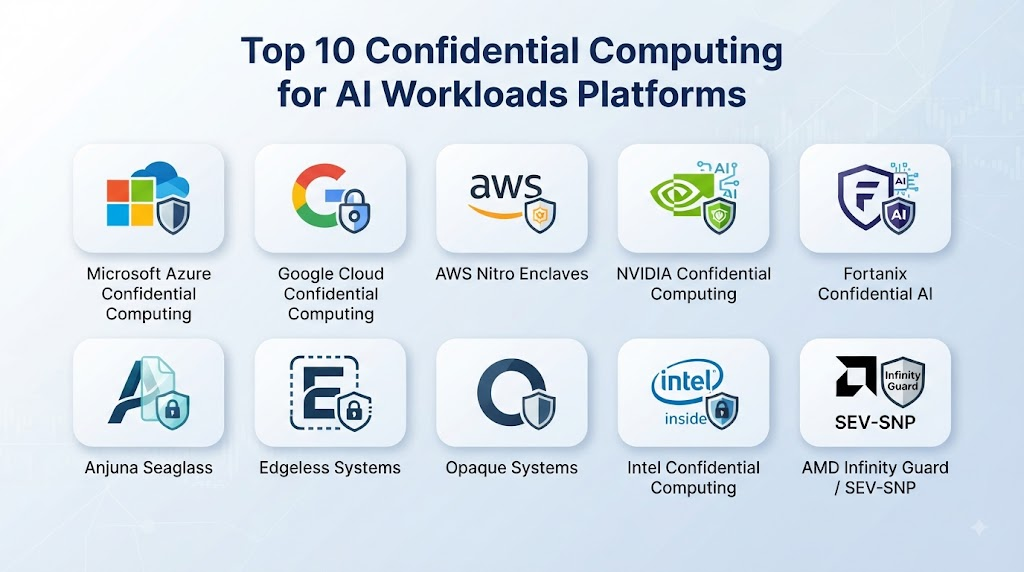
Top 10 Confidential Computing for AI Workloads Platforms
1. Microsoft Azure Confidential Computing
Azure Confidential Computing provides secure cloud environments for protecting sensitive workloads.
Key Features
- Trusted execution environments
- Confidential virtual machines
- Secure AI processing
- Hardware-backed isolation
- Attestation support
- Azure AI integration
Pros
- Strong enterprise cloud integration
- Broad confidential computing support
- Security-focused architecture
Cons
- Best suited for Azure environments
2. Google Cloud Confidential Computing
Google Cloud provides confidential VM and AI workload protection.
Key Features
- Confidential VMs
- Memory encryption
- Secure AI workloads
- Data protection
- Cloud integration
Pros
- Strong cloud security
- Easy Google Cloud integration
Cons
- Google Cloud dependency
3. AWS Nitro Enclaves
AWS Nitro Enclaves provides isolated computing environments.
Key Features
- Secure enclaves
- Data isolation
- Cryptographic attestation
- Secure processing
- AWS integration
Pros
- Strong AWS security architecture
- Developer flexibility
Cons
- Requires AWS expertise
4. Intel SGX
Intel SGX provides hardware-based secure enclaves.
Key Features
- Memory isolation
- Secure computation
- Remote attestation
- Protected applications
Pros
- Widely adopted technology
- Strong hardware security
Cons
- Requires specialized development
5. AMD Secure Encrypted Virtualization (SEV)
AMD SEV protects virtual machines through hardware-based encryption.
Key Features
- VM memory encryption
- Secure virtualization
- Confidential workloads
- Cloud support
Pros
- Strong hardware protection
- Scalable virtualization security
Cons
- Hardware dependency
6. NVIDIA Confidential Computing
NVIDIA provides confidential computing capabilities for AI workloads.
Key Features
- Confidential GPU computing
- Secure AI processing
- Protected inference
- GPU memory protection
- AI infrastructure security
Pros
- Designed for AI workloads
- High-performance computing support
Cons
- NVIDIA hardware dependency
7. IBM Hyper Protect Services
IBM provides confidential cloud services for sensitive workloads.
Key Features
- Secure execution
- Data protection
- Encryption
- Compliance support
- Enterprise security
Pros
- Strong security capabilities
- Enterprise focus
Cons
- Complex implementation
8. Fortanix Confidential Computing Platform
Fortanix provides confidential computing solutions.
Key Features
- Secure enclaves
- Application protection
- Key management
- Data security
- Cloud integration
Pros
- Multi-cloud support
- Strong security platform
Cons
- Requires technical expertise
9. Anjuna Confidential Cloud
Anjuna provides confidential computing software solutions.
Key Features
- Secure workload deployment
- Cloud protection
- Data confidentiality
- Application isolation
Pros
- Easy confidential workload deployment
- Cloud flexibility
Cons
- Specialized platform
10. Edgeless Systems Constellation
Edgeless Systems provides confidential Kubernetes and cloud-native security.
Key Features
- Confidential containers
- Kubernetes support
- Secure workloads
- Cloud-native protection
Pros
- Strong Kubernetes support
- Modern cloud architecture
Cons
- Requires container expertise
Comparison Table: Top 10 Confidential Computing for AI Workloads Platforms
| No. | Tool Name | Best For | Platform(s) Supported | Deployment | Standout Feature | Public Rating |
|---|---|---|---|---|---|---|
| 1 | Azure Confidential Computing | Enterprise AI workloads | Azure | Cloud | Secure AI execution | 4.8/5 |
| 2 | Google Confidential Computing | Cloud AI security | Google Cloud | Cloud | Memory encryption | 4.7/5 |
| 3 | AWS Nitro Enclaves | Secure AWS workloads | AWS | Cloud | Isolated environments | 4.7/5 |
| 4 | Intel SGX | Secure applications | Hardware | Local/Cloud | Secure enclaves | 4.6/5 |
| 5 | AMD SEV | Secure virtualization | Hardware | Cloud | VM encryption | 4.6/5 |
| 6 | NVIDIA Confidential Computing | AI workloads | GPU Cloud | Cloud | Confidential GPU AI | 4.8/5 |
| 7 | IBM Hyper Protect | Enterprise security | Cloud | Managed | Protected computing | 4.6/5 |
| 8 | Fortanix | Multi-cloud security | Cloud | Managed | Confidential platform | 4.6/5 |
| 9 | Anjuna | Cloud confidentiality | Cloud | Managed | Easy deployment | 4.5/5 |
| 10 | Edgeless Systems | Kubernetes AI security | Cloud | Enterprise | Confidential containers | 4.5/5 |
Weighted Evaluation Table
| No. | Tool Name | Security 25% | Ease of Use 15% | AI Support 15% | Performance 10% | Scalability 10% | Compliance 10% | Value 15% | Total Score |
|---|---|---|---|---|---|---|---|---|---|
| 1 | Azure Confidential Computing | 25 | 15 | 15 | 10 | 10 | 10 | 14 | 99 |
| 2 | Google Confidential Computing | 24 | 15 | 15 | 10 | 10 | 10 | 14 | 98 |
| 3 | AWS Nitro Enclaves | 24 | 14 | 15 | 10 | 10 | 10 | 14 | 97 |
| 4 | Intel SGX | 25 | 12 | 14 | 10 | 10 | 10 | 14 | 95 |
| 5 | AMD SEV | 24 | 13 | 14 | 10 | 10 | 10 | 14 | 95 |
| 6 | NVIDIA Confidential Computing | 25 | 14 | 15 | 10 | 10 | 10 | 14 | 98 |
| 7 | IBM Hyper Protect | 24 | 13 | 14 | 10 | 10 | 10 | 13 | 94 |
| 8 | Fortanix | 24 | 14 | 14 | 10 | 10 | 10 | 13 | 95 |
| 9 | Anjuna | 23 | 14 | 14 | 10 | 10 | 10 | 13 | 94 |
| 10 | Edgeless Systems | 23 | 13 | 14 | 10 | 10 | 10 | 13 | 93 |
Which Confidential Computing Platform Is Right for You?
Choose Azure Confidential Computing for enterprise Microsoft environments.
Choose Google Confidential Computing for Google Cloud AI workloads.
Choose AWS Nitro Enclaves for secure AWS applications.
Choose Intel SGX for hardware-level protection.
Choose AMD SEV for encrypted virtualization.
Choose NVIDIA Confidential Computing for AI GPU workloads.
Choose IBM Hyper Protect for regulated industries.
Choose Fortanix for multi-cloud confidential computing.
Choose Anjuna for simplified confidential deployment.
Choose Edgeless Systems for confidential Kubernetes workloads.
Implementation Playbook
Phase 1: Identify Sensitive AI Workloads
- Identify protected models
- Classify sensitive data
- Define security requirements
Phase 2: Select Confidential Environment
- Choose hardware support
- Select cloud platform
- Configure secure execution
Phase 3: Deploy AI Workloads
- Protect models
- Secure data processing
- Enable attestation
Phase 4: Monitor Security
- Track access
- Review security events
- Validate protection
Phase 5: Continuous Improvement
- Update security policies
- Improve AI protection
- Maintain compliance
Common Mistakes
- Running sensitive AI workloads without protection
- Ignoring data during processing
- Poor key management
- No attestation validation
- Limited security monitoring
- Choosing incompatible hardware
FAQs
1. What is Confidential Computing for AI Workloads?
It is a security approach that protects AI data and models while they are being processed.
2. Why is confidential computing important for AI?
It protects sensitive information and proprietary AI models during execution.
3. What technologies support confidential computing?
Trusted execution environments, secure enclaves, and hardware encryption technologies.
4. Can confidential computing protect AI models?
Yes, it helps secure models during training and inference.
5. Who uses confidential AI platforms?
Enterprises, healthcare organizations, financial institutions, and governments.
6. Does confidential computing affect AI performance?
Some overhead may occur, but modern hardware reduces performance impact.
7. Can confidential computing work with cloud AI?
Yes, major cloud providers support confidential computing services.
8. Is confidential computing part of AI security?
Yes, it is an important layer of AI data and model protection.
9. What is a trusted execution environment?
A protected area where sensitive computations run securely.
10. What is the future of confidential AI?
Confidential computing will become increasingly important for secure enterprise AI adoption.
Conclusion
Confidential Computing for AI Workloads is becoming a critical security foundation as organizations deploy advanced artificial intelligence systems. It enables businesses to protect sensitive data, secure AI models, and safely use cloud-based AI services.Platforms such as Microsoft Azure Confidential Computing, Google Confidential Computing, AWS Nitro Enclaves, NVIDIA Confidential Computing, Intel SGX, and Fortanix provide powerful capabilities for building secure AI environments.As AI adoption expands across industries, confidential computing will play a major role in enabling secure, private, and trustworthy artificial intelligence solutions.