Introduction
Hallucination Detection Tools are AI quality and reliability platforms designed to identify, measure, and reduce incorrect, unsupported, or fabricated information generated by large language models (LLMs).
As organizations adopt generative AI applications such as AI assistants, chatbots, RAG systems, copilots, and autonomous AI agents, preventing hallucinations has become a major challenge.
LLM hallucinations occur when an AI model generates responses that appear accurate but contain:
- False information
- Unsupported claims
- Incorrect facts
- Missing context
- Fabricated references
Hallucination Detection Tools help organizations continuously evaluate AI responses and improve reliability.
These platforms help teams:
- Detect inaccurate AI outputs
- Measure factual consistency
- Validate responses against trusted sources
- Improve RAG application quality
- Reduce AI risks
- Maintain user trust
Hallucination Detection Tools are used by:
- AI engineers
- LLM developers
- MLOps teams
- Data scientists
- Enterprise AI teams
- Product teams
Modern hallucination detection platforms provide capabilities such as:
- Faithfulness evaluation
- Grounding checks
- Context validation
- Citation verification
- RAG evaluation
- Response scoring
- Automated testing
- LLM monitoring
- Quality analytics
- Human feedback workflows
The goal of Hallucination Detection Tools is to ensure AI-generated content remains accurate, trustworthy, and aligned with real-world information.
What Are Hallucination Detection Tools?
Hallucination Detection Tools are systems that analyze AI-generated responses to determine whether the information is supported by available knowledge sources.
They compare:
- User questions
- Retrieved documents
- AI responses
- Reference information
to identify whether an answer contains unsupported information.
Example:
User asks:
“What are the side effects of this medicine?”
AI response:
“The medicine improves eyesight permanently.”
The hallucination detection system identifies that the statement is unsupported.
Why Organizations Need Hallucination Detection Tools
Generative AI models can produce incorrect answers because they:
- Predict likely text instead of verifying facts
- Lack real-time knowledge
- Misinterpret context
- Generate unsupported conclusions
Without detection systems, organizations may face:
- Incorrect customer information
- Compliance issues
- Business risks
- Loss of user confidence
Hallucination detection tools help organizations:
- Improve AI accuracy
- Validate responses
- Reduce misinformation
- Build trustworthy AI applications
Types of AI Hallucinations
Factual Hallucination
When AI generates incorrect facts.
Example:
Incorrect dates, names, statistics, or events.
Context Hallucination
When AI misunderstands available information.
Example:
Using unrelated document content.
Citation Hallucination
When AI creates fake:
- Sources
- References
- Links
Reasoning Hallucination
When AI creates incorrect logical conclusions.
RAG Hallucination
When AI generates answers not supported by retrieved documents.
How Hallucination Detection Tools Work
Response Collection
The system captures:
- User input
- Prompt
- AI response
- Retrieved context
Context Analysis
The platform checks:
- Source relevance
- Information coverage
- Supporting evidence
AI Evaluation
The system analyzes:
- Accuracy
- Faithfulness
- Completeness
Scoring
Responses receive scores based on:
- Reliability
- Grounding
- Quality
Alert Generation
Teams receive notifications about:
- Unsafe outputs
- Incorrect responses
- Quality problems
Key Components of Hallucination Detection Platforms
Grounding Evaluation Engine
Checks whether responses are supported by trusted sources.
Fact Verification System
Validates:
- Claims
- Statements
- Information accuracy
RAG Evaluation Layer
Measures:
- Retrieval quality
- Context relevance
- Answer faithfulness
LLM Evaluation Models
Uses AI models to judge:
- Response quality
- Accuracy
- Completeness
Human Feedback System
Collects:
- User ratings
- Expert reviews
- Corrections
Analytics Dashboard
Displays:
- Hallucination trends
- Failure patterns
- Quality metrics
Types of Hallucination Detection Tools
LLM Evaluation Platforms
Focus on:
- AI quality measurement
- Response testing
Examples:
- DeepEval
- TruLens
LLM Observability Platforms
Focus on:
- Monitoring
- Debugging
- Production analysis
Examples:
- Arize Phoenix
- Langfuse
Enterprise AI Governance Platforms
Focus on:
- Compliance
- Risk management
Examples:
- Fiddler AI
- WhyLabs
RAG Evaluation Platforms
Focus on:
- Retrieval accuracy
- Knowledge grounding
Key Features of Hallucination Detection Tools
Faithfulness Evaluation
Measures whether responses match available information.
Context Verification
Checks whether AI responses use correct context.
Citation Validation
Identifies:
- Unsupported references
- Incorrect sources
RAG Testing
Evaluates:
- Retrieval
- Context usage
- Answer generation
Automated Quality Scoring
Provides:
- Accuracy scores
- Reliability scores
- Confidence metrics
Continuous Monitoring
Tracks:
- Production responses
- Model behavior
- Quality changes
Common Use Cases
Customer Support AI
Detecting:
- Incorrect answers
- Unsupported solutions
Enterprise Knowledge Assistants
Validating:
- Internal documents
- Company information
Healthcare AI
Checking:
- Medical responses
- Safety requirements
Legal AI Applications
Validating:
- Legal information
- Document analysis
Financial AI Systems
Monitoring:
- Risk reports
- Financial recommendations
AI Search Applications
Ensuring:
- Relevant answers
- Correct information retrieval
Why Hallucination Detection Tools Matter
Improves AI Trust
Users receive more reliable answers.
Reduces Business Risk
Organizations avoid incorrect AI decisions.
Supports Responsible AI
Teams maintain quality standards.
Improves RAG Systems
Applications provide better grounded answers.
Enables Enterprise AI Adoption
Companies can deploy AI more confidently.
Evaluation Criteria for Buyers
Detection Accuracy
Evaluate:
- Factual checking
- Grounding analysis
- Evaluation reliability
RAG Support
Consider:
- Retrieval evaluation
- Context validation
Integration Support
Look for:
- LLM providers
- AI frameworks
- Application platforms
Automation
Evaluate:
- Continuous testing
- Production monitoring
Reporting
Consider:
- Dashboards
- Quality reports
- Analytics
Security
Evaluate:
- Data privacy
- Enterprise compliance
Key Trends
AI Self-Evaluation
Models are increasingly used to evaluate other AI outputs.
RAG Quality Management
Organizations are improving knowledge-grounded AI systems.
Enterprise AI Safety
Companies are adopting stronger reliability controls.
Agent Hallucination Monitoring
Tools are expanding toward autonomous AI agents.
Automated Fact Checking
AI systems are improving verification capabilities.
Responsible AI Governance
Hallucination detection is becoming part of AI compliance.
Methodology
The following Hallucination Detection Tools were evaluated based on:
- Detection capabilities
- RAG evaluation support
- Monitoring features
- Integration ecosystem
- Accuracy measurement
- Automation
- Security
- Scalability
- Developer experience
- Enterprise readiness
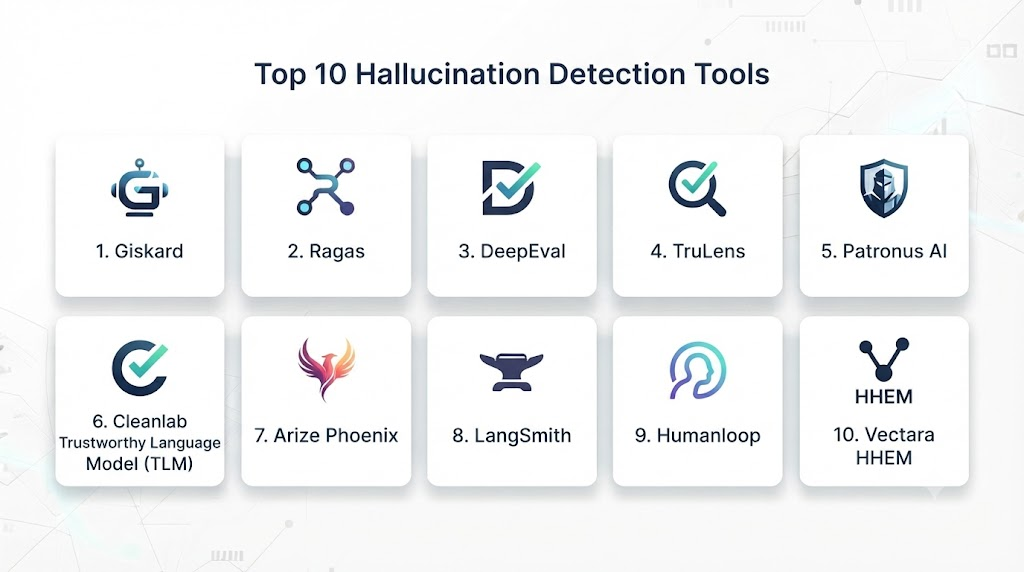
Top 10 Hallucination Detection Tools
1. Arize Phoenix
Arize Phoenix provides open-source AI observability and hallucination analysis capabilities.
Key Features
- LLM tracing
- Hallucination detection
- RAG evaluation
- Response analysis
- Embedding monitoring
- AI debugging
- Quality scoring
- Performance tracking
- Visualization
- Open-source deployment
Pros
- Strong LLM observability
- Excellent debugging
- Open source
- RAG support
- Developer-friendly
Cons
- Requires technical setup
- Learning curve
- Enterprise features vary
Platforms
Cloud and local environments.
Deployment or Support
LLM engineering teams.
Security & Compliance
Depends on deployment.
Integrations & Ecosystem
LLM frameworks.
Support & Community
Developer community.
2. DeepEval
DeepEval provides open-source evaluation frameworks for LLM applications.
Key Features
- Hallucination testing
- Faithfulness metrics
- RAG evaluation
- Custom metrics
- Regression testing
- Automated evaluations
- CI/CD integration
- Test cases
- Quality scoring
- Developer workflows
Pros
- Open source
- Flexible
- Strong evaluation metrics
- Easy integration
- Developer-focused
Cons
- Requires setup
- Technical knowledge needed
- Limited UI features
Platforms
Cloud and local environments.
Deployment or Support
AI developers.
Security & Compliance
Depends on deployment.
Integrations & Ecosystem
LLM applications.
Support & Community
Open-source community.
3. TruLens
TruLens provides feedback-based evaluation for LLM applications.
Key Features
- Hallucination detection
- RAG evaluation
- Feedback functions
- Grounding checks
- Quality metrics
- Testing
- Monitoring
- Experiment tracking
- AI reliability analysis
- Reporting
Pros
- Strong evaluation
- Open source
- RAG-focused
- Flexible
- Developer-friendly
Cons
- Requires setup
- Technical knowledge needed
- Enterprise features vary
Platforms
Cloud and local environments.
Deployment or Support
AI teams.
Security & Compliance
Depends on deployment.
Integrations & Ecosystem
LLM applications.
Support & Community
Developer community.
4. Langfuse
Langfuse provides open-source LLM monitoring and evaluation.
Key Features
- LLM tracing
- Hallucination analysis
- Prompt tracking
- Evaluation workflows
- User feedback
- Analytics
- Dataset management
- Self-hosting
- Monitoring
- API support
Pros
- Open source
- Flexible deployment
- Strong observability
- Good community
- Cost tracking
Cons
- Setup required
- Technical expertise needed
- Advanced features require configuration
Platforms
Cloud and self-hosted environments.
Deployment or Support
LLM application teams.
Security & Compliance
Self-managed security.
Integrations & Ecosystem
AI frameworks.
Support & Community
Open-source community.
5. Ragas
Ragas focuses on evaluation of RAG-based AI applications.
Key Features
- Faithfulness evaluation
- Answer relevance
- Context precision
- Context recall
- RAG benchmarking
- Dataset evaluation
- Automated metrics
- Developer tools
- Open-source framework
- AI testing
Pros
- Strong RAG evaluation
- Open source
- Research-focused
- Good metrics
- Developer-friendly
Cons
- RAG focused
- Requires technical knowledge
- Limited monitoring features
Platforms
Cloud and local environments.
Deployment or Support
RAG developers.
Security & Compliance
Depends on deployment.
Integrations & Ecosystem
RAG frameworks.
Support & Community
Developer community.
6. Fiddler AI
Fiddler AI provides enterprise AI monitoring and governance.
Key Features
- Hallucination monitoring
- Explainability
- AI governance
- LLM evaluation
- Bias detection
- Alerts
- Analytics
- Security
- Compliance
- Reporting
Pros
- Enterprise-ready
- Strong governance
- Explainability
- Security support
- AI monitoring
Cons
- Premium pricing
- Complex setup
- Enterprise-focused
Platforms
Cloud environments.
Deployment or Support
Enterprise AI teams.
Security & Compliance
Enterprise controls.
Integrations & Ecosystem
AI platforms.
Support & Community
Enterprise support.
7. WhyLabs
WhyLabs provides AI observability and quality monitoring.
Key Features
- LLM monitoring
- Data quality
- Hallucination analysis
- AI governance
- Alerts
- Analytics
- Model monitoring
- Reporting
- Production insights
- Risk detection
Pros
- Strong observability
- Enterprise capabilities
- Scalable
- Good governance
- AI monitoring
Cons
- Enterprise pricing
- Requires configuration
- Learning curve
Platforms
Cloud environments.
Deployment or Support
Enterprise teams.
Security & Compliance
Enterprise controls.
Integrations & Ecosystem
ML platforms.
Support & Community
Enterprise support.
8. Guardrails AI
Guardrails AI provides validation and safety controls for AI applications.
Key Features
- Output validation
- Response checking
- Safety rules
- Quality checks
- Custom validators
- LLM integration
- Developer tools
- AI safety workflows
- Open-source framework
- Monitoring support
Pros
- Strong AI safety focus
- Open source
- Flexible
- Developer-friendly
- Custom validators
Cons
- Requires engineering effort
- Configuration needed
- Limited analytics
Platforms
Cloud and local environments.
Deployment or Support
AI developers.
Security & Compliance
Depends on deployment.
Integrations & Ecosystem
LLM applications.
Support & Community
Developer community.
9. Galileo AI
Galileo AI provides AI quality management solutions.
Key Features
- Hallucination detection
- LLM evaluation
- Prompt analysis
- Quality monitoring
- RAG evaluation
- Analytics
- AI safety
- Feedback management
- Reporting
- Enterprise workflows
Pros
- AI-focused
- Strong quality analysis
- Enterprise support
- Good monitoring
- RAG capabilities
Cons
- Enterprise pricing
- Requires setup
- Smaller ecosystem
Platforms
Cloud environments.
Deployment or Support
Enterprise AI teams.
Security & Compliance
Enterprise controls.
Integrations & Ecosystem
AI platforms.
Support & Community
Enterprise support.
10. NVIDIA NeMo Guardrails
NVIDIA NeMo Guardrails provides safety and control layers for LLM applications.
Key Features
- Output control
- Safety rules
- Topic restrictions
- AI behavior management
- LLM integration
- Custom policies
- Developer tools
- Enterprise AI safety
- Workflow control
- Guardrail implementation
Pros
- Strong AI safety
- Enterprise-ready
- Flexible controls
- NVIDIA ecosystem
- Developer support
Cons
- Requires expertise
- Focused on guardrails
- Complex implementation
Platforms
Cloud and enterprise environments.
Deployment or Support
Enterprise AI applications.
Security & Compliance
Enterprise controls.
Integrations & Ecosystem
NVIDIA AI ecosystem.
Support & Community
Developer community.
Comparison Table
| Tool Name | Best For | Platform(s) Supported | Deployment | Standout Feature | Public Rating |
|---|---|---|---|---|---|
| Arize Phoenix | LLM observability | Cloud/Local | Flexible | AI debugging | |
| DeepEval | LLM testing | Cloud/Local | Flexible | Evaluation metrics | |
| TruLens | RAG evaluation | Cloud/Local | Flexible | Feedback functions | |
| Langfuse | LLM monitoring | Cloud/Self-hosted | Flexible | Open source | |
| Ragas | RAG testing | Cloud/Local | Flexible | Faithfulness metrics | |
| Fiddler AI | Enterprise governance | Cloud | Enterprise | Explainability | |
| WhyLabs | AI monitoring | Cloud | Enterprise | Observability | |
| Guardrails AI | AI safety | Cloud/Local | Flexible | Validators | |
| Galileo AI | AI quality | Cloud | Enterprise | Quality management | |
| NVIDIA NeMo Guardrails | LLM control | Cloud/Enterprise | Enterprise | Safety rules |
Weighted Evaluation
| Tool Name | Core Features 25% | Ease of Use 15% | Integrations & Ecosystem 15% | Security & Compliance 10% | Performance & Reliability 10% | Support & Community 10% | Price/Value 15% | Total |
|---|---|---|---|---|---|---|---|---|
| Arize Phoenix | 25 | 14 | 15 | 10 | 10 | 10 | 15 | 99 |
| DeepEval | 24 | 14 | 14 | 10 | 10 | 10 | 15 | 97 |
| TruLens | 24 | 14 | 14 | 10 | 10 | 10 | 15 | 97 |
| Langfuse | 24 | 14 | 15 | 10 | 10 | 10 | 15 | 98 |
| Ragas | 23 | 14 | 14 | 10 | 10 | 10 | 15 | 96 |
| Fiddler AI | 24 | 13 | 14 | 10 | 10 | 10 | 12 | 93 |
| WhyLabs | 24 | 13 | 15 | 10 | 10 | 10 | 13 | 95 |
| Guardrails AI | 23 | 14 | 14 | 10 | 10 | 10 | 15 | 96 |
| Galileo AI | 23 | 13 | 14 | 10 | 10 | 10 | 12 | 92 |
| NVIDIA NeMo Guardrails | 24 | 12 | 15 | 10 | 10 | 10 | 13 | 94 |
Which Hallucination Detection Tool Is Right for You?
Choose Arize Phoenix for LLM observability and debugging.
Choose DeepEval for automated LLM testing.
Choose TruLens for RAG evaluation.
Choose Langfuse for open-source LLM monitoring.
Choose Ragas for RAG quality measurement.
Choose Fiddler AI for enterprise AI governance.
Choose WhyLabs for AI observability.
Choose Guardrails AI for output validation.
Choose Galileo AI for enterprise AI quality management.
Choose NVIDIA NeMo Guardrails for AI safety controls.
Implementation Playbook
Phase 1: Define AI Quality Standards
- Identify risks
- Define accuracy requirements
- Create evaluation metrics
Phase 2: Connect AI Applications
- Capture prompts
- Collect responses
- Add monitoring
Phase 3: Run Evaluations
- Test outputs
- Measure faithfulness
- Detect hallucinations
Phase 4: Improve AI Systems
- Update prompts
- Improve retrieval
- Fine-tune models
Phase 5: Maintain Continuous Monitoring
- Track quality
- Review failures
- Improve reliability
Common Mistakes
- Deploying LLMs without validation
- Ignoring hallucination risks
- No evaluation datasets
- Relying only on human reviews
- Poor source grounding
- No monitoring strategy
- Ignoring AI safety
FAQs
1. What are Hallucination Detection Tools?
They are tools that identify incorrect or unsupported information generated by AI models.
2. Why do LLMs hallucinate?
LLMs generate probable text and may produce information without true verification.
3. Can hallucination detection tools prevent all errors?
They reduce risks but cannot guarantee complete elimination of incorrect outputs.
4. What is faithfulness evaluation?
It measures whether an AI response is supported by available information.
5. Do these tools support RAG applications?
Yes, many specialize in retrieval-augmented generation evaluation.
6. Who uses hallucination detection platforms?
AI engineers, developers, enterprises, and product teams use them.
7. Are open-source hallucination detection tools available?
Yes, DeepEval, TruLens, Ragas, and Langfuse provide open-source options.
8. Can hallucination detection work with different LLMs?
Yes, most tools support multiple AI models.
9. How do these tools improve AI trust?
They identify unreliable responses and help teams improve AI quality.
10. What is the future of hallucination detection?
It will become a standard requirement for safe and reliable enterprise AI systems.
Conclusion
Hallucination Detection Tools are becoming essential for organizations building reliable generative AI applications. They help teams identify inaccurate responses, improve RAG performance, and create safer AI experiences.Platforms such as Arize Phoenix, DeepEval, TruLens, Langfuse, Ragas, and Guardrails AI provide powerful capabilities for evaluating and controlling AI outputs.As LLM applications and AI agents continue to expand, hallucination detection will become a critical part of LLMOps, AI governance, and responsible artificial intelligence.