Introduction
Navigating the intricacies of taxation, corporate governance, financial reporting, and regulatory compliance is one of the most critical responsibilities for individuals, startups, and established enterprises alike. As regulatory frameworks evolve rapidly across local and international jurisdictions, maintaining error-free financial records and filing timely tax returns requires specialized expertise. Whether you are an individual taxpayer aiming to optimize your income tax liabilities, a startup founder incorporating a new business entity, an established corporation preparing for statutory audits, or a Non-Resident Indian (NRI) managing cross-border assets, working with a certified financial expert is paramount. Finding qualified expertise used to require relying solely on word-of-mouth recommendations, but modern digital platforms have transformed the discovery process. Through platforms like BestCaNow , clients can easily evaluate credentials, review specialized domains, and engage top financial experts. This educational guide explores the full spectrum of professional accounting services, details core compliance mandates, compares key accounting models, and provides actionable guidelines to help you select the ideal professional for your specific requirements.
Understanding the Role of a Modern Chartered Accountant
Financial governance extends far beyond basic arithmetic and transaction logging. A qualified financial professional serves as a strategic corporate partner who safeguards organizational solvency, prevents legal liabilities, and identifies legitimate tax-saving opportunities.
+-----------------------------------------------------------------------------------+
|                        MODERN CHARTERED ACCOUNTANT ROLE                           |
+-----------------------------------------------------------------------------------+
|  1. Statutory Compliance   --> GST, Income Tax, MCA, TDS, and ROC Filings        |
|  2. Financial Advisory     --> Capital Structure, Cash Flow & Risk Mitigation     |
|  3. Assurance & Audit      --> Tax Audits, Internal Audits & Statutory Reviews   |
|  4. Strategic Growth       --> Mergers, Valuation, Restructuring & Expansion     |
+-----------------------------------------------------------------------------------+
From Traditional Bookkeeping to Strategic Financial Advisory
Historically, accounting practices focused primarily on historical transaction recording, basic ledger maintenance, and manual preparation of year-end balance sheets. While accurate record-keeping remains a fundamental foundation, modern commercial environments require proactive, forward-looking insights. Contemporary financial advisory encompasses corporate budgeting, capital structure management, working capital optimization, risk management, and strategic mergers or acquisitions. By analyzing real-time financial statements, professional advisers assist leadership teams in making data-driven operational decisions that foster long-term enterprise sustainability.
Essential Services Offered by Financial Professionals
To maintain operational standing with revenue authorities, businesses and high-net-worth individuals must leverage specialized professional services across multiple disciplines.
Income Tax Planning and E-Filing
Taxation regulations are subject to frequent legislative amendments, shifting rate structures, and nuanced deduction mandates. Working with an income tax consultant near me ensures that individual and corporate returns are prepared accurately, utilizing all permissible deductions under relevant statutes. Professional advisers conduct meticulous pre-filing tax reviews, structure executive compensation plans, handle Advance Tax computations, manage Tax Deducted at Source (TDS) filings, and represent clients during official assessment proceedings or notice responses issued by tax authorities.
GST Registration and Continuous Compliance
The Goods and Services Tax framework establishes a unified indirect tax regime, but it demands strict recurring compliance. Engaging a dedicated GST consultant near me enables businesses to complete seamless initial GST registration, determine accurate Harmonized System of Nomenclature (HSN) classification codes, and execute timely monthly or quarterly return filings (such as GSTR-1, GSTR-3B, and GSTR-9 annual returns). Furthermore, professional consultants reconcile Input Tax Credit (ITC) ledgers against vendor disclosures to eliminate credit leakages and prevent tax interest penalties.
Statutory, Tax, and Internal Audit Services
Audit engagements provide independent assurance regarding an organization’s financial health, internal controls, and reporting fairness. Searching for audit services near me allows corporate management to locate qualified audit firms capable of conducting rigorous statutory audits mandated by corporate laws, specialized tax audits under revenue legislation, and operational internal audits designed to uncover process inefficiencies, internal fraud risks, and regulatory non-compliance.
Startup and Business Incorporation Requirements
Launching a new commercial venture requires selecting an appropriate organizational entity and fulfilling mandatory legal prerequisites.
Choosing the Correct Legal Structure
Selecting the appropriate legal entity dictates founder liability, taxation frameworks, equity dilution capacity, and ongoing compliance burdens. Founders typically choose between Sole Proprietorships, Partnerships, Limited Liability Partnerships (LLPs), and Private Limited Companies. A specialized CA for startups assists entrepreneurs in evaluating capital requirements, investor readiness, and operational scalability before submitting incorporation documentation to regulatory registries.
Mandatory Regulatory Filings for MSMEs
Following incorporation, Micro, Small, and Medium Enterprises (MSMEs) must secure relevant operational licenses, including Permanent Account Numbers (PAN), Tax Deduction Account Numbers (TAN), Shops and Establishment registrations, and MSME Udyam certifications. Furthermore, early-stage businesses require professional guidance to implement robust accounting software, configure automated payroll TDS deductions, and satisfy periodic Ministry of Corporate Affairs (MCA) return mandates.
Specialized Taxation and Compliance Considerations for NRIs
Non-Resident Indians managing financial assets, ancestral properties, or active investments in India face complex, dual-jurisdiction tax environments.
Managing Foreign Remittances and Double Taxation Relief
Cross-border financial transactions require strict compliance with foreign exchange management regulations and domestic tax codes. Utilizing a specialized NRI tax consultant in India helps non-residents handle capital gains taxation arising from property sales, manage dividend withholding taxes, process Form 15CA and Form 15CB certifications required for foreign fund remittances, and claim relief under applicable Double Taxation Avoidance Agreements (DTAA) to prevent foreign tax exposure.
Critical Financial & Operational Comparisons
To optimize financial administration, organizations must compare distinct service models, legal structures, and audit types.
1. Online CA Consultation vs In-Person Consultation
| Features | Online CA Consultation | In-Person Consultation |
| Primary Interaction Mode | Secure Video Conferencing & Digital Portals | Physical Office Meetings |
| Geographic Accessibility | Global / Nationwide Access | Limited to Local Proximity |
| Document Exchange | Encrypted Cloud Uploads & Digital Copies | Physical Paper File Exchange |
| Turnaround Time | Rapid, Real-Time Scheduling | Requires Travel & Physical Appointments |
| Cost Structure | Typically Lower Overhead & Flexible Fees | Fixed Retainers & Higher Operational Overhead |
| Best Use Cases | Routine Filings, NRI Consultations, Quick Advice | Complex Legal Disputes, Physical Audit Verification |
2. In-House Accountant vs External Chartered Accountant
| Features | In-House Accountant | External Chartered Accountant |
| Scope of Work | Daily Bookkeeping & Invoicing | Advanced Planning, Statutory Audits & E-Filing |
| Professional Certification | General Accounting Degree / Bookkeeper | Qualified Professional Certification (ICAI) |
| Regulatory Standing | Cannot Sign Statutory Audit Reports | Authorized Legal Signatory for Tax & Audits |
| Cost Structure | Full-Time Salary, Benefits & Overhead | Engagement-Based Fees or Fixed Retainers |
| Strategic Insight | Operational & Day-to-Day Focus | High-Level Governance & Risk Management |
| Best Use Cases | Daily Transaction Recording & Ledger Entry | Annual Tax Filings, Compliance & Financial Audits |
3. Internal Audit vs Statutory Audit
| Features | Internal Audit | Statutory Audit |
| Primary Objective | Process Improvement & Internal Control Check | Express Independent Opinion on Financial Statements |
| Mandate Source | Company Board or Management Discretion | Legal Mandate under Corporate & Tax Laws |
| Reporting Audience | Internal Management & Audit Committee | Shareholders, Tax Authorities & Regulators |
| Focus Area | Operational Efficiency & Fraud Prevention | Compliance with Accounting Standards & Statutes |
| Frequency | Continuous, Monthly, or Quarterly | Annual Review at Financial Year-End |
| Best Use Cases | Enhancing Corporate Governance & Operations | Legal Compliance & Official Regulatory Submissions |
Actionable Best Practices for Corporate Financial Management
Adopting disciplined financial management practices prevents emergency compliance interventions and optimizes organizational capital allocation.
- Maintain Digital Records Continuously: Avoid end-of-year record reconciliation rushes by systematically uploading bills, purchase invoices, and bank statements into secure cloud storage software.
- Separate Personal and Business Accounts: Never mix personal expenditures with commercial business bank accounts, as this compromises liability protection and creates tax audit complications.
- Automate Tax Deductions at Source: Integrate automated payroll software to calculate, deduct, and deposit TDS accurately before monthly statutory deadlines.
- Conduct Monthly Bank Reconciliations: Compare internal general ledgers with bank statements monthly to catch unauthorized charges, missing payments, or accounting entry errors early.
- Establish an Emergency Tax Reserve: Maintain a dedicated liquid reserve account to cover quarterly Advance Tax payments, GST liabilities, and annual tax payments without disrupting working capital.
Expert Tips for Choosing and Managing Your CA Partnership
Selecting the right financial adviser is a long-term strategic decision that directly influences your financial health and security.
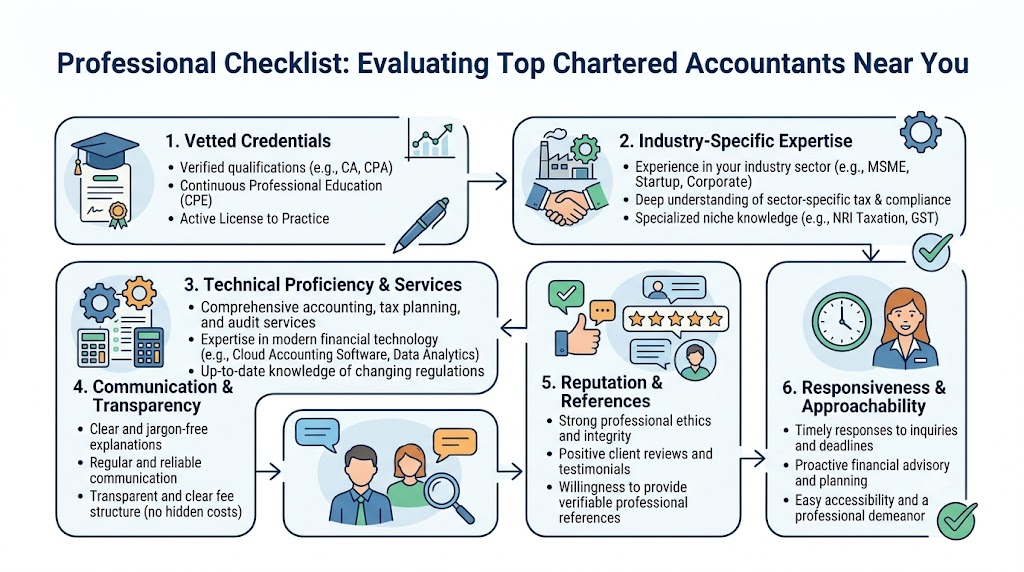
- Verify Official Credentials: Always confirm that the professional or firm holds an active Certificate of Practice from the designated regulatory authority before sharing confidential data.
- Assess Industry-Specific Experience: Ensure the adviser possesses deep experience in your specific operational sector, such as e-commerce, real estate, software development, or international trade.
- Prioritize Communication Transparency: Choose professionals who clearly explain complex statutory requirements without relying exclusively on dense jargon, ensuring you understand your financial position.
- Evaluate Digital Adoption: Partner with advisers who leverage modern communication tools, client management portals, and cloud accounting systems to ensure seamless collaboration.
- Clarify Engagement Terms: Establish clear written engagement contracts detailing service scope, turnaround times, confidentiality obligations, and fee structures upfront to avoid unexpected bills.
Common Financial and Tax Mistakes to Avoid
Suboptimal financial practices can trigger severe regulatory penalties, tax demands, and operational disruptions.
+-----------------------------------------------------------------------------------+
|                        TOP 5 FINANCIAL MISTAKES TO AVOID                          |
+-----------------------------------------------------------------------------------+
|  [!] Missing Statutory Tax Filings    --> Leads to Penalties & Loss of Credits   |
|  [!] Poor Input Tax Credit Tracking   --> Causes Direct Financial Cash Leakage   |
|  [!] Hiring Based Only on Lowest Price --> Risk of Incomplete or Faulty Filings  |
|  [!] Delaying Annual Tax Planning     --> Causes Emergency Rush & Overpayment    |
|  [!] Neglecting ROC & Corporate Rules --> Triggers Fines & Officer Disqualification|
+-----------------------------------------------------------------------------------+
- Delaying Income Tax and GST Return Filings: Missing statutory return deadlines results in daily late fees, compounding interest penalties, and potential cancellation of tax registrations.
- Neglecting Input Tax Credit Reconciliations: Failing to reconcile purchase invoices with vendor GST returns leads to unutilized tax credits, directly inflating operational costs.
- Selecting Advisory Professionals Solely on Price: Choosing financial advisers based exclusively on lower fees often leads to inadequate compliance oversight, omitted disclosures, and costly tax notices later.
- Postponing Tax Planning Until Year-End: Initiating tax saving strategies in the final weeks of the fiscal year restricts investment options and results in tax overpayments.
- Ignoring Corporate Law Compliance: Failing to file annual MCA returns, maintain statutory registers, or record board meeting minutes exposes company directors to severe fines and disqualification risks.
The Evolution of Digital CA Platforms and Direct Directories
Searching for reliable financial professionals historically depended on localized geographic proximity or personal network referrals, restricting client choice. Modern financial directories have completely modernized this discovery process by establishing centralized platforms where individuals and business managers can search, evaluate, and connect with verified experts across diverse specializations.
+-----------------------------------------------------------------------------------+
|                      DIGITAL PLATFORM SELECTION WORKFLOW                          |
+-----------------------------------------------------------------------------------+
|  Step 1: Search Directory by Specialization, Location & Language                   |
|  Step 2: Compare Verified Credentials, Experience & Consultation Modes             |
|  Step 3: Schedule Direct Online CA Consultation or In-Person Appointment         |
|  Step 4: Securely Collaborate, Share Documents & Execute Filings                  |
+-----------------------------------------------------------------------------------+
Digital directories organize expert profiles based on verifiable experience, geographic coverage, foreign taxation knowledge, and technical industry focus. Furthermore, digital platforms facilitate seamless online CA consultation, enabling clients in remote regions or international locations to obtain top-tier advice without requiring physical office visits. This direct transparency empowers clients to select experts whose capabilities perfectly match their specific business model and regulatory demands.
Why Choose BestCaNow for Discovering Verified Professionals
When selecting a trusted platform to connect with top financial experts, BestCaNow provides an intuitive directory designed for modern search requirements. The platform simplifies professional discovery through key features:
- Comprehensive Global Directory: Access a searchable index of verified Chartered Accountants and corporate consultants categorized by city, jurisdiction, and industry focus.
- Transparent Professional Profiles: Review verified experience metrics, professional qualifications, language capabilities, and technical specialization areas prior to booking.
- Flexible Consultation Modes: Choose between secure digital online consultations or direct in-person office meetings based on your schedule and geographical location.
- Diverse Domain Expertise: Easily discover specialized professionals for startup incorporation, GST compliance, cross-border NRI tax planning, statutory audits, and corporate advisory.
- Direct & Frictionless Booking: Streamline preliminary inquiries, schedule consultation appointments, and establish direct contact without unnecessary middleman delays.
Frequently Asked Questions (FAQs)
Q1: What is the primary difference between a tax consultant and a Chartered Accountant?
A Chartered Accountant is a qualified professional who has completed rigorous certification, practical training, and examinations governed by an official statutory body. They possess full legal authority to perform statutory audits and sign financial audit reports. Conversely, a general tax consultant may assist with basic return preparation but lacks statutory auditing authority under corporate law.
Q2: How do I find a qualified Chartered Accountant near me for small business taxes?
You can search specialized online professional directories to locate verified financial experts in your local area. Filter your search by city, business specialization, and client feedback to find an adviser who understands your specific industry requirements and operational scope.
Q3: Can a startup complete company registration without hiring a CA?
While entrepreneurs can theoretically submit incorporation documents directly through official government portals, engaging a specialized professional ensures that legal articles, share capital structures, director disclosures, and preliminary tax registrations (PAN/TAN/GST) are executed correctly without rejection risks.
Q4: What documents are typically required for an online CA consultation regarding income tax filing?
You generally need your Permanent Account Number (PAN), Aadhaar card, Form 16 provided by employers, annual bank account statements, investment proofs (such as ELSS, PPF, or insurance certificates), and Form 26AS/Annual Information Statement (AIS) downloaded from the official tax portal.
Q5: How often does a business need to file GST returns?
GST return frequency depends on your business turnover and registered scheme. Regular taxpayers under the standard scheme file monthly GSTR-1 and GSTR-3B returns, while eligible small businesses under the QRMP scheme file quarterly returns with monthly tax payments. All registered entities must also submit an annual return.
Q6: What is a Tax Audit, and when does it become mandatory for businesses?
A Tax Audit involves an independent examination of a business’s financial accounts to verify compliance with income tax laws. It becomes legally mandatory when commercial turnover exceeds prescribed statutory thresholds or when professionals declare profits lower than statutory presumptive taxation percentages.
Q7: How can an NRI tax consultant in India help reduce double taxation risks?
An NRI tax consultant evaluates double taxation treaties between India and your foreign country of residence. They assist in obtaining Tax Residency Certificates (TRC), applying appropriate treaty withholding rates, certifying foreign remittances, and claiming foreign tax credits on your resident country tax returns.
Q8: What is the difference between a Limited Liability Partnership (LLP) and a Private Limited Company?
A Private Limited Company offers greater equity fundraising flexibility, making it ideal for venture-backed startups, but it carries higher ongoing regulatory compliance burdens. An LLP provides limited liability protection with lower statutory maintenance costs, making it preferable for professional services and closely held businesses.
Q9: Why is Input Tax Credit (ITC) reconciliation so critical for GST compliance?
Input Tax Credit reconciliation ensures that tax paid on business purchases matches vendor disclosures submitted to tax authorities. Unreconciled credits can trigger tax demands, interest charges, or credit blockages, directly reducing operational cash flow and profitability.
Q10: What are Form 15CA and Form 15CB, and why are they necessary for foreign money transfers?
Form 15CA is an online declaration filed by individuals remitting money abroad, while Form 15CB is a formal certification issued by a Chartered Accountant verifying that appropriate taxes have been paid in India before foreign transfer. They are mandatory for cross-border banking compliance.
Q11: Can an individual or business switch their Chartered Accountant during an ongoing financial year?
Yes, clients can transition to a new financial adviser at any point during the year. The process requires settling outstanding fees with the previous adviser and securing a formal No Objection Certificate (NOC) before the new professional assumes compliance duties.
Q12: What is an internal audit, and how does it differ from a statutory annual audit?
An internal audit is an operational review initiated by company management to assess internal controls, operational efficiency, and risk exposure. In contrast, a statutory audit is an independent annual examination required by law to present an accurate financial state to shareholders and regulators.
Q13: How do digital platforms ensure the quality and authenticity of listed Chartered Accountants?
Reputable digital platforms verify credentials, membership numbers, and professional background details against official regulatory registers before approving expert profiles. This rigorous admin review ensures that clients connect exclusively with active, certified financial professionals.
Q14: What penalties apply if a business misses the deadline for filing annual corporate returns?
Missing annual corporate filing deadlines results in compounding daily penalty fees, potential blocking of director identification numbers, administrative fines on company officers, and possible legal prosecution or corporate striking-off by corporate registries.
Q15: How much does an initial consultation with a Chartered Accountant typically cost?
Consultation fees vary depending on professional experience, geographic location, complexity, and consultation mode. Initial online advisory sessions may start at modest rates, whereas comprehensive corporate structuring or complex tax dispute reviews are quoted based on specific project requirements.
Conclusion
Managing financial obligations, tax compliance, corporate governance, and statutory reporting is essential for maintaining personal wealth and organizational growth. Attempting to handle complex legal and tax mandates without qualified professional guidance often leads to missed deductions, costly interest penalties, and unnecessary exposure to regulatory notices. By engaging certified financial advisers, individuals and commercial enterprises ensure full statutory compliance while optimizing their strategic tax positioning. Whether you require routine tax filing assistance, comprehensive startup incorporation services, cross-border NRI taxation advice, or detailed statutory audits, partnering with the right financial expert provides irreplaceable peace of mind.