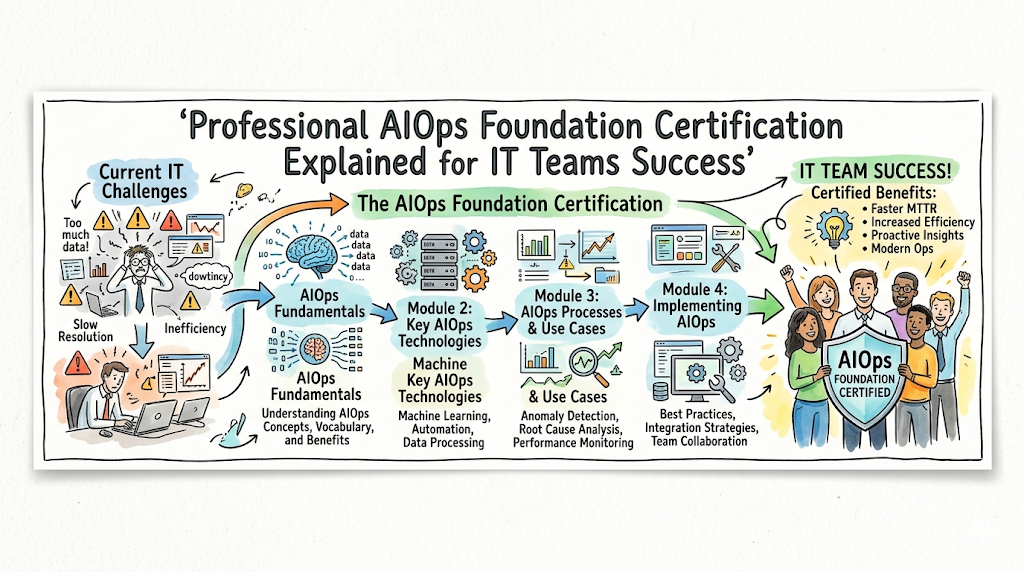
The AIOps Foundation Certification is an essential credential for modern engineers who want to stay ahead in an industry increasingly dominated by automation and data-driven operations. This guide is designed for professionals looking to navigate the transition from traditional IT operations to AI-enhanced workflows, providing a clear roadmap for career growth. Whether you are in India or working within a global team, understanding the intersection of artificial intelligence and IT operations is no longer optional for those in DevOps, cloud-native, or platform engineering roles. By leveraging the training programs at Aiopsschool, professionals can make informed career decisions that ensure long-term relevance and technical excellence in a rapidly changing landscape.
What is the AIOps Foundation Certification?
The AIOps Foundation Certification represents a significant shift in how we approach the reliability and performance of complex digital systems. It exists to validate a professional’s understanding of how artificial intelligence and machine learning can be applied to automate and enhance IT operations tasks. This program emphasizes real-world, production-focused learning, moving beyond academic theory to show how algorithmic insights can solve actual infrastructure challenges.
In the modern enterprise, environments have become too complex for manual human intervention alone to suffice. This certification aligns with modern engineering workflows by introducing concepts like noise reduction, anomaly detection, and predictive maintenance. It provides a structured framework for professionals to understand the lifecycle of data within operations, ensuring that practitioners can implement enterprise-grade AI solutions that improve system uptime and reduce operational fatigue.
Who Should Pursue AIOps Foundation Certification?
This program is highly beneficial for a wide range of roles, including DevOps engineers, SREs, cloud architects, and security professionals who are managing large-scale environments. It is equally relevant for data engineers who want to understand the operational side of AI and for technical managers who need to lead teams through digital transformation. The curriculum is designed to be accessible for beginners while providing the depth required for experienced engineers looking to modernize their skill sets.
In the global market, and particularly within the thriving tech hubs of India, there is a massive demand for professionals who can bridge the gap between traditional operations and data science. Engineering managers and technical leaders should pursue this to better understand how to allocate resources and implement automation strategies that provide a competitive edge. This certification ensures that regardless of your current level, you have a validated understanding of the future of automated operations.
Why AIOps Foundation Certification is Valuable and Beyond
The value of this certification lies in its focus on the longevity and scalability of IT operations through intelligence. As toolchains become more fragmented and data volumes explode, the ability to use AI to find the “signal in the noise” is a high-value skill that ensures a professional remains relevant despite changes in specific software versions. It offers a substantial return on time and career investment by positioning candidates for senior roles in high-growth companies.
Enterprise adoption of AI-driven operations is accelerating as organizations look for ways to reduce mean time to resolution and improve customer experiences. This certification confirms that a professional is capable of moving from a reactive “firefighting” mode to a proactive, predictive posture. By mastering these principles, engineers can future-proof their careers, ensuring they are the ones designing and managing the intelligent systems of tomorrow rather than being replaced by them.
AIOps Foundation Certification Overview
The program is a comprehensive educational journey delivered through the aiopsschool.com platform and hosted on the Aiopsschool website. It is designed to provide a clear, logical progression from basic data concepts to advanced automated remediation strategies. The certification uses a practical, assessment-based approach that tests a candidate’s ability to interpret operational data and apply machine learning models to solve infrastructure problems.
The structure of the certification is managed by industry experts who have years of experience in managing global-scale production systems. It involves a mix of theoretical modules, practical assessments, and hands-on scenarios that reflect the current state of the industry. Ownership of the curriculum ensures that the content is updated to reflect the latest advancements in AI and IT operations, providing a robust and validated path for professional development in the automated era.
AIOps Foundation Certification Tracks & Levels
The certification is organized into three distinct levels: Foundation, Professional, and Advanced. The Foundation level introduces the core concepts of data ingestion, noise reduction, and basic algorithmic patterns, making it the ideal starting point for most professionals. It ensures a shared vocabulary and understanding of how AI interacts with traditional monitoring systems.
The Professional level dives deeper into specialized tracks such as SRE-focused AIOps or DevOps-integrated automation, focusing on the tactical implementation of models in a CI/CD environment. The Advanced level is intended for senior architects and leadership, covering global strategy, governance, and the orchestration of multi-model environments. These levels align with career progression milestones, helping professionals move from individual contributors to strategic technical leaders.
Complete AIOps Foundation Certification Table
| Track | Level | Who it’s for | Prerequisites | Skills Covered | Recommended Order |
| Operations AI | Foundation | All Engineers | Basic DevOps knowledge | Anomaly Detection, Noise Reduction | 1 |
| Operations AI | Professional | SREs, DevOps Leads | Foundation Level | Predictive Analytics, Automated Healing | 2 |
| Operations AI | Advanced | Architects, Managers | Professional Level | Global Governance, Strategic Planning | 3 |
Detailed Guide for Each AIOps Foundation Certification
AIOps Foundation Certification – Foundation Level
What it is
This certification validates a professional’s understanding of the fundamental building blocks of AI-driven operations. It confirms that the holder understands the difference between traditional threshold-based alerting and algorithmic anomaly detection.
Who should take it
It is suitable for entry-level DevOps engineers, junior SREs, and IT managers who need to understand the basic concepts of data science within an operational context.
Skills you’ll gain
- Understanding the lifecycle of operational data.
- Implementing basic noise reduction in monitoring systems.
- Identifying different types of machine learning models used in IT.
- Configuring foundational anomaly detection alerts.
Real-world projects you should be able to do
- Create a filtered dashboard that reduces event noise from a busy service.
- Set up a basic outlier detection model for an application latency metric.
- Identify patterns in historical incident data using automated tools.
Preparation plan
- 7-14 Days: Focus on the core vocabulary of AI and the basic architecture of AIOps platforms.
- 30 Days: Complete practical labs on data ingestion and basic dashboarding.
- 60 Days: Implement a pilot noise reduction project on a non-production system.
Common mistakes
- Treating AIOps as a “magic box” that solves all problems without clean data.
- Neglecting the importance of domain expertise when interpreting AI results.
Best next certification after this
- Same-track option: AIOps Foundation Certification – Professional Level
- Cross-track option: SRE Foundation Certification
- Leadership option: Engineering Management Fundamentals
AIOps Foundation Certification – Professional Level
What it is
The Professional level validates the ability to implement and manage active AI models within a production environment. It focuses on the tactical use of predictive analytics to prevent outages.
Who should take it
This is intended for experienced DevOps leads, SREs, and platform engineers who are responsible for the health of complex, high-scale digital services.
Skills you’ll gain
- Designing and implementing automated remediation workflows.
- Tuning machine learning models for high accuracy in production.
- Integrating AI insights into existing incident management processes.
- Managing the “human-in-the-loop” aspect of automated operations.
Real-world projects you should be able to do
- Build an automated self-healing workflow triggered by a predictive alert.
- Optimize an anomaly detection model to reduce false positives by 40%.
- Lead a post-mortem that uses AI-driven root cause analysis.
Preparation plan
- 7-14 Days: Review advanced algorithmic patterns and remediation frameworks.
- 30 Days: Analyze historical outage data to train predictive models in a lab.
- 60 Days: Deploy and monitor an automated healing script in a staging environment.
Common mistakes
- Trusting automated remediation too early without sufficient validation.
- Failing to update models as the underlying infrastructure changes.
Best next certification after this
- Same-track option: AIOps Foundation Certification – Advanced Level
- Cross-track option: FinOps Professional Certification
- Leadership option: Director of Engineering Track
AIOps Foundation Certification – Advanced Level
What it is
The Advanced level validates the expertise required to design and lead a global AIOps strategy for an enterprise. It focuses on the strategic alignment of AI with business outcomes.
Who should take it
Senior Architects, Directors of Engineering, and CTOs who are responsible for the overall technical strategy and operational excellence of an organization.
Skills you’ll gain
- Designing enterprise-wide AIOps governance and ethics frameworks.
- Managing the financial aspects of large-scale AI operations.
- Architecting multi-model systems for complex, hybrid-cloud environments.
- Leading organizational change to adopt an “AI-first” operational mindset.
Real-world projects you should be able to do
- Develop a three-year strategic roadmap for AI-driven operations in a global firm.
- Negotiate and design an AIOps platform architecture with executive stakeholders.
- Audit and optimize the cost-to-value ratio of an enterprise AI implementation.
Preparation plan
- 7-14 Days: Study executive communication and the financial management of AI.
- 30 Days: Perform a comprehensive audit of an organization’s operational maturity.
- 60 Days: Design a global governance model for automated production changes.
Common mistakes
- Overlooking the cultural resistance to automation and AI within a team.
- Focusing on the complexity of the AI model rather than the business impact.
Best next certification after this
- Same-track option: Executive Leadership in Technology
- Cross-track option: Enterprise Architecture Certification
- Leadership option: Chief Technology Officer Program
Choose Your Learning Path
DevOps Path
The DevOps path focuses on integrating AI and machine learning into the continuous delivery pipeline. This involves using intelligent automation to improve code quality checks and deployment safety. Managers on this path work to ensure that the transition from development to production is enhanced by predictive insights, allowing for faster releases with fewer regressions. It is a journey of making the delivery lifecycle more resilient and data-informed.
DevSecOps Path
The DevSecOps path emphasizes the use of AI to enhance the security posture of an organization. This includes using machine learning for threat detection, automated vulnerability scanning, and predictive security analytics. Leaders in this track learn how to implement security controls that can adapt to changing threats in real-time. It is ideal for those who want to build a “self-securing” infrastructure that protects the business without slowing down development.
SRE Path
The SRE path is dedicated to using AI to maintain and improve system reliability at scale. It focuses on the use of algorithms to manage SLOs, error budgets, and complex incident response. Managers in this track spend their time optimizing observability frameworks and building automated healing systems that reduce the burden on on-call engineers. It is a highly technical path that treats reliability as a data science and software engineering challenge.
AIOps Path
The AIOps path is a pure-play focus on the transformation of IT operations through artificial intelligence. It covers the entire lifecycle of data ingestion, pattern recognition, and automated action across all infrastructure layers. This path is for those who want to be specialists in building the “brains” of the modern data center. It provides the deep technical knowledge required to lead an organization’s shift toward a truly intelligent, autonomous operational model.
MLOps Path
The MLOps path is specifically tailored for those who need to manage the operational lifecycle of machine learning models themselves. This involves building reliable pipelines for model training, deployment, and monitoring in a production environment. Managers ensure that AI models are as stable and performant as any other critical business application. It is the bridge between the experimental world of data science and the rigorous world of enterprise operations.
DataOps Path
The DataOps path focuses on applying reliability and automation principles to the management of large-scale data systems. As organizations become data-driven, the health of the data pipeline becomes just as important as the health of the application. Leaders on this path learn how to use AI to monitor data quality and automate the movement of data across the enterprise. It ensures that the foundation of all business intelligence is stable and trustworthy.
FinOps Path
The FinOps path involves using AI to optimize the financial performance of cloud-native infrastructure. As systems scale, managing the cost of cloud services becomes a complex data problem. This path teaches managers how to use predictive analytics to forecast spending and identify opportunities for cost savings. It is a critical path for ensuring that the technical excellence of an organization is matched by its financial sustainability in the cloud.
Role → Recommended AIOps Foundation Certification
| Role | Recommended Certifications |
| DevOps Engineer | AIOps Foundation Certification – Foundation |
| SRE | AIOps Foundation Certification – Professional |
| Platform Engineer | AIOps Foundation Certification – Foundation & Professional |
| Cloud Engineer | AIOps Foundation Certification – Foundation |
| Security Engineer | AIOps Foundation Certification – Foundation (DevSecOps Track) |
| Data Engineer | AIOps Foundation Certification – Foundation (DataOps Track) |
| FinOps Practitioner | AIOps Foundation Certification – Foundation (FinOps Track) |
| Engineering Manager | AIOps Foundation Certification – Professional & Advanced |
Next Certifications to Take After AIOps Foundation Certification
Same Track Progression
For those who want to deepen their expertise in automated operations, the logical next step is to pursue advanced specializations in areas like Advanced Machine Learning for IT or Autonomous Healing Systems. These programs allow you to move beyond the general principles of AIOps and become a subject matter expert in the mechanics of specific AI implementations. This path is ideal for those who want to lead the most technologically advanced teams in the industry.
Cross-Track Expansion
Broadening your skills into related areas like SRE or FinOps can make you a more versatile and effective leader. By understanding how AI insights can be applied to financial optimization or system reliability frameworks, you can provide more holistic value to your organization. This expansion is perfect for managers who aspire to multi-disciplinary roles like VP of Engineering. It ensures you have the breadth of knowledge required to manage diverse engineering functions.
Leadership & Management Track
Transitioning into executive leadership requires a shift in focus from managing technology to managing strategy, people, and business value. Certifications that focus on organizational behavior, strategic finance, and executive communication are the recommended next steps. This path is for those who want to move into the C-suite and use their technical background to influence the high-level direction of the company. It leverages your AIOps knowledge to drive business-wide digital transformation.
Training & Certification Support Providers for AIOps Foundation Certification
DevOpsSchool
DevOpsSchool is a leading global provider of technical training that focuses on bridging the gap between legacy IT and modern, automated engineering practices. They offer a wide array of programs that cover the entire DevOps lifecycle, ensuring that professionals gain hands-on experience with the latest tools and methodologies. Their approach is rooted in practical, project-based learning, which is essential for mastering complex topics like AIOps. With a faculty of seasoned industry veterans, DevOpsSchool provides learners with real-world insights and mentorship that go beyond the standard curriculum. Their commitment to career development and community support has made them a trusted partner for thousands of engineers looking to excel in the digital economy.
Cotocus
Cotocus specializes in high-impact consulting and technical training, helping organizations navigate the transition to cloud-native and AI-driven architectures. They are known for their ability to tailor learning paths to the specific needs of an enterprise, ensuring that training results in immediate operational improvements. Their expertise in Kubernetes, cloud security, and reliability engineering makes them an ideal support provider for those pursuing advanced certifications. Cotocus emphasizes the importance of understanding the business value of technology, preparing students to lead technical initiatives that align with corporate goals. Their rigorous yet practical training programs are designed for professionals who want to become experts in managing the complexities of modern, distributed production environments.
Scmgalaxy
Scmgalaxy is a prominent community-driven platform that offers an extensive repository of resources, tutorials, and training programs for software configuration and DevOps professionals. They focus on providing accessible, practical knowledge that helps engineers solve real-world problems in their daily work. Their training sessions are highly interactive, fostering a collaborative environment where learners can share experiences and best practices. Scmgalaxy has built a strong reputation for staying ahead of industry trends, ensuring that their community members are always aware of the latest advancements in automation and AI. By providing a platform for continuous learning and professional networking, Scmgalaxy helps engineers and managers grow their careers and stay competitive in the global market.
BestDevOps
BestDevOps is dedicated to delivering premium training experiences that help engineers and technical leaders achieve the highest levels of professional certification. They offer a curated selection of courses that are specifically designed to meet the demands of modern, high-scale engineering organizations. Their curriculum is updated frequently to reflect the rapidly changing technology landscape, with a strong focus on automation, observability, and AI. BestDevOps places a high value on career mentorship, providing students with the guidance they need to navigate their professional journey and secure senior leadership roles. Their mission is to empower the next generation of technical leaders with the skills and confidence required to drive innovation and excellence in the tech industry.
devsecopsschool.com
DevSecOpsSchool focuses on the critical intersection of development, security, and operations, providing specialized training that is essential for building trustworthy systems. They teach engineers how to integrate security into every stage of the software delivery pipeline, using automation and AI to identify and mitigate risks. Their curriculum covers everything from compliance-as-code to automated threat detection, ensuring that students have a comprehensive understanding of modern security practices. By fostering a culture of “security-first” engineering, DevSecOpsSchool prepares professionals to lead initiatives that protect the enterprise without sacrificing agility. Their programs are ideal for those who want to specialize in the security aspects of AIOps and cloud-native management in highly regulated industries.
sreschool.com
SRESchool is a specialized training provider dedicated entirely to the discipline of Site Reliability Engineering. They offer in-depth courses that cover the core tenets of SRE, such as error budgeting, incident management, and toil reduction. Their training is highly practical, using simulations and case studies to teach students how to manage the reliability of complex production systems. By focusing exclusively on the SRE role, they provide a level of depth and specialization that is hard to find in more general programs. SRESchool is the premier destination for engineers who want to master the art of keeping systems running smoothly and for managers who need to build and lead high-performing reliability organizations.
aiopsschool.com
AIOpsSchool is at the forefront of the automated operations movement, providing specialized training on how to use AI and machine learning to manage IT infrastructure. Their programs are designed to help professionals transition from manual operations to data-driven, intelligent workflows. They offer a clear and structured path for mastering anomaly detection, predictive analytics, and automated remediation. As the primary provider for AIOps-specific education, they ensure that their curriculum is always aligned with the latest industry standards and technological breakthroughs. AIOpsSchool is an essential resource for any professional looking to become an expert in the future of automated, autonomous IT operations and lead their organization’s digital transformation.
dataopsschool.com
DataOpsSchool addresses the growing need for reliability and efficiency in the management of large-scale data systems. They provide training that applies DevOps and SRE principles to data engineering, focusing on improving data quality and pipeline stability. Their courses are essential for professionals who manage the infrastructure that supports business intelligence and machine learning models. By teaching students how to use automation and AI to monitor and manage data flows, DataOpsSchool ensures that organizations can rely on their data to drive critical decisions. Their programs are ideal for those who want to bridge the gap between data science and operations and build resilient, data-driven technical environments.
finopsschool.com
FinOpsSchool provides the essential training needed to manage the financial health of cloud-native organizations. They teach engineers and managers how to align cloud spending with business value, focusing on cost transparency and optimization. Their curriculum covers the fundamental principles of the FinOps framework, helping teams make informed decisions about their infrastructure usage through data and AI. By providing a clear understanding of cloud economics, FinOpsSchool empowers leaders to build systems that are not only performant and reliable but also cost-effective. This is a critical skill set for any technical leader who needs to manage large-scale cloud budgets and ensure the long-term financial sustainability of their engineering projects.
Frequently Asked Questions (General)
- What is the main goal of pursuing a certification in AIOps?
The primary objective is to learn how to apply machine learning and AI to automate IT operations, reducing human error and improving system reliability.
- How long does it usually take to prepare for a foundation level exam?
Most professionals require between 30 and 60 days of focused study, depending on their existing background in DevOps and data concepts.
- Are these certifications recognized in the Indian job market?
Yes, they are highly valued by major tech firms and service providers in India who are currently undergoing massive digital transformation efforts.
- Do I need to be a data scientist to take these courses?
No, the foundation level is designed for engineers and managers; you only need a basic understanding of IT operations and a willingness to learn.
- What is the return on investment for an AIOps certification?
The ROI includes higher salary potential, access to senior leadership roles, and the ability to lead high-impact automation projects in your organization.
- Is there a lot of coding involved in the foundation level?
The focus is more on concepts and tool configuration, though some basic scripting knowledge is helpful for the practical lab portions.
- How does AIOps differ from traditional monitoring?
Traditional monitoring relies on static thresholds, while AIOps uses dynamic algorithms to detect anomalies and predict potential issues before they occur.
- Can I take these exams online from my home?
Yes, the certification programs are hosted on digital platforms that allow you to learn and take assessments from anywhere in the world.
- What is the typical passing score for these certifications?
While it varies by specific level, most exams require a score of 70% or higher to demonstrate a validated understanding of the material.
- Do these certifications expire after a certain time?
Most professional certifications recommend a refresh or progression to the next level every few years to keep up with technological advancements.
- Why is “noise reduction” such a major part of the curriculum?
Modern systems generate too many alerts for humans to manage; AI is needed to filter out the irrelevant data so engineers can focus on real issues.
- Who owns and manages the curriculum for these programs?
The curriculum is managed by industry experts and veteran practitioners who ensure the content reflects current enterprise-grade standards and practices.
FAQs on AIOps Foundation Certification
- Is there a specific focus on cloud providers like AWS or Azure?
The certification focuses on vendor-neutral principles that can be applied to any cloud environment, hybrid infrastructure, or on-premise data center.
- What level of experience is recommended before starting?
A basic understanding of the DevOps lifecycle and at least one to two years of experience in IT operations or software development is ideal.
- Does the certification cover the ethical use of AI in operations?
Yes, the higher levels specifically address governance and the ethical considerations of automated decision-making in production environments.
- How are the practical labs conducted during the training?
Labs are usually hosted in a cloud-based sandbox environment where you can interact with real data sets and AIOps tools without risk.
- Can I move directly from Foundation to Advanced level?
It is generally recommended to complete the Professional level first to ensure you have the tactical skills required for advanced strategic planning.
- Is there a community or alumni network for certified professionals?
Many providers, including Aiopsschool, offer access to forums and alumni groups where you can network and share insights with other practitioners.
- How does this certification help an Engineering Manager?
It provides the technical vocabulary and strategic framework needed to lead a team through the adoption of AI-driven tools and workflows.
- What is the most difficult part of the AIOps Foundation exam?
Most candidates find the transition from threshold-based thinking to algorithmic probability to be the most challenging conceptual shift.
Conclusion
From the perspective of a mentor who has watched the industry shift through multiple eras of technology, the AIOps Foundation Certification is a highly worthwhile investment. We are moving toward a future where “operations” will be synonymous with “automated operations,” and those who do not understand the underlying mechanics of AI will find themselves at a disadvantage. This certification provides the structural foundation you need to not just survive this shift, but to lead it. It is not just about the credential; it is about the shift in perspective that comes from understanding how to manage complexity through intelligence. If you are looking to move beyond manual tasks and start making a strategic impact on your organization’s reliability and efficiency, this is a practical and necessary step. For those willing to put in the work, the career opportunities that follow are substantial, providing a clear path to becoming a leader in the next generation of technical engineering.
Excellent overview! The focus on building strong foundational skills in AI-powered IT operations makes this certification highly relevant for modern teams.
Very insightful breakdown of AIOps Foundation Certification and its real value for IT teams. It clearly shows how AI-driven operations can improve efficiency, automation, and smarter decision-making in modern IT systems.