Introduction
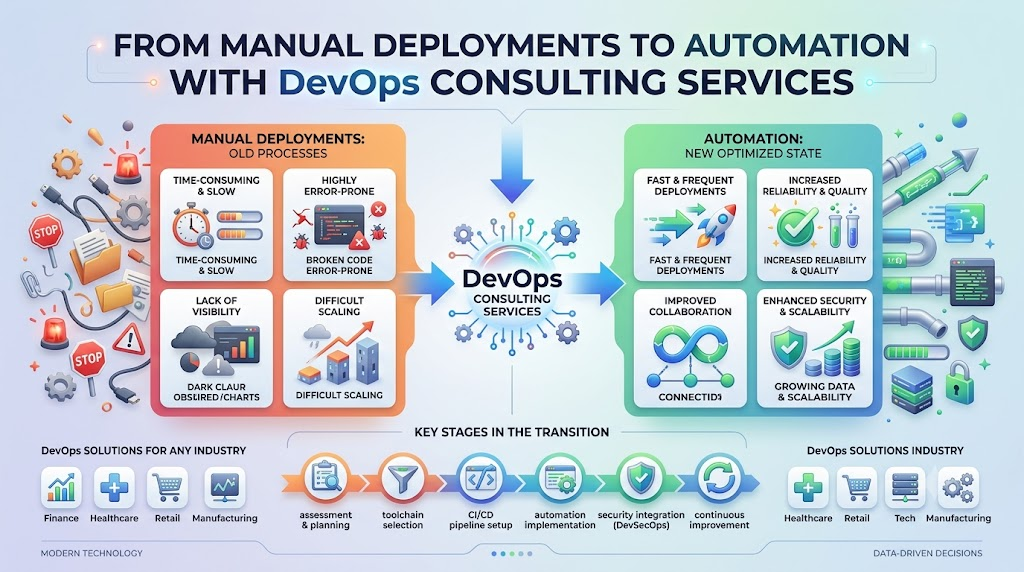
For software engineers and systems administrators working directly in production environments, delivery breakdowns are not abstract business metrics; they are painful midnight pages, failed Friday deployments, and hours lost tracing cryptic environment variable discrepancies. When build pipelines fail intermittently, manual access keys circulate in chat channels, or deployments require tribal knowledge and nervous console tapping, engineering teams end up trapped in a cycle of constant firefighting. True modernization requires dismantling these unstable routines and replacing them with deterministic, repeatable infrastructure systems. Partnering with hands-on DevOps Consulting Services gives delivery teams direct access to seasoned systems architects who understand the messy realities of enterprise tech stacks. Rather than handing down theoretical corporate slides, a practitioner-driven consulting engagement enters the trenches alongside internal staff to refactor brittle deployment pipelines, harden container environments, and enforce immutable infrastructure. This deep dive examines modern delivery architecture, pragmatic tooling choices, hands-on migration strategies, and operational trade-offs from the perspective of the engineers who build and maintain production systems every day.
The Reality in the Trenches: Why Infrastructure Breaks Down
In fast-moving engineering environments, technical debt rarely accumulates from a lack of engineering talent. It accumulates from relentless feature pressure combined with fragmented tooling. Over time, development squads deploy quick hotfixes directly into cloud consoles, bypass testing suites to hit arbitrary quarterly sprint deadlines, and treat infrastructure provisioning as an afterthought.
This patchwork engineering model creates three severe operational failure modes:
- Configuration Drift: When changes are made manually inside staging or production clusters, environment parity disappears. An artifact that passes local testing crashes instantly upon deployment to production because kernel parameters, shared libraries, or network policies differ.
- Alert Fatigue and Fragile Observability: When operations teams configure hundreds of generic CPU thresholds without context, on-call engineers become overwhelmed by non-critical notifications. Crucial signals—such as database connection exhaustion or degraded API latency—get buried in noise until end users begin reporting outages.
- Siloed Tribal Knowledge: When only two senior engineers know how to run the multi-step deployment scripts or troubleshoot an ingress controller, the entire release cycle becomes brittle. Every promotion depends on individual availability rather than an automated, audited system.
+-----------------------------------------------------------------------------------+
|                        THE FRAGILE DELIVERY PIPELINE                              |
|                                                                                   |
|  Local Code  --> Manual Build --> Flaky Tests --> Console Tweaks --> Staging Drift|
|       |                                                                    |      |
|       +-------------------- Alert Storms & Outages <-----------------------+      |
+-----------------------------------------------------------------------------------+
                                         │
                                         ▼ [ Modernization via IaC & GitOps ]
+-----------------------------------------------------------------------------------+
|                       THE RESILIENT DELIVERY ENGINE                               |
|                                                                                   |
|  Git Commit  --> Automated CI --> SAST/SCA Scan --> Immutable Image --> K8s/Cloud |
|       │                                                                    │      |
|       +---------------- Correlated Tracing & Alerts <----------------------+      |
+-----------------------------------------------------------------------------------+
Core Engineering Disciplines Modernized by DevOps Consultants
A successful engagement resolves practical architectural friction. When specialists assess an enterprise infrastructure stack, technical remediation focuses on five distinct disciplines.
1. Immutable Infrastructure and Declarative Code
Managing servers as pets rather than livestock leads directly to unrepeatable outages. Modern consultants enforce immutable infrastructure principles using Infrastructure as Code (IaC) tools like Terraform, OpenTofu, and Pulumi. Every network subnet, IAM policy, storage bucket, and container runtime is declared in version-controlled repositories. State files are strictly locked in remote, encrypted backends with automated drift detection routines that flag and reconcile unauthorized infrastructure alterations.
2. Standardized Container Orchestration
Containerizing microservices inside Docker images solves local runtime consistency, but orchestrating those containers in production demands rigorous systems engineering. Specialized Kubernetes Consulting Services step in to structure cluster architecture across Amazon EKS, Azure AKS, or Google Cloud GKE. Practitioners focus on:
- Defining strict resource requests and limits to eliminate noisy-neighbor issues on worker nodes.
- Configuring Horizontal Pod Autoscalers (HPA) coupled with cluster-level autoscalers like Karpenter to prevent node exhaustion during sudden traffic spikes.
- Structuring Ingress controllers and service meshes (such as Cilium or Istio) to guarantee mTLS encryption and transparent traffic routing across microservice boundaries.
- Enforcing Pod Security Standards (PSS) to disallow root privilege escalation within runtime pods.
3. Declarative Delivery via GitOps
Traditional push-based deployment models require CI runners to maintain broad administrative privileges inside production virtual private clouds (VPCs). This creates a dangerous attack vector. Modern delivery pipelines invert this architecture by using GitOps operators like ArgoCD or Flux.
In a GitOps workflow, the desired state of your applications and infrastructure lives in a declarative Git repository. An in-cluster operator periodically compares the live cluster configuration against the Git repository. If drift occurs, the operator synchronizes the cluster back to the version-controlled state. Deployments and rollbacks become simple Git commits and reverts, eliminating manual kubectl intervention in production clusters.
4. Continuous Security Integration (Shift-Left)
Security cannot be treated as an isolated audit scheduled a week before a major production launch. DevSecOps Consulting Services introduce automated, non-disruptive defensive checks directly into the continuous integration loop:
- Static Analysis (SAST): Scans source code during pull requests to detect dangerous logic flaws and known syntax vulnerabilities.
- Software Composition Analysis (SCA): Inspects open-source application dependencies to identify vulnerable libraries before packaging.
- Container Hardening: Runs image vulnerability scans (using tools like Trivy) and generates Software Bills of Materials (SBOMs) to secure runtime packages.
- Dynamic Secrets Injection: Eliminates hardcoded API credentials by integrating tools like HashiCorp Vault or cloud key management services, retrieving temporary, rotatable credentials at runtime.
5. Telemetry Architecture and SRE Practices
Collecting terabytes of unstructured log messages does not guarantee system observability. SRE Consulting Services shift focus from monitoring raw server health to instrumenting distributed tracing and practical telemetry. Using open standards like OpenTelemetry, consultants help engineering teams trace a request across distributed microservices, databases, and third-party APIs. This allows engineers to pinpoint the exact line of code or network hop generating latency anomalies.
Strategic Infrastructure Delivery Models: A Comparative Analysis
Different organizational environments require distinct operational structures. The following breakdown highlights how various service and delivery models function in real-world environments.
| Delivery Model | Operational Focus | Primary Engineering Value | Practical Operational Limit |
| In-House Platform Team | Long-term proprietary architectures and internal tools. | Deep institutional context and total platform ownership. | High hiring costs, skill shortages, and risk of insular engineering habits. |
| DevOps Consulting Services | Architecture revamps, infrastructure redesign, and CI/CD rebuilds. | Experienced perspective, best practices, and targeted velocity. | Requires internal engineering bandwidth to review and adopt implementations. |
| Managed DevOps Services | Ongoing infrastructure maintenance, system updates, and tier-1 response. | Offloads operational maintenance so developers focus on application code. | Demands well-defined operational runbooks and tight access governance. |
| DevOps Outsourcing Services | Extending delivery capacity for defined pipelines and cloud migrations. | Flexible engineering capacity without long-term operational headcount overhead. | Requires detailed documentation and clear communication boundaries. |
The Engineer’s Migration Roadmap: How Consulting Projects Roll Out
A structured consulting engagement prioritizes minimal system downtime and steady operational improvements.
Phase 1: Deep Discovery & Dependency Mapping
   └── Map network topology, review pipeline run times, audit IAM privileges and secrets.
Phase 2: Reference Architecture Blueprint
   └── Define modular IaC components, standardize container images, design CI/CD templates.
Phase 3: Golden Path Implementation
   └── Build and test an automated pipeline on a representative staging service.
Phase 4: Workload Cutover & GitOps Integration
   └── Migrate production services, configure automated health checks and ingress routing.
Phase 5: Operational Enablement & SRE Drills
   └── Run chaos tests, establish incident runbooks, and train internal staff.
Discovery and Architectural Analysis
Rather than guessing where problems lie, consultants analyze code repositories, Dockerfiles, cloud IAM configurations, and pipeline logs. They identify manual intervention points, long-running build phases, unencrypted data channels, and untracked infrastructure changes.
Designing the Golden Path
Consultants build a “Golden Path”—a pre-packaged, fully supported deployment template. This standardized workflow includes baseline CI linting, container builds, automated security scanning, and declarative deployments, giving development squads an easy, supported route to production.
Building and Validating the Pilot Pipeline
Before touching mission-critical production systems, the team migrates a representative, non-critical workload to the new platform. This reference pipeline validates build speeds, testing reliability, secret injection mechanisms, and rollback routines in a controlled environment.
Production Migration and Traffic Cutover
When migrating stateful workloads or multi-tier services, Cloud Migration Services protocols come into play. Consultants implement phased cutovers—such as blue-green deployments or canary rollouts using weighted DNS or ingress routing. This ensures that new versions receive a small percentage of real user traffic while telemetry monitors for error spikes, allowing for an instant rollback if unexpected regressions occur.
Hands-on Knowledge Transfer and Operational Drills
Tools are only as effective as the engineers running them. The engagement wraps up with detailed operational runbooks, architectural reviews, and hands-on Corporate DevOps Training. Internal engineers participate in live failure drills, practicing cluster recoveries, pipeline rollbacks, and node drain procedures so they can operate the new platform with complete confidence.
Practical Engineering Trade-Offs
No architectural shift is free of trade-offs. Implementing modern DevOps systems requires balancing several practical factors.
Operational Advantages
- Deterministic Deployments: Eliminates unexpected failures caused by environment drift, ensuring that what runs in staging behaves identically in production.
- Rapid Incident Recovery: Declarative GitOps architectures allow engineering teams to roll back broken deployments in minutes with a simple Git revert.
- Stronger Security Posture: Automated pipeline scanning catches vulnerable packages, hardcoded secrets, and loose IAM configurations long before production promotion.
- Higher Infrastructure Efficiency: Dynamic autoscaling and rightsizing policies eliminate idle, overprovisioned cloud capacity.
Implementation Challenges
- Initial Adoption Overhead: Standardizing pipelines requires developers to refactor legacy deployment scripts and adapt to stricter code validation rules.
- Distributed System Complexity: Shifting from monolithic deployments to containerized microservices introduces networking, service discovery, and tracing overhead.
- Toolchain Governance: Without clear guidelines, teams risk introducing redundant plugins, operators, and monitoring tools that create maintenance headaches.
- Cloud Budget Realities: Elastic auto-scalers and complex multi-region setups can drive up cloud costs if resource quotas and tag policies are not strictly monitored.
When Does an Engineering Team Need External DevOps Consulting?
Technical leaders and senior practitioners should watch for these clear operational signals:
- Lengthy, Stressful Releases: When deploying a new release requires weekend shifts, manual checklist execution, or extensive downtime.
- Persistent Staging-Production Discrepancies: When bugs routinely slip through staging environments and only appear once exposed to live production traffic.
- Kubernetes Operational Hurdles: When internal teams struggle with ingress configuration, persistent storage reliability, dynamic scaling, or complex cluster upgrades.
- Slow Feedback Loops: When build pipelines take forty-five minutes or more to execute, stalling developer focus and delaying bug fixes.
- Unclear Production Visibility: When the operations team learns about outages from customer support tickets rather than automated observability alerts.
Practical Tips
- Treat Pipeline Code Like Production Software: Keep CI/CD scripts, Helm charts, and Terraform manifests modular, linted, and reviewed under strict source control.
- Isolate Secrets Completely: Never pass cleartext tokens or passwords through pipeline configuration files; use dynamic secrets engines that generate temporary, auditable credentials.
- Implement Health Checks Correctly: Configure Kubernetes readiness and liveness probes carefully to prevent traffic from hitting uninitialized application pods.
- Automate Environment Teardowns: Configure ephemeral test environments to shut down automatically after pull requests merge to avoid running up unused cloud resources.
- Focus on Mean Time to Recovery (MTTR): Systems will inevitably experience failures; design deployment and rollback workflows so your team can recover within minutes rather than hours.
Frequently Asked Questions
What is the core focus of modern DevOps consulting services?
DevOps consulting services focus on analyzing, designing, and automating the entire software delivery lifecycle. Consultants work alongside internal teams to eliminate manual configuration drift, automate continuous integration and deployment pipelines, codify cloud environments, harden container security, and implement production observability to make releases predictable and reliable.
How do consulting services address unstable deployments?
Consultants diagnose the root causes of deployment instability, such as missing dependency locks, inconsistent staging environments, and untested database migrations. They replace manual release steps with automated CI/CD pipelines, containerized workloads, automated regression testing, and declarative GitOps workflows that support instant, automated rollbacks.
Can DevOps consultants assist with Kubernetes cluster operational challenges?
Yes. Specialized Kubernetes consulting covers cluster architecture, network policy design, pod security standards, node auto-scaling, persistent volume performance, and automated rolling cluster upgrades. Consultants help teams resolve operational headaches across Amazon EKS, Azure AKS, and Google Cloud GKE environments.
How does an organization prepare for a cloud migration engagement?
Preparation involves cataloging applications, mapping service dependencies, auditing database volumes, and identifying compliance or data residency constraints. A reliable cloud migration plan classifies workloads, defines automated Infrastructure as Code blueprints, and tests data replication thoroughly before executing production cutovers.
What is the difference between SRE consulting and standard monitoring setups?
Standard monitoring simply collects server metrics like CPU usage, memory consumption, and disk capacity. SRE consulting establishes Service Level Indicators (SLIs) and Objectives (SLOs) tied directly to the end-user experience, introduces distributed application tracing, manages error budgets, and automates incident response runbooks to systematically reduce downtime.
How do consultants ensure internal engineers can maintain the new platform?
A proper consulting engagement avoids black-box implementations. Consultants pair directly with internal engineers, maintain modular and heavily documented code repositories, write practical troubleshooting runbooks, and provide customized corporate training to ensure internal staff can confidently maintain, update, and scale the infrastructure.
How does Infrastructure as Code prevent configuration drift?
Infrastructure as Code (IaC) documents your desired cloud topology in version-controlled text files. By running automated pipeline executions with tools like Terraform or OpenTofu, every environment is provisioned using identical parameters. Scheduled drift detection jobs identify and remediate any manual changes made outside of Git.
What role does GitOps play in secure software delivery?
GitOps turns a Git repository into the single source of truth for your running systems. In-cluster operators pull changes from Git rather than requiring external CI tools to have direct administrative access to production networks. This creates an immutable audit trail, simplifies regulatory compliance, and enables fast rollbacks via Git commits.
Can early-stage engineering teams benefit from DevOps consulting?
Yes. Engaging consultants early helps growing teams establish solid architectural patterns, automated build pipelines, and secure cloud defaults from day one. Setting up clean infrastructure foundations prevents teams from having to stop feature development later to untangle messy technical debt and complex cloud architectures.
What distinguishes DevOps consulting from ongoing managed DevOps services?
DevOps consulting focuses on discovery, system architecture, workflow automation, and structured implementation projects to establish modern platforms. Managed DevOps services provide continuous operational support, taking responsibility for ongoing cluster patching, 24/7 monitoring, incident triage, and ongoing pipeline maintenance.
Conclusion
Building a dependable software delivery pipeline is a systems engineering challenge that requires clear architecture, disciplined automation, and strong operational habits. Moving away from manual configurations, noisy monitoring dashboards, and brittle release scripts allows teams to turn continuous delivery into a predictable, everyday capability. Collaborating with seasoned specialists from Cotocus for targeted DevOps Consulting Services gives internal engineering teams the architectural guidance and hands-on support needed to modernize their cloud delivery pipelines. By codifying infrastructure, adopting declarative GitOps workflows, and integrating defensive security into every build, organizations can eliminate operational drag and build a modern platform that supports reliable software delivery at scale.