Introduction
If you are planning to build a strong career in cloud engineering, DevOps, SRE, or platform operations, then the Google Cloud Professional Engineer certification is an important credential to understand. This certification is designed for professionals who want to build, manage, and improve production systems on Google Cloud. It is not just about learning cloud services; it is about learning how to make the right engineering decisions in real business environments. This guide is written for working engineers, software professionals, and managers in India and globally who want a practical understanding of the certification path. It explains what the certification is, who should take it, what skills it builds, how to prepare for it, and what certification paths you can follow after it. The goal is to help you make a confident decision and prepare in a structured way. Many professionals study cloud technologies but struggle to connect concepts with real-world projects. This guide solves that problem by focusing on job-ready skills, realistic preparation plans, and role-based recommendations. Whether you are switching to cloud, improving your current role, or planning the next career move, this guide will give you a clear direction.
Certification Overview
The Google Cloud Professional Engineer certification is a professional-level credential that validates your ability to design, build, deploy, and operate solutions on Google Cloud. It focuses on practical engineering capabilities such as architecture decisions, service selection, operations, monitoring, security, and performance optimization. This makes it highly relevant for professionals handling real production workloads. It is especially useful for engineers who are already working with cloud systems or are moving from traditional infrastructure and software roles into cloud-first teams. Instead of only asking theoretical questions, the certification path encourages a deeper understanding of how to build cloud systems that are scalable, reliable, and secure.
Certification Table
| Certification | Track | Level | Who it’s for | Prerequisites | Skills covered | Recommended order |
|---|---|---|---|---|---|---|
| Google Cloud Professional Engineer | Cloud / Platform Engineering | Professional | Cloud engineers, DevOps engineers, SREs, platform teams, software engineers | Basic cloud concepts, Linux, networking, IAM, deployment basics | Architecture, deployment, operations, reliability, security, optimization | 1 (Start here if targeting GCP engineering roles) |
| Google Cloud Professional Cloud DevOps Engineer (next same-track style progression) | DevOps / SRE | Professional | Engineers moving toward automation, release engineering, reliability | CI/CD, monitoring, infrastructure automation, cloud basics | CI/CD, observability, incident response, SLOs, automation | 2 (After core cloud engineering confidence) |
| Google Cloud Security-focused certification path (cross-track direction) | DevSecOps / Security | Professional / Specialization path | Security engineers, cloud engineers moving into security | IAM, networking, cloud fundamentals, compliance basics | Security architecture, IAM, policy, risk reduction | 2 or 3 (after cloud foundation) |
| Cloud/Platform Leadership & Architecture path | Leadership / Architecture | Advanced Career Path | Senior engineers, leads, managers | Hands-on cloud experience, team/project ownership | Design decisions, governance, cost, platform strategy | 3 (after execution-level certifications) |
What Is Google Cloud Professional Engineer?
The Google Cloud Professional Engineer certification validates your ability to design and manage cloud solutions on Google Cloud in a business-ready way. It covers the full engineering lifecycle: planning, building, deploying, operating, monitoring, and improving cloud-based systems. This makes it valuable for professionals who are responsible for production systems, not only development tasks.
A key strength of this certification is that it teaches you to think in terms of trade-offs and outcomes. For example, in real projects, you must balance security, cost, performance, and scalability at the same time. This certification helps you build that decision-making mindset, which is exactly what employers expect from cloud professionals.
It is also a strong bridge certification. Software engineers, operations teams, DevOps engineers, and platform engineers can all use it as a common cloud foundation before moving into deeper specialization areas like SRE, DevSecOps, DataOps, or FinOps.
Why This Certification Matters
For Engineers
For engineers, this certification helps create a strong cloud engineering foundation that goes beyond basic service usage. It improves your ability to design systems, troubleshoot issues, and choose the right cloud services for real workloads. This is important because employers often test scenario thinking, not just definitions.
It also helps engineers become more confident in production conversations. If you are in meetings where topics like reliability, deployment strategy, IAM, or cost optimization come up, this certification preparation helps you contribute with practical understanding. That can improve both your performance and your visibility in the team.
For Managers
For managers, this certification gives a structured benchmark to evaluate cloud capability within teams. Even if managers do not perform hands-on deployment daily, understanding what this certification covers helps them guide hiring, training, and technical planning more effectively. It creates better communication between engineering and leadership.
Managers also benefit because certified or well-prepared engineers usually make better decisions with less trial and error. That can improve delivery timelines, reduce avoidable cloud mistakes, and strengthen cloud governance in the team. In short, it supports more predictable engineering outcomes.
For Organizations
Organizations benefit when cloud engineers are trained in architecture, operations, security, and optimization as one connected discipline. This reduces the common problem where teams know how to deploy but struggle to maintain reliability and cost efficiency later. Strong cloud engineering practices improve long-term delivery quality.
This certification also supports digital transformation efforts where cloud systems must scale across teams and environments. Engineers with this knowledge can build repeatable, stable, and secure solutions that support business growth. That makes the certification valuable not only for individuals but also for team capability building.
Who Should Take It?
This certification is a strong fit for professionals who are involved in cloud infrastructure, application deployment, operations, and platform reliability. It is especially useful for people who want to move from “basic cloud usage” to “owning cloud systems” in production. If your role includes cloud decisions, this certification is likely relevant.
It is also a great choice for professionals who want career growth across cloud-focused roles. Since it covers architecture, operations, security basics, and optimization, it supports many career directions such as DevOps, SRE, platform engineering, and cloud engineering. This makes it a high-value certification for both specialists and generalists.
Best-fit roles include:
- Cloud Engineers
- DevOps Engineers
- Platform Engineers
- Site Reliability Engineers (SREs)
- Software Engineers moving to cloud roles
- Technical Leads
- Operations engineers transitioning to cloud
Even if you are not fully hands-on yet, this certification can still help if you regularly work with cloud teams and need a stronger technical understanding. It is especially helpful for professionals who want to improve their decision-making and communication in cloud projects.
Skills You’ll Gain
Preparing for the Google Cloud Professional Engineer certification helps you build skills that are directly useful in modern cloud roles. You will not only learn what services exist, but also when and why to use them. This is critical because real-world cloud work depends on making the right choice under business constraints.
Another major benefit is that you begin to think like a system owner. That means considering reliability, security, monitoring, performance, and cost together instead of separately. This mindset is what separates a cloud user from a cloud engineer.
Key skills you’ll build:
- Designing cloud architecture for scale and reliability
- Choosing the right GCP services for different workloads
- Deploying and managing applications in cloud environments
- Identity and access management (IAM) planning
- Networking basics for production systems
- Monitoring, logging, and alerting setup
- Troubleshooting operational and deployment issues
- Security best practices for cloud systems
- Performance tuning and resource optimization
- Cost-aware engineering and governance thinking
These skills also improve your interview readiness. Many cloud interviews are based on practical scenarios such as service selection, failure handling, deployment strategy, and troubleshooting. Certification preparation helps you develop strong responses in these areas.
Mini-Section: Google Cloud Professional Engineer
What it is
Google Cloud Professional Engineer is a professional-level cloud certification that validates your ability to build and manage secure, scalable, and reliable solutions on Google Cloud. It focuses on architecture, deployment, operations, and optimization in real production-like scenarios. This makes it highly relevant for engineers handling modern cloud workloads.
It is not limited to one tool or one service area. Instead, it tests your ability to combine multiple cloud capabilities to meet technical and business requirements. That is why it is considered a strong career credential for cloud-focused roles.
Who should take it
This certification is ideal for professionals who are already working with cloud systems or preparing to move into cloud engineering roles. It is especially useful for engineers who want stronger confidence in architecture, deployment, and production operations. If your job involves cloud decisions, this certification will add practical value.
Recommended for:
- Cloud Engineers
- DevOps Engineers
- Site Reliability Engineers (SREs)
- Platform Engineers
- Software Engineers working with cloud deployments
- Technical Leads and engineering decision-makers
It is also a smart option for professionals who want to build a strong foundation before specializing in DevSecOps, DataOps, AIOps/MLOps, or FinOps. A solid cloud engineering base makes all those future paths easier and more meaningful.
Skills you’ll gain
This certification helps you build a balanced cloud engineering skill set across design, deployment, operations, and reliability. You will improve your understanding of how cloud systems behave in production and how to manage them effectively. The preparation also strengthens your judgment in choosing services and solving operational problems.
Skills you’ll gain:
- Cloud solution design and architecture planning
- GCP service selection based on workload requirements
- Production deployment and release strategy thinking
- IAM and access control design
- Monitoring, logging, and alerting practices
- Troubleshooting cloud application and infrastructure issues
- Security and governance basics
- Performance and scalability tuning
- Cost and resource optimization planning
These are not just exam skills. They are the same capabilities that help engineers work better in real projects and collaborate more effectively across development, operations, and security teams.
Real-world projects you should be able to do after it
After preparing for this certification, you should be able to handle common cloud engineering responsibilities with much more confidence. You will understand how to design systems for multiple environments, deploy applications, apply security controls, and monitor system health in production. This is one of the biggest practical benefits of certification-focused learning.
You should also be able to reason through trade-offs in real project situations. For example, you may need to choose between simplicity and scalability, or between speed and governance. This certification builds the mindset required for those decisions.
Real-world projects you should be able to do:
- Build and deploy a production-ready web application on GCP
- Design secure dev/test/prod cloud environments
- Implement IAM roles using least-privilege practices
- Set up monitoring dashboards, logs, and alerts
- Troubleshoot deployment failures and performance issues
- Plan scaling strategies for increasing traffic
- Optimize cloud resources to improve cost efficiency
- Support application migration from on-prem to GCP
These project outcomes make the certification highly useful for both job changes and internal role growth. They show that your learning can directly translate into execution.
Preparation plan (7–14 days / 30 days / 60 days)
A good preparation plan depends on your current experience level and available study time. Some professionals already work with GCP daily and only need structured revision, while others need more time to build fundamentals before moving into scenario-based practice. The most effective plan is one that is realistic and consistent.
No matter which timeline you choose, focus on understanding service use cases, architecture trade-offs, IAM, networking, monitoring, and troubleshooting. These are core areas that usually make a big difference in both exam performance and real-world cloud engineering ability.
7–14 Days (Fast-track for experienced professionals)
This plan is best for professionals who already use Google Cloud regularly and need focused revision before the exam. The main goal is not to learn everything from zero, but to refresh key concepts, improve weak areas, and practice scenario-based thinking. Daily disciplined revision is important in this short timeline.
Suggested approach:
- Review exam topics and key GCP services
- Revise IAM, networking, compute, storage, and operations
- Solve scenario-based practice questions every day
- Focus on weak areas using targeted revision notes
- End with mock tests and mistake review
The fast-track plan works only if you already have practical experience. If you are guessing many mock test answers, move to a 30-day plan instead.
30 Days (Balanced plan for working engineers)
This is the most practical plan for working professionals who can study consistently while handling job responsibilities. It gives enough time to build understanding, revise important topics, and practice case-style questions without rushing. A 30-day plan also reduces stress compared to last-minute preparation.
Suggested weekly structure:
- Week 1: Core GCP services and cloud architecture basics
- Week 2: IAM, networking, security, governance concepts
- Week 3: Operations, monitoring, logging, troubleshooting
- Week 4: Mock tests, scenario practice, revision and error analysis
- Final days: Quick recap of notes and weak topics
This plan works very well when combined with short daily sessions and one longer weekly study block. It gives a good balance between theory, practice, and revision.
60 Days (Best for beginners/intermediate learners)
This plan is ideal for learners who are new to GCP or still developing cloud fundamentals. It gives enough time to understand concepts properly, do hands-on practice, and build exam confidence gradually. It is also the best option for career switchers and software engineers entering cloud roles for the first time.
Suggested timeline:
- Weeks 1–2: Cloud basics + core GCP services
- Weeks 3–4: IAM, networking, and deployment patterns
- Weeks 5–6: Reliability, monitoring, troubleshooting, optimization
- Weeks 7–8: Mock tests, scenario review, revision cycles
This plan helps you learn deeply instead of memorizing topics. It also gives space to revisit difficult areas like IAM and networking, which many learners underestimate at first.
Common mistakes
Many learners fail to prepare effectively because they focus too much on memorizing service names and too little on understanding real use cases. This certification checks practical judgment, so a memorization-only approach usually creates weak results. The exam and real work both require scenario thinking.
Another common problem is poor revision strategy. Some learners keep consuming new resources without reviewing mistakes or strengthening weak areas. A smaller, focused study plan with revision and practice is usually more effective than using too many materials.
Common mistakes to avoid:
- Studying only definitions, not practical scenarios
- Ignoring IAM and networking fundamentals
- Memorizing services without knowing when to use them
- Skipping troubleshooting and operations topics
- Not practicing architecture trade-off decisions
- Using too many study resources at once
- Taking mock tests without reviewing wrong answers
Avoiding these mistakes can improve both your exam readiness and your real-world cloud engineering confidence. Good preparation is less about volume and more about quality and consistency.
Best next certification after this
After completing the Google Cloud Professional Engineer certification, the best next certification depends on your career direction. This certification gives a strong cloud engineering foundation, so your next step should build specialization on top of it. That is how you create a strong and logical career path.
For example, DevOps and SRE professionals can move toward a cloud DevOps/SRE path, while security-focused professionals can move toward a cloud security or DevSecOps direction. If you are moving into leadership, an architecture and governance-oriented path may be more useful than another execution-focused certification.
A smart next step is one that matches your job responsibilities, not just market trends. When your certification path aligns with your actual work, you learn faster and create stronger career outcomes.
Choose Your Path (6 Learning Paths)
This section is designed to help you choose a certification and learning sequence based on your career goal. Many professionals know they want “cloud growth,” but they are not sure whether to focus on DevOps, SRE, security, data, AI/ML operations, or cost optimization. The Google Cloud Professional Engineer certification works as a strong common foundation for all these tracks.
Each path below starts with cloud engineering because modern technical roles depend on cloud infrastructure knowledge. Once that foundation is strong, you can specialize with more confidence and build a role-focused skill set that employers value.
1) DevOps Path
The DevOps path is ideal for engineers who want to improve software delivery speed, automation quality, and deployment reliability in cloud environments. The Google Cloud Professional Engineer certification helps build the cloud foundation needed to support CI/CD, infrastructure automation, and scalable release workflows. Without that foundation, DevOps work often becomes tool-focused but architecture-weak.
After this certification, focus on CI/CD design, Infrastructure as Code, deployment strategies, environment consistency, and automation for repeatable delivery. This path is strong for professionals working with platform teams, release pipelines, or cloud-native application deployments.
Best for: DevOps Engineers, build/release engineers, automation-focused platform teams.
2) DevSecOps Path
The DevSecOps path is best for professionals who want to combine cloud engineering with security thinking across the delivery lifecycle. The Google Cloud Professional Engineer certification gives you strong understanding of IAM, networking, deployment, and operations, which are essential before adding advanced security controls. This foundation helps you secure real systems, not only pass audits.
After the foundation, focus on pipeline security, cloud security controls, access policies, secrets handling, compliance support, and secure deployment practices. This path is highly valuable because organizations increasingly expect engineers to build security into delivery processes, not treat security as a separate final step.
Best for: Security Engineers, DevOps Engineers, cloud engineers moving toward security ownership.
3) SRE Path
The SRE path is ideal for professionals focused on reliability, observability, incident response, and production stability. Google Cloud Professional Engineer is a strong starting point because it covers the cloud design and operational knowledge needed to support reliable systems. SRE work becomes much easier when you already understand cloud services and deployment behavior.
After this certification, go deeper into monitoring, alerting, SLI/SLO thinking, incident management, postmortems, and performance tuning. This path is a strong fit for professionals who want to reduce outages, improve service quality, and build resilient cloud platforms at scale.
Best for: SREs, operations engineers, cloud support engineers, reliability-focused platform teams.
4) AIOps / MLOps Path
This path is suitable for professionals who want to work at the intersection of cloud platforms, machine learning operations, and intelligent system management. The Google Cloud Professional Engineer certification gives you the infrastructure and operational understanding needed before managing ML pipelines, model deployments, or AI-enabled operations. Without cloud engineering strength, MLOps usually becomes difficult to scale and maintain.
After the cloud foundation, focus on pipeline orchestration, model deployment workflows, monitoring for ML systems, automation, and operational governance. If you are in AIOps, add observability and automated response use cases. If you are in MLOps, add model lifecycle management and production delivery discipline.
Best for: MLOps Engineers, ML Platform Engineers, AIOps practitioners, cloud engineers entering AI platforms.
5) DataOps Path
The DataOps path is best for professionals building and operating data pipelines, analytics platforms, and data infrastructure in cloud environments. Google Cloud Professional Engineer helps you understand the cloud building blocks needed for secure, scalable, and reliable data operations. This is important because DataOps is not only about data processing, but also about platform quality and operational stability.
After this certification, focus on workflow orchestration, data pipeline reliability, environment management, data access control, and monitoring for data systems. This path helps data teams improve consistency, reduce operational issues, and deliver faster with better quality.
Best for: Data Engineers, Analytics Engineers, Data Platform Engineers, Cloud Data Operations teams.
6) FinOps Path
The FinOps path is for professionals who want to improve cloud cost governance, optimization, and financial accountability without reducing engineering quality. The Google Cloud Professional Engineer certification is useful here because cost optimization is impossible without understanding how cloud resources are designed and used. Strong FinOps work depends on technical awareness, not just billing reports.
After building cloud engineering fundamentals, focus on resource usage patterns, rightsizing, budgeting, policy controls, cost allocation, and cross-team collaboration between engineering and finance. This path is valuable for both engineers and managers because cloud cost decisions often require technical and business thinking together.
Best for: FinOps Practitioners, Cloud Engineers with cost responsibility, engineering managers, platform owners.
Role → Recommended Certifications Mapping
| Role | Recommended Start | Recommended Next | Why it fits |
|---|---|---|---|
| DevOps Engineer | Google Cloud Professional Engineer | Cloud DevOps / CI-CD specialization path | Builds strong cloud foundation + automation reliability |
| SRE | Google Cloud Professional Engineer | SRE/DevOps-oriented cloud certification path | Covers operations, monitoring, reliability thinking |
| Platform Engineer | Google Cloud Professional Engineer | Architecture / Platform governance path | Good for scalable internal platform design |
| Cloud Engineer | Google Cloud Professional Engineer | Security or DevOps path | Strengthens delivery + security + operations |
| Security Engineer | Google Cloud Professional Engineer (if cloud new) | Cloud security / DevSecOps path | Adds cloud context before deeper security specialization |
| Data Engineer | Google Cloud Professional Engineer | DataOps / cloud data engineering path | Helps with infrastructure and operations around data systems |
| FinOps Practitioner | Google Cloud Professional Engineer (core understanding) | FinOps/cloud cost management path | Improves technical understanding of billing drivers |
| Engineering Manager | Google Cloud Professional Engineer (awareness-focused prep) | Architecture / leadership-oriented path | Helps in technical decision-making and team guidance |
Next Certifications to Take (3 Options)
Choosing the next certification after Google Cloud Professional Engineer should be based on your current responsibilities and future career direction. This certification already gives you a strong execution-level base, so the next step should add depth in a focused area. A random next certification may add a badge, but it may not add real career value.
The three options below cover the most practical next moves: staying in the same cloud engineering/DevOps track, moving cross-track into a specialization, or growing toward leadership and architecture.
1) Same Track (Cloud Engineering / DevOps)
If you want to continue in cloud delivery, automation, and operational excellence, the best next step is a Google Cloud DevOps / SRE-oriented path. This builds on your cloud engineering base and adds deeper focus on CI/CD, observability, reliability, incident response, and automation. It is a natural progression for DevOps and SRE professionals.
This option is ideal when your daily work includes deployments, release pipelines, monitoring, and service reliability. It also helps if your goal is to become a senior cloud DevOps engineer or platform/SRE specialist.
2) Cross-Track (Security / Data / FinOps)
If you want to specialize, choose a path that aligns with your role and project direction. Security-focused professionals can move into DevSecOps or cloud security; data-focused engineers can move toward DataOps or cloud data engineering; cost-focused teams can move toward FinOps. This path gives you specialization while keeping a strong cloud engineering base.
Cross-track learning is a smart move because organizations need professionals who understand both cloud infrastructure and a specialization area. This combination often creates stronger job differentiation and long-term career growth.
3) Leadership (Architecture / Engineering Management)
If you already manage projects, lead teams, or make technical decisions, a leadership-oriented path can be the best next step. Instead of only focusing on another hands-on certification, this path emphasizes architecture thinking, governance, cloud standards, cost strategy, and decision-making at scale. It helps you move from execution to influence.
This option is especially valuable for senior engineers, technical leads, and engineering managers. It supports better planning, better hiring decisions, and better alignment between engineering work and business priorities.
Practical Study Strategy for Working Professionals
Most professionals preparing for this certification are already working full-time, which means they need a realistic study system rather than a perfect one. The biggest challenge is usually not the exam difficulty itself, but maintaining consistency while balancing job responsibilities. A practical strategy helps you stay disciplined without burnout.
The best approach is to study in small, focused sessions and review regularly. Cloud certification preparation is more effective when you build understanding over time instead of trying to memorize everything in a few days.
How to Study While Working Full-Time
If you are working full-time, create a study plan that fits your schedule instead of copying someone else’s routine. Even 45–90 minutes per day can produce strong results if you stay consistent and focus on high-value topics. The key is daily continuity and weekly revision.
Recommended approach:
- Study in short daily sessions (45–90 minutes)
- Keep one weekly deep study block (3–4 hours)
- Maintain a mistake notebook for mock-test errors
- Revise weak topics every week
- Use practical examples, not only theory notes
This style of preparation works well because it reduces stress and increases retention. It is also easier to maintain for a 30-day or 60-day plan.
What to Prioritize First
Many learners make the mistake of studying topics randomly. A better method is to begin with the most important building blocks, especially those that affect multiple areas of cloud engineering. This creates a strong foundation and makes advanced topics easier to understand.
Priority order:
- Core GCP services (compute, storage, networking)
- IAM and security basics
- Deployment workflows and operations
- Monitoring, logging, alerting, troubleshooting
- Architecture trade-offs and optimization
When you study in the right order, your confidence grows faster. It also improves your ability to answer scenario-based questions because the concepts connect naturally.
Best Learning Method
There is no single perfect resource for everyone, but there is a reliable learning method: combine concept study, hands-on understanding, scenario practice, and revision. This method works because it prepares you for both the exam and real cloud work. If you only read theory, your learning stays shallow.
Best method combination:
- Concept study for foundation
- Real use-case examples for context
- Hands-on labs for confidence
- Scenario-based mock questions for exam readiness
- Revision + error review for improvement
This method is especially powerful for working professionals because it reduces wasted effort. Instead of studying too much content, you focus on the type of understanding that actually creates results.
Career Outcomes and Value
The Google Cloud Professional Engineer certification can significantly improve your professional credibility, especially if you work in cloud-focused environments or want to move into them. It shows that you understand not only cloud tools, but also how to use them responsibly in production systems. This is important because employers value engineering judgment, not just platform familiarity.
It can also improve your confidence in interviews and internal technical discussions. Many professionals know cloud basics but struggle to explain architecture decisions, deployment strategies, and reliability trade-offs clearly. Certification preparation helps you build that clarity and communicate with more confidence.
Career value you may gain:
- Stronger credibility for cloud engineering roles
- Better performance in scenario-based interviews
- More confidence in architecture and operations discussions
- Easier transition into DevOps/SRE/platform roles
- Improved production system thinking
- Better alignment with cloud reliability and optimization goals
The certification brings the best results when combined with hands-on project experience. Think of it as a force multiplier: it makes your practical experience easier to explain, validate, and grow into a stronger career story.
Top Institutions That Help in Training cum Certifications
DevOpsSchool
DevOpsSchool is a well-known name in the DevOps and cloud training ecosystem and is often chosen by professionals looking for structured technical learning. It is recognized for practical orientation, career-focused mentoring support, and certification-aligned preparation. For learners targeting cloud, DevOps, SRE, or platform roles, it can be a useful option for guided learning.
It is also suitable for professionals who prefer a roadmap-based approach instead of learning from random tutorials. This helps reduce confusion and improves consistency during certification preparation.
Cotocus
Cotocus is commonly associated with enterprise-focused learning and consulting-oriented technical exposure. It can be useful for professionals who want to understand cloud implementation from a practical business and delivery perspective. This is valuable for learners who want real-world context beyond exam-only preparation.
It may also support professionals who want to connect certification learning with broader digital transformation and cloud adoption use cases. That makes it a relevant option for both engineers and technical managers.
Scmgalaxy
Scmgalaxy has long-standing visibility in the DevOps and automation learning ecosystem and is known among many technical learners. It is often considered by professionals who want support in automation, cloud, and engineering practices with a structured learning path. This makes it useful for foundational and intermediate learners.
It can be a good choice for professionals who are building practical knowledge step by step and want a clearer path before moving into advanced certification tracks.
BestDevOps
BestDevOps is widely known for training in DevOps, cloud, and modern engineering domains. It is often selected by learners who want certification-focused preparation combined with practical examples and role-relevant skills. This combination can be helpful for professionals targeting real job outcomes.
It can also support learners who want to connect cloud engineering preparation with DevOps practices, automation workflows, and operational discipline. This makes it a useful option for role-based learning.
devsecopsschool.com
devsecopsschool.com is useful for professionals who want to add a security-first perspective to their cloud engineering journey. It can help learners understand how cloud, security, and delivery practices connect in modern DevSecOps environments. This is valuable for engineers moving from cloud operations into secure delivery roles.
It is especially relevant for professionals who plan to specialize in IAM, secure pipelines, compliance-aware engineering, or cloud security operations after building a cloud foundation.
sreschool.com
sreschool.com is a strong option for professionals focusing on reliability, observability, and production operations. It can help cloud engineers and SREs build better understanding of monitoring, incident response, and service reliability practices. This complements Google Cloud engineering preparation very well.
It is particularly useful for learners who want to move toward SRE responsibilities such as uptime improvement, alerting quality, and operational resilience in cloud environments.
aiopsschool.com
aiopsschool.com can help professionals who want to explore intelligent operations, automation-driven monitoring, and operational analytics. It is useful for learners planning to expand beyond cloud engineering into AIOps or ML-enabled operational workflows. This is becoming increasingly relevant in modern cloud operations teams.
For cloud engineers, it can act as a specialization layer after building core platform and operations knowledge. That creates a stronger path toward future-ready roles.
dataopsschool.com
dataopsschool.com is useful for professionals who want to connect cloud engineering skills with data pipelines and data platform operations. It can help Data Engineers and platform teams improve their understanding of operational reliability, delivery workflows, and data environment governance. This is a strong complement to cloud platform learning.
It is especially helpful for professionals who work in analytics, data engineering, or pipeline operations and want to improve cloud-based execution and reliability practices.
finopsschool.com
finopsschool.com is relevant for professionals focused on cloud cost optimization, governance, and financial accountability. It can help Cloud Engineers, managers, and FinOps practitioners build the knowledge needed to improve cloud spending decisions. This is increasingly important as organizations scale cloud usage.
For learners who already understand cloud infrastructure basics, FinOps learning adds a high-value business skill. It helps connect technical decisions with cost impact and long-term platform efficiency.
FAQs — Career, Preparation, Value, and Sequence
1) Is Google Cloud Professional Engineer difficult?
Yes, it is generally considered a professional-level certification, so it can be challenging for many learners. The main difficulty comes from scenario-based questions that test your ability to make practical cloud decisions, not just remember service names. If you study with real use cases and mock practice, it becomes much more manageable.
The exam becomes easier when you understand architecture trade-offs, IAM, networking, and operations clearly. A structured study plan and regular revision usually make a big difference.
2) How much time does it take to prepare?
The preparation time depends on your background and daily study consistency. Experienced cloud engineers may prepare in 2–4 weeks with focused revision, while beginners or career switchers may need 6–8 weeks or longer. The quality of your preparation matters more than the number of days.
If you are working full-time, a 30-day or 60-day plan is usually more realistic than a short crash plan. Daily progress and weekly revision help build confidence steadily.
3) Do I need coding experience?
You do not need advanced software development skills to prepare for this certification, but basic scripting and automation awareness are helpful. You should understand how applications are deployed, configured, and managed in cloud environments. This helps you answer real-world scenario questions more effectively.
If you already know basic shell scripting or automation logic, that is usually enough to begin. The certification focuses more on engineering decisions than deep coding interviews.
4) Do I need prior Google Cloud experience?
Prior GCP experience is highly helpful because it improves your understanding of service behavior and use cases. However, beginners can still prepare if they spend enough time learning fundamentals and practicing scenarios. The key is to build a strong base before rushing into mock exams.
If you are completely new to GCP, choose a longer plan and focus on core services, IAM, networking, and deployment basics first. This reduces confusion later.
5) Is this certification good for DevOps engineers?
Yes, it is an excellent certification for DevOps engineers who work on cloud deployments, infrastructure automation, and production systems. It builds strong cloud engineering fundamentals that support CI/CD, scalability, and operational reliability. Without this base, DevOps work can become tool-heavy but weak in architecture.
It is also a strong starting point before moving into deeper DevOps/SRE or platform engineering certifications. This makes it a practical and career-relevant choice.
6) Is this certification useful for managers?
Yes, especially for engineering managers and technical managers who guide cloud teams. Even if they are not doing daily deployments, understanding this certification helps them make better decisions around hiring, architecture review, delivery risk, and technical planning. It improves communication with engineers and vendors.
Managers who understand cloud engineering fundamentals can also support better team development plans. This leads to more consistent project outcomes and stronger cloud governance.
7) What should I study first?
Start with the core building blocks: compute, storage, networking, IAM, and deployment basics. These topics support almost every other cloud engineering area, so understanding them early makes the rest of the preparation easier. Then move into operations, monitoring, troubleshooting, and optimization.
A random topic order often causes confusion and weak retention. A structured sequence improves learning speed and confidence.
8) Is hands-on practice necessary?
Hands-on practice is strongly recommended because many exam questions are based on practical scenarios and operational decisions. Even basic exposure to cloud workflows helps you understand why certain choices are better than others. This also improves long-term skill value beyond the exam.
If full lab practice is not possible, at least use case-based learning and scenario exercises regularly. Practical thinking is essential for this certification.
9) Can software engineers take this certification?
Yes, software engineers can benefit greatly from this certification, especially if they work on cloud-native applications or want to move into platform/cloud roles. It helps them understand deployment environments, operations, scalability, and cloud architecture decisions. This makes them stronger contributors in modern engineering teams.
It is also a smart bridge from application development into DevOps, SRE, and cloud engineering careers. Many software engineers use this certification to expand their role scope.
10) What is the best sequence after this certification?
A strong sequence is to move from cloud engineering foundation into a role-specific specialization. For example, many professionals go from Google Cloud Professional Engineer to a DevOps/SRE path, security/DevSecOps path, or architecture/leadership path. The right sequence depends on your role and long-term goals.
Choose the next certification based on where you want to grow, not only what is popular. Role alignment creates better learning and better career outcomes.
11) Does this certification help in job changes?
Yes, this certification can improve your profile for job changes, especially in cloud-focused roles. It helps demonstrate structured cloud engineering knowledge and strengthens your confidence in technical interviews. Recruiters and hiring managers often view it as a signal of serious cloud capability.
The biggest impact comes when you combine the certification with real project examples. Together, they create a stronger and more credible career story.
12) Is the certification worth it if I already work in cloud?
Yes, it is still valuable even if you already work in cloud because it validates your knowledge in a structured way and often reveals weak areas. Many professionals discover gaps in IAM, networking, reliability, or optimization while preparing. Fixing those gaps improves both performance and confidence.
It can also help you move into stronger roles, gain internal recognition, or prepare for more advanced certifications. So the value is often both technical and career-related.
FAQs on Google Cloud Professional Engineer
1) Who should take Google Cloud Professional Engineer first: DevOps Engineer or Cloud Engineer?
Both DevOps Engineers and Cloud Engineers can take this certification as a first major cloud credential. For Cloud Engineers, it builds structured cloud design and operations knowledge. For DevOps Engineers, it strengthens the cloud foundation needed for automation, CI/CD, and reliability work.
The best choice depends less on job title and more on your actual responsibilities. If you work with cloud deployments and production systems, this certification is a strong starting point.
2) Is it only for Google Cloud specialists?
No, it is most valuable for GCP-focused careers, but the engineering thinking applies broadly across cloud platforms. You learn architecture planning, reliability, operations, IAM thinking, and optimization principles that are useful in other cloud environments too. This makes the certification useful even for multi-cloud professionals.
That said, the strongest direct career impact comes when your role uses Google Cloud or plans to adopt it. Platform context always improves certification value.
3) What is the biggest benefit of this certification?
The biggest benefit is improved cloud engineering decision-making in real-world situations. It helps you think beyond service names and focus on what to build, how to deploy, and how to operate systems safely and efficiently. This is the kind of thinking employers trust in production roles.
It also improves confidence in architecture and operational discussions. Many professionals feel this improvement even before they complete the exam because the preparation itself is practical.
4) What type of preparation gives the best result?
The best results usually come from a mixed preparation method: concept learning, practical examples, mock tests, and mistake review. If you only read theory, your understanding may remain shallow and you may struggle with scenario-based questions. Balanced preparation builds both knowledge and decision-making ability.
A good study system also includes revision cycles and a weak-topic strategy. Reviewing mistakes regularly is one of the fastest ways to improve.
5) Should I learn security before this exam?
You do not need advanced security specialization before this exam, but you should understand cloud security basics. IAM, least privilege, access control, and basic governance concepts are important and frequently relevant. These topics support both exam success and real cloud work.
Deep security learning can come after this certification if you plan to move into DevSecOps or cloud security roles. Think of this certification as a foundation, not the final security destination.
6) Can this certification help me move into SRE?
Yes, it is a strong foundation for moving into SRE because SRE work depends on cloud operations, reliability, and production system understanding. This certification helps you build that base through architecture, monitoring, deployment, and optimization topics. It supports the system thinking that SRE teams need.
To complete the transition, add observability, incident response, SLO/SLI concepts, and reliability practices. Together, this creates a very strong SRE path.
7) What if I fail on the first attempt?
Failing on the first attempt does not mean you are not capable; it usually means your preparation had gaps. Treat it as a diagnostic result and identify which topics or question styles caused difficulty. Then rebuild your plan with stronger revision and scenario practice.
Many professionals pass on a later attempt after improving their weak areas and reviewing mock-test mistakes more carefully. A focused second preparation cycle is often much more effective.
8) Is this certification enough by itself?
It is a strong and respected certification, but the best career results come when it is combined with hands-on project experience and problem-solving ability. Certification validates structured knowledge, while projects prove execution. Employers usually value both together.
So yes, it is important and useful, but it becomes much more powerful when you can explain real examples of what you have built, deployed, or improved.
Testimonials
Rahul K.
“This certification path helped me move from basic cloud usage to real cloud engineering thinking. I became more confident in architecture discussions, deployment choices, and operational planning. It also improved my interview answers because I could explain trade-offs more clearly.”
Sneha M.
“I was already working in operations, but this preparation gave me a better understanding of IAM, monitoring, and troubleshooting in cloud environments. It helped me think in a more structured way and made my transition toward SRE responsibilities much easier.”
Arjun P.
“The biggest change for me was not just learning services, but learning how to make better cloud decisions. I started looking at reliability, security, and cost together, which improved the quality of my work and my confidence during technical discussions.”
Neha S.
“This guide made the certification path easy to understand. The preparation timelines and role-based mapping were especially helpful because I could choose a path that matched my current job and future goals without feeling lost.”
Conclusion
The Google Cloud Professional Engineer certification is a strong career investment for professionals who want to build serious cloud engineering capability and grow into modern technical roles such as Cloud Engineer, DevOps Engineer, SRE, Platform Engineer, and even cloud-focused leadership positions. It helps you develop practical skills in architecture, deployment, operations, reliability, security basics, and optimization, which are essential in real production environments. If you prepare with a structured plan, role-based focus, hands-on thinking, and consistent revision, this certification can become more than an exam achievement—it can become a major step in your long-term career growth across DevOps, DevSecOps, SRE, AIOps/MLOps, DataOps, or FinOps paths.
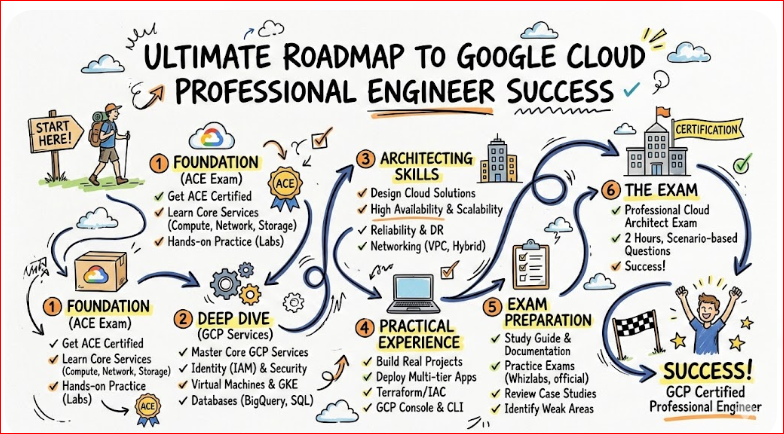
Strong and practical roadmap for Google Cloud Professional Engineer—clearly outlines key skills, services, and exam preparation strategy for real-world cloud success.
Very useful roadmap! Simple, clear, and perfect for anyone preparing for Google Cloud Professional Engineer certification. Really helpful guidance!