Introduction
Moving your business to the cloud is no longer a “nice to have” option. It is a absolute necessity for modern growth. But as systems grow, they become complex and harder to manage. This is where the GCP Professional Cloud Architect comes in. If you want to design, develop, and manage robust, secure, and scalable solutions on Google Cloud, this is the gold standard for your career.In this guide, I will share the deep insights I have gathered from a lifetime of navigating the shift from physical data centers to global cloud networks. As an expert who has seen these technologies evolve from their infancy, I can tell you that this specific certification is one of the most respected credentials in the world today. It transforms you from a technician into a strategic architect who can bridge the gap between business goals and technical reality.
Google Cloud Certification Overview
Before you jump into the Architect role, it is helpful to see how the different Google Cloud certifications work together. Each track is designed to focus on a specific part of the cloud ecosystem, from basic operations to advanced data handling. Use the table below to find the right starting point for your current skill level and goals.
| Track | Level | Who it’s for | Prerequisites | Skills Covered | Recommended Order |
| Cloud Architect | Professional | Solutions Architects, Lead Engineers | 3+ years industry exp. | Infrastructure design, Security, Compliance | 2nd or 3rd |
| Cloud DevOps Engineer | Professional | DevOps & SREs | 3+ years industry exp. | CI/CD, Monitoring, SRE practices | 2nd |
| Cloud Security Engineer | Professional | Security Specialists | 3+ years industry exp. | Identity management, Encryption, Network security | 3rd |
| Data Engineer | Professional | Data Scientists, BI Devs | 3+ years industry exp. | BigQuery, Dataflow, ML models | 2nd |
| Associate Cloud Engineer | Associate | Junior Admins, New Grads | 6 months+ cloud exp. | Deploying apps, Monitoring, Managing projects | 1st |
Deep Dive: GCP Professional Cloud Architect
What it is
This certification is a professional-level badge that shows you can design and plan a cloud solution architecture. It focuses on your ability to manage and provision the cloud solution infrastructure while ensuring security and compliance. It is highly respected because it requires a mix of technical skill and business logic.
Who should take it
This path is ideal for senior software engineers, solution architects, and technical managers who are responsible for large-scale migrations. If you find yourself making decisions about which cloud services to use for a project, this is for you. It is also perfect for those who want to move into a leadership role within a cloud team.
Skills you’ll gain
- You will learn how to design for high availability and business continuity across different regions.
- You will gain the ability to manage and provision cloud infrastructure using code and automation.
- You will understand how to design for security, ensuring that all data is safe and meets legal rules.
- You will be able to analyze and optimize both technical and business processes to save time and money.
Real-world projects you should be able to do
- You can lead the migration of a massive on-premise legacy system to a modern Google Cloud environment.
- You will be able to set up global load-balancing systems that handle millions of users across the world.
- You can implement multi-region Kubernetes clusters that allow applications to scale up or down automatically.
- You will be able to build secure data pipelines that process real-time information for business intelligence.
Preparation Plan
- 7–14 days (The “Fast Track”): This is for engineers who already use Google Cloud every single day at work. Spend your time looking at the four official case studies and taking practice exams to learn the question logic. Focus only on the areas where you feel a bit weak or unsure.
- 30 days (The “Standard Path”): This is a great pace for most working professionals who can give two hours a day to study. Use the first two weeks for documentation and the last two weeks for hands-on labs. Make sure to build a few small projects to see how the services talk to each other.
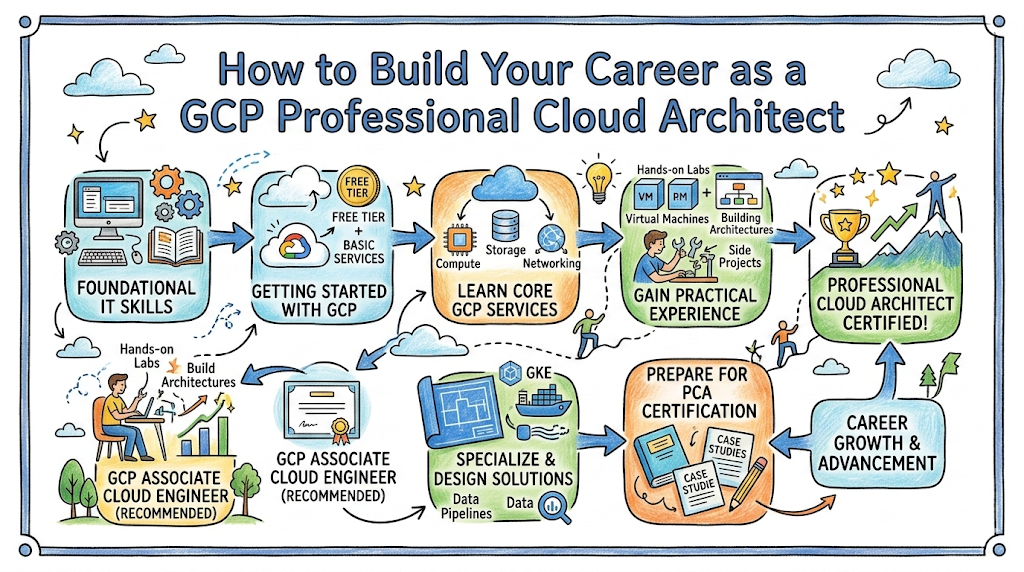
- 60 days (The “Foundation Builder”): If you are new to cloud or coming from another platform, take your time with this path. Start with the basics of the Associate Cloud Engineer level to build a strong base of knowledge. Use the second month to dive deep into the professional architecture syllabus and case studies.
Common Mistakes
- Many people fail because they ignore the official case studies, which make up a large part of the exam.
- A common error is memorizing what services do instead of understanding when to use one over the other.
- Many candidates skip the networking section, but understanding VPCs and hybrid connectivity is essential for passing.
- Rushing the exam without doing hands-on labs is a mistake, as the questions test practical experience, not just theory.
Best next certification after this
After you become a Certified Architect, the best next step is usually the Professional Cloud Security Engineer badge. This adds a layer of deep security knowledge to your architecture skills. Alternatively, moving into the Professional Data Engineer track is great if you want to focus on Big Data and Machine Learning.
Choose Your Path: 6 Specialized Learning Tracks
1. DevOps Path
This track is all about speed and automation in the cloud environment. You will focus on building CI/CD pipelines and using tools like Terraform to manage your infrastructure. It is the best path for those who want to bridge the gap between writing code and running it in production.
2. DevSecOps Path
Security is no longer something you add at the very end of a project. In this path, you learn how to bake security into every single step of the software development lifecycle. You will use Google’s advanced security tools to keep your applications safe from the moment the first line of code is written.
3. SRE Path
Site Reliability Engineering is about applying software engineering mindsets to operations problems. You will focus on things like error budgets, monitoring, and making sure that systems stay up and running even when things go wrong. This path follows the same principles that Google uses to keep its own services running globally.
4. AIOps/MLOps Path
This is a modern path that combines artificial intelligence with IT operations to make systems smarter. You will learn how to automate incident response and use machine learning models to predict when a system might fail. It is a great choice for those who enjoy working with cutting-edge data and automation tools.
5. DataOps Path
DataOps focuses on the entire lifecycle of data, from the moment it is collected to the moment it is analyzed. You will learn how to build robust data pipelines using tools like BigQuery, Dataflow, and Pub/Sub. This path is perfect for professionals who want to ensure that data is always high-quality and available for the business.
6. FinOps Path
FinOps is the practice of bringing financial accountability to the variable spend model of the cloud. You will learn how to balance the cost of cloud services with the performance needs of the application. This path is becoming very popular as companies look for ways to grow without blowing their budgets.
Role → Recommended Certifications
| Role | Recommended Certifications | Why it’s for this role |
| DevOps Engineer | Associate Cloud Engineer → Professional Cloud DevOps Engineer | Focuses on automating infrastructure, managing CI/CD pipelines, and ensuring seamless application deployment. |
| SRE (Site Reliability Engineer) | Associate Cloud Engineer → Professional Cloud DevOps Engineer → Professional Cloud Architect | Combines operational efficiency with architectural design to ensure systems are scalable, reliable, and highly available. |
| Platform Engineer | Associate Cloud Engineer → Professional Cloud Architect | Provides the high-level design skills needed to build the internal platforms that other development teams use daily. |
| Cloud Engineer | Associate Cloud Engineer → Professional Cloud Network Engineer | Focuses on the “plumbing” of the cloud—setting up VPCs, interconnects, and ensuring low-latency communication between services. |
| Security Engineer | Associate Cloud Engineer → Professional Cloud Security Engineer | Specializes in identity management, data encryption, and building secure perimeters to protect against modern cyber threats. |
| Data Engineer | Associate Cloud Engineer → Professional Data Engineer | Geared toward managing large-scale data processing, storage in BigQuery, and building automated data pipelines. |
| FinOps Practitioner | Associate Cloud Engineer → Professional Cloud Architect | Helps in understanding the technical architecture to better manage cloud spend, optimize resources, and improve ROI. |
| Engineering Manager | Digital Cloud Leader → Professional Cloud Architect | Gives leaders the technical depth to communicate with engineering teams and the strategic vision to make business-driven cloud decisions. |
Next Certifications to Take
Once you have cleared the GCP Professional Cloud Architect exam, you have three main ways to grow your career further. You can choose to go deeper into your current track, branch out into a new area, or move into a leadership-focused certification.
- Same Track (Deep Dive): Consider the Professional Cloud Network Engineer to master the complex networking that supports your architecture.
- Cross-Track (Broaden Skills): Take the Professional Data Engineer certification to understand how to design systems for massive data and AI workloads.
- Leadership Track: Look into the Google Cloud Digital Leader if you are moving into a role that involves more business strategy and stakeholder management.
Top Institutions for GCP Training
Choosing the right place to learn can make a huge difference in how quickly you master these complex topics. Here are the top institutions that provide excellent training and certification help:
- DevOpsSchool: This is a top-tier institution that offers very detailed technical workshops and hands-on labs. They focus on real-world scenarios that help you understand how cloud architecture works in a live environment. Their trainers are experts who provide great support for clearing the exam on your first try.
- Cotocus: They are well-known for providing corporate-level training that is customized for team needs. If your company is looking to move a whole department to the cloud, Cotocus provides the structured learning paths needed for a smooth transition. They focus on both theory and the practical application of cloud tools.
- Scmgalaxy: This is more than just a training center; it is a massive community of cloud and DevOps enthusiasts. They offer a huge library of tutorials, guides, and practice resources that are updated regularly. It is a fantastic place to find peer support and deep-dive articles on specific cloud challenges.
- BestDevOps: This institution is perfect for working professionals who need to learn quickly through focused bootcamps. They strip away the fluff and focus on the core skills and exam questions you need to know. Their teaching style is direct and designed to get you certified as fast as possible.
- Specialized Schools: For very specific areas of interest, you can visit devsecopsschool.com, sreschool.com, aiopsschool.com, dataopsschool.com, and finopsschool.com. These sites offer deep expertise in niche fields like security, reliability, and machine learning operations. They are the best choice if you want to become a true specialist in one area.
General Cloud Certification FAQs
- Is the GCP Professional Cloud Architect exam hard? It is widely considered one of the most difficult cloud exams because it requires a deep understanding of business logic and architecture.
- How much time do I need to study? Most professionals with some experience need about 2 to 3 months of steady study to feel fully prepared.
- Are there any prerequisites? While there are no official requirements, Google suggests having at least 3 years of industry experience before trying this level.
- In what order should I take the exams? The best path is to pass the Associate Cloud Engineer exam first to build your confidence and basic knowledge.
- Does this certification expire? Yes, Google Cloud certifications are valid for two years, after which you will need to recertify to keep your status.
- Will this help me get a job in India? Yes, demand for GCP architects is booming in cities like Bangalore, Pune, and Gurgaon as more companies move to the cloud.
- What is the passing score? Google doesn’t give an exact number, but most people aim for at least 70% to 80% on practice exams to be safe.
- Can I take the exam online? Yes, you can choose to take it from home with a remote proctor or visit a physical testing center near you.
- What is the exam format? The exam consists of multiple-choice and multiple-select questions that test your ability to solve practical problems.
- How much does it cost? The registration fee for the professional-level exams is currently $200 USD.
- Is GCP better than AWS or Azure? Each platform has its own strengths, but GCP is often seen as the leader in data, analytics, and Kubernetes.
- What happens if I fail? You can take the exam again, but you must wait 14 days after the first attempt and longer for further attempts.
GCP Professional Cloud Architect Specific FAQs
- How many case studies are in the exam? You will usually get questions based on 2 of the 4 official case studies that Google provides in advance.
- Is coding required for this exam? You don’t need to be a programmer, but you must understand how code interacts with the cloud and how to read basic scripts.
- How heavily is Kubernetes (GKE) tested? It is a major part of the exam, so you should spend a lot of time learning how containers work on Google Cloud.
- Do I need to know about Anthos? Yes, understanding how to manage hybrid and multi-cloud environments using Anthos is very important for this level.
- What is the focus on security? You need to be an expert in IAM roles, service accounts, and how to set up secure network perimeters.
- Are there labs in the actual exam? No, the exam is all questions, but doing labs during your study is the only way to truly understand the material.
- Is this certification good for managers? Yes, it gives managers the technical authority they need to lead high-performing engineering teams and make smart budget choices.
- Does the exam cover Google’s AI tools? It covers them from an architectural point of view, meaning you should know which AI service fits a specific business need.
Testimonials
“I had been working in general IT for many years, but I felt my career had hit a wall. Taking the GCP Architect course changed everything for me. It gave me a new way to look at how systems are built and helped me land a much better role.” — Rajesh
“The case studies in this certification were a real eye-opener for me. They moved me away from just managing servers to actually designing solutions that help the business grow. It was a challenging journey, but the reward was worth every hour of study.” — Suman
“As someone who moved from a developer role into management, this certification was essential. It gave me the technical confidence to speak with my engineers and the business knowledge to speak with my directors. I highly recommend it to anyone in a similar spot.” — Pooja
Conclusion
Becoming a GCP Professional Cloud Architect is one of the best moves you can make for your career in the modern tech world. It is a journey that moves you from being a technical doer to a technical leader. By mastering the art of cloud architecture, you ensure that you stay relevant and valuable in an ever-changing industry. The road to certification requires discipline and a lot of hands-on practice, but the professional doors it opens are incredible. Take the first step today by choosing your path and starting your study plan. Your future in the cloud is waiting for you.
Great career guide for GCP Cloud Architect! Clear, practical steps that really help in planning a strong cloud career path. Very insightful and motivating!