Introduction
AWS Certified Security – Specialty is for professionals who want to prove they can secure real AWS environments, not just understand security theory. In day-to-day cloud work, you deal with identity access, encryption, network protection, logging, alerts, and incident response—all while teams are deploying changes continuously. This certification helps you build that end-to-end security mindset and shows that you can design and operate secure workloads at scale. In this guide, you will learn what the certification covers, who should take it, what skills you will gain, how to prepare in 7–14 days, 30 days, or 60 days, and what career outcomes you can expect after passing. If you work as a DevOps engineer, cloud engineer, security engineer, platform engineer, or even an engineering manager responsible for cloud risk, this guide will help you choose the right path and prepare with confidence.
What is AWS Certified Security – Specialty?
AWS Certified Security – Specialty (SCS-C02) is a specialist-level credential focused on designing and running secure workloads on AWS. It tests real decision-making: choosing the right controls, reducing blast radius, keeping evidence, and building repeatable security guardrails. This is not an “only theory” exam. It rewards people who have hands-on habits: logging, access control, encryption strategy, incident readiness, and governance.
Why this certification is valuable for engineers and managers
For engineers
- You learn how to secure AWS services in real architecture patterns (multi-account, shared services, workload accounts).
- You build confidence in IAM design, key management, logging pipelines, and response playbooks.
- You become better at trade-offs (security vs speed vs cost) without breaking delivery.
For managers
- You learn what “good cloud security” looks like in measurable controls.
- You can guide teams toward audit readiness and continuous compliance.
- You understand where to invest: guardrails, detection, training, and incident drills.
Certification table
| Track | Level | Who it’s for | Prerequisites | Skills covered | Recommended order |
|---|---|---|---|---|---|
| AWS Security | Specialty | Security engineers, cloud engineers, DevOps/SRE, platform teams, managers owning security outcomes | Strong AWS basics, comfort with IAM, networking, logging, encryption concepts, and real environment exposure | Incident response, logging & monitoring, infrastructure security, IAM, data protection, governance | Take after you can design AWS workloads confidently; best after solid AWS core and security fundamentals |
Exam domains and what to focus on (practical view)
A reliable study approach is to map your work to the exam domains and practice the “why” behind each decision.
Domain 1: Incident Response
Focus on: detect → triage → contain → eradicate → recover → learn.
Practice: how you isolate resources, rotate credentials, preserve evidence, and write a clean incident report.
Domain 2: Logging and Monitoring
Focus on building evidence-ready logging.
Practice: org-level logging patterns, central log account, alerting strategy, and “what signal means what.”
Domain 3: Infrastructure Security (20%)
- Network segmentation, edge protection, secure compute patterns, vulnerability management.
Hands-on practice ideas include VPC segmentation, WAF + Shield patterns, EC2 hardening, patch baselines, and container security basics (EKS/ECS).
Domain 4: Identity and Access Management (16%)
- Least privilege IAM, federation, cross-account access, permission boundaries, SCPs, identity lifecycle.
Hands-on practice: writing IAM policies from requirements, IAM Identity Center (SSO), cross-account role assumption, and SCP guardrails.
Domain 5: Data Protection (18%)
- Encryption at rest/in transit, KMS key policies, secrets handling, data classification.
Hands-on practice: KMS key policy vs IAM policy, grants, rotation, S3 encryption + bucket policies, Secrets Manager vs Parameter Store, and sensitive data discovery workflows.
Domain 6: Management and Security Governance (14%)
- Multi-account governance, baseline controls, continuous compliance signals.
Hands-on practice: AWS Organizations OU strategy, guardrails, config-style controls, Security Hub reporting, and evidence readiness practices.
AWS Certified Security – Specialty mini-sections
What it is
A specialty certification that validates your ability to secure AWS workloads through strong identity controls, data protection, monitoring, incident response, and governance. It is scenario-driven and expects practical security judgment.
Who should take it
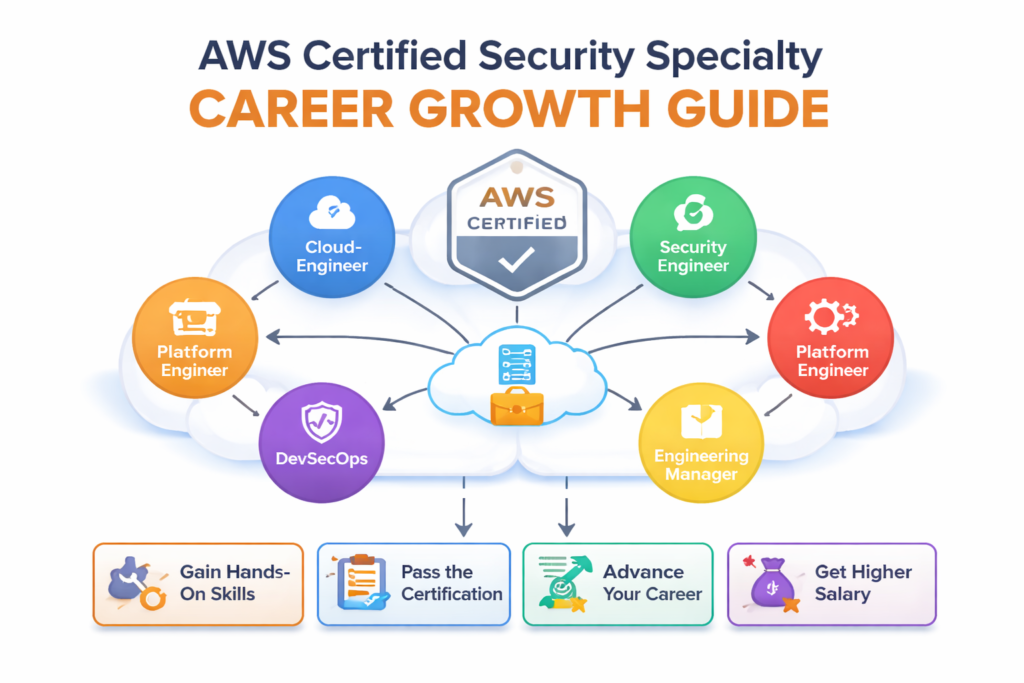
- Security Engineers working on cloud security controls and security architecture
- Cloud Engineers responsible for secure deployments and compliance
- DevOps / Platform Engineers building secure automation and guardrails
- SREs owning reliability with security constraints (access, logging, incident response)
- Engineering Managers accountable for risk reduction, audit readiness, and secure delivery
Skills you’ll gain
- Designing least-privilege IAM for humans, services, and cross-account access
- Building multi-account guardrails using organization-level controls
- Setting up logging and detection so incidents are caught early
- Implementing encryption and key management the right way
- Creating incident response workflows that preserve evidence and reduce blast radius
- Improving governance with repeatable compliance signals and reporting
Real-world projects you should be able to do after it
- Build a multi-account AWS security baseline with centralized logging and delegated security administration
- Implement org-wide detection + alerting and tune it to reduce noise
- Design secure VPC segmentation and private access patterns for internal services
- Implement KMS + secrets strategy for apps and pipelines (rotation, grants, least privilege)
- Create an incident runbook and run tabletop drills with realistic cloud scenarios
- Build an audit evidence pack (logs, access reviews, retention, change records) ready for review
Preparation plan (7–14 days / 30 days / 60 days)
7–14 days (fast-track if you already work on AWS security)
- Day 1–2: Map domains to your gaps. Make a checklist by domain weight.
- Day 3–5: IAM deep practice: policies, role assumption, permission boundaries, SCP reasoning.
- Day 6–8: Logging baseline: centralize logs, define alerts, validate evidence trails.
- Day 9–11: Data protection: KMS decisions, key policies vs IAM policies, secrets rotation patterns.
- Day 12–14: Full practice exams + review wrong answers with “why not” notes.
30 days (practical and realistic)
Use a weekly structure like:
- Week 1: Build baseline and refresh IAM + KMS fundamentals.
- Week 2: Logging + infrastructure security patterns (segmentation, endpoints, hardened access).
- Week 3: Detection + incident response drills (choose best next action, reduce blast radius).
- Week 4: Governance + full timed simulations and deep review of mistakes.
60 days (best for people new to cloud security depth)
- Weeks 1–2: AWS core + security basics (IAM, networking basics, encryption fundamentals)
- Weeks 3–5: Hands-on labs mapped to each domain (especially logging, IR, governance)
- Weeks 6–7: Scenario practice (long form questions, trade-offs, best next step decisions)
- Week 8: Full revision, timed exams, and final weak-area repairs
Common mistakes
- Memorizing services but failing to choose the best security decision in a scenario
- Writing IAM that “works” but violates least privilege or lacks guardrails
- Ignoring evidence and audit trail needs (logs not centralized, retention missing)
- Treating encryption as a checkbox and missing key policy and access design
- Overbuilding tools while skipping fundamentals (logging, access reviews, runbooks)
- Not practicing multi-account patterns (the exam expects real-world AWS operating models)
Best next certification after this
A good next step depends on whether you want deeper AWS architecture, broader security leadership, or platform ownership:
- Deeper AWS architecture track (broaden design responsibility)
- Cross-track security leadership (move into governance and strategy)
- Platform/DevOps leadership (secure delivery at scale)
Choose your path (6 learning paths)
1) DevOps path
Goal: deliver faster without weakening security.
- Learn secure CI/CD, secret handling, least privilege for pipelines
- Build repeatable guardrails so teams can ship safely
- Focus domains: IAM, data protection, logging
2) DevSecOps path
Goal: integrate security into delivery.
- Make security controls part of build, deploy, and runtime checks
- Improve policy design, identity federation, and detection workflows
- Focus domains: IAM, governance, incident response
3) SRE path
Goal: reliability with strong operational security.
- Centralize logging, monitor security signals, run incident drills
- Design access for on-call and responders (least privilege + fast recovery)
- Focus domains: logging/monitoring, incident response, governance
4) AIOps / MLOps path
Goal: secure data + pipelines + models.
- Strong secrets handling, encryption strategy, identity boundaries for services
- Monitoring for drift, anomalies, and suspicious behavior in pipelines
- Focus domains: data protection, IAM, monitoring
5) DataOps path
Goal: secure data movement and governance.
- Data classification, encryption, access patterns, audit trails
- Reduce risk in ETL, data lakes, and analytics workflows
- Focus domains: data protection, governance, logging
6) FinOps path
Goal: reduce waste without creating risk.
- Cost controls must not weaken logging, encryption, or incident readiness
- Design budgets and controls that keep security always-on
- Focus domains: governance, logging/monitoring, secure automation
Role → Recommended certifications mapping
| Role | Recommended certifications (sequence logic) |
|---|---|
| DevOps Engineer | Start with strong AWS foundations → add AWS Certified Security – Specialty for secure pipelines and guardrails |
| SRE | Reliability + incident readiness → AWS Certified Security – Specialty to strengthen detection, access, and response |
| Platform Engineer | Multi-account governance + guardrails → AWS Certified Security – Specialty to standardize secure platforms |
| Cloud Engineer | Architecture + operations → AWS Certified Security – Specialty for secure workload design decisions |
| Security Engineer | Direct match → AWS Certified Security – Specialty as core proof of AWS security expertise |
| Data Engineer | Secure data flows + encryption → AWS Certified Security – Specialty for KMS, secrets, classification, governance |
| FinOps Practitioner | Governance mindset + controls → AWS Certified Security – Specialty to prevent cost cutting from weakening controls |
| Engineering Manager | Risk, governance, and audit readiness → AWS Certified Security – Specialty to understand practical cloud security decisions |
Next certifications to take (3 options)
Option 1: Same track (go deeper in AWS security + architecture)
Choose this if you want to own secure cloud architecture decisions end-to-end:
- Focus on advanced cloud architecture design and secure scaling patterns
- Build deeper confidence in designing secure workloads across teams
Option 2: Cross-track (broaden into platform + reliability + automation)
Choose this if you want to lead secure delivery across engineering:
- Add DevSecOps practices to embed security into pipelines
- Strengthen SRE skills so incidents are handled cleanly and calmly
Option 3: Leadership track (governance + management)
Choose this if you want to lead teams, programs, and controls:
- Move toward security management, risk governance, and audit leadership
- Build stakeholder communication skills and control ownership
Top institutions that help with training + certification preparation
DevOpsSchool
DevOpsSchool offers structured training that blends AWS security concepts with hands-on labs and exam-style scenarios. It helps learners build real skills in IAM design, logging strategy, encryption choices, and incident response. The learning path is job-focused, so you can directly apply it to real cloud projects while preparing for the certification.
Cotocus
Cotocus supports learners with practical, industry-aligned guidance that connects AWS security topics to real implementation needs. It is helpful for professionals who want to understand how security controls work in actual DevOps and cloud environments. The focus is more on realistic problem-solving than only theory.
Scmgalaxy
Scmgalaxy provides step-by-step learning tracks that suit both working engineers and beginners building security depth. It helps you strengthen fundamentals first and then move toward exam readiness through structured practice. It is useful if you prefer guided learning with clear progression.
BestDevOps
BestDevOps is known for role-based preparation and job-aligned certification support. It helps learners translate certification topics into real project capability and interview readiness. If your goal is career growth along with certification success, it can be a practical choice.
devsecopsschool
devsecopsschool is a strong fit if you want to integrate security into CI/CD and platform workflows. It supports learning around policy thinking, secure automation, and building guardrails that teams can follow without slowing delivery. This aligns well with the Security Specialty mindset of repeatable controls.
sreschool
sreschool supports reliability engineers and platform teams with strong operational practices. It helps learners connect incident response, monitoring signals, access governance, and runbooks in a structured way. This is valuable because the certification expects solid incident readiness and monitoring discipline.
aiopsschool
aiopsschool helps teams handle high-volume signals using analytics and automation thinking. It can support your learning in detection, alert tuning, and operational response workflows. This is useful for security monitoring and incident workflows that need speed and clarity.
dataopsschool
dataopsschool supports professionals working with data platforms, pipelines, and governance needs. It helps you build strong habits around data protection, access controls, encryption, and audit readiness. This aligns with the certification’s focus on protecting data across AWS services.
finopsschool
finopsschool helps you connect cost optimization with secure governance. It supports practical thinking around budgets, controls, and ensuring cost savings do not weaken essential security signals like logging, encryption, and monitoring. This is valuable in real enterprises where cost and security must balance.
AWS Certified Security – Specialty: FAQs
1) Is AWS Certified Security – Specialty hard?
Yes, it is advanced and scenario-heavy. Success depends more on security decision-making than memorizing definitions.
2) How long does preparation usually take?
If you already work on AWS security, 30 days is a strong plan. If you are new to deeper security topics, 60 days is safer for steady progress.
3) Do I need another AWS certification first?
It is not strictly required, but many candidates benefit from having strong AWS architecture fundamentals before attempting the specialty level.
4) What should I practice most?
IAM policy writing, cross-account patterns, centralized logging, KMS decisions, and incident response drills are high value because they show up in real scenarios.
5) What is the most common reason people fail?
They study services in isolation but struggle with “best next action” or “most secure design” choices under constraints (operations, evidence, blast radius).
6) Is it good for DevOps and SRE roles?
Yes. It helps DevOps and SRE professionals build safer guardrails, better logging, and stronger response workflows—skills that matter daily in production.
7) What are the best prerequisites to have?
Comfort with AWS basics, networking patterns (VPC and segmentation), IAM fundamentals, encryption concepts, and real-world exposure to logs and alerts.
8) What career outcomes can this help with?
It can support movement into Cloud Security Engineer, Security Architect (AWS), Platform Security, DevSecOps Engineer, and senior cloud roles where security ownership is expected.
Additional FAQs
1) How difficult is AWS Certified Security – Specialty?
It is considered an advanced-level exam because questions are scenario-based and test decision-making, not memorization. If you are strong in IAM, encryption, logging, and incident response, it becomes manageable with structured practice.
2) How much time do I need to prepare?
Most learners fall into three tracks:
- 7–14 days if you already work daily on AWS security controls and troubleshooting
- 30 days if you have solid AWS experience but need focused security depth
- 60 days if you are new to deeper cloud security domains or do not practice daily
3) What prerequisites should I have before attempting this certification?
You should be comfortable with:
- AWS core services and basic cloud architecture
- IAM users/roles/policies and least privilege thinking
- Networking basics (VPC, subnets, security groups, NACLs)
- Encryption concepts (at rest, in transit) and secrets handling
- Logging and monitoring basics (what to log, where to store, how to alert)
4) Do I need another AWS certification first?
It is not mandatory, but it helps a lot if you already understand AWS architecture and operations. Without that base, you may struggle with scenario questions that assume real-world AWS design knowledge.
5) What is the best study sequence for this exam?
A practical sequence is:
- IAM & access control (least privilege, cross-account, SCP thinking)
- Data protection (KMS concepts, secrets strategy, encryption choices)
- Logging & monitoring (centralized logs, alerting, evidence readiness)
- Infrastructure security (segmentation, secure endpoints, protection layers)
- Incident response + governance (containment, recovery, reporting)
6) What is the most important topic to master?
IAM is usually the highest-impact area because it appears across many scenarios and affects every workload. If your IAM reasoning is strong, your accuracy improves across the whole exam.
7) Is the exam more theoretical or practical?
It is practical in the sense that it tests “best next step” and “best secure design” choices. Even if you know service names, you must choose the option that reduces risk, preserves evidence, and scales with operations.
8) What is the biggest mistake candidates make?
They try to memorize services and skip hands-on practice. The exam often requires you to pick the best option among several “technically possible” answers, and that skill comes from real patterns, not reading alone.
9) What is the value of this certification in the job market?
It is valuable because many teams are moving workloads to AWS and need people who can secure cloud environments without slowing delivery. It signals that you can handle identity, encryption, monitoring, and response in production-like conditions.
10) What career outcomes can this certification support?
It can help you move into or grow within roles like:
- Cloud Security Engineer
- Security Engineer (AWS-focused)
- DevSecOps Engineer
- Platform Engineer (security guardrails)
- Security Architect (cloud workloads)
It can also strengthen seniority in DevOps/SRE roles where security ownership is expected.
11) What roles benefit the most from AWS Certified Security – Specialty?
It benefits professionals who own cloud workloads and must secure them end-to-end, especially: DevOps Engineers, SREs, Platform Engineers, Cloud Engineers, and Security Engineers.
12) Is it worth it for engineering managers?
Yes, if you manage teams responsible for cloud risk, audits, incidents, and compliance. You gain a clear view of what “good cloud security” looks like and how to measure it through repeatable controls and evidence.
Testimonials
Skylar Bennett
“This guide on the AWS Certified Security Specialty exam is really practical and easy to follow… it breaks down the key topics and explains what to focus on in simple terms.”
Rohit (Cloud Engineer)
“I stopped guessing and started practicing IAM and KMS decisions in real labs. Once I learned how to justify the ‘best’ option, the exam scenarios felt predictable.”
Meera (Security Engineer)
“The biggest upgrade was how I built logging and response habits. Even before the exam, my work improved because I could explain what evidence we need and why.”
Conclusion
AWS Certified Security – Specialty is a strong signal that you can secure AWS workloads in the real world—not just in slides. If you focus on the core habits—least privilege IAM, strong encryption and key management, evidence-ready logging, incident drills, and multi-account governance—you will not only prepare for the exam, you will become the person teams trust during security reviews and production incidents. Follow the plan that matches your current level, practice hands-on every week, and review mistakes deeply. When you treat security as a system of repeatable guardrails (not a one-time setup), certification success becomes a natural result of how you operate every day.
Excellent AWS Security Specialty guide! Very clear and practical roadmap for certification prep and long-term career growth in cloud security.