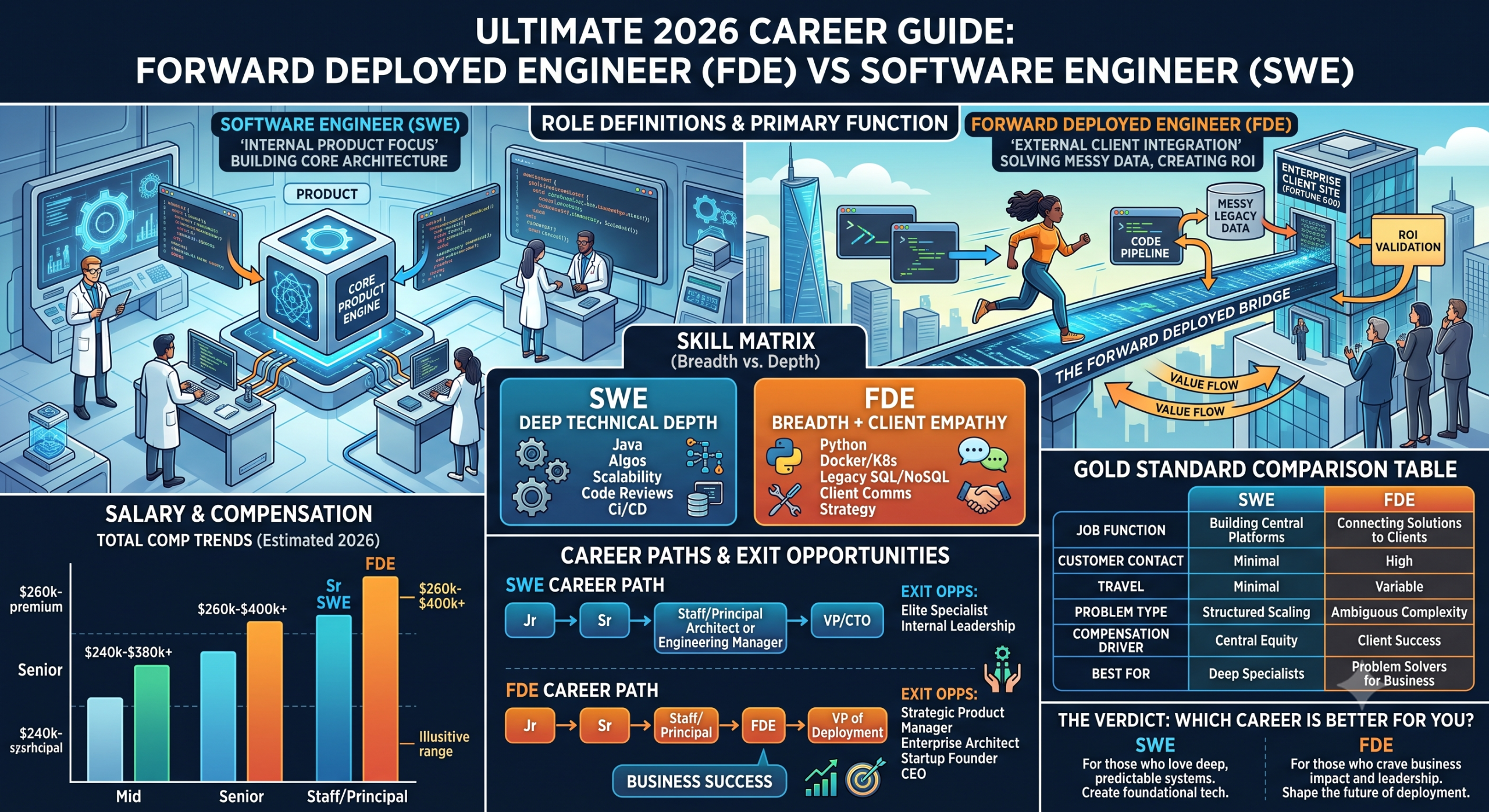
The Complete Basic-to-Advanced Career Guide for 2026
Simple answer first
Software Engineer is better if you want deep technical focus, stable engineering growth, stronger remote-work options, and a clearer career ladder.
Forward Deployed Engineer is better if you want customer-facing engineering, real-world business impact, AI deployment work, faster learning across industries, and a role closer to product, consulting, architecture, and entrepreneurship.
The best answer is not:
“FDE is better.”
or
“Software Engineer is better.”
The real answer is:
Software Engineer is better for deep builders. Forward Deployed Engineer is better for technical problem-solvers who want to build directly inside the customer’s reality.
That is the whole game.
1. What is a Software Engineer?
A Software Engineer designs, builds, tests, maintains, and improves software systems.
In simple words:
A Software Engineer builds the actual product, platform, application, service, API, or system that users depend on.
Software engineers may work on:
- Backend services
- Frontend applications
- Mobile apps
- Cloud infrastructure
- Developer platforms
- Databases
- APIs
- Internal tools
- AI features
- Security systems
- Distributed systems
- Testing and automation
The U.S. Bureau of Labor Statistics describes software developers as people who create computer applications and underlying systems, analyze user needs, design software, ensure programs function properly, and document systems for future maintenance. The same BLS page lists the 2024 median annual wage for software developers at $133,080 and projects 15% employment growth from 2024 to 2034, which is much faster than average.
So the Software Engineer role is broad, mature, proven, and still growing strongly.
2. What is a Forward Deployed Engineer?
A Forward Deployed Engineer, or FDE, is an engineer who works directly with customers to solve real business problems by building, integrating, deploying, and improving software in the customer’s environment.
In simple words:
A Forward Deployed Engineer is a software engineer who goes closer to the customer, understands the messy real-world problem, builds the solution, drives adoption, and brings product feedback back to the company.
OpenAI describes its Forward Deployed Engineers as engineers who lead end-to-end deployments of frontier models in production with strategic customers, owning discovery, technical scoping, system design, build, and production rollout. OpenAI also says success is measured through production adoption, measurable workflow impact, and feedback that changes product and model roadmaps.
Palantir describes its Forward Deployed Software Engineer role as the original blueprint for embedding engineers directly with customers to tackle their most pressing challenges, build solutions with business-critical data and AI, and drive projects from ideation to deployment.
AWS has also made FDE a major AI-era strategy, announcing a dedicated Forward Deployed Engineering organization backed by a $1 billion investment to embed experts with customers and co-develop agentic AI solutions.
So FDE is not just a fancy title. It is becoming a serious career category in enterprise AI, data, cloud, and high-stakes product deployment.
3. The simplest difference
A Software Engineer usually builds the product.
A Forward Deployed Engineer makes the product work in the customer’s real world.
| Question | Software Engineer | Forward Deployed Engineer |
|---|---|---|
| Where do they spend most energy? | Product, codebase, platform, architecture | Customer problem, deployment, integration, adoption |
| Who is the main audience? | Product team, engineering team, end users | Customer users, customer engineers, executives, internal product team |
| What do they build? | Product features and systems | Customer-specific solutions, integrations, workflows, production deployments |
| What is success? | Reliable feature shipped | Customer outcome achieved |
| Main risk | Building wrong or unreliable software | Building something that works technically but fails in customer adoption |
| Best personality fit | Deep technical builder | Technical builder + problem solver + communicator |
A Software Engineer may ask:
What is the best way to build this feature?
A Forward Deployed Engineer may ask:
What is the real customer problem, and what must we build so this actually works in production?
Both are engineering.
But they are different games.
4. Why this comparison matters in 2026
This comparison matters because AI is changing both careers.
In the past, a Software Engineer could mostly focus on code, architecture, and delivery inside a product team. That still exists, and it still matters.
But AI has created a new problem:
Many AI products are easy to demo but hard to deploy into real business workflows.
That is why FDE roles are rising. AWS says customers have moved past simply exploring AI and now want to make AI core to how they operate; its FDE model is designed to compress deployments from months to days and leave customers self-sufficient with deployed systems, knowledge graphs, runbooks, documentation, and trained internal champions.
At the same time, Software Engineering is not dying. BLS still projects strong growth for software developers, quality assurance analysts, and testers from 2024 to 2034.
The future is not “FDE replaces Software Engineer.”
The future is:
Software Engineers will use AI to build faster. FDEs will use engineering and AI to make products actually work inside complex organizations.
5. Career identity: builder vs deployed builder
Here is the cleanest mental model.
flowchart LR
    A[Software Engineer] --> B[Builds Core Product]
    B --> C[Ships Features, Services, Platforms]

    D[Forward Deployed Engineer] --> E[Builds with Customer Reality]
    E --> F[Ships Outcomes, Integrations, Adoption]

    C --> G[Product Value]
    F --> G[Product Value]
Both careers create value.
But they create value from different angles.
Software Engineer:
“I build the product so many users can use it.”
Forward Deployed Engineer:
“I make the product succeed in a specific customer environment, then turn that learning into reusable product improvement.”
6. Role comparison at a glance
| Criteria | Software Engineer | Forward Deployed Engineer |
|---|---|---|
| Core work | Build software | Build and deploy solutions with customers |
| Coding depth | High | Medium to high |
| Customer exposure | Low to medium | High |
| Ambiguity | Medium | Very high |
| Travel | Usually low | Can be medium to high |
| Meetings | Medium | High |
| Product influence | Medium to high | High through customer feedback |
| Technical specialization | Easier to go deep | Broader, more cross-functional |
| Business exposure | Medium | High |
| Career ladder clarity | Usually clearer | Depends heavily on company |
| Remote flexibility | Often better | Often lower due to customer/office needs |
| Best for | Deep technical builders | Technical owners of customer outcomes |
| Worst fit for | People who dislike long engineering cycles | People who dislike customer pressure |
7. What does a Software Engineer actually do?
A Software Engineer usually works inside an engineering team.
Typical work includes:
| Responsibility | Simple explanation |
|---|---|
| Design | Decide how software should work |
| Coding | Write application, backend, frontend, infrastructure, or platform code |
| Testing | Make sure software behaves correctly |
| Code review | Review other engineers’ code |
| Debugging | Fix bugs and production issues |
| Architecture | Design reliable, scalable systems |
| Documentation | Explain systems for future maintenance |
| Collaboration | Work with product managers, designers, QA, SREs, and other engineers |
| Maintenance | Improve existing systems |
| Performance | Make systems faster and more efficient |
| Security | Protect data, access, and systems |
BLS lists common software developer duties such as analyzing users’ needs, designing and developing software, recommending upgrades, planning how application pieces fit together, maintaining programs, testing, and documenting systems.
A Software Engineer’s day is usually centered around the codebase.
8. What does a Forward Deployed Engineer actually do?
A Forward Deployed Engineer usually works at the boundary between company and customer.
Typical work includes:
| Responsibility | Simple explanation |
|---|---|
| Discovery | Understand the customer’s real problem |
| Technical scoping | Convert unclear needs into buildable work |
| Solution architecture | Design how the solution should fit into customer systems |
| Coding | Build custom apps, integrations, automations, dashboards, AI workflows |
| Deployment | Launch the system in production |
| Integration | Connect with customer APIs, databases, cloud, identity, and data |
| Adoption | Help users actually use the solution |
| Feedback | Bring customer learning back to product and engineering teams |
| Documentation | Create runbooks, playbooks, handoff docs |
| Risk management | Handle security, compliance, timeline, and stakeholder risks |
OpenAI’s FDE description includes owning technical delivery from prototype to stable production, building full-stack systems, embedding with customer teams, scoping work, coding when needed, codifying patterns into tools or playbooks, and sharing field feedback with Research and Product.
Palantir’s FDSE description includes architecture decisions, large-scale data work, custom applications, direct customer stakeholder engagement, and driving high-stakes projects from ideation to deployment.
An FDE’s day is centered around the customer outcome.
9. Workflow comparison
Software Engineer workflow
flowchart TD
    A[Product Roadmap] --> B[Engineering Design]
    B --> C[Implementation]
    C --> D[Code Review]
    D --> E[Testing]
    E --> F[Release]
    F --> G[Monitoring]
    G --> H[Iteration]
Forward Deployed Engineer workflow
flowchart TD
    A[Customer Problem] --> B[Discovery]
    B --> C[Technical Scoping]
    C --> D[Prototype]
    D --> E[Customer Feedback]
    E --> F[Production Build]
    F --> G[Security + Governance]
    G --> H[Rollout]
    H --> I[Adoption]
    I --> J[Reusable Product Learning]
    J --> K[Product Roadmap]
The Software Engineer workflow starts from the product roadmap.
The FDE workflow starts from customer pain.
That one difference changes everything.
10. The biggest hidden difference: problem clarity
Software Engineers usually work with more defined requirements.
Not always perfect, of course. Engineering requirements are famous for being messy. But usually there is a product manager, design spec, ticket, roadmap, or architecture proposal.
Forward Deployed Engineers often begin before the problem is fully clear.
Customer may say:
“We need AI.”
But the real problem may be:
“Our claims team spends 6 hours per day reading messy PDFs and entering decisions into three systems.”
Customer may say:
“We need a dashboard.”
But the real problem may be:
“Executives do not trust the data because five teams define the same metric differently.”
Customer may say:
“We need automation.”
But the real problem may be:
“The workflow crosses legal, finance, operations, and security, and nobody owns the full process.”
This is why FDEs need discovery skills.
A Software Engineer is often asked to solve a defined engineering problem.
An FDE is often asked to discover what the real problem is before solving it.
11. Depth vs breadth
Software Engineering usually rewards depth.
Forward Deployed Engineering rewards breadth plus enough depth.
| Career | Technical shape |
|---|---|
| Software Engineer | Deep specialization is highly valuable |
| Forward Deployed Engineer | Broad technical range is highly valuable, but weak coding still hurts |
A backend Software Engineer may go very deep into:
- Distributed systems
- Database internals
- API performance
- Concurrency
- Event-driven architecture
- Reliability
- Security
- Compiler/runtime behavior
An FDE may need to move across:
- Backend
- Frontend
- Data
- Cloud
- Authentication
- AI models
- Integrations
- Security reviews
- Dashboards
- Customer workflows
- Executive communication
The FDE does not always need to be the best specialist in every area.
But the FDE must know enough to connect the full system.
12. Skill comparison
| Skill | Software Engineer | Forward Deployed Engineer |
|---|---|---|
| Coding | Very high | High |
| System design | High | High |
| Product thinking | Medium to high | Very high |
| Customer discovery | Low to medium | Very high |
| Communication | Medium to high | Very high |
| Debugging | High | High |
| Cloud/infrastructure | Depends on role | Often important |
| Data engineering | Depends on role | Often important |
| AI deployment | Increasingly important | Very important in AI FDE roles |
| Security/compliance | Depends on product | Very important in enterprise deployments |
| Business understanding | Medium | Very high |
| Travel readiness | Low | Sometimes high |
| Ambiguity handling | Medium | Very high |
| Documentation | Medium | High |
| Adoption/change management | Low to medium | High |
OpenAI specifically says FDE candidates may thrive if they have 5+ years of engineering or technical deployment experience including customer-facing work, production-grade frontend/backend coding ability, experience with LLM-powered systems, clear communication, risk spotting, and calm judgment under pressure.
That shows the role is not “less technical.” It is technical plus customer-facing plus delivery ownership.
13. Salary comparison
Software Engineer salary
For the U.S. market, BLS reports that software developers had a median annual wage of $133,080 in May 2024. BLS also projects strong job growth for software developers, quality assurance analysts, and testers from 2024 to 2034.
That is a broad national median, not a Big Tech compensation number. Senior engineers at top technology companies can earn far more through equity, bonuses, and level-based compensation.
Forward Deployed Engineer salary
FDE salaries can be very strong, especially at AI and enterprise software companies.
OpenAI’s NYC Forward Deployed Engineer posting lists compensation of $162K–$280K plus equity.
Palantir’s New York Forward Deployed Software Engineer posting lists an estimated salary range of $135K–$200K per year, with total compensation potentially including restricted stock units, sign-on bonus, and other incentives.
Salary interpretation
| Career | Compensation reality |
|---|---|
| Software Engineer | Very wide range; strongest at Big Tech, infra, AI, finance, security, and senior levels |
| Forward Deployed Engineer | Often strong at elite AI/data/platform companies, especially when role includes production ownership, travel, customer impact, and business-critical delivery |
Which pays better?
It depends.
At average market level, Software Engineer has more total job openings and more stable salary data.
At elite AI companies, senior FDE roles can pay extremely well because they combine engineering, product, customer trust, and revenue impact.
The better framing:
Software Engineering has broader salary stability. FDE has higher upside when you join the right company, solve important customer problems, and turn field work into product leverage.
14. Lifestyle comparison
This is where many people make the wrong decision.
They compare only salary and prestige.
Bad idea.
Lifestyle matters.
| Lifestyle factor | Software Engineer | Forward Deployed Engineer |
|---|---|---|
| Deep work time | Higher | Lower |
| Context switching | Medium | High |
| Customer meetings | Lower | Higher |
| Travel | Lower | Higher |
| Remote work | Usually easier | Often harder |
| Schedule predictability | Better | More variable |
| Pressure type | Technical deadlines | Technical + customer + business pressure |
| Communication load | Medium | High |
| Emotional labor | Lower | Higher |
| Learning variety | Medium | Very high |
OpenAI’s NYC FDE role requires hybrid office work and travel up to 50%, which is a major lifestyle factor, not just a job detail.
Palantir’s FDSE posting says ability and interest to travel up to 25% may be needed, flexible based on personal preferences.
So before choosing FDE, ask yourself:
Do I want my engineering career to include customer rooms, ambiguity, travel, and business pressure?
If the answer is yes, FDE may be amazing.
If the answer is no, Software Engineering may be better.
15. Career growth comparison
Software Engineer career ladder
flowchart TD
    A[Junior Software Engineer] --> B[Software Engineer]
    B --> C[Senior Software Engineer]
    C --> D[Staff Engineer]
    D --> E[Principal Engineer]
    E --> F[Distinguished Engineer]

    C --> G[Engineering Manager]
    G --> H[Director of Engineering]
    H --> I[VP Engineering / CTO]
Software Engineering has a mature ladder.
You can grow as:
- Individual contributor
- Tech lead
- Staff engineer
- Principal engineer
- Engineering manager
- Architect
- Founder
- CTO
Forward Deployed Engineer career ladder
flowchart TD
    A[Associate / Junior FDE] --> B[Forward Deployed Engineer]
    B --> C[Senior FDE]
    C --> D[Lead / Staff FDE]
    D --> E[FDE Manager]
    D --> F[Platform / Product Engineering Lead]
    D --> G[Solutions Architecture Leader]
    D --> H[Enterprise AI Leader]
    D --> I[Founder / Startup Operator]
FDE career paths can become very powerful, but they are less standardized.
A strong FDE can move into:
- Senior FDE
- FDE lead
- Platform engineer
- Product manager
- Solutions architect
- Customer engineering leader
- Enterprise AI leader
- Startup founder
- GTM/product strategy
- Technical consulting founder
FDE is especially good for people who may later want to become founders because it teaches customer pain, business workflow, technical delivery, pricing pressure, adoption, and enterprise politics.
Tiny spicy truth: many brilliant engineers can build. Far fewer can find a painful customer problem, build the right thing, get users to adopt it, and turn it into a repeatable business. FDE trains exactly that muscle.
16. Which role is better for beginners?
Software Engineer is usually better for most beginners
Why?
Because beginners need engineering depth first.
If you are early in your career, Software Engineering gives you:
- Strong coding foundation
- Code review habits
- System design exposure
- Testing discipline
- Production engineering basics
- Mentorship from senior engineers
- Better technical depth
- Clearer career ladder
FDE can work for beginners, but only in the right company
Palantir’s FDSE posting requires 1+ years of relevant post-college work experience and strong coding proficiency, which shows some FDE-style roles can be accessible relatively early.
But for many AI FDE roles, companies prefer experienced engineers. OpenAI’s FDE posting asks for 5+ years of engineering or technical deployment experience including customer-facing work.
Beginner verdict
| Your situation | Better first step |
|---|---|
| You are a fresher with weak coding | Software Engineer |
| You are a fresher with strong coding and high communication ability | Either, but Software Engineer is safer |
| You already built real products and enjoy customers | FDE can work |
| You want long-term AI enterprise career | Start as Software Engineer, then move into FDE after strong foundation |
| You want startup/founder path | FDE may accelerate business learning |
For most people: become a solid Software Engineer first, then choose FDE if you want more customer and business exposure.
17. Which role is better for experienced engineers?
For experienced engineers, the decision becomes more interesting.
Choose Software Engineer if you want:
- Deep technical mastery
- Platform or infrastructure specialization
- Better remote options
- Fewer customer meetings
- Clearer engineering ladder
- More time in code
- Less travel
- More predictable work style
- Staff/principal engineering track
Choose FDE if you want:
- More customer impact
- More business context
- AI deployment work
- Ambiguous, high-stakes problems
- More ownership
- Faster domain learning
- More product influence
- Enterprise workflow exposure
- Founder-like experience inside a company
Experienced engineers often move to FDE when they get tired of building features without seeing the real-world impact.
But not everyone enjoys it.
Some engineers try FDE and realize:
“I actually miss quiet engineering time.”
That is valid.
18. Which role is better in the AI era?
Both are good, but they benefit from AI in different ways.
Software Engineer in the AI era
AI helps Software Engineers:
- Generate code faster
- Write tests
- Refactor
- Debug
- Summarize codebases
- Create prototypes
- Improve documentation
- Build AI-powered features
But AI also raises the bar. Engineers must become better at architecture, judgment, verification, security, and system-level thinking.
A 2026 review on AI-native software engineering argues that generative AI and agentic AI are reshaping software engineering practice, education, and professional roles, and that the central challenge is educating engineers for judgment, verification, and orchestration rather than code production alone.
FDE in the AI era
AI makes FDE more important because enterprises need help deploying AI into real workflows.
AI FDEs may work on:
- RAG systems
- AI agents
- Workflow automation
- AI governance
- Evaluation frameworks
- Customer data integration
- Human-in-the-loop approval
- Model observability
- Cost control
- Enterprise adoption
AWS’s FDE announcement is a strong signal here: its organization is specifically focused on helping customers build production AI systems with their data, governance, and processes.
AI-era verdict
| Goal | Better career |
|---|---|
| Build core AI products | Software Engineer |
| Build AI platforms and infrastructure | Software Engineer |
| Deploy AI inside enterprises | Forward Deployed Engineer |
| Work directly with customer AI adoption | Forward Deployed Engineer |
| Become an AI startup founder | FDE may be stronger |
| Become a deep AI systems engineer | Software Engineer may be stronger |
19. Technical depth: who becomes stronger?
This depends on the person.
Software Engineers usually become stronger in:
- Code quality
- Architecture depth
- Large-scale systems
- Performance
- Reliability
- Distributed systems
- Product engineering
- Engineering craft
Forward Deployed Engineers usually become stronger in:
- System integration
- Customer discovery
- Applied architecture
- Data workflow understanding
- AI deployment
- Security/compliance trade-offs
- Business impact
- Product-market feedback
- Ambiguous problem solving
A Software Engineer may know one product deeply.
An FDE may know many customer problems broadly.
Neither is automatically superior.
It is like comparing a surgeon and an emergency doctor. One goes deep in a controlled setting. The other makes high-pressure decisions in messy reality.
Both are serious.
20. The “better career” decision matrix
Use this table honestly.
| You prefer… | Better choice |
|---|---|
| Deep coding | Software Engineer |
| Customer problem solving | FDE |
| Remote work | Software Engineer |
| Travel and field exposure | FDE |
| Clear career ladder | Software Engineer |
| Ambiguous high-impact work | FDE |
| Stable daily schedule | Software Engineer |
| Business and product exposure | FDE |
| Becoming Staff/Principal Engineer | Software Engineer |
| Becoming founder/operator | FDE |
| Fewer meetings | Software Engineer |
| More human interaction | FDE |
| Specialist identity | Software Engineer |
| Generalist/operator identity | FDE |
| Product roadmap work | Software Engineer |
| Customer deployment work | FDE |
| AI model/product building | Software Engineer |
| AI adoption and workflow deployment | FDE |
21. Personality fit
Software Engineer personality fit
You may love Software Engineering if:
- You enjoy deep focus
- You like clean technical problems
- You enjoy building scalable systems
- You prefer fewer meetings
- You like improving code quality
- You enjoy technical mastery
- You want a clear promotion ladder
- You like remote-friendly work
- You prefer product/team environment over customer environment
FDE personality fit
You may love FDE if:
- You like solving messy problems
- You enjoy talking to users
- You can handle unclear requirements
- You like business context
- You want visible impact
- You enjoy switching domains
- You like building fast
- You can explain complex things simply
- You are calm under pressure
- You want founder-like experience
Warning
Do not choose FDE only because it sounds cooler.
Choose FDE because you genuinely like this sentence:
“I want to build software directly inside the customer’s real-world chaos.”
If that sentence excites you, FDE may be your thing.
If that sentence makes you tired, stay Software Engineer and sleep peacefully. Your nervous system will thank you.
22. Stress comparison
Both roles are stressful, but in different ways.
| Stress type | Software Engineer | Forward Deployed Engineer |
|---|---|---|
| Technical debt | High | Medium to high |
| Production incidents | Medium to high | Medium to high |
| Customer escalation | Lower | High |
| Deadline pressure | Medium to high | High |
| Ambiguous scope | Medium | Very high |
| Travel fatigue | Low | Medium to high |
| Context switching | Medium | High |
| Political pressure | Medium | High |
| Code ownership pressure | High | Medium to high |
| Business outcome pressure | Medium | High |
Software Engineer stress often comes from:
- Code complexity
- Deadlines
- On-call
- Bugs
- Architecture decisions
- Technical debt
- Scaling issues
FDE stress often comes from:
- Customer pressure
- Ambiguous scope
- Executive expectations
- Integration blockers
- Travel
- Adoption problems
- Security reviews
- Timeline compression
Different poison, basically. Pick your flavor carefully.
23. Impact comparison
Software Engineers can have massive impact when they build core systems used by millions.
FDEs can have massive impact when they solve high-value problems for strategic customers.
| Impact type | Software Engineer | FDE |
|---|---|---|
| Product scale | Very high | Medium to high |
| Customer-specific impact | Medium | Very high |
| Revenue influence | Medium to high | High |
| Product roadmap influence | Medium to high | High if feedback loop is strong |
| User adoption ownership | Medium | High |
| Business outcome ownership | Medium | Very high |
| Reusable platform impact | High | High if patterns are productized |
A Software Engineer may impact millions of users indirectly.
An FDE may impact one huge customer very directly.
Both can be meaningful.
24. FDE is not “less engineering”
This is a common misconception.
A weak FDE role may become support, pre-sales, or custom services.
But a strong FDE role is real engineering.
OpenAI’s FDE posting explicitly includes building full-stack systems, owning technical delivery from prototype to stable production, contributing directly in code, and codifying patterns into tools and building blocks.
Palantir’s FDSE posting asks for strong coding proficiency and includes architecture, large-scale data, AI, custom applications, and project execution.
So the better question is not:
Is FDE real engineering?
The better question is:
Is this specific company’s FDE role real engineering?
That difference matters.
25. Company quality matters more for FDE
Software Engineer roles are relatively standardized.
FDE roles vary heavily by company.
At a great company, FDE means:
- You build production systems
- You influence product
- You solve strategic customer problems
- You work with strong engineers
- Your field learning becomes reusable product capability
At a bad company, FDE means:
- You do random customer support
- You build throwaway custom scripts
- You are pulled into sales demos
- You have no product influence
- You are blamed when customers are unhappy
- You travel constantly without career growth
Before accepting an FDE role, ask:
- How much coding will I actually do?
- Will I own production systems?
- How does customer feedback reach product?
- Are FDEs respected by core engineering?
- What percentage of work is pre-sales, support, implementation, and product development?
- How much travel is expected?
- What does promotion look like?
- Do FDEs build reusable tools or only one-off custom work?
- What happens after customer deployment?
- What metrics define success?
These questions can save your career from becoming a very well-paid chaos internship.
26. Software Engineer is not “boring”
Another misconception:
“FDE is exciting, Software Engineering is boring.”
Nope.
Software Engineering can be extremely exciting if you work on:
- AI infrastructure
- Distributed systems
- Security
- Databases
- Robotics
- Developer tools
- Operating systems
- Cloud platforms
- Autonomous vehicles
- Fintech infrastructure
- Large-scale consumer products
- Machine learning platforms
Software Engineering is still the foundation.
FDE depends on Software Engineering.
Without Software Engineers building strong products and platforms, FDEs would have nothing solid to deploy.
27. When Software Engineer is clearly better
Choose Software Engineer if you strongly value:
1. Deep technical mastery
You want to become excellent at systems, architecture, programming, performance, reliability, or infrastructure.
2. Fewer customer-facing responsibilities
You prefer internal collaboration over external stakeholder management.
3. Better remote flexibility
Software Engineering generally has more remote-friendly roles than FDE.
4. Clear promotion ladder
The Software Engineer path from junior to senior to staff to principal is more mature.
5. Long-term technical specialization
If you want to become a database engineer, compiler engineer, ML infrastructure engineer, security engineer, or distributed systems expert, Software Engineering is the cleaner route.
6. More uninterrupted work
FDE context switching can be brutal. If you need deep focus, Software Engineering is safer.
28. When FDE is clearly better
Choose FDE if you strongly value:
1. Customer impact
You want to see your work used in real business workflows.
2. Ambiguous problem solving
You enjoy figuring out the problem, not just building assigned tickets.
3. Business exposure
You want to understand how companies buy, deploy, adopt, and expand technology.
4. AI deployment
You want to work on the hardest part of AI: making it useful, safe, measurable, and adopted inside real organizations.
5. Founder-style learning
FDE teaches customer pain, product-market fit, enterprise sales dynamics, and delivery.
6. Cross-functional leadership
You enjoy working with product, engineering, security, legal, executives, users, and sales.
7. Visible ownership
You want to be close to the outcome, not ten layers away from the user.
29. Interview comparison
Software Engineer interviews usually test:
| Area | What they check |
|---|---|
| Coding | Can you solve programming problems? |
| Data structures/algorithms | Can you reason efficiently? |
| System design | Can you design scalable systems? |
| Debugging | Can you solve technical issues? |
| Behavioral | Can you work well in a team? |
| Domain depth | Backend, frontend, infra, ML, mobile, security, etc. |
FDE interviews usually test:
| Area | What they check |
|---|---|
| Coding | Can you build real software? |
| System design | Can you design under real constraints? |
| Customer scenario | Can you discover and scope vague problems? |
| Product sense | Can you build useful workflows? |
| Communication | Can you explain trade-offs clearly? |
| Ambiguity | Can you move without perfect requirements? |
| AI deployment | Can you understand model behavior, evals, RAG, agents, and safety? |
| Ownership | Can you drive outcome across teams? |
Example Software Engineer question
Design a scalable notification service.
Example FDE question
A bank wants an AI assistant for compliance analysts. Legal is worried about hallucinations, security wants strict access control, and users do not trust AI answers. How would you scope, build, evaluate, and roll out the first version?
The FDE question is not just architecture.
It is architecture plus people plus risk plus adoption.
30. How to move from Software Engineer to FDE
This is one of the best career moves for people who already have solid engineering ability.
Step 1: Keep your coding strong
Do not become “only communication.” Good FDEs still build.
Step 2: Volunteer for customer-facing work
Look for chances to join:
- Customer debugging calls
- Enterprise onboarding
- Technical discovery
- Proof-of-concept projects
- Integration projects
- Field escalations
Step 3: Learn product discovery
Practice questions like:
- Who is the user?
- What workflow is broken?
- What is the cost of the problem?
- What does success look like?
- What data is trusted?
- What systems must integrate?
- What security constraints exist?
Step 4: Build cross-functional muscle
Work with:
- Product managers
- Sales engineers
- Customer success
- Security
- Legal
- Support
- Executives
- Data teams
Step 5: Learn AI deployment
For 2026, learn:
- RAG
- Agents
- Tool calling
- Evals
- Prompt design
- Guardrails
- AI observability
- Cost controls
- Human approval workflows
Step 6: Rewrite your resume
Change bullets from feature-only to outcome-driven.
Weak:
Built API for customer data.
Strong:
Built and deployed customer data integration API used by enterprise onboarding team, reducing manual import time by 70% and enabling production rollout for three strategic accounts.
FDE resumes should show engineering plus customer outcome.
31. How to move from FDE to Software Engineer
This move is also possible.
Some FDEs later want deeper technical work.
To move from FDE to Software Engineer:
- Strengthen code depth.
- Build reusable product/platform components.
- Contribute to core codebases.
- Show code quality, testing, and architecture rigor.
- Reduce “custom services” framing in your resume.
- Highlight production engineering, not only customer management.
- Build technical design documents.
- Own internal platform improvements.
Strong FDE-to-SWE positioning:
Built reusable deployment framework from repeated customer patterns, reducing implementation time by 40% and moving custom integrations into core product architecture.
That shows product engineering, not just field work.
32. Career risk comparison
Software Engineer risks
| Risk | Explanation |
|---|---|
| Skill commoditization | Basic coding is increasingly assisted by AI |
| Narrow specialization | You may become too tied to one stack |
| Less business exposure | You may not learn customer/product reality |
| Feature factory trap | You may build tickets without understanding impact |
| Promotion bottleneck | Senior to staff can be difficult |
| Burnout from technical debt | Legacy systems can drain energy |
FDE risks
| Risk | Explanation |
|---|---|
| Role ambiguity | Some companies misuse the title |
| Travel burnout | Customer work can be exhausting |
| Less deep coding time | You may lose technical sharpness if not careful |
| Custom work trap | One-off implementations may not compound |
| Customer pressure | Escalations can be intense |
| Weak career ladder | Promotions may be less standardized |
| Internal respect gap | Core engineering may undervalue field work in weak cultures |
Neither path is risk-free.
The trick is choosing the risks you are willing to manage.
33. The advanced comparison: product leverage vs customer leverage
Software Engineers usually create product leverage.
FDEs create customer leverage.
flowchart TD
    A[Software Engineer] --> B[Reusable Product Capability]
    B --> C[Many Customers Benefit]

    D[Forward Deployed Engineer] --> E[Strategic Customer Outcome]
    E --> F[Field Learning]
    F --> G[Reusable Pattern]
    G --> B
The best companies connect these loops.
Bad FDE model:
Customer asks → FDE builds one-off solution → solution dies or becomes maintenance burden.
Great FDE model:
Customer asks → FDE builds solution → learns pattern → product team turns pattern into reusable capability → many customers benefit.
That is why OpenAI mentions codifying working patterns into tools, playbooks, or building blocks, and sharing field feedback with Research and Product.
That is the difference between FDE as custom services and FDE as strategic product advantage.
34. The gold-standard decision framework
Ask yourself these 12 questions.
| Question | If yes, lean toward |
|---|---|
| Do I want more time writing code than talking to customers? | Software Engineer |
| Do I want to solve messy business problems directly? | FDE |
| Do I want a clearer technical ladder? | Software Engineer |
| Do I want founder-like exposure? | FDE |
| Do I dislike travel? | Software Engineer |
| Do I enjoy customer rooms and high-pressure ambiguity? | FDE |
| Do I want deep systems expertise? | Software Engineer |
| Do I want to understand how technology becomes business value? | FDE |
| Do I prefer stable roadmap work? | Software Engineer |
| Do I like discovering the problem before building? | FDE |
| Do I want strong remote flexibility? | Software Engineer |
| Do I want to deploy AI into real enterprise workflows? | FDE |
Scoring method
Give yourself 1 point for each side.
- If Software Engineer gets 8+ points: choose Software Engineer.
- If FDE gets 8+ points: choose FDE.
- If both are close: start as Software Engineer, then move toward FDE after 2–4 years.
- If you already have 5+ years of engineering and want customer/business exposure: seriously consider FDE.
35. Resume comparison
Software Engineer resume should show:
- Technical depth
- Code quality
- Architecture
- Scale
- Performance
- Reliability
- Ownership
- Team collaboration
- Product delivery
Example:
Designed and implemented event-driven order processing service handling 5M+ daily events with 99.95% availability, reducing processing latency by 38%.
FDE resume should show:
- Technical build
- Customer problem
- Stakeholder work
- Deployment
- Adoption
- Business outcome
- Reusable learning
Example:
Led deployment of AI document review workflow for enterprise legal team, integrating SSO, RAG, audit logs, and human approval; reduced review time by 42% and converted repeated deployment patterns into reusable implementation playbook.
Notice the difference.
Software Engineer resume says:
“I built a strong system.”
FDE resume says:
“I built a strong system that solved a customer problem and created measurable impact.”
36. Portfolio comparison
Best Software Engineer portfolio projects
| Project | Shows |
|---|---|
| Distributed task queue | Backend depth |
| Scalable API with caching | System design |
| Database performance project | Data and optimization |
| Frontend product clone with clean architecture | UI engineering |
| Kubernetes deployment platform | DevOps/platform skill |
| Open-source library | Code quality and collaboration |
| AI coding assistant plugin | Modern AI product engineering |
Best FDE portfolio projects
| Project | Shows |
|---|---|
| AI compliance assistant with citations | RAG, governance, trust |
| Customer support automation with human approval | Workflow + AI + safety |
| Enterprise dashboard with RBAC | Data + security + business visibility |
| Cloud cost optimization advisor | Business impact + infrastructure |
| Incident response copilot | DevOps + AI + real workflow |
| Sales operations automation | Integration + adoption |
| Document extraction pipeline | AI + evaluation + production thinking |
FDE portfolios should include a case study, not just code.
Use this format:
- Problem
- Users
- Current workflow
- Constraints
- Architecture
- Build
- Security
- Deployment
- Adoption
- Metrics
- Lessons
- Reusable pattern
That format screams FDE readiness.
37. Which career is better for money?
If you want broad, reliable high income
Software Engineering is safer.
There are more jobs, more companies, more ladders, and more compensation data.
If you want elite upside in AI/customer deployment
FDE can be excellent.
OpenAI and Palantir’s posted ranges show that strong FDE roles can pay very well, especially with equity and strategic customer impact.
Money verdict
| Goal | Better |
|---|---|
| Stable high-paying career | Software Engineer |
| Elite AI/customer deployment upside | FDE |
| More job options globally | Software Engineer |
| Higher business-facing leverage | FDE |
| Easier freelancing/remote contracts | Software Engineer |
| Better founder preparation | FDE |
38. Which career is safer?
Software Engineering is safer as a broad career category.
Why?
- More companies hire Software Engineers.
- The title is standardized.
- Career ladders are mature.
- Skills transfer across industries.
- Remote jobs are more common.
- Demand is supported by broad labor data.
FDE is more specialized.
Why?
- Fewer companies use the title.
- Role quality varies.
- Career ladder may be unclear.
- Travel/customer pressure may be high.
- The title may mean different things at different companies.
But FDE may be safer inside the right trend: enterprise AI deployment.
AWS’s large investment and OpenAI’s current FDE hiring footprint are strong signals that the role is strategically important in AI adoption.
So:
Software Engineering is safer broadly. FDE is hotter in elite AI and enterprise deployment contexts.
39. Which career is better for becoming a founder?
FDE may be better.
Why?
Because founders need to learn:
- Customer pain
- Sales conversations
- Business workflow
- Product-market fit
- Adoption
- Pricing pressure
- Stakeholder management
- Delivery
- Trust
- Iteration
- Productization
FDE gives direct practice in those skills.
Software Engineers can absolutely become great founders too. Many do.
But some Software Engineers struggle because they build before deeply understanding the customer.
FDE trains the opposite:
Understand the customer deeply, then build.
That is founder gold.
40. Which career is better for long-term technical mastery?
Software Engineering is usually better.
Why?
Because technical mastery requires long periods of focus.
You need time to go deep into:
- Complex codebases
- Architecture
- Performance
- Reliability
- Security
- Distributed systems
- Internal platform design
- Scaling patterns
FDE can build strong technical skill too, but the role often has more meetings, travel, customer interruptions, and cross-functional work.
If your dream is to become a world-class systems engineer, database engineer, compiler engineer, or infrastructure architect, Software Engineering is probably the better main path.
41. Which career is better for AI?
It depends what part of AI you want.
| AI interest | Better career |
|---|---|
| Model infrastructure | Software Engineer |
| AI product backend | Software Engineer |
| AI frontend/product features | Software Engineer |
| AI evaluation platform | Software Engineer or FDE |
| RAG deployment for customers | FDE |
| Enterprise AI adoption | FDE |
| AI agents inside business workflows | FDE |
| AI governance and rollout | FDE |
| AI research engineering | Software Engineer / ML Engineer |
| AI startup founder | FDE can be powerful |
If you want to build AI products, choose Software Engineering.
If you want to make AI work in real companies, choose FDE.
That is the cleanest distinction.
42. The final verdict
Software Engineer is better if:
- You want deep technical mastery
- You want more coding time
- You want clearer career growth
- You want stronger remote options
- You want less travel
- You want to specialize
- You want a broad, stable job market
- You prefer product/team work over customer-facing work
Forward Deployed Engineer is better if:
- You want customer-facing engineering
- You like messy real-world problems
- You want business impact
- You want AI deployment work
- You like product plus engineering plus consulting
- You may want to become a founder
- You can handle ambiguity and pressure
- You enjoy explaining, scoping, building, and driving adoption
Best overall path for most people
For most people, the best path is:
flowchart LR
    A[Start as Software Engineer] --> B[Build Strong Technical Foundation]
    B --> C[Take Customer-Facing / Integration Projects]
    C --> D[Move into Forward Deployed Engineer if You Enjoy It]
    D --> E[Choose Future Path]
    E --> F[Senior FDE / AI Deployment Leader]
    E --> G[Staff Software Engineer]
    E --> H[Product / Platform Leader]
    E --> I[Founder]
In plain English:
Start with Software Engineering. Build depth. Then move into FDE if you want more customer impact, AI deployment, and business ownership.
That gives you the safest foundation and the highest optionality.
43. Final one-line answer
Software Engineer is the better career for deep technical mastery and long-term stability. Forward Deployed Engineer is the better career for engineers who want customer-facing impact, AI deployment, business exposure, and founder-like growth.
So the real question is not:
Which career is better?
The real question is:
Do you want to build software from inside the product team, or do you want to build software from inside the customer’s reality?
Choose that honestly, and the career choice becomes obvious.
FAQ
Is Forward Deployed Engineer higher than Software Engineer?
No. It is not automatically higher. It is a different role. Some FDE roles are senior and strategic; others are implementation-heavy. Some Software Engineer roles are junior; others are principal-level. Compare level, scope, compensation, and responsibilities.
Does FDE require coding?
Good FDE roles require coding. OpenAI and Palantir both describe FDE/FDSE roles that involve building systems, writing production-grade code, and delivering technical solutions.
Is FDE just consulting?
Not at strong companies. Consulting often focuses on advice or implementation. FDE should involve engineering ownership, production deployment, and product feedback loops.
Is Software Engineering still a good career after AI?
Yes. BLS projects strong employment growth for software developers, QA analysts, and testers from 2024 to 2034. AI changes the work, but it does not remove the need for engineers who can design, verify, secure, and operate real systems.
Is FDE good for freshers?
Usually Software Engineering is safer for freshers because it builds deep fundamentals. Some FDE roles are open to early-career candidates, but many AI FDE roles prefer experienced engineers with customer-facing and deployment experience.
Which role has better work-life balance?
Usually Software Engineer. FDE can involve more meetings, travel, customer escalations, and unpredictable deadlines. But this depends heavily on company and team.
Which role pays more?
Both can pay very well. Software Engineering has broader salary stability. Elite FDE roles at AI/data/platform companies can have very strong compensation, especially with equity and strategic customer impact.
Which role is better for remote work?
Software Engineering is usually better for remote work. FDE roles often require customer meetings, office presence, or travel.
Which role is better for becoming a founder?
FDE may be better for founder preparation because it teaches customer discovery, business pain, adoption, enterprise workflow, and product-market fit. Software Engineering is better for deep product-building skill. The strongest founder profile combines both.
Can I switch from Software Engineer to FDE later?
Yes. This is one of the best paths. Build technical depth first, then add customer discovery, product thinking, AI deployment, and stakeholder communication.
Can I switch from FDE to Software Engineer later?
Yes, but you must keep your coding and architecture skills strong. Highlight reusable product/platform work, production systems, and technical ownership.
What is the best career choice in 2026?
For most people: start as a Software Engineer. Move toward FDE if you enjoy customer-facing, ambiguous, high-impact work. For AI enterprise careers, FDE is one of the hottest emerging paths.