Introduction
On-Device LLM Runtimes are platforms or frameworks that allow large language models (LLMs) to run locally on devices such as smartphones, tablets, edge servers, or embedded systems. Unlike cloud-based LLMs, these runtimes perform inference on the device, improving latency, privacy, and reducing dependency on network connectivity.
On-device LLMs are increasingly relevant as AI moves to mobile, IoT, and edge computing scenarios. They enable real-time NLP, chatbots, translation, code generation, and contextual recommendations without sending sensitive data to the cloud.
Real-world use cases include:
- Personal AI assistants running entirely on smartphones
- Real-time language translation and transcription
- Privacy-focused healthcare or legal document analysis
- Edge device analytics for industrial IoT
- Offline predictive text, autocomplete, and code generation
What buyers should evaluate:
- Model size compatibility with device hardware
- Runtime performance and latency
- Memory and battery efficiency
- Supported model formats and precision (FP16, INT8, etc.)
- Platform and OS compatibility (iOS, Android, Windows, Linux)
- API and SDK availability for integration
- Security and privacy controls for on-device data
- Update mechanisms for model refresh
- Developer tooling and documentation
- Open-source vs proprietary licensing
Best for: Mobile developers, AI engineers, IoT/edge solution architects, privacy-focused enterprises, and organizations needing offline AI capabilities.
Not ideal for: Teams relying solely on large-scale cloud inference, where device constraints limit model complexity or performance.
Key Trends in On-Device LLM Runtimes
- Model quantization and compression for low-resource devices
- Hardware acceleration using GPUs, NPUs, or DSPs
- Open-source runtime ecosystems enabling community-driven innovation
- Multi-platform support with cross-compilation for iOS, Android, Linux, Windows
- Optimized memory and battery usage for mobile deployments
- Local privacy-first inference for sensitive domains
- Integration with mobile apps, IoT devices, and edge computing pipelines
- Support for multiple LLM formats (ONNX, GGML, PyTorch, TensorRT)
- Incremental model updates without full redeployment
- Developer tooling for benchmarking, profiling, and deployment
How We Selected These Tools (Methodology)
- Adoption in mobile and edge AI deployments
- Performance efficiency on constrained hardware
- Cross-platform support and runtime stability
- Supported model types and quantization techniques
- Security and privacy features for local inference
- Ease of integration via APIs and SDKs
- Open-source community strength and documentation
- Model update and deployment flexibility
- Developer tooling for benchmarking and profiling
- Cost-effectiveness and licensing options
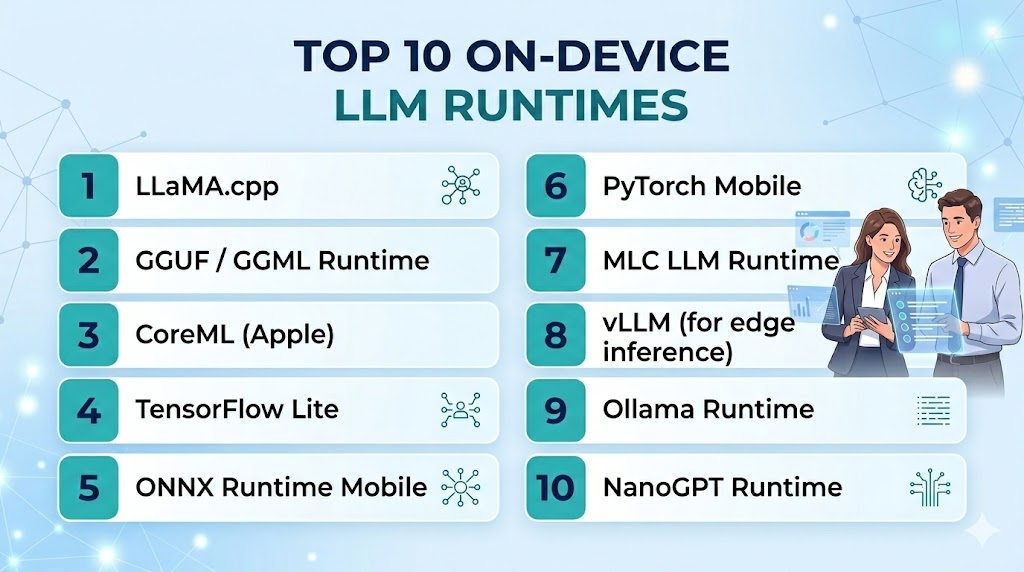
Top 10 On-Device LLM Runtimes
1- LLaMA.cpp
Short description: Lightweight C++ runtime for LLaMA models enabling on-device inference on CPUs with minimal dependencies.
Key Features
- Supports GGML quantized models
- Low-memory footprint
- Cross-platform compilation
- CPU-based inference
- Optimized for desktop and mobile devices
- Command-line interface for testing
- Open-source community contributions
Pros
- Extremely lightweight and portable
- Works on low-resource devices
- Open-source and free to use
Cons
- Limited GPU acceleration
- No native mobile SDK
Platforms / Deployment
- Windows / Linux / macOS
- Self-hosted / Local
Security & Compliance
Not publicly stated
Integrations & Ecosystem
- CLI tools for integration
- Community wrappers for Python
- Custom embedding pipelines
Support & Community
- Active GitHub community
- Documentation and examples
- Community-driven support
2- GGUF / GGML Runtime
Short description: On-device runtime designed for quantized LLMs in GGML format, focusing on efficiency and portability.
Key Features
- INT8 / INT4 quantized model support
- CPU-only and GPU acceleration
- Cross-platform binaries
- Open-source libraries
- Lightweight memory usage
- High performance on small devices
Pros
- Extremely efficient inference
- Portable across devices
- Open-source ecosystem
Cons
- Limited commercial support
- Integration requires developer expertise
Platforms / Deployment
- Windows / Linux / macOS / Android / iOS
- Self-hosted / Local
Security & Compliance
Not publicly stated
Integrations & Ecosystem
- Python bindings
- CLI interfaces
- Community-developed mobile wrappers
Support & Community
- GitHub issues and community
- Documentation and examples
3- CoreML (Apple)
Short description: Apple’s ML runtime for iOS and macOS devices, allowing on-device LLM inference with native acceleration.
Key Features
- Integration with iOS apps
- GPU / NPU hardware acceleration
- Support for CoreML model conversion
- On-device privacy by default
- Performance optimization via Metal
- Model quantization and batching
Pros
- Native performance on Apple devices
- Privacy-focused
- Well-supported SDK
Cons
- Limited to Apple ecosystem
- Model conversion needed for LLMs
Platforms / Deployment
- iOS / macOS
- Cloud / Local (on-device inference)
Security & Compliance
Not publicly stated
Integrations & Ecosystem
- Swift and Objective-C SDKs
- Xcode integration
- Custom model pipelines
Support & Community
- Apple developer documentation
- Forums and tech support
- Active developer community
4- TensorFlow Lite
Short description: Lightweight runtime for running LLMs and other ML models on mobile and edge devices.
Key Features
- Support for quantized models
- Android and iOS support
- GPU and Edge TPU acceleration
- Optimized memory usage
- Cross-platform model conversion
- On-device inference APIs
Pros
- Widely adopted and mature
- Multiple hardware acceleration options
- Open-source
Cons
- Limited LLM-specific optimizations
- Requires model conversion
Platforms / Deployment
- Android / iOS / Linux / Windows
- Local / Edge deployment
Security & Compliance
Not publicly stated
Integrations & Ecosystem
- Python, Java, C++ APIs
- Edge TPU integration
- Community model repositories
Support & Community
- Extensive documentation
- Community support forums
- Tutorials and examples
5- ONNX Runtime Mobile
Short description: Runtime for deploying ONNX models on mobile and edge devices, suitable for quantized LLM inference.
Key Features
- ONNX model format support
- Mobile-specific optimization
- GPU acceleration via Metal / Vulkan
- Cross-platform inference
- Low-latency and memory-efficient
- Supports model quantization
Pros
- Broad platform support
- Optimized for mobile and edge
- Open-source and flexible
Cons
- Conversion required from native LLM formats
- Limited prebuilt LLM integrations
Platforms / Deployment
- Android / iOS / Linux / Windows
- Local / Edge
Security & Compliance
Not publicly stated
Integrations & Ecosystem
- Python, C++, Java APIs
- Integration with mobile apps
- Deployment pipelines for edge devices
Support & Community
- GitHub community
- Documentation and samples
- Community-driven help
6- PyTorch Mobile
Short description: PyTorch runtime optimized for mobile devices to run LLMs and other models locally.
Key Features
- Mobile-optimized inference
- iOS and Android support
- GPU and CPU acceleration
- Quantization support
- Model scripting for deployment
Pros
- Familiar PyTorch ecosystem
- Flexible and portable
- Active community support
Cons
- Requires optimization for large LLMs
- Device memory can be limiting
Platforms / Deployment
- Android / iOS
- Local / Edge
Security & Compliance
Not publicly stated
Integrations & Ecosystem
- Python API for mobile
- TorchScript deployment
- Integration into native apps
Support & Community
- Documentation and tutorials
- Community forums
- GitHub support
7- MLC LLM Runtime
Short description: Open-source runtime for running quantized LLMs on CPU, GPU, and Apple Silicon devices.
Key Features
- Optimized for GGML models
- Supports INT8 / INT4 quantization
- Cross-platform support
- High performance on edge devices
- Low memory footprint
Pros
- Efficient on-device inference
- Open-source and lightweight
Cons
- Limited commercial support
- Technical integration required
Platforms / Deployment
- Linux / macOS / Windows / iOS / Android
- Local / Edge
Security & Compliance
Not publicly stated
Integrations & Ecosystem
- Python bindings
- CLI tools
- Community pipelines
Support & Community
- GitHub issues
- Documentation
- Community discussions
8- vLLM (for edge inference)
Short description: Lightweight runtime for serving LLMs efficiently on constrained hardware and edge devices.
Key Features
- Memory-efficient streaming inference
- Batch processing optimizations
- GPU acceleration support
- Quantization support
- Monitoring and metrics
Pros
- Optimized for latency-sensitive tasks
- Supports multiple LLMs
Cons
- More complex setup
- Focused on developers
Platforms / Deployment
- Linux / Windows / macOS
- Local / Edge
Security & Compliance
Not publicly stated
Integrations & Ecosystem
- Python API
- Integration with ML pipelines
- Monitoring dashboards
Support & Community
- GitHub documentation
- Community forums
9- Ollama Runtime
Short description: On-device runtime for deploying LLMs on macOS and iOS with privacy-first design.
Key Features
- Mac and iOS deployment
- Local inference with private data
- Optimized for Apple Silicon
- API integration for apps
- Quantization and optimization
Pros
- Privacy-focused
- Optimized for Apple devices
Cons
- Limited cross-platform support
- Fewer models available
Platforms / Deployment
- macOS / iOS
- Local
Security & Compliance
Not publicly stated
Integrations & Ecosystem
- Swift APIs
- Native macOS/iOS integration
Support & Community
- Documentation
- Community GitHub
10- NanoGPT Runtime
Short description: Lightweight runtime for small GPT-like models optimized for local inference on desktop or edge devices.
Key Features
- Small model sizes
- CPU and GPU support
- Quantization support
- Open-source and portable
- Easy integration via Python
Pros
- Fast and lightweight
- Ideal for experimentation
Cons
- Not for large models
- Limited enterprise features
Platforms / Deployment
- Windows / Linux / macOS
- Local / Edge
Security & Compliance
Not publicly stated
Integrations & Ecosystem
- Python APIs
- Custom pipelines
- Open-source tooling
Support & Community
- GitHub support
- Community contributions
- Documentation
Comparison Table (Top 10)
| Tool Name | Best For | Platform(s) Supported | Deployment | Standout Feature | Public Rating |
|---|---|---|---|---|---|
| LLaMA.cpp | Low-resource CPU inference | Windows, Linux, macOS | Local | Lightweight GGML inference | N/A |
| GGUF / GGML Runtime | Quantized LLMs | Cross-platform | Local | Efficient INT8/INT4 inference | N/A |
| CoreML | Apple ecosystem | iOS, macOS | Local | Native hardware acceleration | N/A |
| TensorFlow Lite | Mobile & edge apps | Android, iOS, Linux | Local | Multi-device support | N/A |
| ONNX Runtime Mobile | Mobile deployment | Android, iOS | Local | ONNX model optimization | N/A |
| PyTorch Mobile | Developer LLM apps | Android, iOS | Local | Familiar PyTorch ecosystem | N/A |
| MLC LLM Runtime | Edge inference | Linux, macOS, Windows | Local | Lightweight, efficient | N/A |
| vLLM | Latency-sensitive apps | Linux, Windows, macOS | Local | Streaming inference | N/A |
| Ollama Runtime | Apple privacy apps | macOS, iOS | Local | Privacy-first Apple inference | N/A |
| NanoGPT Runtime | Lightweight GPT | Windows, Linux, macOS | Local | Small GPT inference | N/A |
Evaluation & Scoring
| Tool Name | Core (25%) | Ease (15%) | Integrations (15%) | Security (10%) | Performance (10%) | Support (10%) | Value (15%) | Weighted Total |
|---|---|---|---|---|---|---|---|---|
| LLaMA.cpp | 8 | 8 | 6 | 7 | 8 | 7 | 8 | 7.7 |
| GGUF / GGML | 8 | 7 | 6 | 7 | 8 | 7 | 8 | 7.6 |
| CoreML | 8 | 8 | 7 | 8 | 8 | 7 | 7 | 7.7 |
| TensorFlow Lite | 8 | 7 | 7 | 7 | 8 | 7 | 7 | 7.5 |
| ONNX Runtime Mobile | 7 | 7 | 7 | 7 | 8 | 7 | 7 | 7.4 |
| PyTorch Mobile | 7 | 8 | 7 | 7 | 7 | 7 | 7 | 7.3 |
| MLC LLM Runtime | 7 | 7 | 6 | 7 | 8 | 7 | 8 | 7.4 |
| vLLM | 7 | 7 | 6 | 7 | 8 | 7 | 7 | 7.2 |
| Ollama Runtime | 6 | 8 | 6 | 7 | 7 | 7 | 7 | 7.0 |
| NanoGPT Runtime | 6 | 8 | 6 | 7 | 7 | 7 | 8 | 7.1 |
Which On-Device LLM Runtime Is Right for You?
Solo / Freelancer
- LLaMA.cpp, NanoGPT, or GGUF runtime for experimentation or small-scale deployment.
SMB
- TensorFlow Lite, ONNX Runtime Mobile, or PyTorch Mobile for mobile/edge apps.
Mid-Market
- MLC LLM Runtime or vLLM for multi-device deployment and edge pipelines.
Enterprise
- CoreML, Ollama Runtime, or vLLM for Apple ecosystems or large-scale edge deployment.
Budget vs Premium
- Budget: LLaMA.cpp, NanoGPT, GGUF
- Premium: CoreML, MLC LLM Runtime, vLLM
Feature Depth vs Ease of Use
- Lightweight runtimes: fast onboarding, limited features
- Enterprise runtimes: deeper optimization and device-specific tuning
Integrations & Scalability
- Enterprise and edge pipelines benefit from APIs and multi-platform support
- Smaller developers can use lightweight runtimes for quick prototyping
Security & Compliance Needs
- Apple-centric or private inference use cases: CoreML, Ollama Runtime
- Open-source runtimes require internal controls for sensitive data
Frequently Asked Questions (FAQs)
1- Pricing models?
Mostly open-source; some commercial runtimes have enterprise subscription models.
2- Do all runtimes support quantization?
Most support INT8/INT4 for memory efficiency; check individual runtime docs.
3- Which devices are supported?
Varies: mobile (iOS/Android), desktop (Windows/Linux/macOS), edge devices.
4- Can I run large LLMs on-device?
High-resource devices can run mid-size models; extreme compression or offloading needed for very large models.
5- Is GPU acceleration available?
Some runtimes support GPU, NPU, or TPU acceleration, especially CoreML and TensorFlow Lite.
6- Are updates easy?
Open-source runtimes require manual updates; commercial runtimes may offer automated updates.
7- Can I integrate with mobile apps?
Yes, via SDKs or APIs provided by the runtime.
8- How to optimize memory?
Use model quantization, layer pruning, or smaller models.
9- Do I need technical expertise?
Lightweight runtimes require programming knowledge; enterprise runtimes provide more tooling.
10- Are privacy-sensitive tasks possible?
Yes — on-device inference keeps data local and reduces cloud exposure.
Conclusion
On-Device LLM Runtimes enable real-time, private, and low-latency AI applications on mobile, desktop, and edge devices. Lightweight runtimes are ideal for experimentation, prototyping, or small teams, while enterprise runtimes provide optimized performance, cross-device deployment, and Apple/edge integration.
I appreciated how the blog focuses on performance, privacy, and edge AI considerations while comparing different runtime options.
The article covers performance, compatibility, and hardware acceleration well, but it would be interesting to examine user experience trade-offs. On-device runtimes may offer strong privacy and low latency, yet users can still be affected by storage consumption, thermal throttling, and battery impact during extended AI interactions. In many real-world applications, adoption depends as much on device usability as on inference speed.